

Yes: BFA accreditation signals that a franchisor has passed an independent, ethical vetting process, and that badge carries real weight in the UK market. Accredited status gives franchisors credibility, marketing reach and access to legal support, while franchisees get independent vetting, dispute resolution and a professional network behind them. This article explains how accreditation works, what it costs, and where to start whether you’re checking a brand’s membership or browsing Franchiselocal for accredited opportunities.
What is British Franchise Association accreditation?
The British Franchise Association was established in 1977 and remains the UK’s leading self-regulatory body for franchising. It exists because UK franchising has no dedicated statutory framework. Instead, the BFA’s Code of Ethics fills that gap, setting standards for fair disclosure, viable business models and honest recruitment practices, aligned with the wider European Code of Ethics that governs franchising standards across the continent.
Membership isn’t a single tier. The BFA covers franchisors seeking accreditation, franchisees who join as individual members, and advisors and suppliers who support the sector, including solicitors, bankers and consultants who specialise in franchise work. Each category signals something slightly different to the market, but the common thread is scrutiny. A franchisor carrying BFA accreditation has had its operation examined by people outside the business, not just described by its own sales literature.
That distinction matters because franchise recruitment is built on trust between strangers. A prospective franchisee is being asked to invest savings, sometimes a redundancy payout or a remortgaged home, into a business model they’ve never run. Independent verification changes the nature of that conversation entirely.
Key benefits for franchisors
Accreditation does more for a franchisor than sit as a logo on a website. It changes how the brand is perceived by three audiences that matter most: prospective franchisees, lenders, and the wider industry press.
- Recruitment credibility: candidates researching a brand see BFA membership as proof the model has been independently reviewed, not just self-reported, which tends to shorten the trust-building phase of recruitment.
- Marketing exposure: accredited franchisors appear in BFA directories, can enter industry awards, and get visibility at BFA-organised events and exhibitions.
- Legal and commercial support: members gain access to best-practice guidance, benchmarking data and a network of specialist advisors who understand franchise law specifically, rather than commercial law generally.
- Professional development: the BFA Academy runs a structured training calendar, and staff can work towards the Qualified Franchise Professional (QFP) designation, which raises the operational standard across a franchise network rather than leaving it to individual franchisees to work things out.
Legal commentators note that these benefits extend beyond marketing. Sprintlaw’s analysis of the BFA points to practical support around recruitment and legal risk management as a core reason franchisors pursue membership, not just the reputational lift.
Pro Tip: If you’re a franchisor building your first disclosure documents, look at the BFA Academy’s course calendar before you draft anything. Several sessions are aimed directly at first-time members preparing for accreditation, and they’ll flag gaps in your paperwork before an assessor does.
Key benefits for franchisees
If you’re the one buying into a franchise, accreditation shifts a chunk of the risk assessment away from you and onto an independent body that’s already done some of the checking.
- Independent vetting: a franchisor seeking BFA accreditation has its financials, franchise agreements, and marketing claims reviewed by assessors who aren’t paid to make the brand look good.
- Dispute resolution and mediation: BFA members can access mediation services designed specifically for franchise relationships, aimed at resolving disagreements before they become expensive court cases.
- Education and peer support: franchisees get access to BFA-run events and training, plus a network of other franchisees who’ve faced the same early-stage problems, which cuts down the isolation that catches a lot of first-time franchisees off guard.
- Ongoing reassurance: because accreditation isn’t permanent, franchisees benefit from the BFA’s re-accreditation checks, which include revisiting franchisee satisfaction as part of the review.
The mediation point deserves more weight than it usually gets. Franchise disputes are rarely simple contract disagreements. They involve an ongoing working relationship, shared branding, and often a personal financial stake on both sides. A resolution process built around keeping that relationship intact, rather than settling it in front of a judge, tends to protect both the franchisee’s investment and the franchisor’s reputation. That’s a genuinely different outcome to a standard commercial dispute.
How accreditation works: process, criteria and timelines
Accreditation isn’t a form-filling exercise. The BFA describes it as a collaborative audit of the franchisor’s whole operation, and it goes considerably further than most trade body checks.
- Document and operational review: assessors examine franchise agreements, operations manuals, marketing materials, and financial disclosures against the Code of Ethics.
- Legal review: franchise agreements are checked for fairness and clarity, since ambiguous terms are one of the most common sources of later disputes.
- Franchisee satisfaction survey: existing franchisees are surveyed independently, so the franchisor can’t simply present its best relationships and hide the difficult ones.
- Membership tier assignment: brands progress through Emerging, Expanding and Established categories as their franchise network matures and the evidence base grows.
- Periodic re-accreditation: the BFA’s Rules of Membership set out reaccreditation intervals and the remedial steps or, in serious cases, termination that follow if standards slip.
Re-accreditation commonly happens on a roughly three-yearly cycle, which keeps the badge meaningful rather than a one-off credential earned once and forgotten.
Membership carries fees, which vary by category and the size of the franchise network, plus an ongoing commitment to the Code of Ethics and cooperation with future audits. The BFA has been explicit that it sees accreditation as developmental rather than a fixed pass mark, favouring education and training over statutory regulation as the route to raising standards across the sector.
How does BFA membership affect recruitment, funding and risk?
Accreditation’s commercial value shows up in three practical places: lead quality, funding conversations, and risk perception.
- Recruitment: the BFA logo, directory listing and industry awards give a franchisor a credibility shortcut in marketing that non-members don’t have, which typically improves the ratio of serious enquiries to time-wasters.
- Funding and supplier relationships: lenders, investors and suppliers treat BFA membership as a positive signal because it means the business model has already had independent scrutiny, which can smooth due diligence conversations rather than replace them.
- PR and profile: BFA channels, award schemes and exhibition presence give members promotional reach that’s harder to build independently, particularly for younger networks.
Accreditation doesn’t guarantee profitability, and it won’t make a weak franchise model succeed. What it does is reduce the chance you’re evaluating a brand on marketing claims alone. Measuring the return on membership means tracking whether recruitment quality improves and whether disputes drop, not assuming the badge does the selling by itself.
Pro Tip: Ask any BFA-accredited franchisor how many disputes have gone to mediation versus litigation in the last three years. A brand confident in its accreditation will usually tell you straight, because the answer reflects well on the process, not just the outcome.
What does BFA accreditation look like in practice?
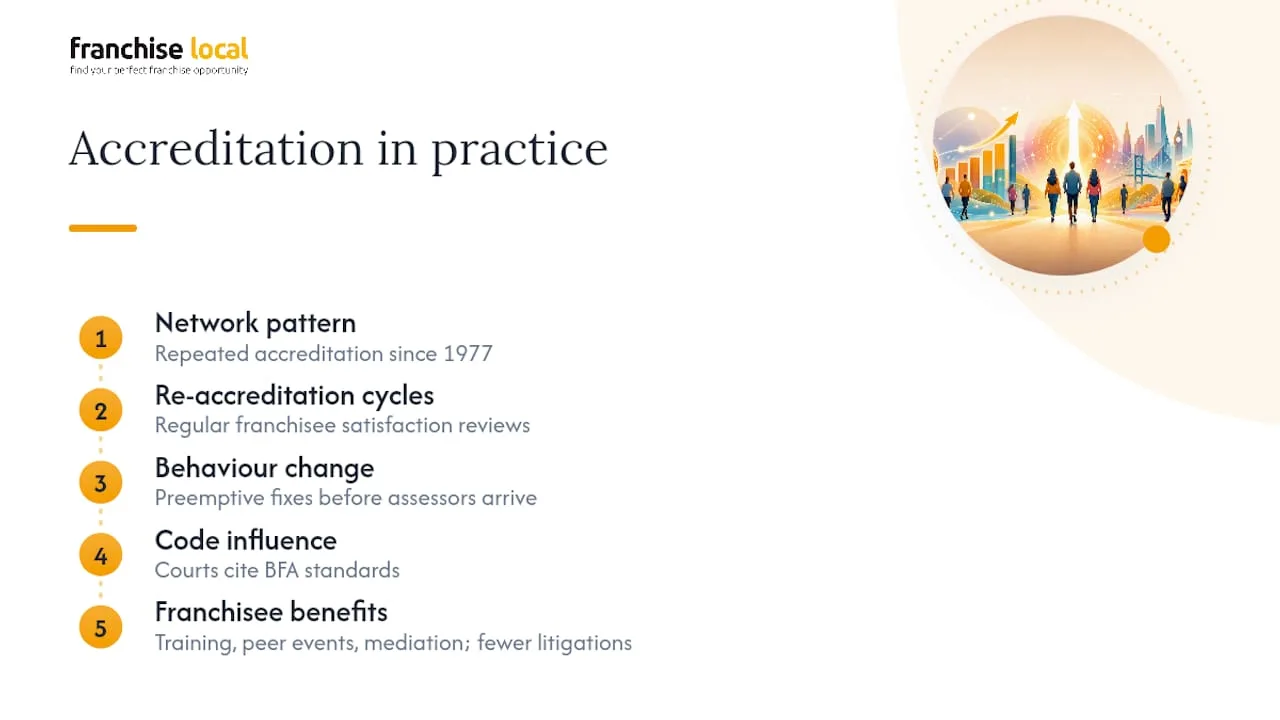
The clearest evidence of accreditation’s impact isn’t a single case study. It’s the pattern across the network the BFA has built since 1977. Franchisors that progress from Emerging to Established membership typically go through several re-accreditation cycles, each one forcing a fresh look at franchisee satisfaction rather than resting on an initial assessment from years earlier.
That repeated scrutiny changes behaviour inside franchise networks over time. A franchisor preparing for its second or third re-accreditation knows the franchisee satisfaction survey is coming again, so operational issues that might otherwise get ignored tend to get addressed before the assessor arrives. LegalVision’s commentary on the Code of Ethics notes that UK courts have referenced BFA standards when interpreting best practice in franchise disputes, even for cases involving non-member businesses. That’s a meaningful signal: the Code’s influence extends beyond the membership list itself.
For franchisees, the practical impact tends to be less dramatic and more cumulative. Access to BFA-run training, peer networks at member events, and a mediation route that doesn’t automatically escalate to court all reduce the day-to-day friction of running a franchised outlet. None of that shows up as a single dramatic success story. It shows up as fewer disputes reaching litigation and fewer franchisees feeling stranded when problems arise, which is arguably the more useful measure of whether accreditation is actually working.
How do you start the accreditation process?
Franchisors ready to pursue accreditation should start directly with the BFA’s franchisor membership page, which sets out the categories, documentation requirements and initial contact route. Expect to prepare your franchise agreement, operations manual, marketing materials and financial disclosures before making contact, since the review process moves faster when that paperwork already exists.
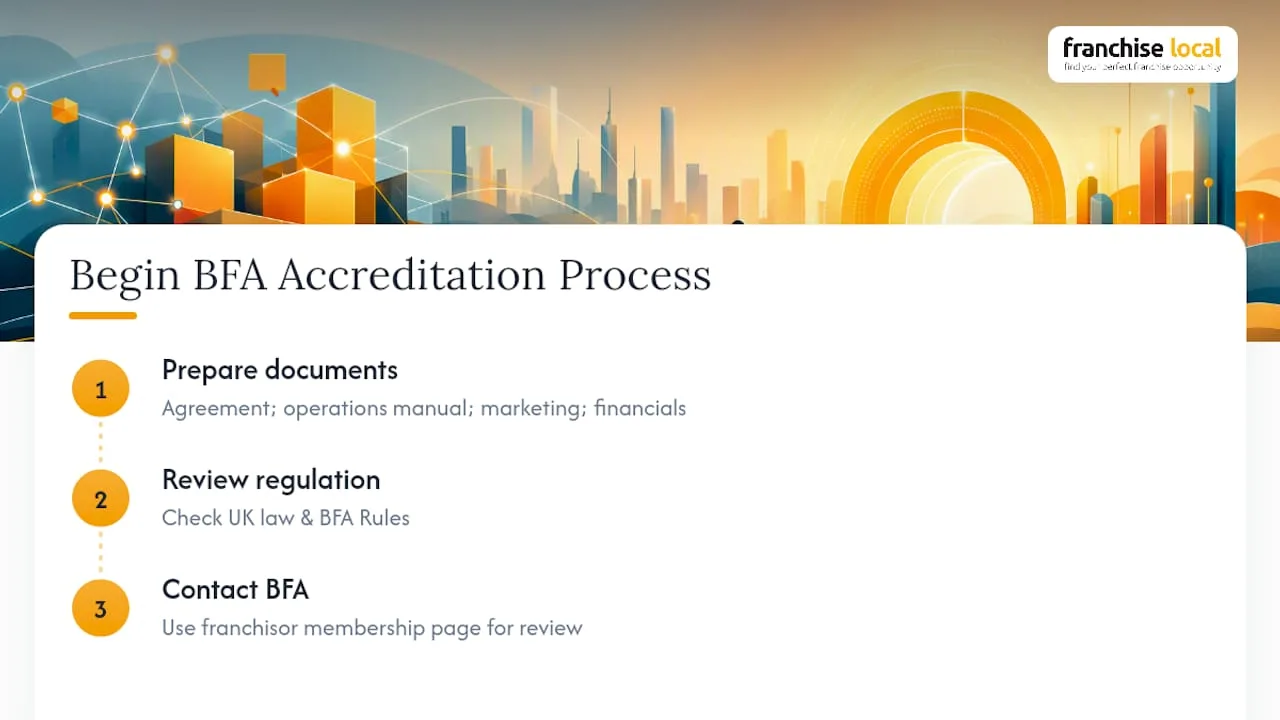
Before applying, it’s worth reviewing the UK’s broader franchise regulation landscape so you understand where the BFA Code sits relative to general commercial law, and checking your franchise legal requirements against the BFA’s Rules of Membership to spot gaps early.
Franchisees don’t apply for accreditation themselves, since it’s the franchisor’s business that gets assessed. But if you’re evaluating a franchise opportunity, checking the BFA member directory is a sensible first step before signing anything. Meeting accredited franchisors face to face at BFA-affiliated franchise exhibitions gives you a chance to ask about their accreditation history directly, including how many re-accreditation cycles they’ve completed and what came up in their franchisee satisfaction surveys. That conversation tells you more than any brochure.
Find BFA-accredited franchises through Franchiselocal
A digital directory lists UK franchise opportunities across industries, price points and lifestyle fits, which makes it a practical starting point once you know what accreditation should mean for the brands you’re considering. Rather than researching each franchisor’s BFA status one website at a time, users can filter and compare opportunities directly, then cross-check membership claims against the BFA’s own directory before taking things further.
If you’re weighing up several accredited brands, run each one through our due diligence readiness scorecard to structure your questions before you speak to a franchisor, and use the ROI estimator to sanity-check the financial claims in their disclosure pack. The directory isn’t the accrediting body. That’s the BFA’s role. But it serves as a discovery layer to help find accredited opportunities worth researching in the first place, including trending franchise opportunities currently listed across the UK market. Start by browsing current listings, note which brands carry BFA membership, and use the scorecard before you contact a single franchisor directly.
Where to check the primary sources
For the rules themselves, go straight to the BFA’s official site, its Rules of Membership, and its dispute resolution page for mediation details.
FAQ
What does BFA stand for?
BFA stands for the British Franchise Association, the UK’s leading self-regulatory body for franchising, established in 1977.
What is the BFA Code of Ethics?
The BFA Code of Ethics sets standards for fair disclosure, viable business models and honest recruitment practices, aligned with the European Code of Ethics and enforced through the accreditation and re-accreditation process.
What are the advantages and disadvantages of owning a franchise?
Advantages include a tested business model, brand recognition and ongoing support; disadvantages include franchise fees, limited operational freedom and reliance on the franchisor’s decisions. Choosing a BFA-accredited franchise reduces some of that risk because the model has already been independently checked.
How often does BFA re-accreditation happen?
Re-accreditation commonly happens on a roughly three-yearly cycle, and franchisors that fail to maintain standards face remedial action or, in serious cases, termination of membership.
Does BFA accreditation guarantee a franchise will be profitable?
No. Accreditation confirms the franchisor’s model, disclosure and ethics have passed independent review, but it doesn’t guarantee profitability or individual franchisee success.