

More than 30,000 British franchise outlets operate across the United Kingdom, yet understanding the fine print of franchise agreements can seem daunting for even seasoned entrepreneurs. For those considering a franchise investment, mastering the legal details is vital to protect your interests and build a stable business. This guide offers clear explanations of critical contract terms, helping UK business owners make informed decisions about joining a trusted franchise network.
What defines a franchise agreement in the UK
A franchise agreement is the foundational legal document that establishes the critical relationship between a franchisor and franchisee in the United Kingdom. This comprehensive legal contract defines the precise operational parameters, rights, and responsibilities that govern how a franchisee can utilise a franchisor’s established business model, brand, and intellectual property.
At its core, a franchise agreement outlines several key components that protect both parties’ interests. These typically include specific provisions regarding territorial rights, financial obligations, operational standards, training requirements, and the duration of the franchising relationship. The agreement serves as a blueprint that dictates everything from initial investment and ongoing royalty payments to marketing expectations and performance benchmarks.
The legal framework surrounding franchise agreements in the UK mandates clear disclosure of all critical terms, ensuring transparency and preventing potential misunderstandings. Franchisees receive explicit guidelines about using trademarks, implementing standardised business processes, maintaining quality control, and adhering to the established brand standards. These contractual provisions help maintain consistency across different franchise locations while providing a structured pathway for entrepreneurial growth.
Pro tip: Before signing any franchise agreement, engage a solicitor specialising in commercial law to thoroughly review the document and explain all legal implications carefully.
Types of franchise agreements and their differences
Franchise agreements in the United Kingdom are not one-size-fits-all, but instead comprise several distinct models tailored to different business expansion strategies. Franchise agreement structures can be categorised into three primary types: direct franchising, master franchising, and area development agreements, each with unique characteristics and operational implications.
In a direct franchising model, the franchisor maintains direct control by licensing their business model and brand directly to individual franchisees. This approach allows for more hands-on management and standardised operations. Master franchise agreements represent a more complex structure, where a master franchisee receives rights to sub-franchise within a specific geographical region, effectively becoming a mini-franchisor responsible for recruiting, training, and supporting additional franchisees. This model is particularly useful for international expansion or entering markets with complex local dynamics.
The area development agreement provides another strategic option, requiring franchisees to open multiple outlets within a designated territory within a specified timeframe. This model suits entrepreneurs with significant capital and ambition to develop a substantial regional presence. Each agreement type carries distinct financial obligations, territorial rights, and operational expectations, making it crucial for potential franchisees to understand the nuanced differences and select a model aligned with their business goals and resources.
Here is a comparison of the main types of franchise agreements available in the UK:
| Agreement Type | Level of Control | Suitable For | Expansion Strategy |
|---|---|---|---|
| Direct Franchising | High franchisor oversight | Individual entrepreneurs | Gradual, localised growth |
| Master Franchise Agreement | Regional master franchisee | Large investors or firms | Rapid, international scaling |
| Area Development | Multiple outlets per owner | Experienced business owners | Concentrated regional build-up |
Pro tip: Consult a franchise law specialist to thoroughly analyse the specific terms and long-term implications of each franchise agreement type before making a commitment.
Core terms and legal framework explained
The legal framework governing franchise agreements in the United Kingdom encompasses a complex set of provisions designed to protect both franchisors and franchisees. While no specific standalone franchise law exists, multiple legal instruments intersect to create a robust regulatory environment. Commercial contract principles underpin the fundamental relationships, drawing from contract law, intellectual property regulations, and competition guidelines to establish clear operational boundaries.
Key core terms within franchise agreements typically address critical areas of business interaction. These include detailed provisions about intellectual property usage, territorial rights, financial obligations, performance standards, training requirements, and termination conditions. Franchisees must comprehend their precise contractual responsibilities, which often involve ongoing royalty payments, adherence to operational manuals, mandatory marketing contributions, and maintaining specific quality control standards set by the franchisor.
The legal documentation surrounding franchise agreements requires meticulous attention to detail, with comprehensive disclosure documents playing a crucial role in transparency. British courts expect franchise agreements to demonstrate fairness, reasonableness, and clear communication of mutual expectations. This means franchisors must provide potential franchisees with complete information about the business model, financial projections, potential risks, and realistic performance expectations. Franchise agreements must balance protecting the franchisor’s brand integrity while providing franchisees with reasonable opportunities for business growth and entrepreneurial success.
Pro tip: Engage a specialised commercial solicitor with franchise experience to thoroughly review all legal documentation before signing, ensuring you fully understand every clause and potential implication.
Rights and responsibilities of franchisors and franchisees
The franchise relationship represents a delicate balance of rights and responsibilities, with each party bearing significant obligations to maintain the integrity and success of the business partnership. Franchise agreements fundamentally establish a structured framework that defines the precise expectations and boundaries for both franchisors and franchisees in the United Kingdom.

Franchisors hold critical responsibilities that extend far beyond initial business licensing. They must provide comprehensive training programmes, maintain robust operational manuals, offer ongoing support systems, and protect their intellectual property and brand reputation. Their key rights include establishing standardised operational procedures, conducting regular performance assessments, enforcing quality control standards, and retaining the authority to terminate agreements if franchisees fail to meet specified performance metrics. Conversely, franchisees are entitled to receive consistent support, access to established business systems, brand recognition, and the right to operate within their designated territorial boundaries.
Franchisee responsibilities are equally comprehensive and demanding. They must adhere strictly to operational guidelines, maintain prescribed quality standards, pay ongoing royalties and marketing contributions, participate in required training programmes, and represent the brand professionally. Their rights include receiving proper initial and continuous training, accessing proprietary business systems, benefiting from national marketing initiatives, and operating within a clearly defined territorial scope. The symbiotic nature of this relationship requires mutual commitment, transparency, and a shared vision for business success.
Pro tip: Conduct thorough due diligence by speaking with existing franchisees to gain unfiltered insights into the real-world expectations and challenges of the franchise relationship.
Financial and operational risks involved
Franchising presents a complex landscape of potential financial and operational risks that prospective entrepreneurs must carefully evaluate before committing to a business partnership. Franchise investment strategies require meticulous due diligence to understand the multifaceted challenges inherent in these business relationships. Potential franchisees must recognise that while franchising offers a structured business model, it simultaneously exposes them to significant financial vulnerabilities.
Financial risks are particularly pronounced and can manifest in multiple dimensions. Initial franchise fees, ongoing royalty payments, mandatory marketing contributions, and substantial startup capital requirements create substantial financial pressure. Franchisees must navigate potential revenue uncertainties, including seasonal fluctuations, market competition, and the inherent performance variability of their specific franchise model. Additionally, underestimating working capital needs or experiencing slower-than-anticipated revenue generation can quickly destabilise a franchisee’s financial foundation, potentially risking personal financial assets and long-term economic stability.
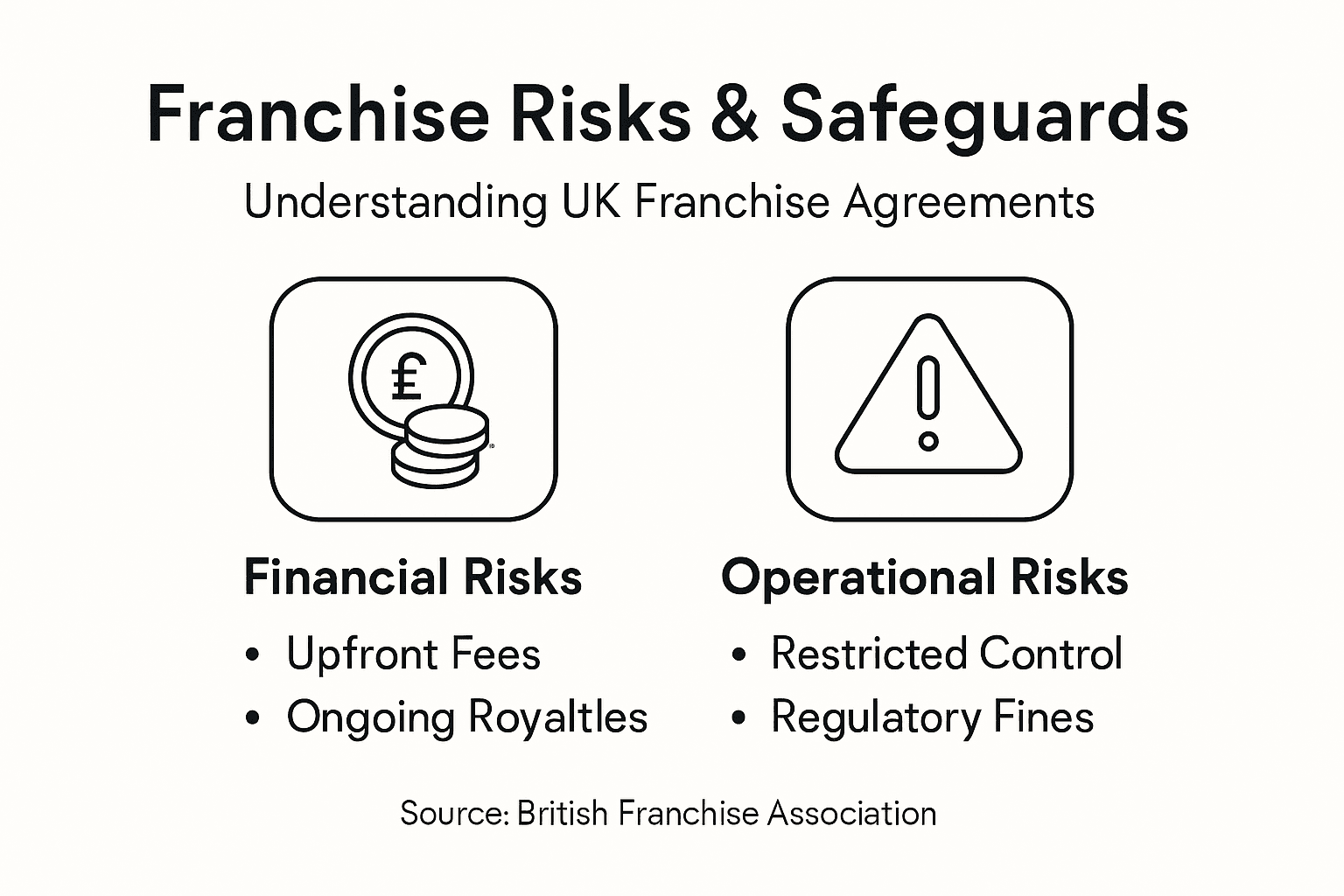
Operational risks complement the financial challenges, presenting equally complex considerations. Franchisees face strict operational constraints that limit entrepreneurial flexibility, requiring unwavering adherence to franchisor-mandated procedures, quality standards, and business practices. The potential for contract termination looms if performance metrics are not consistently met, creating a high-pressure operational environment. External factors such as economic downturns, changing consumer preferences, technological disruptions, and regional market dynamics can further complicate the operational landscape, potentially rendering even well-established franchise models vulnerable to unexpected challenges.
The following table summarises typical financial and operational risks franchisees face:
| Risk Type | Common Challenges | Potential Impact |
|---|---|---|
| Financial | Royalty fees, revenue uncertainty | Strained business cash flow |
| Operational | Strict procedural compliance | Limited decision-making freedom |
| External | Economic or market shifts | Reduced sales, adapting needs |
Pro tip: Develop a comprehensive financial contingency plan that includes at least six months of operating expenses as a buffer against potential operational and revenue uncertainties.
Exit strategies and agreement termination procedures
Franchise agreements in the United Kingdom are governed by complex termination procedures that demand careful navigation and strategic planning. These legal frameworks outline precise conditions under which either the franchisor or franchisee can dissolve their business relationship, with significant implications for both parties’ financial and professional futures.
Termination mechanisms typically encompass multiple scenarios, including breach of contract, persistent underperformance, financial insolvency, or mutual agreement. Franchisees must understand that exit strategies are not simply about walking away, but involve intricate legal and financial considerations. Potential exit routes include selling the franchise to another qualified buyer, negotiating a buyback with the franchisor, or allowing the franchise agreement to expire naturally. Each pathway carries distinct financial consequences, potential non-compete restrictions, and obligations regarding proprietary materials and intellectual property.
The British legal landscape requires franchisors to provide clear, transparent termination clauses that protect both parties’ interests. These provisions often include specific notice periods, financial settlement calculations, and procedures for handling ongoing obligations. Franchisees should pay particular attention to potential financial penalties, requirements for returning operational manuals and branded materials, and any restrictions on future business activities within the same industry. Understanding these nuanced termination procedures is crucial for mitigating potential legal disputes and financial complications during the exit process.
Pro tip: Engage a specialised commercial solicitor to thoroughly review your franchise agreement’s termination clauses at least six months before considering any exit strategy.
Empower Your Entrepreneurial Journey Through Informed Franchise Choices
Navigating the complexities of franchise agreements in the United Kingdom can feel overwhelming, especially when faced with critical terms, operational restrictions, and financial risks. This article highlights the importance of understanding franchisor and franchisee rights, termination procedures, and the different types of franchise agreements before making any commitments. Entrepreneurs seeking to confidently access franchise opportunities that align with their lifestyle and investment goals need a trusted resource that offers comprehensive insight and tailored options.
Discover how FranchiseLocal simplifies this crucial decision-making process by providing an extensive directory of UK franchises, filtered by investment level, industry sector, and business model. Whether you are considering direct franchising, master franchising, or area development agreements, use the platform to explore detailed listings and connect with franchisors who meet your precise criteria. Act now to secure your place in the UK franchise market with clear knowledge and strategic support by visiting FranchiseLocal today and start comparing opportunities that fit your unique ambitions and financial planning.
Frequently Asked Questions
What is a franchise agreement?
A franchise agreement is a legally binding document that outlines the relationship between a franchisor and franchisee, detailing operational parameters, rights, and responsibilities for utilizing the franchisor’s business model and brand.
What are the key components of a franchise agreement?
Key components typically include provisions for territorial rights, financial obligations, operational standards, training requirements, and the duration of the franchise relationship, all aimed at protecting both parties’ interests.
What are the different types of franchise agreements?
The main types of franchise agreements are direct franchising, master franchising, and area development agreements, each serving different business expansion strategies and with varied levels of control and oversight.
What are the financial risks associated with owning a franchise?
Financial risks include initial franchise fees, ongoing royalty payments, and potential revenue uncertainties due to market competition or seasonal fluctuations, which can strain cash flow and impact long-term stability.