

Every british entrepreneur looking to invest faces a crucial decision when considering franchise ownership—over 90 percent of UK franchises report profitable performance, yet hidden legal traps and unclear terms can turn opportunity into risk. Understanding the fine print of a franchise agreement is essential for anyone aiming to join a respected brand and secure their investment. This guide sheds light on what every british business owner should know to confidently take their next step in the franchise world.
What Is a Franchise Agreement in the UK?
A franchise agreement represents a legally binding contract between a franchisor (the original business owner) and a franchisee (the individual purchasing the right to operate a business under an established brand). In essence, this agreement grants entrepreneurs the opportunity to replicate a successful business model while operating under a recognised commercial framework.
The core purpose of a franchise agreement is to establish clear parameters for how a franchisee can utilise the franchisor’s intellectual property, brand reputation, operational systems, and ongoing support. Unlike standard business arrangements, franchise agreements are unique because they provide a structured pathway for entrepreneurs to leverage an existing successful business framework.
Typically, a comprehensive franchise agreement will outline several critical components, including territorial rights, financial obligations, operational standards, training requirements, and ongoing royalty payments. These contracts are meticulously designed to protect both the franchisor’s brand integrity and the franchisee’s investment. They specify exact conditions under which the franchisee can use trademarks, business processes, and proprietary systems while maintaining consistent quality across different business locations.

Quick Tip: Always engage a legal professional specialising in franchise law to thoroughly review your franchise agreement before signing, as these contracts contain complex legal nuances that can significantly impact your business future.
Types of Franchise Agreements Explained
Understanding the different types of franchise agreements is crucial for entrepreneurs considering franchising as a business model. The UK franchise market offers diverse arrangements that cater to various investment levels, operational scales, and business objectives, allowing potential franchisees to select an approach that best matches their entrepreneurial goals.
Generally, franchise agreements can be categorised into several primary types based on operational and investment characteristics. These include home-based franchises, mobile franchises, retail franchises, and master franchises. Each type comes with distinct operational requirements, initial investment levels, and potential returns. Home-based franchises typically represent the lowest initial investment, offering flexibility for entrepreneurs seeking minimal overhead costs. Mobile franchises provide similar advantages, allowing business operations without a fixed physical location.
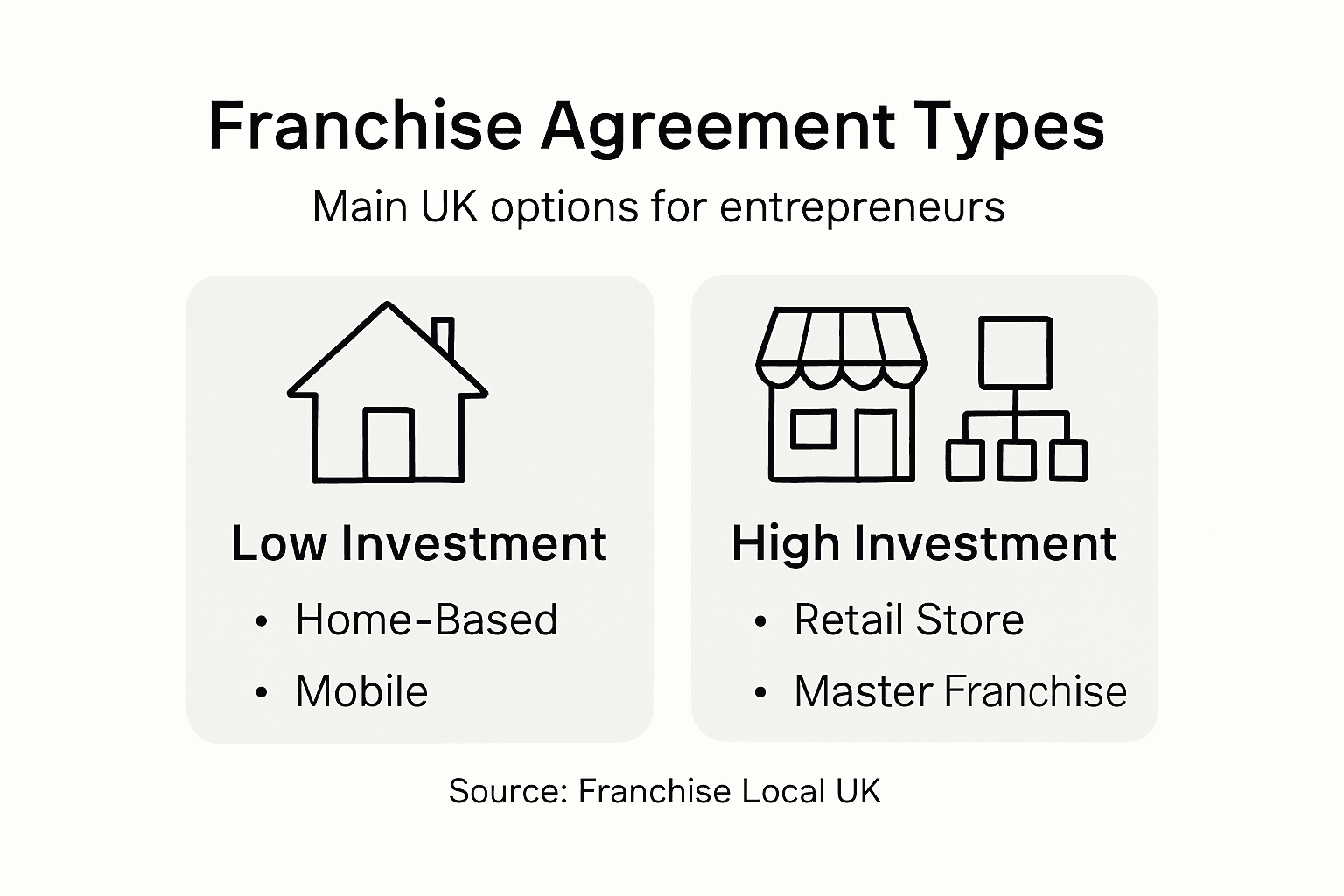
Retail franchises, by contrast, involve establishing a physical storefront and often require substantially higher initial capital. These might include food service establishments, retail shops, or specialised service centres. Master franchises represent another sophisticated model where the franchisee gains rights to develop and sub-franchise within a specific geographic region, effectively becoming a regional franchisor responsible for recruiting and supporting additional franchisees.
Here’s a concise comparison of common franchise agreement types available in the UK market:
| Franchise Type | Typical Initial Investment | Operational Setup | Entrepreneur Profile |
|---|---|---|---|
| Home-based | Lowest (£5k–£20k) | Operates from home office | Flexible, new to business |
| Mobile | Low (£10k–£30k) | Vehicle, no location needed | Suits mobile, service-driven roles |
| Retail | High (£50k–£250k+) | Physical storefront | Retail management experience |
| Master | Highest (£100k+) | Multi-site management | Experienced, leadership skills |
Professional Insight: Carefully assess your personal financial capacity, lifestyle preferences, and business ambitions when selecting a franchise type, as each model demands different levels of commitment and expertise.
Key Terms and Provisions to Expect
Franchise agreements are complex legal documents containing numerous critical provisions that define the relationship between franchisor and franchisee. Understanding these terms is essential for protecting your business interests and ensuring a clear operational framework that minimises potential future disputes or misunderstandings.
The most fundamental contractual terms typically include specific financial obligations, territorial rights, and performance standards. Financial provisions will outline precise royalty structures, initial franchise fees, ongoing marketing contributions, and potential additional charges. Territory provisions critically define the geographical boundaries within which the franchisee can operate, specifying exclusive or non-exclusive rights and potential restrictions on business activities.
Beyond financial and territorial clauses, franchise agreements must comprehensively address operational standards, training requirements, and quality control mechanisms. These provisions typically mandate adherence to established brand protocols, specify mandatory training programmes, and outline the franchisor’s rights to conduct periodic performance reviews. Additional key provisions often include detailed terms regarding contract duration, renewal conditions, termination clauses, and potential sale or transfer of the franchise rights. Intellectual property protections are equally crucial, with most agreements specifying exact usage guidelines for trademarks, operational manuals, and proprietary business systems.
Professional Insight: Always engage a specialist franchise solicitor to meticulously review all contract terms before signing, as subtle contractual nuances can significantly impact your long-term business prospects and legal protections.
Legal Framework and Industry Standards
The legal landscape surrounding franchising in the United Kingdom represents a complex ecosystem of regulatory oversight, designed to protect both franchisors and franchisees while maintaining high standards of business practice. Understanding this intricate framework is essential for entrepreneurs considering franchise investment, as compliance and regulatory adherence can significantly impact business success.
At the core of the UK’s franchise regulatory environment are multiple governing bodies that establish and enforce statutory processes and standards. The Financial Conduct Authority (FCA), Companies House, and sector-specific regulators play critical roles in monitoring franchise operations. These organisations ensure transparency, fair trading practices, and consumer protection by setting stringent guidelines for business conduct, financial reporting, and operational integrity.
Franchise businesses must navigate a multifaceted legal landscape that encompasses various regulatory requirements. These include company registration protocols, tax obligations, employment laws, intellectual property protections, and sector-specific compliance standards. Depending on the industry, franchises might need additional accreditations or meet specific regulatory benchmarks. For instance, franchises in financial services, healthcare, or food production face more rigorous scrutiny and must demonstrate consistent adherence to industry-specific regulations beyond standard business requirements.
Professional Insight: Engage a specialist franchise solicitor who understands the nuanced legal landscape to help you navigate the complex regulatory requirements specific to your chosen industry and business model.
Rights, Duties, and Financial Commitments
Franchise agreements establish a structured relationship between franchisors and franchisees, carefully defining the rights, responsibilities, and financial obligations that govern their business partnership. Understanding these intricate details is crucial for entrepreneurs considering franchise ownership, as they directly impact long-term business performance and financial sustainability.
The core of the franchise relationship revolves around specific financial and operational commitments. Franchisees typically have rights that include using the established brand name, receiving initial and ongoing training, accessing proprietary operational systems, and benefiting from the franchisor’s marketing support. Correspondingly, they incur significant financial duties such as paying initial franchise fees, ongoing royalties (usually calculated as a percentage of total revenue), regular marketing contributions, and potentially additional administrative or support charges.
Beyond financial commitments, franchisees bear substantial operational responsibilities. These include maintaining strict brand standards, adhering to operational protocols, participating in mandatory training programmes, and consistently representing the brand’s reputation and quality benchmarks. The franchisor, in turn, assumes duties of providing comprehensive support, maintaining intellectual property rights, delivering operational guidance, and ensuring the overall franchise network’s success. These reciprocal obligations create a symbiotic relationship where both parties’ success is interconnected and mutually dependent.
Professional Insight: Create a comprehensive financial spreadsheet detailing all potential franchise costs and projected revenues, ensuring you fully understand the complete financial landscape before making your investment commitment.
Risks, Common Pitfalls, and How to Exit
Franchise investments, while promising significant opportunities, also encompass substantial risks that entrepreneurs must carefully navigate. Understanding these potential challenges is crucial for developing robust risk mitigation strategies and protecting your business investment from unexpected complications.
The most prevalent risks in franchise ventures stem from financial incentives and potential mis-selling. These can include misleading sales practices, overstated revenue projections, and inadequate disclosure of operational challenges. Common pitfalls include insufficient due diligence, unrealistic expectations about brand support, underestimating initial and ongoing financial commitments, and failing to thoroughly understand the franchise’s operational requirements. Franchisees might also encounter challenges related to territorial restrictions, limited operational flexibility, and potential conflicts with franchisor guidelines.
Exiting a franchise agreement involves complex legal and financial considerations. Franchise contracts typically outline specific termination clauses, which may include substantial financial penalties, restrictions on future business activities, and complex confidentiality requirements. Potential exit strategies range from selling the franchise, negotiating a contract termination, or transferring ownership, each requiring meticulous legal and financial planning. Entrepreneurs must carefully review their franchise agreement’s exit provisions, understanding potential limitations on business transfer, non-compete clauses, and financial obligations during and after contract termination.
The following table summarises the primary risks and exit challenges in franchise investments:
| Risk Area | Typical Challenge | Possible Mitigation Step |
|---|---|---|
| Financial Mis-selling | Overestimated earnings, hidden costs | Thorough due diligence, legal advice |
| Operational Restrictions | Limited flexibility, strict guidelines | Review contract for operational scope |
| Exit Clause Complexities | Penalties, non-compete issues | Negotiate clear exit provisions |
| Inadequate Support | Insufficient franchisor training | Confirm support commitments upfront |
Professional Insight: Consult a franchise-specific legal professional before signing any agreement to fully understand your exit options and potential financial implications, ensuring you have a comprehensive strategy for all potential scenarios.
Discover the Right Franchise Agreement for Your UK Business Journey
Navigating the complexities of franchise agreements can feel overwhelming, especially when faced with crucial decisions on financial commitments, operational responsibilities, and exit strategies. This article highlights key challenges like understanding territorial rights, royalty structures, and legal obligations that UK entrepreneurs must tackle before signing on the dotted line. If you are looking to align your investment with a franchise that matches your lifestyle and budget while avoiding common pitfalls, taking the right next step is critical.
Explore a broad range of franchise opportunities tailored to your needs on Franchise Local. Our comprehensive UK franchise directory enables you to filter options by investment level, business model, and industry sector to find a franchise that suits your ambitions and resources. Don’t let uncertainty hold you back from a promising future. Start your search today to connect with trusted franchisors and access detailed information to confidently navigate your franchise agreement and investment journey. Visit Franchise Local now and take control of your entrepreneurial future.
Frequently Asked Questions
What is a franchise agreement?
A franchise agreement is a legally binding contract between a franchisor and a franchisee that allows the franchisee to operate a business under an established brand, following the franchisor’s specified conditions and guidelines.
What are the different types of franchise agreements?
The main types of franchise agreements include home-based franchises, mobile franchises, retail franchises, and master franchises, each varying in initial investment requirements, operational setup, and entrepreneur profile.
What key terms should be included in a franchise agreement?
A franchise agreement should outline critical terms such as financial obligations, territorial rights, operational standards, training requirements, intellectual property usage, renewal conditions, and provisions for termination and exit strategies.
What risks should entrepreneurs consider when entering a franchise agreement?
Entrepreneurs should be aware of risks such as financial mis-selling, operational restrictions, exit clause complexities, and inadequate support from the franchisor. Conducting thorough due diligence before signing any agreement is essential.