

The franchise industry in the UK generates close to £20 billion annually and includes over 1,000 franchise systems spanning remarkably diverse sectors. Yet many aspiring franchisees struggle to decode which sectors align with their investment goals, risk tolerance, and lifestyle preferences. Understanding the fundamental differences between franchise sectors—from personal services to property maintenance—is essential for making informed decisions that lead to profitable, sustainable ventures. This guide decodes the main franchise industry sectors operating across the UK, revealing how sector dynamics directly influence profitability, growth potential, and long-term success for prospective franchisees.
Key takeaways
| Point | Details |
|---|---|
| Massive employment impact | Franchising employs over 700,000 people across the UK, demonstrating the sector’s economic significance. |
| Personal services growth | The personal services sector grew 53% from 2018 to 2024, outpacing most other franchise categories. |
| Cleaning sector strength | Cleaning and care sectors remain consistently profitable with stable demand across economic cycles. |
| Due diligence necessity | Thorough investigation of franchisors’ financial and legal standing is vital to choose the right sector and avoid costly mistakes. |
Understanding the franchise sectors in the UK
The UK franchise landscape encompasses an impressive variety of sectors, each with distinct operational models, capital requirements, and market dynamics. Franchise sectors range from traditional food and beverage operations to emerging technology-driven services, creating opportunities for investors with vastly different skills and resources. The breadth of options means you can find franchise opportunities aligned with nearly any professional background or personal interest.
Franchise sectors typically fall into several broad categories:
- Personal services, including domiciliary care, beauty treatments, and health services
- Cleaning and maintenance, covering commercial and residential properties
- Food and beverage, from quick-service restaurants to speciality coffee shops
- Property services, encompassing estate agencies and property maintenance
- Business services, including accounting, marketing, and recruitment
- Retail, ranging from convenience stores to specialised product outlets
- Automotive, covering repairs, valeting, and vehicle sales
Each sector operates under different regulatory frameworks, faces unique market pressures, and requires varying levels of initial investment. Understanding these fundamental differences helps you narrow down suitable franchise opportunities that match your financial capacity and operational preferences. The UK franchise market includes over 1,000 systems, so grasping sector characteristics becomes essential for efficient decision-making.
Sector definitions also reveal operational realities that impact your daily work life. A food franchise typically requires premises, staff management, and inventory control, whilst a mobile cleaning franchise might operate from home with minimal overhead. These structural differences affect not just profitability but also lifestyle compatibility, making sector understanding crucial before committing capital.

The UK market’s dynamism means new sectors continue to emerge as consumer preferences evolve and technology creates fresh service opportunities. Sectors that barely existed a decade ago, such as senior care franchises and eco-friendly cleaning services, now represent substantial market segments with proven profitability models.
Economic impact and growth trends across key franchise sectors
The economic contributions of UK franchise sectors reveal both stability and exciting growth opportunities for prospective investors. Franchising employs over 700,000 people across the country, with certain sectors demonstrating remarkable expansion whilst others provide steady, recession-resistant returns. Understanding these patterns helps you identify where market momentum supports new franchise launches.
Personal services emerged as a standout performer in recent years, with domiciliary care growing 53% between 2018 and 2024. This sector dominated British Franchise Association awards in 2024, reflecting both profitability and franchisee satisfaction. The ageing UK population drives sustained demand for care services, creating long-term growth prospects that appeal to socially conscious investors seeking stable returns.
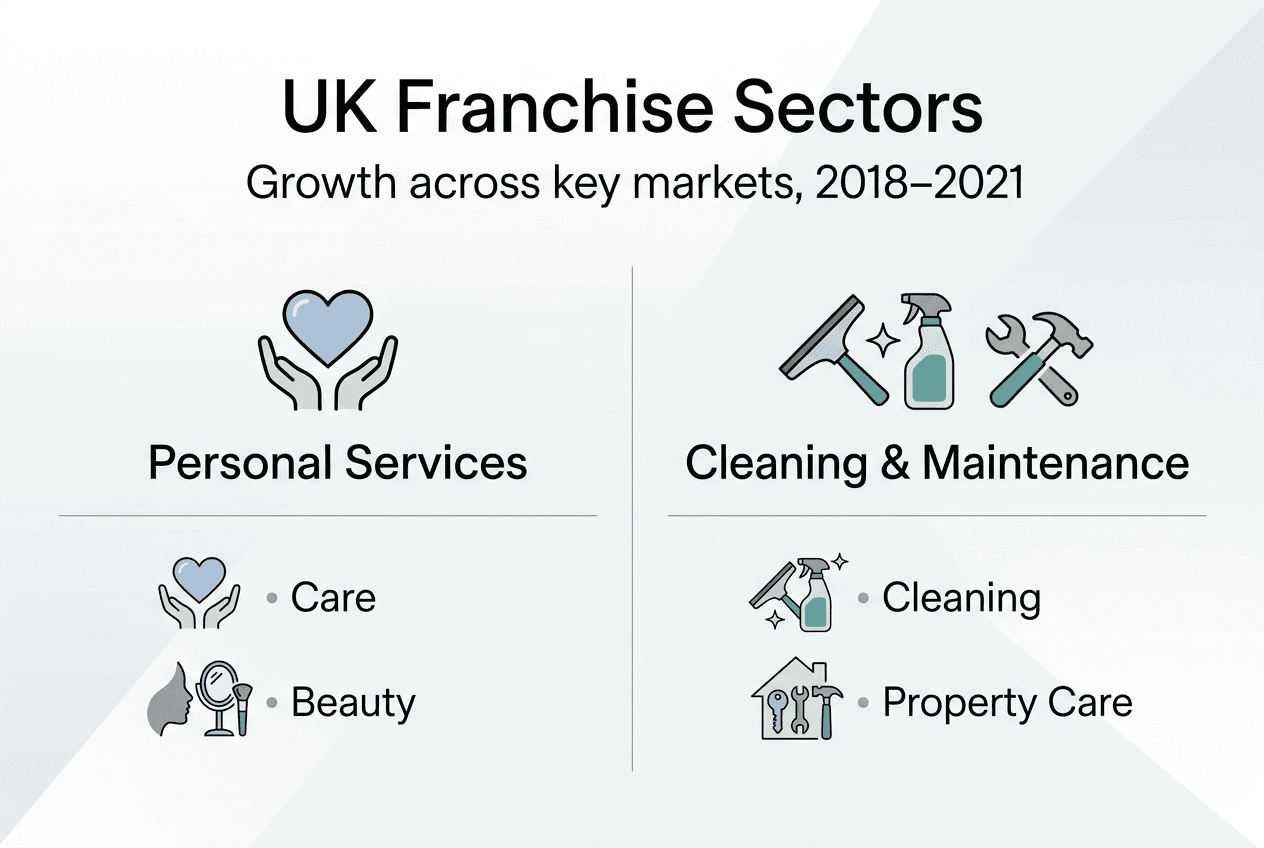
The cleaning sector represents one of the largest franchise categories, with the UK cleaning industry worth over £59 billion. This sector’s essential nature provides remarkable resilience during economic downturns, as businesses and households continue requiring cleaning services regardless of broader economic conditions. Commercial cleaning franchises particularly benefit from recurring revenue models that generate predictable cash flow.
Key economic indicators across major sectors:
| Sector | Market Value | Employment | Growth Rate |
|---|---|---|---|
| Cleaning services | £59 billion+ | 150,000+ | Stable 3-5% annually |
| Personal services | £8 billion+ | 120,000+ | 53% (2018-2024) |
| Food and beverage | £12 billion+ | 200,000+ | Variable 2-8% |
| Property services | £6 billion+ | 80,000+ | Moderate 4-6% |
Property maintenance and home improvement franchises also demonstrate consistent performance, driven by the UK’s ageing housing stock and ongoing renovation demand. These sectors often combine product sales with service delivery, creating multiple revenue streams that enhance profitability. Business services franchises, including accounting and recruitment, tend to mirror broader economic cycles but offer higher margins for franchisees with relevant professional backgrounds.
Exploring the best franchise opportunities in the UK reveals how economic trends translate into practical investment options. Sectors experiencing regulatory changes, such as environmental services benefiting from sustainability mandates, often present first-mover advantages for early franchisees. Monitoring latest franchise trends helps you spot emerging sectors before market saturation reduces returns.
“The franchise model’s strength lies in proven systems that reduce individual business risk whilst allowing entrepreneurs to capitalise on established brand recognition and operational expertise.”
Economic data also highlights sectors where consolidation creates opportunities. As independent operators struggle with compliance costs or marketing challenges, franchise systems offering comprehensive support gain market share, benefiting franchisees who join during growth phases.
How different franchise sectors compare: profitability, stability and risks
Profitability varies dramatically across franchise sectors, influenced by factors including initial investment, operational complexity, and market competition. Franchises in essential services typically demonstrate more stable profit margins than those in discretionary spending categories, as consumer behaviour during economic uncertainty favours necessities over luxuries. Understanding these dynamics helps you select sectors matching your risk tolerance.
Essential service franchises, such as cleaning and care, benefit from recurring revenue models where clients commit to ongoing contracts rather than one-time purchases. This structure provides predictable cash flow that simplifies financial planning and supports business valuation. Discretionary sectors like leisure or premium food services can generate higher margins during economic booms but face revenue volatility when consumers tighten budgets.
Brand support and comprehensive training programmes significantly reduce franchisee risk compared to independent business ownership. Franchising offers reduced risk through proven models, brand recognition, and operational support, yet sectors reliant on discretionary spending face higher exposure during economic downturns. The franchisor’s track record and support infrastructure often matter more than sector selection alone.
Key risk factors by sector:
- Capital intensity: Food franchises often require £100,000-£500,000 initial investment, whilst mobile service franchises may start under £20,000
- Regulatory compliance: Care and food sectors face stringent regulations requiring ongoing training and certification costs
- Market saturation: Established sectors like coffee shops face intense competition, whilst emerging sectors offer less crowded markets
- Economic sensitivity: Luxury services decline sharply in recessions, whilst essential services maintain demand
- Operational complexity: Multi-unit food operations demand sophisticated management, whilst solo service franchises offer simpler operations
Sector comparison for investment planning:
| Factor | Essential Services | Discretionary Services | Business Services |
|---|---|---|---|
| Revenue stability | High | Low to moderate | Moderate |
| Initial investment | Low to moderate | Moderate to high | Low to moderate |
| Profit margins | Moderate | Variable | High |
| Economic resilience | Excellent | Poor to moderate | Moderate |
Diversification across multiple units or complementary sectors can mitigate financial exposure, though this strategy requires substantial capital and management capacity. Some franchisors actively encourage multi-unit ownership, offering territorial protections and volume discounts that enhance profitability for committed investors.
Pro Tip: Focus on sectors where you possess relevant experience or genuine interest, as operational knowledge and personal motivation significantly impact franchise success rates beyond pure financial metrics.
Legal and financial due diligence becomes critical for risk assessment, particularly in sectors with complex regulatory requirements. Understanding franchise legal considerations helps you evaluate contractual obligations, territorial rights, and exit provisions that affect long-term profitability. Consulting resources like the Institute of Chartered Accountants provides professional perspectives on financial risk management.
Examining franchise success factors in the UK reveals that sector selection represents just one component of profitable franchise ownership. Franchisor support quality, location selection, and franchisee commitment often determine outcomes more than sector characteristics alone.
Practical steps to choose the right franchise sector for you
Selecting the optimal franchise sector requires systematic evaluation of both market opportunities and personal circumstances. Begin by conducting thorough due diligence that extends beyond marketing materials to examine actual franchisee experiences and financial performance. Due diligence reduces franchise failure rates by thoroughly investigating franchisors’ financial and legal standing before commitment.
Essential due diligence activities include:
- Reviewing Item 19 financial performance representations in disclosure documents to understand realistic revenue expectations
- Speaking with current and former franchisees about profitability, support quality, and operational challenges
- Examining the franchise agreement with legal counsel to clarify ongoing fees, territorial rights, and renewal terms
- Analysing market saturation in your target territory to assess competitive intensity
- Verifying franchisor financial stability through company accounts and credit reports
Evaluate ongoing fees and support structures, not just initial investment requirements. Some franchises charge lower upfront fees but impose higher royalties or marketing contributions that erode profitability over time. Compare the total cost of ownership across sectors, including working capital needs, equipment replacement cycles, and mandatory upgrades that affect long-term returns.
Consider sector trends and economic resilience when projecting future performance. Sectors benefiting from demographic shifts, such as senior care responding to population ageing, offer stronger growth trajectories than mature markets facing declining demand. Regulatory changes can create opportunities in sectors like environmental services whilst imposing costs in others, making policy awareness essential for informed selection.
Personal interest and lifestyle compatibility significantly influence franchise success beyond pure financial considerations. Operating a business you find genuinely engaging sustains motivation through inevitable challenges, whilst misalignment between franchise requirements and personal preferences leads to burnout. Assess whether you prefer customer-facing roles or back-office operations, hands-on work or management delegation, and fixed location or mobile flexibility.
Pro Tip: Visit multiple operating franchise units during peak and quiet periods to observe real working conditions, customer interactions, and operational demands before committing capital to any sector.
Seek expert advice from franchise consultants, accountants, and solicitors who specialise in franchise transactions. Professional guidance helps you navigate complex disclosure documents, negotiate favourable terms, and avoid common pitfalls that trap inexperienced investors. Understanding franchise due diligence in the UK provides frameworks for systematic evaluation that reduces decision-making risk.
Compare sectors based on alignment with your skills, available capital, risk tolerance, and lifestyle goals rather than chasing headline profitability claims. The most profitable franchise for another investor may prove unsuitable for your circumstances, making personalised assessment essential. Exploring the benefits of franchising helps clarify whether franchise ownership suits your entrepreneurial objectives compared to independent business creation or alternative investments.
Explore franchise opportunities and expert guidance
Now that you understand how franchise sectors differ in profitability, stability, and operational requirements, exploring specific opportunities aligned with your goals becomes the logical next step. FranchiseLocal offers a comprehensive franchise industries directory where you can filter opportunities by sector, investment level, and operational model to identify suitable matches efficiently. The platform connects you with established franchise systems across all major sectors, from emerging care services to proven cleaning operations.
Access expert resources through the ultimate franchising guide to deepen your knowledge of franchise selection, legal considerations, and operational best practices. Connect with trusted franchise service providers offering legal, financial, and operational assistance tailored to your specific sector interests and investment capacity. Professional support transforms sector knowledge into actionable investment decisions backed by thorough analysis.
Frequently asked questions
What are the main franchise industry sectors in the UK?
Key sectors include personal services such as domiciliary care and beauty treatments, cleaning and maintenance covering commercial and residential properties, food and beverage operations, property services including estate agencies, and business services like accounting and recruitment. Each sector offers distinct operational models, capital requirements, and growth prospects. Explore the main franchise sectors in the UK to compare specific opportunities across categories.
How can I assess the growth potential of a franchise sector?
Review market data including employment figures, sector valuation trends, and awards recognition from organisations like the British Franchise Association to identify expanding sectors. Analyse consumer demand stability by examining whether services are essential or discretionary, as essential services demonstrate greater resilience during economic uncertainty. Consider demographic trends such as population ageing that drive long-term demand in sectors like care services. Monitor franchise sector growth trends to spot emerging opportunities before market saturation reduces returns.
Why is due diligence especially important when choosing a franchise sector?
Due diligence uncovers critical information about franchisor financial health, legal obligations, and actual franchisee satisfaction that marketing materials often obscure. Thorough investigation reduces failure risk by revealing operational challenges, hidden costs, and support quality before you commit capital. Sector-specific due diligence examines regulatory requirements, market saturation, and competitive dynamics that affect profitability. Understanding the importance of franchise due diligence provides systematic frameworks for evaluating both franchisors and sectors to make informed investment decisions.
Which franchise sectors offer the best recession resistance?
Essential service sectors including cleaning, property maintenance, and care services demonstrate the strongest recession resistance because demand persists regardless of economic conditions. These sectors benefit from recurring revenue models where clients maintain contracts even during budget constraints. Business services like accounting also show resilience as regulatory compliance requirements continue regardless of economic cycles. Discretionary sectors such as luxury retail or premium dining face significant revenue declines during recessions, making them higher-risk choices for conservative investors.