

For many prospective franchisees in the United Kingdom, making sense of where your marketing contributions go can be equally daunting and crucial. Understanding the workings of a franchise marketing fund is key to seeing real value from your investment, whether you join a railway, retail, or service-based network. This guide shows how these funds are managed, how contributions are calculated, and what oversight protects your interests as you weigh your options.
What Is a Franchise Marketing Fund?
A franchise marketing fund is a strategic financial mechanism designed to pool resources from multiple franchise operators, enabling coordinated and comprehensive marketing initiatives across an entire franchise network. Unlike individual marketing efforts, these centralised funds provide a more powerful and cost-effective approach to brand promotion and customer acquisition.
The core purpose of a franchise marketing fund is to create a collective investment strategy where each franchise contributes a percentage of their revenue towards a shared marketing pool. Franchise marketing strategies typically involve several key components:
- Centralised national advertising campaigns
- Digital marketing efforts across multiple channels
- Brand consistency and messaging development
- Market research and consumer insights
- Promotional materials and collateral
Specifically for UK franchise networks, these marketing funds serve critical functions. By standardising marketing support, franchisors can ensure that individual franchise units benefit from professional, coordinated marketing approaches that would be financially challenging to implement independently.

Franchise marketing funds are typically structured as mandatory contributions, with franchisees contributing a set percentage of their gross sales—usually ranging between 1-2%. This pooled investment allows for more sophisticated marketing strategies, leveraging economies of scale that individual franchises could not achieve alone.
Pro tip: Before joining a franchise, carefully review the marketing fund’s contribution requirements and assess the demonstrated return on marketing investment from previous campaigns.
Fee Structures and Typical Contributions
Franchise marketing funds typically operate on a standardised contribution model where franchisees are required to allocate a specific percentage of their gross revenue towards a centralised marketing budget. The financial calculation methods vary depending on the franchise network’s size, complexity, and marketing objectives.
Most franchise marketing funds establish contribution structures based on several key parameters:
- Percentage of gross revenue (commonly 1-2%)
- Fixed monthly or quarterly contributions
- Sliding scale contributions based on franchise unit performance
- Additional one-time marketing investments for specific campaigns
- Pro-rata adjustments for newer or smaller franchise locations
The financial governance of these marketing funds is typically managed by the franchisor, with transparent financial arrangements ensuring accountability and clear reporting mechanisms. Franchisees receive detailed breakdowns of how their contributions are utilised, including expenditure on national advertising, digital marketing campaigns, and brand development initiatives.
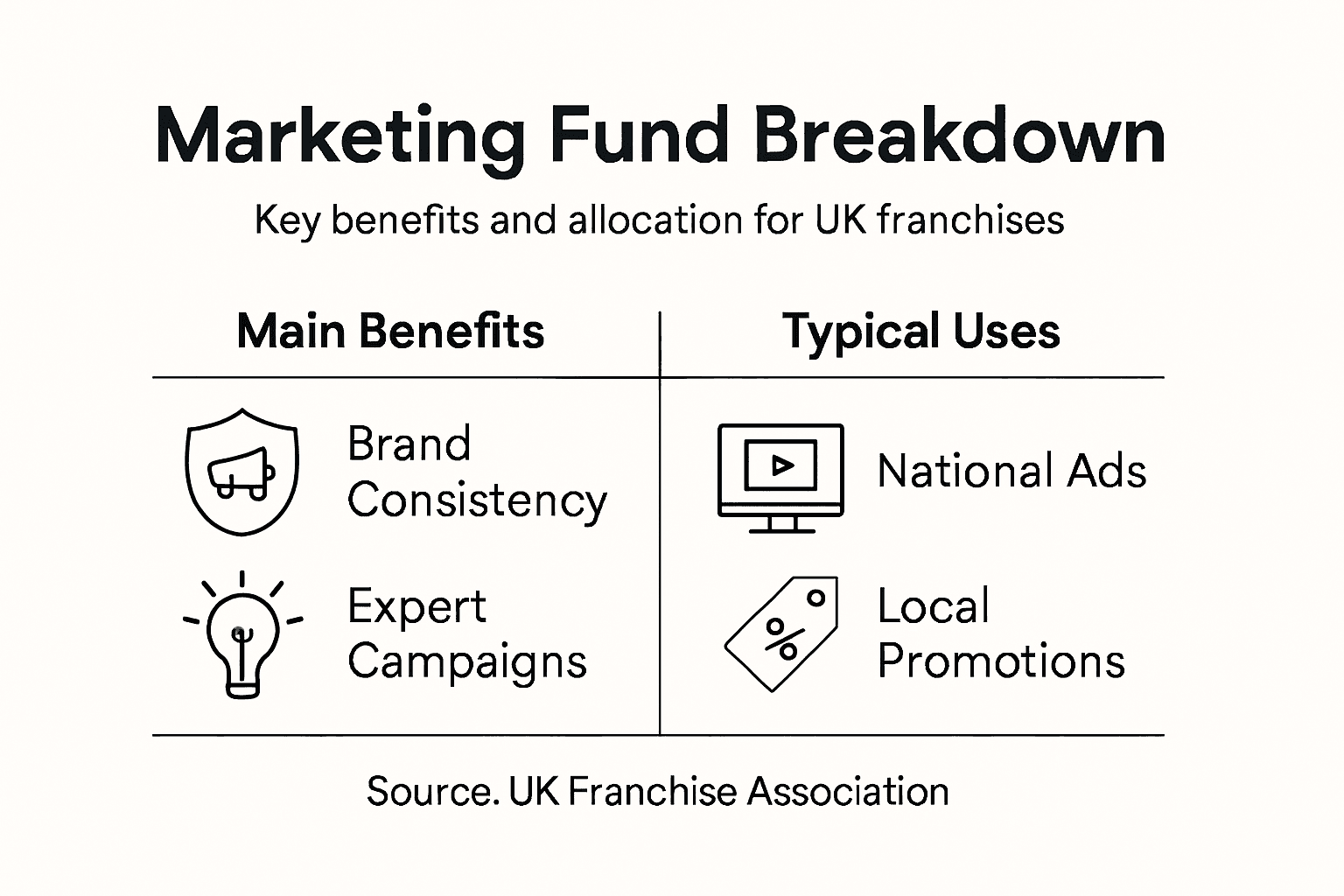
For UK franchises, contribution levels often reflect the specific industry and market dynamics. Technology and service-based franchises might have higher marketing fund percentages (up to 3-4%), while retail franchises typically maintain contributions around 1.5-2% of gross revenue. These structured contributions enable sophisticated, coordinated marketing strategies that individual franchise units could not independently afford.
Here is a summary comparing different franchise marketing fund contribution models and their typical applications:
| Contribution Model | Typical Usage | Financial Impact |
|---|---|---|
| Percentage of gross revenue | Most franchise types | Scales with performance |
| Fixed monthly/quarterly payment | Smaller or start-up franchisors | Predictable, easier budgeting |
| Sliding scale based on performance | Service or tech franchises | Rewards high-performing units |
| One-time campaign investment | Major new launches | Enables major strategic pushes |
| Pro-rata for new locations | Recently opened franchises | Reduces early financial strain |
Pro tip: Always request a comprehensive breakdown of how marketing fund contributions will be invested before committing to a franchise agreement, ensuring transparency and potential return on your marketing investment.
Legal Duties and Fund Management in the UK
In the United Kingdom, franchise marketing funds are subject to rigorous legal oversight, ensuring transparency, accountability, and protection of franchisee interests. Regulatory supervision mechanisms play a critical role in maintaining the integrity of these financial structures, with multiple layers of governance monitoring their operation and management.
The legal framework governing franchise marketing funds encompasses several key regulatory requirements:
- Mandatory financial reporting and disclosure
- Independent audit processes
- Transparent fund allocation mechanisms
- Conflict of interest prevention protocols
- Compliance with Financial Conduct Authority guidelines
- Protection of franchisee investment contributions
Franchise marketing funds must adhere to strict legal responsibilities outlined in franchising regulations, which mandate comprehensive documentation and accountability. Franchisors are legally obligated to provide detailed breakdowns of how marketing fund contributions are utilised, ensuring that every pound invested can be traced and justified.
The Financial Conduct Authority (FCA) plays a pivotal role in overseeing these funds, requiring franchisors to demonstrate robust risk management strategies, maintain proper liquidity, and implement fair valuation practices. This regulatory approach protects franchisees by ensuring that marketing investments are managed professionally and with complete transparency, minimising potential misuse of collective funds.
Pro tip: Request a comprehensive legal review of the franchise marketing fund’s governance structure and request historical performance reports to understand how funds have been managed previously.
Allocation of Funds: National vs Local Campaigns
Franchise marketing funds employ a sophisticated strategic allocation model that carefully balances national brand messaging with localised marketing initiatives. Authorised marketing fund strategies typically divide resources to maximise both broad market penetration and targeted regional engagement.
The typical fund allocation breakdown often follows these strategic parameters:
- National campaigns: 60-70% of total marketing budget
- Local/regional promotions: 30-40% of total marketing budget
- Digital marketing channels: Integrated across national and local strategies
- Community-specific targeted advertising
- Performance-based funding adjustments
- Seasonal campaign flexibility
National campaigns focus on building overarching brand recognition, leveraging economies of scale to create high-impact marketing efforts that individual franchise locations could not independently achieve. These initiatives typically include television advertising, national press coverage, and comprehensive digital marketing strategies that establish consistent brand messaging across the United Kingdom.
Funding allocation principles emphasise the importance of creating a balanced approach that allows local franchisees to adapt marketing materials to their specific regional contexts. This approach ensures that while the core brand message remains consistent, local franchisees can tailor marketing efforts to address unique local market characteristics, consumer preferences, and regional nuances.
This table highlights the differences in fund allocation between national and local campaigns in franchise marketing:
| Allocation Area | Typical Budget Share | Main Focus |
|---|---|---|
| National Campaigns | 60-70% | Brand recognition, large-scale reach |
| Local Campaigns | 30-40% | Community engagement, local offers |
| Digital Channels | Across both areas | Social media, online advertising |
Pro tip: Request a detailed breakdown of your franchise’s marketing fund allocation strategy, ensuring a balanced approach between national brand building and local market penetration.
Common Pitfalls and How to Avoid Them
Franchise marketing funds are susceptible to several critical operational risks that can undermine their effectiveness and potentially erode franchisee confidence. Financial governance frameworks highlight the importance of understanding and proactively mitigating these potential challenges.
The most prevalent pitfalls in franchise marketing fund management include:
- Lack of transparent financial reporting
- Insufficient performance tracking mechanisms
- Misalignment between national and local marketing objectives
- Uneven fund allocation across franchise network
- Inadequate compliance with regulatory requirements
- Poor communication about fund utilisation
- Absence of clear performance metrics
One significant challenge is the potential for fund mismanagement, where marketing contributions are not strategically deployed or lack measurable impact. Governance risk management principles suggest implementing robust oversight mechanisms that include regular independent audits, comprehensive performance reporting, and clear accountability structures to prevent potential misuse of collective marketing investments.
Successful franchise marketing funds maintain a delicate balance between centralised control and local autonomy. This requires creating flexible frameworks that allow for strategic national campaigns while simultaneously providing franchisees with sufficient flexibility to adapt marketing materials to their specific regional markets. By establishing clear governance protocols, maintaining transparent communication, and regularly evaluating marketing fund performance, franchisors can build trust and ensure the long-term effectiveness of their collective marketing investments.
Pro tip: Request quarterly detailed reports on marketing fund expenditure and demand clear, measurable key performance indicators to track the actual return on your marketing investments.
Maximise Your Franchise Investment with Strategic Marketing Funds
Understanding the critical role of a franchise marketing fund can be overwhelming. The article highlights key challenges such as transparent fund management, allocation between national and local campaigns, and ensuring measurable returns on your marketing contributions. These pain points are essential for UK investors who want to see real growth without risking mismanaged funds or unclear financial reporting. Terms like percentage of gross revenue, fund governance, and performance metrics reveal the complexity behind the scenes.
If you want to confidently navigate these challenges and find franchise opportunities that match your investment goals and lifestyle, explore Franchise Local UK. This platform offers a wide selection of franchises complete with vital information to help you assess the marketing support structures and contribution expectations before committing. Discover options filtered by industry, price point, and operational models while gaining insights into how marketing funds are handled within each franchise.
Take control of your franchise journey today. Visit Franchise Local UK to connect with reputable franchise brands that prioritise transparent marketing investments. Make an informed choice and start growing with confidence.
Frequently Asked Questions
What is a franchise marketing fund?
A franchise marketing fund is a collective financial resource pooled from multiple franchise operators to support coordinated marketing initiatives, allowing for more effective and cost-efficient brand promotion.
How are contributions to the franchise marketing fund typically calculated?
Contributions are usually calculated as a percentage of gross sales, commonly ranging from 1-2%, although some franchises may require higher percentages based on specific industry needs.
What are the key benefits of a franchise marketing fund for franchisees?
The key benefits include access to professional marketing campaigns, brand consistency, economies of scale in advertising, and improved consumer insights that individual franchises may struggle to achieve on their own.
What are common pitfalls associated with franchise marketing funds?
Common pitfalls include lack of transparency in financial reporting, misalignment between national and local marketing goals, and insufficient performance tracking mechanisms which can lead to ineffective marketing strategies.