

Many people assume that signing a franchise agreement is the hard part. Hand over the cheque, receive a manual, and off you go. In reality, franchise onboarding is far more than a paperwork exchange — it is a structured, months-long process designed to give you every tool you need to run a profitable business. Get it right, and you launch with confidence. Underestimate it, and you risk costly mistakes that could have been avoided. This guide walks you through every stage, from pre-opening setup to post-launch support, so you know exactly what to expect and how to make the most of it.
Key Takeaways
| Point | Details |
|---|---|
| Structured process | Franchise onboarding is a multi-step integration ensuring new franchisees hit the ground running. |
| Comprehensive support | Effective onboarding includes training, resources, and ongoing guidance beyond initial setup. |
| Success predictors | Franchisees with robust onboarding achieve higher satisfaction and lower failure rates. |
| Critical first 90 days | The initial three months set the tone for long-term franchisee performance. |
What is franchise onboarding?
Franchise onboarding is the structured integration process franchisors use to bring new franchisees into their network and prepare them to operate successfully. It is not simply a training day or a welcome pack. Think of it as the bridge between signing your agreement and confidently running your business at full capacity.
The distinction between onboarding and standard employee training is significant. Employee induction typically covers job-specific tasks within an existing structure. Franchise onboarding, by contrast, prepares you to own and manage an entire business operation. You are learning brand standards, financial management, customer service protocols, local marketing, and compliance requirements all at once. It is far broader in scope and far higher in stakes.
For the franchisor, effective onboarding protects brand consistency across every location in the network. A poorly onboarded franchisee can damage customer trust built over years. For you as the franchisee, it is the foundation on which everything else is built. Skipping steps or rushing through the process is one of the most common reasons new franchisees struggle in their first year.
“Franchise onboarding is the structured process franchisors use to integrate new franchisees, covering everything from compliance and training to territory setup and ongoing support.”
In terms of timing, most onboarding programmes run for 3 to 6 months, with the first 90 days being particularly critical. This is when habits form, systems get embedded, and the relationship between you and your franchisor is truly established. Franchisors who invest heavily in this window tend to build stronger, more consistent networks. If you are still researching which franchise to join, understanding how a brand approaches its structured recruitment process can tell you a great deal about how seriously they take franchisee success.
Step-by-step franchise onboarding process
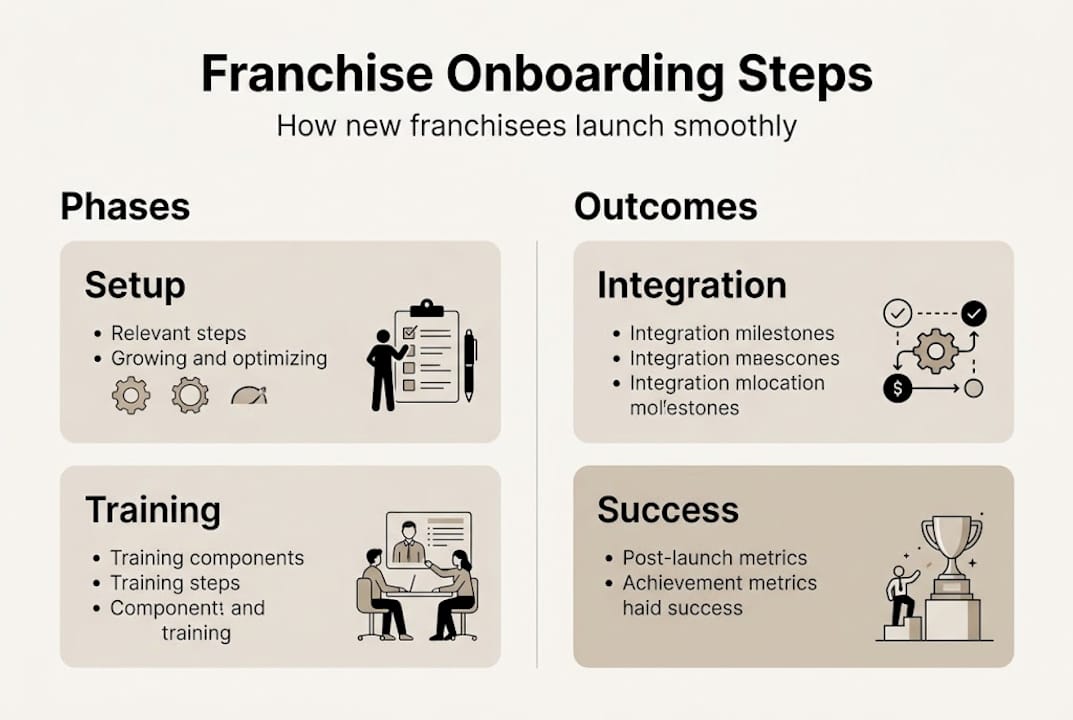
Knowing what to expect at each stage removes anxiety and helps you prepare properly. Here is how a well-structured onboarding process typically unfolds, based on key onboarding phases used by leading franchise brands.
- Pre-onboarding setup. Before day one, your franchisor should provide operations manuals, set up your technology systems, and ensure all legal and compliance paperwork is in order. This is also when your territory is formally mapped.
- Day one introductions. You meet key members of the support team, get access to internal platforms, and begin your initial brand and operations training.
- Territory mapping and site selection. For bricks-and-mortar or territory-based franchises, this phase involves identifying your trading area, assessing local competition, and finalising your location.
- Operations and marketing training. This is the most intensive phase. You learn how to run daily operations, manage staff, handle customer complaints, and execute local marketing campaigns.
- Staff recruitment and pre-launch activities. You hire and train your team, set up supplier accounts, and complete any local authority requirements.
- Grand opening. Your franchisor typically provides hands-on support during your launch week, which is outlined in most franchise launch checklists.
- Post-launch support and first 90-day check-ins. Regular calls, performance reviews, and on-site visits keep you on track through the critical early period.
| Onboarding phase | Typical duration | Key outcome |
|---|---|---|
| Pre-onboarding setup | 2 to 4 weeks | Systems and compliance ready |
| Initial training | 1 to 3 weeks | Brand and operations knowledge |
| Territory and site setup | 2 to 6 weeks | Location confirmed and ready |
| Pre-launch activities | 2 to 4 weeks | Staff hired, suppliers confirmed |
| Grand opening | 1 week | Business trading |
| Post-launch support | Ongoing (90 days minimum) | Performance and confidence building |
Pro Tip: Ask your franchisor for a written onboarding timeline before you sign. If they cannot provide one, that is a red flag worth taking seriously. Strong franchisors treat onboarding as a project with clear milestones, not a loose collection of meetings. You can also review what well-structured training programmes look like to benchmark what you should be receiving.
Training, support, and resources: what you receive
Once you understand the stages, it is equally important to know the quality and variety of support you should expect. Onboarding success hinges on standardisation, customisation to your background, and continuous support throughout the process.
Here is what a well-resourced onboarding programme typically includes:
- Classroom and practical training covering the full business model, sales techniques, and daily operations
- A dedicated franchise support manager who is your primary contact throughout onboarding and beyond
- Digital learning platforms giving you on-demand access to training materials, brand guidelines, and compliance documents
- Marketing toolkits including templates, local advertising guidance, and social media assets
- Financial management training covering cash flow, reporting, and royalty structures
- Performance benchmarks so you know what good looks like in your first 30, 60, and 90 days
The customisation element is often overlooked. A franchisee with a background in retail needs different emphasis than one coming from a corporate finance role. Good franchisors assess your skills early and tailor parts of the programme accordingly. This is not about lowering standards. It is about making the training genuinely useful rather than generic.

| Support type | When provided | Purpose |
|---|---|---|
| Initial training | Pre-launch | Build core competency |
| Dedicated support manager | Throughout onboarding | Day-to-day guidance |
| Performance reviews | 30, 60, 90 days | Identify gaps early |
| Ongoing helpdesk | Post-launch | Resolve operational issues |
| Annual franchise conference | Yearly | Network and strategy updates |
Poor onboarding significantly increases the risk of franchisee failure, while strong processes build scalable, satisfied networks. Understanding the full range of franchise support systems available in the UK helps you ask the right questions before committing. You should also honestly assess which franchisee skills you bring to the table so you can identify where you will need the most support.
How onboarding sets you up for success: lessons and pitfalls
Onboarding does not just prepare you to open your doors. It shapes your confidence, your compliance, and your long-term profitability. The difference between franchisees who thrive and those who struggle is often visible within the first 90 days.
Here are the most common pitfalls that derail new franchisees during onboarding:
- Inconsistent messaging from the franchisor. If your support team gives conflicting advice, it creates confusion and erodes trust early.
- Lack of customisation. A one-size-fits-all programme ignores your strengths and leaves skill gaps unaddressed.
- Insufficient post-launch support. Many franchisors invest heavily in pre-opening training but go quiet after launch. This is when you need guidance most.
- Franchisee passivity. Some new franchisees treat onboarding as something that happens to them rather than something they actively drive.
- Skipping the operations manual. It sounds obvious, but many franchisees skim this document and pay for it later.
“Poor execution of onboarding risks high failure costs, while strong processes build scalable networks and high franchisee satisfaction across the entire brand.”
The milestone moments that most reliably predict positive outcomes are: completing initial training with a formal sign-off, achieving first-month revenue targets, and having a documented 90-day review with your support manager. These are not bureaucratic boxes to tick. They are genuine indicators that you and your franchisor are aligned.
For support after onboarding, the best franchisors maintain structured check-ins, peer networking groups, and access to specialist advisers long after your grand opening. If a franchisor cannot clearly explain what happens six months after launch, treat that as important information.
Our perspective: why onboarding is your make-or-break success factor
Having observed hundreds of UK franchisees launch their businesses, one pattern stands out clearly. The franchisees who struggle rarely failed because of a bad territory or a weak product. They failed because they treated onboarding as a formality rather than a foundation.
Conventional wisdom says that success in franchising comes from following the system. That is true, but incomplete. Following the system only works if you genuinely understand it, and that understanding comes from taking onboarding seriously as an active participant, not a passive recipient.
The high performers we see consistently do three things differently. They ask more questions during training. They build real relationships with their support managers rather than treating them as a helpdesk. And they review their performance data honestly rather than explaining away early shortfalls.
The uncomfortable truth is that training’s impact on franchise success is not just about what the franchisor delivers. It is about how much you invest in absorbing it. The franchisees who treat week two of training with the same focus as week one are the ones still growing in year three.
Find your next step in franchising
Understanding the onboarding process is one of the most valuable things you can do before choosing a franchise. It tells you how a brand treats its people, how seriously it takes consistency, and what your day-to-day experience will actually look like. At Franchise Local, we give you the tools to make that assessment with confidence. Explore our ultimate guide to franchising to deepen your knowledge, connect with specialist advisers through our franchise service providers directory, or browse our full franchise directory to find opportunities that match your investment level and lifestyle. The right franchise with the right onboarding process is out there.
Frequently asked questions
How long does franchise onboarding usually take in the UK?
Most franchise onboarding processes last 3 to 6 months, with the first 90 days being the most critical period for establishing good habits and hitting early performance milestones.
What support do franchisors provide after onboarding is complete?
Ongoing support typically includes regular performance reviews, marketing assistance, helpdesk access, and structured check-ins to ensure continued growth and brand compliance.
Why is franchisee training different from regular employee training?
Franchisee training covers the full business model, including sales, operations, compliance, financial management, and local market adaptation, which is far broader in scope than a standard employee induction.