

For a UK franchise site you plan to invest in and brand, take a commercial lease aligned to the franchise term. For a short-term test site, a licence usually works better. The immediate risk to check either way is security of tenure and mislabelling: courts look at what an agreement actually does, not what it’s called. Before you sign anything, confirm whether the franchise needs bespoke fit-out or a long trading horizon, as explained in this guide to master franchise digital marketing to boost growth. If it does, a lease should be your default.
Lease versus licence: legal and practical differences for franchise occupiers in the UK
A commercial lease gives you exclusive possession of the property for a fixed term, usually with statutory renewal rights under the Landlord and Tenant Act 1954. A licence gives you permission to occupy, nothing more. That distinction sounds academic until a dispute lands in front of a judge, at which point it becomes the entire case.
The leading authority here is Street v Mountford. The House of Lords held that if an arrangement grants exclusive possession for a term at a rent, it will generally be treated as a tenancy regardless of what the parties chose to call it. A landlord and franchisee can label a document a “licence” all they like, but if it functions like a lease, a court can treat it as one. This cuts both ways for franchise operators: it protects you from being wrongly denied tenant rights, but it also means you cannot use a licence label to dodge landlord obligations you’d rather avoid.
For franchised retail units, hospitality venues, and clinics that need shopfitting, signage, and a settled trading base, a lease is nearly always the safer instrument. It gives you the security to justify capital spend on fit-out and the statutory footing to negotiate renewal when the franchise term rolls forward.
A licence tends to suit different circumstances:
- Pop-up trials testing a franchise concept in a new town before committing to a full lease.
- Serviced office or co-working desks for franchise back-office functions with no customer-facing fit-out.
- Seasonal or event-based franchise formats where the site only trades for weeks at a time.
- Market-testing kiosks inside shopping centres, where the centre operator retains tight control over layout and hours.
One practical caveat: Scotland’s property law differs from England and Wales in several material respects, including how leases and occupation rights are treated. If your franchise territory includes a Scottish site, get local advice rather than assuming English case law transfers directly. The commercial lease options available across the UK vary enough by structure and jurisdiction that a one-size template rarely holds.
Aligning the lease with the franchise agreement and recognising ‘sandwich’ risks
Franchise property sits inside a structure that a standard tenant never has to think about: the franchise agreement itself. Get the two documents out of step, and you can end up paying rent on a unit long after your right to trade under the brand has ended.
Some franchisors hold a headlease from the landlord and then grant an underlease, or “sandwich” arrangement, to individual franchisees. This gives the franchisor control over the estate, but it often leaves you with limited bargaining power on rent review mechanics and service charge caps, since you’re negotiating with an intermediary rather than the freeholder directly. Where a franchise property lease UK arrangement involves a sandwich structure, insist on full transparency of the headlease terms before you sign, or push to negotiate a direct lease with the landlord where that’s realistically on the table.
The core alignment problem is straightforward but easy to miss under deal pressure: a ten-year lease paired with a five-year franchise term, and no usable break clause, leaves you contractually tied to premises rent after you’ve lost the right to trade under that brand. That mismatch is one of the most common causes of franchisee financial distress, and it’s entirely avoidable at the negotiation stage.
Four things to tie together before you sign anything:
- Term length. Match the lease term (or at least the first break point) to the franchise agreement’s initial term.
- Renewal rights. Confirm the franchise renewal process and timeline line up with any lease renewal option, so you’re not left mid-negotiation on one while the other lapses.
- Assignment and step-in rights. Check whether the franchisor can step in or approve a new operator if you exit, and whether the lease permits assignment on the same terms.
- Guarantors and warranties. Understand exactly what you’re personally guaranteeing and for how long it survives beyond the franchise relationship ending.
Pro Tip: Map every lease break date against your financing assumptions before you sign. If your bank loan or franchise investment repayment schedule runs longer than your first usable break clause, you’re carrying property risk your business plan hasn’t accounted for.
None of this happens in isolation. A franchise agreement typically sits alongside a cluster of linked documents, personal guarantees, supplier terms, software licences, and the property lease or licence itself, and the contract review priorities for UK franchise operators depend on reading all of them together, not each in turn.
Clause-by-clause checklist to negotiate in a franchise lease
Heads of terms get agreed quickly, often before either side has thought hard about the detail. That’s exactly when you should slow down. Every item below has caused real delays or disputes for franchise operators, and each is negotiable if you raise it early.
- Permitted use. Make sure the clause is broad enough to cover everything the franchise actually does: delivery, takeaway, extended trading hours, click and collect. A narrow permitted use clause can block a franchisor-mandated service change years into the lease.
- Fit-out and reinstatement. Secure landlord pre-authorisation for your franchisor’s standard fit-out specification where possible, and clarify what you must strip out and restore at lease end.
- Signage and shopfront. Confirm the franchisor’s brand signage requirements are actually permitted under the landlord’s estate rules and any local planning controls, before you commit to the unit.
- Rent review and service charge. Understand the review mechanism (open market, RPI-linked, or fixed uplifts) and push for a service charge cap so unpredictable estate costs don’t blindside your budget.
- Insurance and business rates. Clarify who insures the building versus contents, and confirm the rates liability sits where you expect it to.
- Break clauses and assignment. Insist on break rights you can realistically exercise (not ones buried behind conditions you’ll never satisfy) and assignment terms that let you sell the business without the landlord holding a veto.
- Guarantees and deposits. Negotiate a time-limited personal guarantee or a rent deposit instead of an open-ended guarantee, and ask for the guarantee to reduce or fall away after a clean payment history.
Landlord consent that isn’t time-bound is a trap in disguise. Practitioners consistently flag that consent clauses tied to franchisor-required fit-out or alterations should carry objective, time-limited criteria. Without that, a landlord can sit on an approval indefinitely and delay your opening date at real financial cost. Building this into the heads of terms, rather than trying to fix it after exchange, is the difference between a manageable timeline and a stalled launch.
Franchise buyers researching legal documents for buying a franchise often underestimate how much of the eventual dispute risk sits inside the property clauses rather than the franchise agreement itself.
Practical pre-signing steps: due diligence, timeline, costs and advisers to instruct
The sequence matters more than most franchisees expect, and skipping a step rarely saves time, it just moves the delay somewhere less convenient.
- Agree heads of terms with the landlord, covering rent, term, break rights, and permitted use in outline.
- Instruct a commercial solicitor and a chartered surveyor to review the draft lease, the landlord’s legal pack, and the property’s physical condition together.
- Request the landlord’s legal pack and confirm any consents needed, including superior landlord consent if the site sits within a sandwich structure.
- Get franchisor sign-off on the site, fit-out plans, and lease terms, since most franchise agreements make this a condition of trading rights.
- Progress fit-out design and planning applications in parallel with legal exchange, rather than waiting until completion to start.
Expect the whole process to take several months from heads of terms to opening day, with delays most often arising around fit-out approvals, landlord consent turnaround, and franchisor sign-off rather than the legal drafting itself.
Four advisers earn their fee here. A commercial solicitor reviews the lease and flags onerous clauses. A chartered surveyor assesses the building’s condition and advises on rent review evidence. An accountant models the true occupancy cost against your franchise financials. A franchise adviser, separate from the franchisor, sanity-checks how the property terms interact with the franchise agreement, drawing on the kind of franchisee due diligence checklist legal advisers use for exactly this cross-check.
Budget beyond the headline rent: legal fees, surveyor fees, a rent deposit, dilapidations provisions, and fit-out costs the franchisor’s specification demands but the landlord won’t contribute to. Reviewing franchise legal requirements in the UK alongside your property costs early tends to surface these hidden lines before they surprise you at completion.
How Franchiselocal helps you find franchise opportunities that match your property needs
Many franchise sites offer search filters that let you narrow franchise opportunities by industry, investment band, and location in one pass, rather than trawling dozens of franchisor websites separately.
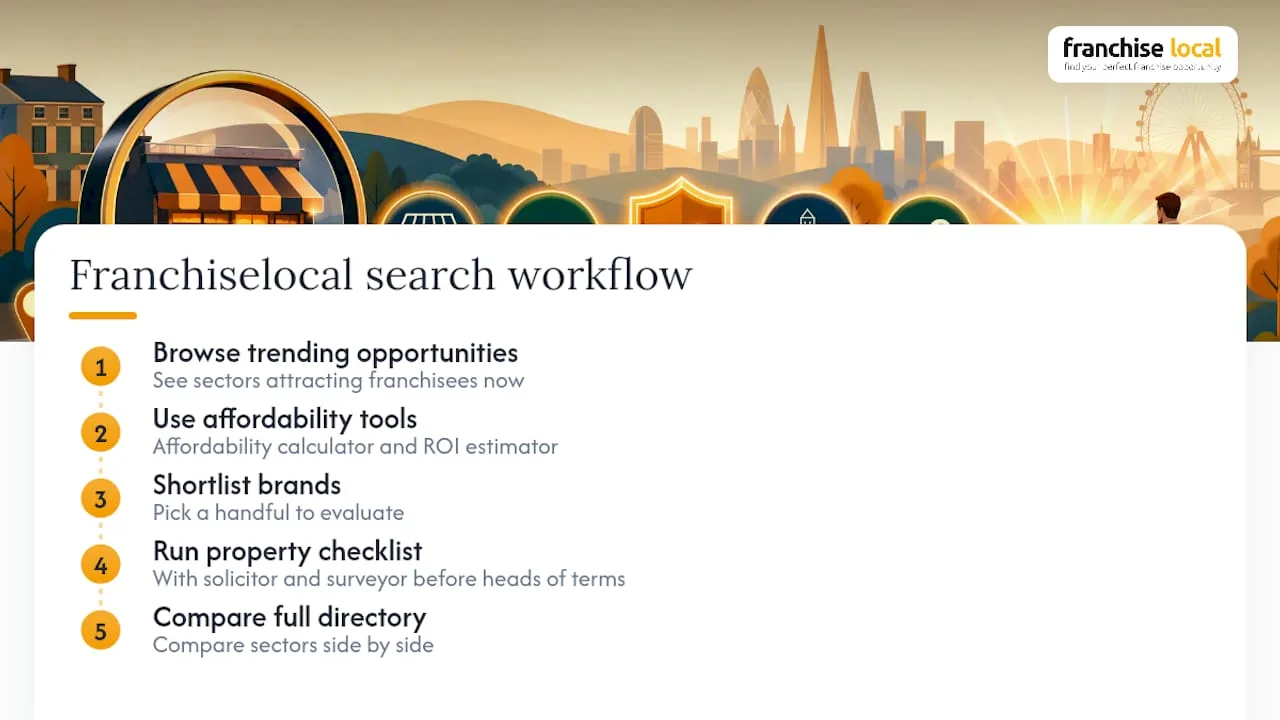
Start with the trending franchise opportunities page to see which sectors are attracting franchisees right now, then use the affordability calculator and ROI estimator to test whether a given investment level and rent burden actually stack up against realistic returns. Once you’ve shortlisted a handful of brands, run the property checklist covered above with your solicitor and surveyor before you commit to heads of terms on any specific site. If you’re still deciding which sector fits your budget and property ambitions, the full franchise directory by industry is the fastest way to compare options side by side.