

Franchise scaling offers UK entrepreneurs a proven pathway to business growth, with 89% of franchised units remaining profitable despite economic headwinds. Yet profitability alone doesn’t guarantee expansion success. Scaling requires systematic approaches, from choosing the right development model to building robust support frameworks. This guide unpacks strategic options including master franchising and multi-unit development, plus critical legal and operational considerations that determine whether your franchise thrives or stalls during growth.
Key Takeaways
| Point | Details |
|---|---|
| Market Foundation | UK franchise systems number over 1,000 with 89% unit profitability supporting expansion potential. |
| Scalable Systems | Documented operations manuals and training programs enable consistent replication across locations. |
| Master Franchising | Regional exclusive rights accelerate growth by leveraging local partner expertise and capital. |
| Multi-Unit Strategy | Existing franchisees opening 3 to 5 units increases market penetration with reduced recruitment risk. |
| Support Infrastructure | Strong legal frameworks and ongoing franchisee training ensure brand integrity during expansion. |
Context: The UK Franchise Market Landscape
Understanding where your franchise fits within the broader UK market shapes your scaling strategy. The UK franchising market includes 1,009 franchise systems as of 2024, demonstrating a mature but still growing ecosystem. This stability creates opportunities for entrepreneurs with proven concepts ready to expand.
Sector trends reveal shifting consumer preferences. Personal services franchises expanded 53% since 2018, whilst retail sectors face headwinds from ecommerce competition. Your franchise marketing strategy UK approach must account for these sector dynamics when targeting expansion regions.
Economic conditions in 2026 present a mixed picture. Franchisor outlook remains cautiously optimistic, with digital communication tools enabling better franchisee management. International expansion interests some UK brands, though domestic growth remains the primary focus for most systems.
Key market characteristics include:
- Franchise unit profitability at 89% provides strong foundation for growth
- Service-based franchises outperforming product-focused models
- Technology adoption accelerating across franchise networks
- Increased scrutiny of sustainability and ethical practices
These factors influence which scaling strategies work best. A personal services franchise might prioritise master franchising to penetrate new regions quickly, whilst a retail concept could focus on multi-unit development in proven markets. Aligning your franchise expansion tips UK strategy with market realities prevents costly missteps.
Building a Scalable Franchise Model
Before considering expansion models, you need a franchise that can replicate successfully. A scalable franchise model requires clear, repeatable systems such as documented operations manuals and training programs. Without these foundations, rapid growth amplifies problems rather than profits.

Your operations manual becomes the blueprint every new franchisee follows. It should cover daily procedures, customer service standards, inventory management, and problem resolution. The more detailed and tested these documents, the easier replication becomes. Think of McDonald’s consistency across thousands of locations, that stems from exhaustive documentation.
Standardised technology systems maintain brand consistency as you scale. Point of sale systems, customer relationship management platforms, and inventory tracking tools should integrate seamlessly. When every location uses identical systems, you gain centralised visibility into performance metrics and can identify issues before they cascade.
Training programmes transform your manual into practical skills. Initial training should immerse new franchisees in your brand culture and operational methods. Ongoing education addresses market changes, new product launches, and skill development. Budget for training infrastructure early, it pays dividends in franchisee success rates.
Pro Tip: Test your systems thoroughly with company-owned locations before franchising. This validates processes and reveals gaps that might derail franchisees.
Core scalability elements include:
- Comprehensive operations manuals updated quarterly
- Standardised technology stack across all locations
- Multi-week initial training with ongoing support
- Quality assurance protocols and mystery shopping programmes
- Clear brand guidelines covering every customer touchpoint
These systems protect your brand as it grows. When you how to franchise your business UK, investors and franchisees expect proven, transferable processes. Weak systems create inconsistent customer experiences that damage your reputation faster than marketing can rebuild it.
Invest time perfecting your model before accelerating growth. A slower, methodical approach to building scalable franchise models prevents the chaos that often accompanies rushed expansion.
Deep Dive: Master Franchise Development Strategy
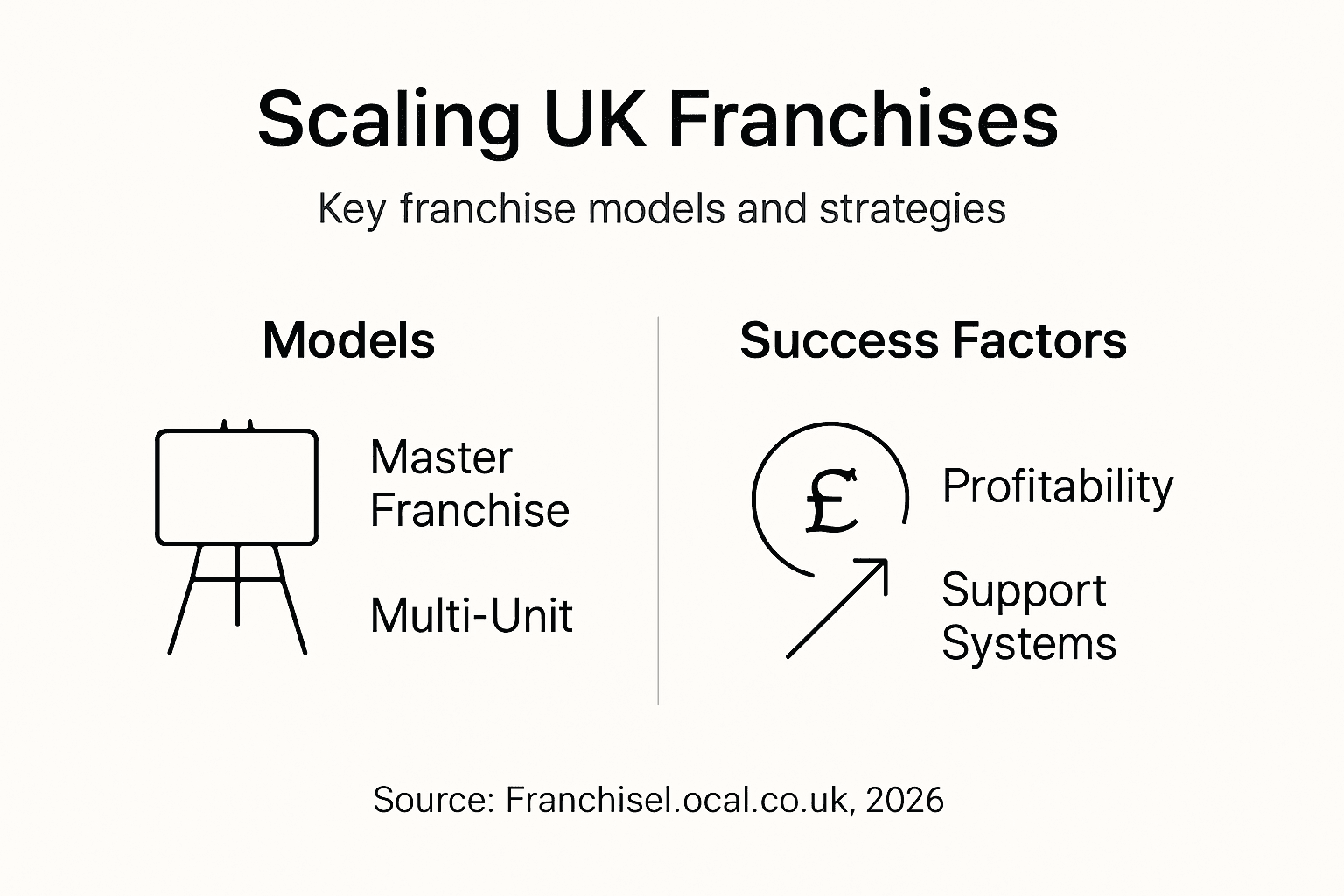
Master franchising accelerates territorial expansion by delegating regional growth to capable partners. Master franchising enables rapid, large-scale expansion by granting exclusive regional rights, leveraging local expertise and capital. This model suits UK franchisors eyeing Scotland, Wales, Northern Ireland, or even international markets without massive capital outlays.
Here’s how the structure works:
- You grant a master franchisee exclusive rights to develop your brand in a defined territory
- The master franchisee recruits, trains, and supports sub-franchisees in that region
- You receive upfront fees plus ongoing royalties from the master franchisee
- The master franchisee profits from sub-franchisee fees and royalties
- Both parties benefit from accelerated growth with shared risk
Local market knowledge becomes your competitive advantage. A master franchisee in Edinburgh understands Scottish consumer preferences, regulatory nuances, and recruitment channels far better than a London-based franchisor. This expertise increases sub-franchisee success rates and speeds market penetration.
Capital requirements drop significantly compared to company-owned expansion. The master franchisee funds regional infrastructure, marketing, and support systems. You focus resources on brand development and master franchisee oversight rather than managing dozens of individual locations.
Pro Tip: Vet master franchise candidates as rigorously as you’d screen a business partner, because that’s exactly what they become.
Critical success factors:
| Factor | Implementation |
|---|---|
| Legal Framework | Comprehensive master franchise agreement covering territory, duration, performance targets, and termination clauses |
| Partner Selection | Proven business experience, capital reserves, cultural fit with brand values, and expansion track record |
| Support Systems | Regular communication, shared technology platforms, marketing resources, and operational guidance |
| Quality Control | Mystery shopping, performance audits, sub-franchisee satisfaction surveys, and brand compliance monitoring |
| Financial Structure | Balanced fee model incentivising both recruitment and ongoing sub-franchisee success |
The master franchise model demands ongoing involvement despite delegating daily operations. You must maintain brand standards, approve marketing campaigns, and resolve disputes between master franchisees and sub-franchisees. Strong franchise support systems UK prevent quality erosion as your network expands.
This strategy works best when entering unfamiliar markets where local expertise justifies sharing profits. Learn more about master franchising benefits before committing to this growth path.
Deep Dive: Multi-Unit Franchise Development Strategy
Multi-unit development takes a different approach, empowering existing successful franchisees to open additional locations. Multi-unit franchisees typically open 3 to 5 units, increasing brand penetration with less risk than recruiting new franchisees. This strategy builds on proven relationships whilst accelerating market coverage.
The economics favour both parties. Multi-unit operators achieve economies of scale in purchasing, marketing, and administration. You benefit from faster expansion with franchisees who already understand your systems and culture. Recruitment costs drop when one conversation yields multiple locations instead of one.
Operational efficiency improves with concentration. A franchisee managing three locations in Birmingham can share staff during peak periods, consolidate purchasing, and amortise fixed costs across more revenue. This efficiency often translates to higher profitability per location compared to single-unit operations.
Key considerations include:
- Franchisee capability to manage multiple locations simultaneously
- Market density supporting three to five units without cannibalisation
- Operational systems scalable beyond single location management
- Financial capacity for staggered openings over two to three years
- Support infrastructure helping multi-unit operators succeed
Comparing development strategies:
| Aspect | Master Franchising | Multi-Unit Development |
|---|---|---|
| Best For | New territories, international expansion | Established markets, proven franchisees |
| Capital Source | Master franchisee funds growth | Individual franchisee investment |
| Speed | Very rapid regional coverage | Moderate, sequential openings |
| Control | Delegated to master franchisee | Direct franchisor relationship |
| Risk | Concentrated in master franchisee | Distributed across franchisees |
Multi-unit agreements typically grant development rights for specific territories with opening timelines. A franchisee might commit to three locations over 24 months, with performance milestones triggering additional territory releases. This structure balances growth speed with execution capability.
Pro Tip: Offer multi-unit incentives like reduced royalty rates or fee discounts for franchisees opening their third and subsequent locations.
The strategy requires robust franchise support systems UK because multi-unit operators need different resources than single-location owners. Management training, financial planning tools, and multi-location technology become essential. Discover multi-unit franchise development strategies tailored for UK markets.
Common Misconceptions About Franchise Scaling
Several myths derail franchise expansion efforts. Understanding these misconceptions prevents costly mistakes as you grow your network.
Myth one: A great concept guarantees scaling success. Reality differs sharply. Many assume rapid franchise growth can occur without strong franchisee support, but neglecting this leads to operational inconsistency and stalling. Your product might be excellent, but without systems, training, and ongoing assistance, franchisees struggle and your brand suffers.
Myth two: Faster expansion always beats methodical growth. Aggressive timelines appeal to ambitious entrepreneurs, yet rushing expansion without operational readiness creates chaos. Units open before support infrastructure exists, leading to inconsistent customer experiences and franchisee frustration. Sustainable growth respects your capacity to maintain standards.
Myth three: Master franchising means hands-off income. Some view master franchise fees as passive revenue requiring minimal involvement. Wrong. You must vet sub-franchisees, monitor brand compliance, resolve conflicts, and ensure the master franchisee delivers quality support. Delegation doesn’t equal abdication.
Myth four: Franchisee selection matters less than location count. Prioritising quantity over quality damages long-term viability. One problematic franchisee can trigger legal disputes, negative reviews, and brand damage outweighing ten successful locations. Rigorous screening protects your network.
Reality checks:
- Mature systems and processes matter more than growth speed
- Franchise support systems importance increases exponentially with network size
- Legal frameworks require ongoing refinement as markets evolve
- Technology investments scale better than manual processes
- Franchisee satisfaction predicts long-term profitability better than unit count
Pro Tip: Survey franchisees quarterly about support quality, profitability challenges, and improvement suggestions to catch issues before they escalate.
The strongest franchise networks balance growth ambition with operational excellence. Learn from franchise scaling misconceptions others have encountered to avoid repeating preventable mistakes.
Summary and Practical Next Steps for UK Entrepreneurs
Transforming franchise scaling knowledge into action requires systematic planning. Follow these steps to implement effective growth strategies:
- Assess franchise readiness by evaluating profitability consistency, system documentation quality, and franchisee satisfaction scores across existing locations before expanding
- Choose your scaling model based on target markets, capital availability, and control preferences, selecting master franchising for unfamiliar territories or multi-unit development for proven regions
- Develop legal frameworks including comprehensive franchise agreements, territory definitions, performance standards, and dispute resolution mechanisms with experienced franchise solicitors
- Build support infrastructure covering initial training, ongoing education, marketing resources, technology platforms, and field support before accelerating recruitment
- Recruit strategically using defined criteria prioritising business acumen, cultural alignment, and financial capacity over speed, thoroughly vetting each candidate
- Monitor unit economics tracking key performance indicators like average unit revenue, franchisee profitability, customer satisfaction, and operational compliance across your network
- Iterate based on feedback conducting regular franchisee surveys, performance reviews, and market analysis to refine systems and address emerging challenges
Your franchise readiness UK assessment determines timing. Rushing expansion before systems mature or profitability stabilises magnifies problems. Patience during preparation pays dividends during execution.
Invest heavily in franchisee support systems UK infrastructure before signing new agreements. Training facilities, technology platforms, field support teams, and marketing resources should scale ahead of franchisee count. This proactive approach prevents the reactive firefighting that plagues underprepared franchisors.
Regular communication maintains alignment as your network grows. Monthly newsletters, quarterly conferences, and annual conventions build community whilst disseminating best practices. Franchisees who feel supported and heard become brand ambassadors rather than critics.
Sustainability and innovation future-proof your franchise. Consumer expectations around environmental responsibility and ethical practices continue rising. Integrating these values into operations attracts quality franchisees and customers whilst differentiating your brand in crowded markets.
Explore Franchise Opportunities and Support at FranchiseLocal.co.uk
Implementing franchise scaling strategies becomes easier with expert resources and vetted opportunities. FranchiseLocal.co.uk provides comprehensive tools supporting UK entrepreneurs throughout their franchise journey. Access our ultimate franchising guide covering everything from initial concept validation to multi-location management.
Connect with experienced franchise service providers UK including solicitors, accountants, marketing agencies, and consultants specialising in franchise development. These professionals help navigate legal complexities, financial structuring, and operational challenges unique to franchise scaling.
Explore master franchise opportunities UK if regional development interests you, or browse multi-unit options matching your investment capacity and industry preferences. Our directory filters opportunities by sector, investment level, and growth potential, streamlining your search for the right expansion vehicle. Whether you’re franchising your existing business or acquiring franchise rights, FranchiseLocal.co.uk delivers the insights and connections driving successful growth.
Frequently Asked Questions About Franchise Scaling Strategies
What is the best scaling model for UK franchises?
No universal best model exists. Master franchising suits unfamiliar territories where local expertise justifies profit sharing, whilst multi-unit development works best in proven markets with capable existing franchisees. Your choice depends on target geography, capital availability, desired control levels, and growth timeline.
How do I assess if my franchise is ready to scale?
Evaluate three critical areas: consistent profitability across existing locations for at least 12 months, comprehensive documented systems covering all operations, and high franchisee satisfaction scores indicating strong support infrastructure. If any area shows weakness, strengthen it before expanding to prevent magnifying problems.
What legal protections are critical when scaling franchises?
Comprehensive franchise agreements defining territory rights, performance obligations, quality standards, termination conditions, and dispute resolution mechanisms form your foundation. Trademark registration, operations manual copyright, and intellectual property protections prevent unauthorised use. Consult franchise solicitors experienced in UK law to ensure compliance with disclosure requirements and franchise-specific regulations.
How important is franchisee support during expansion?
Critically important. Neglecting support infrastructure causes operational inconsistency, franchisee dissatisfaction, and eventual network stalling regardless of concept quality. Budget for training programmes, field support staff, technology platforms, and marketing resources scaling ahead of franchisee count. Strong support systems differentiate successful networks from failed experiments.
Can technology improve franchise scaling success?
Absolutely. Standardised point of sale systems, centralised inventory management, customer relationship platforms, and performance dashboards maintain consistency whilst providing visibility across locations. Cloud-based training platforms reduce costs whilst improving accessibility. Communication tools enable real-time problem solving. Technology investments that scale efficiently outperform manual processes as networks grow.
Should I prioritise growth speed or franchisee quality?
Prioritise quality consistently. One problematic franchisee damages your brand through poor customer experiences, legal disputes, and negative word of mouth outweighing benefits from ten successful locations. Rigorous screening, thorough training, and ongoing support create a foundation for sustainable growth. Speed without quality creates networks that collapse under their own dysfunction.