

Franchise lead forms are digital data collection tools that capture prospective franchisee details and trigger a structured qualification process from the moment you submit your enquiry. Understanding how franchise lead forms work is the first step to navigating the franchise inquiry process with confidence. Platforms like Wagbar, Franchise Intelligence Group, and Arahi AI have built entire qualification workflows around the data these forms collect. A well-designed lead form does not just gather your name and email. It feeds a scoring engine that determines whether you speak to a sales representative within hours or enter a longer nurturing sequence.
How franchise lead forms work: from submission to first contact
Submitting a franchise lead form starts a structured qualification process, including a callback within 24–48 hours and a 15–30 minute qualifying phone call. That timeline is not arbitrary. Franchisors use it to contact you while your interest is still fresh and your answers are still consistent with what you submitted.
The sequence after submission typically follows these steps:
- Automated acknowledgement. You receive an email or SMS confirming receipt of your enquiry, often within minutes of submitting.
- Scheduling link sent. A booking link arrives so you can select a convenient time for a discovery call, removing friction from the process.
- Initial qualifying call. A franchisor representative speaks with you for 15–30 minutes. This call has a dual purpose: it qualifies your readiness and briefs you on the franchise model.
- Franchise Qualification Form. After the call, franchisors often send a longer secondary form. This detailed qualification form collects employment history, financial references, and deeper intent signals.
- CRM routing. Your profile is assigned a status: hot, warm, or cold. Hot leads move directly to sales conversations. Warm and cold leads enter nurturing sequences.
Pro Tip: Treat the initial qualifying call as a two-way interview. You are assessing the franchisor just as much as they are assessing you. Prepare specific questions about territory exclusivity, training support, and ongoing fees before the call.
Franchise lead qualification assesses operational intent, territory fit, and financial capacity before moving a prospect into sales conversations. This means the form you submit is not just an enquiry. It is the first filter in a structured sales funnel. Franchisors use the data to prioritise their sales effort and avoid spending time on prospects who are not financially or operationally ready.
Manual screening vs automated qualification: which is faster?
Manual qualification has one significant weakness: speed. A sales representative reviewing form submissions one by one introduces delays that cool leads before contact is even made. By the time a rep picks up the phone, a prospect may have already submitted forms to three other franchise brands.

| Factor | Manual screening | Automated qualification |
|---|---|---|
| Response time | Hours to days | Within minutes |
| Lead scoring | Subjective, rep-dependent | Consistent, criteria-based |
| Hot lead routing | Delayed by review queue | Instant alert to sales rep |
| Nurture sequences | Manual follow-up required | Triggered automatically |
| Consistency | Variable across team | Uniform across all leads |
Automated qualification improves response time and lead conversion by assigning hot, warm, or cold status based on form data, vastly improving efficiency over manual reviews. The practical implication is clear: a prospect who scores as a hot lead receives a scheduling link within minutes rather than waiting for a human to review their submission.
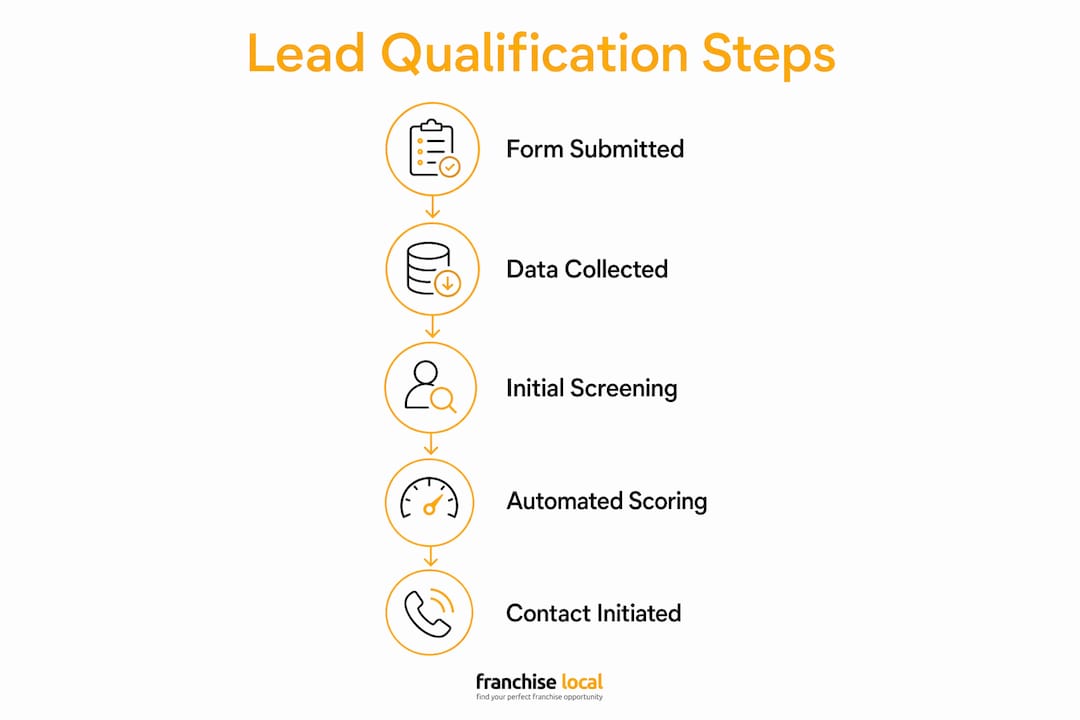
Automated systems used by platforms like Arahi AI and Franchise Intelligence Group apply scoring criteria directly to the data fields you complete. Investment readiness, planned start date, and target territory each carry a weighted score. The system totals these scores and routes your profile accordingly.
Key components of an automated scoring workflow include:
- Investment readiness score. Based on liquid capital declared and investment range selected.
- Timeline score. Prospects planning to launch within three to six months score higher than those with no defined timeline.
- Territory alignment. Your postcode or region is checked against available territories in real time.
- Lead origin tracking. Where you found the listing, whether through a directory, paid search, or referral, influences initial scoring.
Franchise sales automation workflows typically send immediate email and SMS acknowledgements plus scheduling links within minutes after form submission. Speed to next step significantly impacts conversion rates. Automated scheduling links sent within minutes reduce friction and keep leads engaged before interest fades.
What data fields form the backbone of a franchise lead form?
Lead forms capture structured input like finances, intent, and geography to score leads and trigger routing into hot, warm, or cold engagement tracks. Every field on a franchise lead form exists for a reason. Removing or skipping fields weakens the scoring model and reduces the accuracy of your routing.
Financial information fields
Financial fields are the most heavily weighted in any qualification model. Typical fields include:
- Liquid capital available. This is cash you can access without selling assets. Most franchise lead forms ask you to select a range, such as under £10,000, £10,000 to £50,000, or over £50,000.
- Total investment budget. Separate from liquid capital, this covers the full amount you are prepared to commit including borrowing.
- Funding source. Whether you plan to self-fund, use a business loan, or seek investor backing affects your qualification score.
For prospects considering borrowing, reviewing a small business funding checklist before completing a lead form helps you answer financial questions accurately and confidently.
Intent and timeline fields
Intent fields reveal how serious you are and how soon you plan to act. Franchisors weight these heavily because a prospect planning to launch within six months requires very different handling from someone browsing with no fixed timeline.
- Planned start date or launch window
- Full-time or part-time operation preference
- Prior business ownership experience
- Reason for enquiring now
Geographic and territory fields
Territory data tells franchisors whether your preferred location is available and whether it aligns with their expansion plans. Consistent, specific answers about timeline and geography improve positive routing and reduce mismatch rejections during calls. Vague answers like “anywhere in the UK” often score lower than a specific postcode or region because they signal unclear intent.
Understanding how to select franchise territories before completing a lead form gives you a sharper answer to geographic questions and improves your qualification score from the outset.
Pro Tip: Fill in every field on a franchise lead form, even optional ones. Incomplete forms often trigger lower scores in automated systems, pushing you into a cold nurture track rather than a direct sales conversation.
Structured lead intake forms that align closely with ideal franchisee profiles enable more accurate AI scoring and better resource allocation across sales teams. This means your honesty and specificity directly affect the quality of the response you receive.
How do compliance rules affect the franchise sales timeline?
The FTC Franchise Rule requires franchisors to provide the Franchise Disclosure Document at least 14 calendar days before any agreement signing or payment acceptance. This rule applies in the United States and shapes how franchise sales processes are structured globally, including how UK franchisors model their own disclosure timelines.
The 14-day period is calculated on calendar days, including weekends. No payment can be accepted and no agreement can be signed during this window. The rule exists to give prospective franchisees adequate time to review the disclosure document with a solicitor or financial adviser before committing.
Common misconceptions about this period include:
- “Signing quickly shows commitment.” Signing before the 14-day period ends is legally prohibited in jurisdictions where the FTC rule applies. It is not a sign of enthusiasm. It is a compliance breach.
- “The waiting period is just a formality.” The 14-day window is the most valuable due diligence period in the entire process. Use it to review financials, speak to existing franchisees, and consult a solicitor.
- “Franchisors can waive the waiting period.” They cannot. Any franchisor who pressures you to sign early or suggests the waiting period can be shortened is displaying a significant red flag.
High-pressure attempts to shorten or void the 14-day FDD waiting rule are red flags. The period should be treated as a critical due diligence phase, not an obstacle.
The 14-day waiting period after FDD delivery is not a delay in your franchise journey. It is a legal protection designed to ensure you make an informed decision. Any franchisor who treats it as an inconvenience is telling you something important about how they operate.
For UK prospects, the British Franchise Association sets its own code of conduct around disclosure timelines. While the specific 14-day FTC rule is a US regulation, UK franchise agreements increasingly mirror this structure. Treat any disclosure period as your window to conduct thorough research, not as a pause in momentum.
Practical steps to use the disclosure period effectively:
- Instruct a solicitor with franchise experience to review the agreement
- Contact at least three existing franchisees in the network and ask direct questions about support and profitability
- Review the franchisor’s audited accounts for the past two to three years
- Cross-reference the territory data in the disclosure document against your own market research
What I have learned about franchise lead forms after years in this space
The biggest mistake prospective franchisees make is treating a lead form like a casual enquiry. They fill in rough figures, select vague timelines, and choose broad geographic preferences. Then they wonder why the franchisor’s follow-up feels generic or why they end up in a slow nurture sequence rather than a direct conversation.
Qualification is best viewed as a pre-call filtering system based on form data and AI scoring rather than a post-contact judgment call. That insight changes everything. The form is not a preamble to the real process. The form is the process. Your answers determine the quality of the response you receive before a human ever reads your name.
I have also seen the opposite problem on the franchisor side. Brands that rely entirely on automation without any human follow-up lose good prospects who simply want a conversation before committing to a discovery call. The best franchise sales processes combine automated speed with a personal phone call that feels genuine rather than scripted. Automation handles the routing. A real person closes the relationship.
The compliance piece matters more than most prospects realise. Rushing through the FDD review period because you are excited about a brand is one of the most common and costly mistakes in franchise buying. That 14-day window is your best opportunity to find problems before they become your problems. Use it fully.
For franchisors, the lesson is equally clear. A lead form that collects too little data produces weak scoring. A form that asks too much deters completion. The sweet spot is a form that captures financial range, timeline, territory preference, and intent in under five minutes. Pair that with proven lead generation strategies and your conversion rate improves at every stage of the funnel.
— Will
Franchiselocal: find your next franchise opportunity in the UK
Franchiselocal connects prospective franchisees with hundreds of UK-based franchise opportunities across industries, investment levels, and locations. Whether you are researching networking franchises, loans franchises, driving franchises, or telecommunications franchises, the platform makes it straightforward to filter by budget, lifestyle, and region. Each listing includes direct enquiry forms so you can apply what you have learned here and submit well-prepared, accurate responses. Franchiselocal also provides guidance resources to support you at every stage of the discovery process, from initial research through to signing day.
FAQ
What is a franchise lead form?
A franchise lead form is a digital enquiry form that collects structured information from prospective franchisees, including financial capacity, territory preference, and intended start date, to trigger a qualification and routing process.
How quickly do franchisors respond after you submit a lead form?
Most franchisors aim to make contact within 24–48 hours of form submission. Automated systems can send acknowledgement emails and scheduling links within minutes of receipt.
What information should you have ready before filling in a franchise lead form?
Prepare your available liquid capital, total investment budget, preferred territory or postcode, and a realistic launch timeline. Specific, consistent answers improve your qualification score and increase the likelihood of a direct sales conversation.
What happens if your lead form answers do not match what you say on the call?
Discrepancies between form answers and call responses commonly cause leads to be marked as unqualified. Franchisors treat consistency as a signal of seriousness and reliability.
Is the 14-day FDD waiting period relevant to UK franchise buyers?
The 14-day rule is a US FTC regulation, but UK franchise agreements increasingly reflect similar disclosure timelines. UK prospects should treat any disclosure period as a legal and practical due diligence window and use it to review documents with a qualified solicitor.