

Nearly one in five British entrepreneurs now explore franchising as their route to business ownership. For anyone aiming to stand out in the competitive British market, a strong franchise business plan is the foundation for both securing investment and ongoing success. This guide uncovers step-by-step strategies, expert research tips, and actionable insights tailored for British franchise seekers who want to build confidence from the very first stage.
Step 1: Research franchise opportunities and requirements
Researching franchise opportunities is your crucial first step towards building a successful UK business. This process involves understanding the landscape of available franchises, evaluating potential markets, and determining the legal and financial requirements specific to the United Kingdom.
Start by exploring the comprehensive franchise landscape through government resources. With 5.5 million small and medium enterprises representing 99.8% of the UK business population, you have numerous potential pathways. Consider multiple research channels: industry websites, franchise directories, government publications, and professional networking platforms. Key areas to investigate include sector diversity, investment requirements, operational models, and territorial opportunities.

Your research should methodically cover several critical dimensions. First, analyse sector performance and growth potential across different franchise categories. Look into industries like retail, food service, professional services, and home-based businesses. Examine franchise disclosure documents carefully, paying attention to initial investment costs, ongoing fees, training support, and territorial rights. Contact existing franchisees to gain insider perspectives on operational realities. Financial institutions and innovation support agencies can provide additional guidance on funding and eligibility criteria.
Expert Recommendation: Allocate at least 4-6 weeks for thorough franchise opportunity research, ensuring you comprehensively understand each potential investment before making a commitment.
Here is a summary of franchise sector opportunities and their distinctive potential in the UK:
| Franchise Sector | Typical Investment Range | Growth Outlook | Unique Advantage |
|---|---|---|---|
| Retail | £20,000–£250,000 | Steady | High street brand visibility |
| Food Service | £15,000–£300,000 | Growing | Robust consumer demand |
| Professional Services | £10,000–£150,000 | Moderate | Flexible business models |
| Home-based | £5,000–£50,000 | Expanding | Lower operating costs |
Step 2: Define your business model and target market
Defining your business model and target market is a critical step in transforming your franchise concept into a viable UK enterprise. This process requires strategic thinking, market research, and a deep understanding of your potential customers and operational framework.
Start by examining the comprehensive SME landscape to understand the nuanced composition of UK businesses. Analyse micro-enterprises and medium-sized businesses within your chosen sector to identify unique market opportunities. Your business model should articulate how you will generate revenue, deliver value, and differentiate yourself from competitors. Consider factors like service offerings, pricing strategies, operational costs, and potential revenue streams specific to your franchise category.
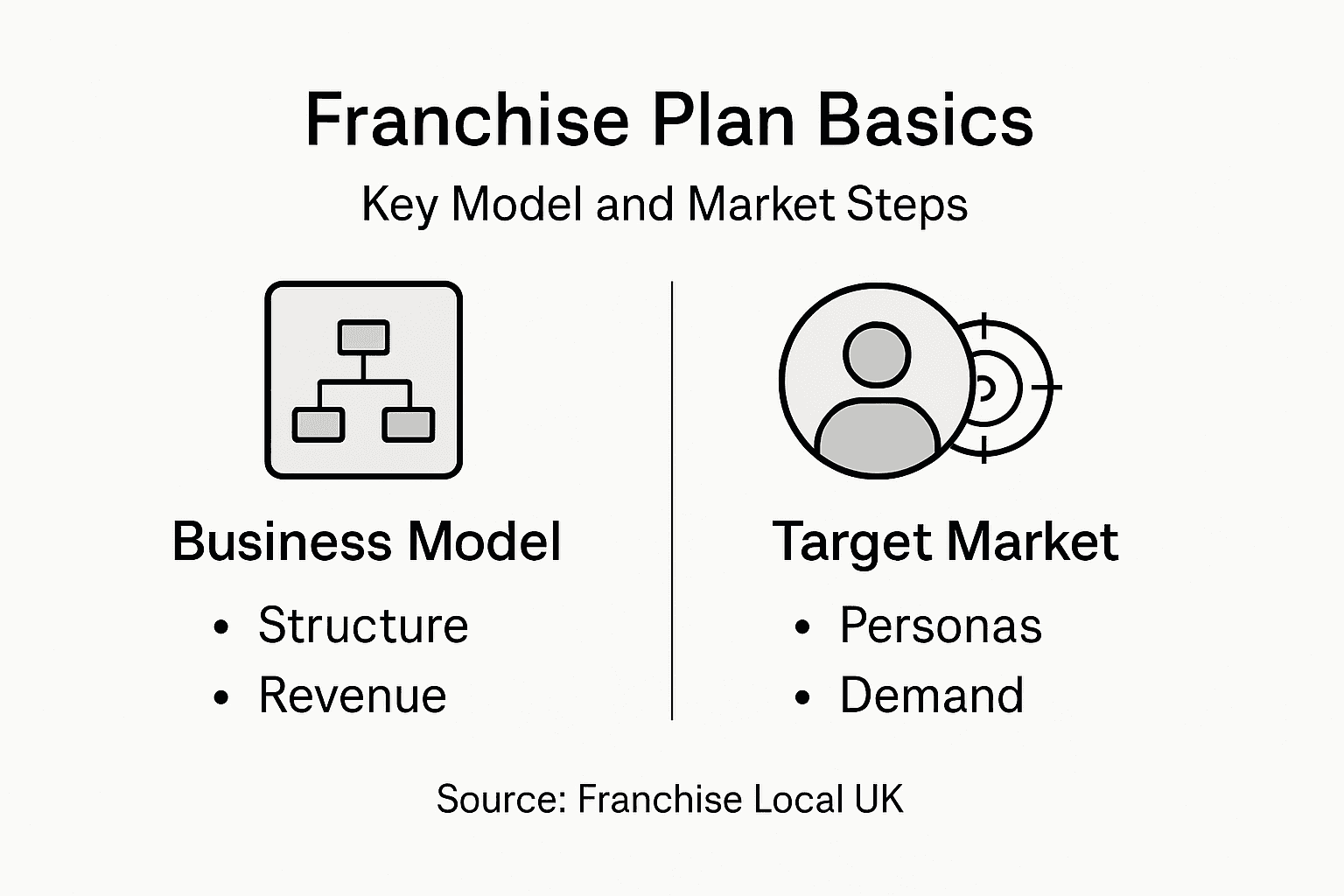
Your target market definition requires meticulous research and strategic alignment. Develop detailed customer personas that capture demographic, psychographic, and behavioural characteristics. Look beyond traditional segmentation by incorporating principles of purposeful business which emphasise societal and environmental considerations. Modern UK consumers increasingly value businesses that demonstrate corporate responsibility and authenticity. Map your target audience’s needs, preferences, pain points, and expectations to create a compelling value proposition that resonates with their aspirations.
Expert Recommendation: Conduct at least 20-30 targeted interviews or surveys with potential customers to validate your business model and refine your market understanding.
Step 3: Outline operations, staffing and processes
Creating a robust operational framework is fundamental to your franchise’s success, requiring meticulous planning of organisational structure, workflow processes, and strategic staffing approaches. This critical phase transforms your business concept into a practical, executable model that can consistently deliver value to customers.
Begin by examining the statutory franchising guidance to understand the procedural requirements specific to UK business operations. Map out your entire operational workflow, identifying key processes, potential bottlenecks, and efficiency opportunities. Consider developing detailed standard operating procedures that outline step-by-step guidelines for each critical business function. Your operational blueprint should include recruitment strategies, training protocols, quality control mechanisms, customer service standards, and performance measurement criteria.
Staffing represents a crucial dimension of your operational planning. Develop a comprehensive workforce strategy that aligns with your business model and growth projections. Look beyond traditional recruitment by exploring advanced operations management principles that emphasise skill development, team dynamics, and continuous improvement. Consider factors such as workforce flexibility, skills matching, career progression pathways, and cultural fit. Create detailed job descriptions, establish clear performance expectations, and design compensation structures that motivate and retain top talent.
Expert Recommendation: Invest time in creating comprehensive operational documentation that can be easily replicated and scaled as your franchise grows.
Step 4: Develop financial projections and funding strategy
Developing a comprehensive financial strategy is the backbone of your franchise venture, requiring careful planning, realistic projections, and a nuanced understanding of your financial landscape. This crucial step transforms your business concept into a financially viable and sustainable enterprise.
Begin by constructing detailed financial models that capture every potential revenue stream and expense category. Your projections should encompass startup costs, operational expenses, expected revenue, cash flow forecasts, and potential investment requirements. Reference the government spending accountability frameworks to ensure your financial planning aligns with UK regulatory expectations. Create multiple scenario models including conservative, moderate, and optimistic projections to demonstrate your understanding of potential financial variations.
Your funding strategy must be comprehensive and multi-dimensional. Explore diverse financing options including traditional bank loans, franchise-specific lending programmes, government grants, angel investors, and private equity. Consider developing a detailed investment pitch deck that clearly articulates your financial projections, market opportunity, competitive advantages, and potential return on investment. Prepare comprehensive financial documentation including three-year profit and loss statements, balance sheets, cash flow projections, break-even analysis, and detailed assumptions underpinning your financial models. Demonstrate financial acumen by showing clear pathways to profitability and robust risk management strategies.
Expert Recommendation: Work with a certified accountant specialising in franchise businesses to validate your financial projections and refine your funding approach.
For reference, here are key financial modelling scenarios and what they reveal about franchise viability:
| Scenario | Revenue Assumption | Main Risk Factor | Key Planning Benefit |
|---|---|---|---|
| Conservative | Slow, steady growth | Market saturation | Ensures prudent budgeting |
| Moderate | Gradual market adoption | Variable costs | Balances ambition and caution |
| Optimistic | Rapid expansion | Competition response | Highlights long-term potential |
Step 5: Validate your business plan for investment readiness
Validating your business plan is a critical process that transforms your franchise concept from a promising idea into an investment-worthy opportunity. This stage requires rigorous scrutiny, strategic refinement, and comprehensive preparation to demonstrate your venture’s potential to prospective investors.
Start by thoroughly reviewing the comprehensive business plan guidelines to ensure your document meets professional standards. Critically evaluate every section of your plan through an investor’s perspective. Assess the clarity of your value proposition, market analysis depth, competitive landscape understanding, financial projections, and risk mitigation strategies. Your goal is to create a document that not only illustrates your business potential but also demonstrates your strategic thinking and commercial awareness.
Develop a robust validation framework that systematically tests your business assumptions. Conduct detailed scenario analyses exploring best case, worst case, and most likely outcomes. Seek feedback from industry experts, potential franchisees, and financial advisors who can provide objective insights into your business model. Leverage business readiness assessment tools to identify potential weaknesses and refine your strategy. Prepare comprehensive documentation that showcases your understanding of market dynamics, operational capabilities, financial projections, and growth potential. Anticipate and proactively address potential investor questions by developing clear, concise responses that demonstrate your preparedness and commercial acumen.
Expert Recommendation: Engage an independent business consultant to conduct a comprehensive review of your business plan before presenting it to potential investors.
Frequently Asked Questions
What are the initial steps for creating a franchise business plan in the UK?
To start creating a franchise business plan in the UK, conduct thorough research on franchise opportunities and legal requirements. Gather information about different franchise sectors and potential investment needs, as well as analysis of market trends for at least four to six weeks to solidify your understanding.
How can I define my target market for a franchise business?
Defining your target market involves detailed research to create customer personas that highlight demographics, preferences, and behaviours. Conduct 20 to 30 interviews or surveys with potential customers to refine your understanding of their needs and validate your business model.
What should I include in the operational framework of my franchise?
Your operational framework should detail key processes, staffing strategies, and standard operating procedures that align with your business model. Map out workflows and develop comprehensive documentation to ensure consistency and scalability within the first few months of planning.
How do I develop financial projections for my franchise business?
Developing financial projections requires creating detailed models that outline all potential revenues, expenses, and cash flow scenarios. Reference three-year forecasts and multiple scenarios to ensure robust financial planning and to anticipate varying financial outcomes.
What is the best approach to validate my franchise business plan?
To validate your franchise business plan, review it from an investor’s perspective, assessing every segment for clarity and viability. Engage with industry experts for feedback and conduct scenario analyses to bolster your business model before presenting it to potential investors.
Why is it important to create comprehensive operational documentation for my franchise?
Creating comprehensive operational documentation is crucial as it guides staff practices and ensures consistency in service delivery. Invest time in this documentation to make your franchise easily replicable and scalable, especially useful as your business grows.