

A franchise portal is a centralised digital platform that consolidates franchise business listings, enabling entrepreneurs to discover, filter, and evaluate opportunities in one place. The term “franchise portal” is widely used in everyday conversation, though the industry also refers to these platforms as franchise directories or franchise listing sites. Platforms such as FranchiseDirect, BizBuySell, and FranchiseGator are established examples, each allowing users to search by sector, investment level, and geography. Understanding what a franchise portal does, and what it cannot do, is the first step to using one well.
What is a franchise portal and how does it work?
A franchise portal is a searchable online database of franchise opportunities, structured to help prospective franchisees move from initial curiosity to shortlisted candidates. The core function is aggregation: hundreds or thousands of franchise listings sit in one place, each with a profile covering investment requirements, sector, territory availability, and contact details.

Most portals offer layered filtering. You can narrow results by industry (food and beverage, cleaning, education), by investment band (under £10,000, £10,000–£50,000, £50,000 and above), and by location. This filtering is the portal’s primary value at the discovery stage. Without it, comparing franchise opportunities across sectors would require visiting dozens of individual websites.
The two types of franchise portal
The industry distinguishes two fundamentally different types of portal, and confusing them is a common mistake.
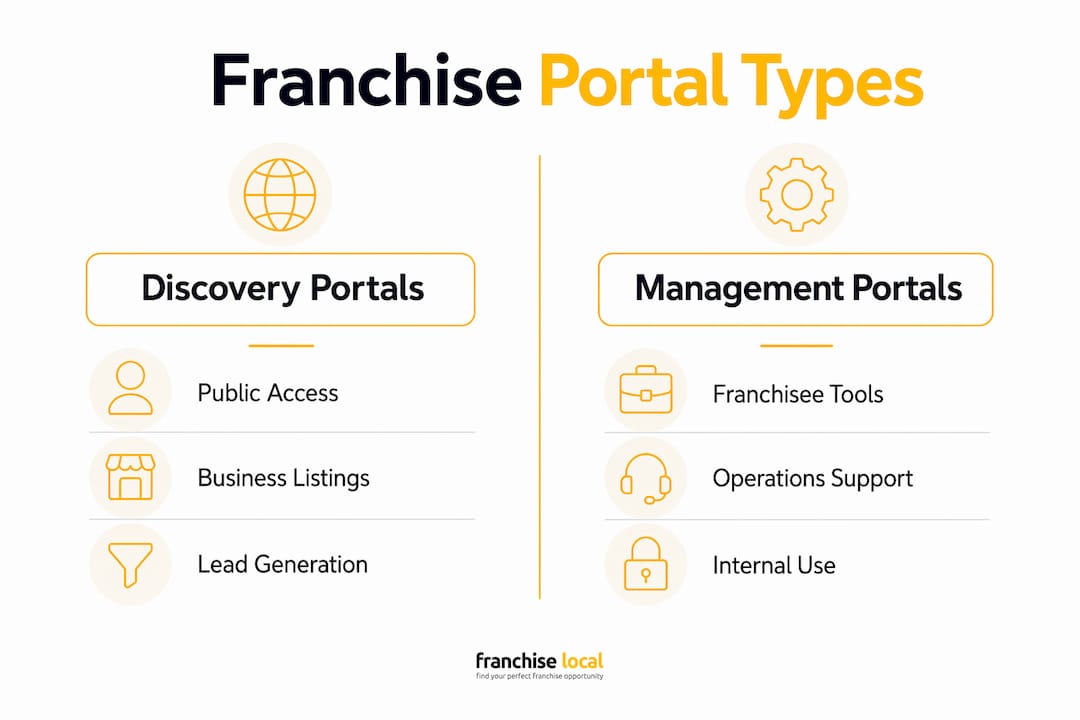
Discovery portals serve prospective franchisees. They are public-facing directories where entrepreneurs browse listings, submit enquiries, and receive information packs from franchisors. FranchiseDirect and Franchiselocal are examples of this type.
Franchise management portals serve existing franchisees and franchisors. According to research, franchise management portals act as the operational backbone linking headquarters with store-level execution, covering workflows, compliance tracking, and performance dashboards. These are internal tools, not publicly accessible directories.
This article focuses on discovery portals, which are the type most relevant to entrepreneurs evaluating franchise opportunities.
Key features found on discovery portals
- Search and filter tools: Filter by sector, investment level, lifestyle preference (home-based, part-time), and UK region
- Franchise profiles: Each listing includes a brand overview, investment range, support offered, and contact options
- Enquiry and lead forms: Prospective franchisees submit interest directly through the portal; the franchisor receives the lead
- Franchise Disclosure Document (FDD) guidance: Some portals signpost where to request the FDD, which contains 23 mandated disclosure items required by law under 16 CFR Part 436
- Editorial content: Guides, sector spotlights, and FAQs that help users understand what they are evaluating
- Saved searches and alerts: Notify users when new listings match their criteria
The lead generation process works in both directions. Entrepreneurs find franchisors through the portal. Franchisors, in turn, pay for featured listings or lead packages to reach qualified prospects. This commercial model shapes how portals present information, which is worth keeping in mind as you browse.
What are the benefits and limitations of franchise portals?
Franchise portals deliver clear advantages at the top of the discovery funnel. They also carry limitations that catch many first-time franchise buyers off guard.
Benefits at a glance
The primary benefit is breadth. A single portal session can expose you to 50 or more franchise opportunities across multiple sectors, all filterable by your budget and location. Franchise portals account for 37% of digital deals for franchises overall. That figure confirms portals are not a marginal channel; they are a primary route through which franchise transactions begin.
Portal profiles also provide a useful first-pass credibility check. A well-maintained listing signals that a franchisor is actively recruiting and investing in its brand presentation. Conversely, incomplete or outdated portal profiles can disqualify a brand before a candidate ever visits the corporate website. For entrepreneurs, this means a polished profile is a positive signal worth noting, though not a guarantee of quality.
Limitations to understand before you rely on them
| Factor | Strength | Limitation |
|---|---|---|
| Volume of listings | High: hundreds of opportunities in one place | Can overwhelm without a clear filtering strategy |
| Lead quality | Broad reach for franchisors | Portal leads have low conversion rates due to top-of-funnel intent |
| Information depth | Good for initial overview | Insufficient for final investment decisions |
| Profile accuracy | Reflects active franchisors | Outdated profiles mislead candidates |
| Cost to franchisors | Scalable advertising | Premium placements skew visibility |
The low conversion rate issue deserves direct attention. Portal users typically contact multiple brands simultaneously, which means your enquiry sits alongside dozens of others in a franchisor’s inbox. This is not a flaw in the portal itself. It reflects where you are in the process: exploring, not committing. The mistake is treating a portal enquiry as thorough research rather than a starting point.
Pro Tip: When you submit an enquiry through a portal, note the response time and quality of the follow-up. A franchisor who replies within 24 hours with tailored information is demonstrating the support culture you can expect as a franchisee.
Portals also lack the depth needed for final evaluation. Portals should be viewed as search engines valuable for breadth and initial filtering, but insufficient for final investment decisions that require direct franchisor engagement. This is the single most important limitation to internalise before you begin your search.
How do franchise portals compare to other discovery methods?
Franchise portals are one channel among several. Each method has a distinct role, and the most effective franchise searches use more than one.
Franchise brokers
Franchise brokers (also called franchise consultants) work with prospective franchisees to match them with suitable opportunities from a curated portfolio. Brokers provide higher quality leads at lower volume compared to portals, offering exclusivity and pre-qualified matches. The trade-off is that brokers represent a subset of available franchises, typically those paying referral fees. You will not see the full market through a broker alone.
For a detailed comparison of how brokers operate versus portal discovery, the broker model explained by Franchise Fast Track is worth reviewing alongside your portal research.
Direct franchisor websites
Visiting a franchisor’s own website after finding them on a portal gives you unfiltered information: territory maps, franchisee testimonials, financial performance representations, and recruitment criteria. Direct sites often contain detail that portal profiles summarise or omit. Cross-referencing portal information against the corporate site is a non-negotiable step in due diligence.
Social media and community networks
LinkedIn, Facebook groups, and franchisee forums provide peer-level intelligence that no portal can replicate. Existing franchisees share unfiltered experiences, and franchisors use social channels to demonstrate culture and activity. These sources complement portal research rather than replace it.
AI assistants and search engines
Prospective franchisees increasingly use tools like ChatGPT or Perplexity to ask broad questions about franchise sectors before visiting a portal. These tools are useful for framing your thinking but do not provide live listings or verified financial data.
How the methods stack up
- Portals: Best for breadth, initial filtering, and discovering brands you did not know existed
- Brokers: Best for personalised matching and pre-qualified shortlists, particularly if you are unsure which sector suits you
- Direct franchisor sites: Best for depth, accuracy, and formal application processes
- Social and peer networks: Best for candid franchisee feedback and cultural signals
- AI and search engines: Best for sector education and framing initial questions
The distinction between discovery portals and franchise management portals also matters here. If you are already a franchisee, your franchisor’s internal management portal is where operational support, training materials, and compliance tools live. That is a separate system entirely from the directory you used to find the opportunity.
How to use a franchise portal effectively when evaluating opportunities
Using a franchise portal well requires a structured approach. Browsing without a framework produces a long list of vaguely interesting options and no clear next step.
A practical evaluation process
-
Define your criteria before you open the portal. Decide on your maximum investment, preferred sector, geographic area, and lifestyle requirements (full-time, part-time, home-based). Portals like Franchiselocal allow filtering by all of these simultaneously. Entering without criteria leads to decision fatigue.
-
Filter aggressively, then expand. Start with your tightest filters and review the results. If fewer than ten opportunities appear, widen one variable at a time. This prevents you from being overwhelmed by volume while still exposing you to the full range.
-
Assess the portal profile critically. Look for investment transparency, territory clarity, and evidence of franchisor support. A profile that avoids stating investment ranges or support structures is a signal to investigate further before enquiring.
-
Submit targeted enquiries, not blanket ones. Contact three to five franchises that genuinely match your criteria. A focused enquiry receives a better response than a generic one, and it keeps your shortlist manageable.
-
Request the Franchise Disclosure Document promptly. The FDD must be provided at least 14 days before signing agreements. Use this document to verify the claims made in the portal profile. The FDD’s 23 disclosure items cover litigation history, financial performance, franchisee obligations, and renewal terms.
-
Cross-check portal information against the franchisor’s website. Consistency across discovery touchpoints builds trust; discrepancies erode credibility. If the portal profile and the corporate site tell different stories about investment levels or territory availability, ask the franchisor directly for clarification.
-
Speak to existing franchisees. Ask the franchisor for a list of current franchisees and contact them independently. Questions about day-to-day support, marketing assistance, and whether they would invest again are more revealing than any portal profile.
Pro Tip: Use the franchise comparison process to score each shortlisted franchise against the same criteria. Comparing five opportunities on a consistent framework produces far clearer decisions than relying on gut feel after separate conversations.
Pitfalls to avoid
Relying solely on portal information is the most common error. Portals are the starting point, not the finish line. A second pitfall is ignoring portal profile quality when assessing franchisors. If a brand cannot maintain an accurate, complete listing on a public directory, that reflects on its operational standards. A third pitfall is submitting too many enquiries at once. Managing ten simultaneous conversations with franchisors is difficult and dilutes the quality of your due diligence on each.
For a structured approach to reviewing the agreements that follow your portal research, the guide on evaluating franchise agreements provides a clear framework for what to look for before you sign.
Why portals are misunderstood, and how to use them properly
Working with franchise entrepreneurs over many years, I have seen the same misunderstanding repeat itself. Someone discovers a portal, spends an afternoon browsing, submits five enquiries, and then describes themselves as having “done their research.” They have not. They have completed the first five minutes of a process that takes weeks.
Portals are genuinely powerful tools. The fact that 37% of digital franchise deals originate through them is not a coincidence. They create discovery at scale, and for entrepreneurs who do not have a broker or an existing network in franchising, they are often the most practical entry point. But the mistake is treating discovery as due diligence.
The other issue I see is that entrepreneurs underestimate how much the portal profile shapes their first impression of a brand. A franchisor with a thin, outdated listing is telling you something about how they manage their business. I would not dismiss a brand on that basis alone, but I would factor it in. The best franchisors treat their portal presence as seriously as their own website.
My honest advice: use portals to build your initial longlist, then leave them behind. The real evaluation happens in direct conversations, FDD reviews, and calls with existing franchisees. Portals get you to the door. You have to walk through it yourself.
— Will
Start your franchise search with Franchiselocal
Franchiselocal is the UK’s dedicated franchise directory, listing opportunities across every major sector and investment level. Whether you are looking for a home-based business under £10,000 or a full-time commercial venture, the platform filters by industry, budget, and location so your search starts with relevant results rather than noise. Browse UK franchise opportunities across sectors including business services, networking, and B2B, or explore curated categories like networking franchises for relationship-driven business models. Franchiselocal also provides guides, evaluation resources, and expert advice to support every stage of your decision, from first browse to final agreement.
FAQ
What is a franchise portal in simple terms?
A franchise portal is an online directory where prospective franchisees can search, filter, and enquire about franchise business opportunities. It consolidates listings from multiple franchisors in one searchable platform.
What is the difference between a discovery portal and a franchise management portal?
A discovery portal is a public directory used to find and evaluate franchise opportunities. A franchise management portal is an internal operational system used by franchisors and existing franchisees for compliance, training, and brand management.
Are franchise portals reliable for making investment decisions?
Portals are reliable for initial discovery and shortlisting, but insufficient for final investment decisions without direct franchisor engagement, FDD review, and franchisee interviews.
How do franchise portals generate leads for franchisors?
Franchisors pay for listings or featured placements on portals. When a prospective franchisee submits an enquiry, the franchisor receives the lead directly. Portal leads tend to be high in volume but require nurturing to convert.
What should i do after finding a franchise on a portal?
Request the Franchise Disclosure Document, cross-check portal information against the franchisor’s own website, and speak directly to existing franchisees. The portal enquiry is the start of due diligence, not the end of it.