

Reviewing franchise finance is the process of assessing the financial viability of a franchise opportunity before committing capital, using key documents such as the Franchise Disclosure Document (FDD), audited franchisor accounts, and unit-level profit and loss statements. The FDD contains critical financial sections including Item 19 (financial performance representations), Item 21 (audited franchisor financial statements), and Items 5 through 7 (fees and initial investment estimates). Skipping this review is the single most common reason new franchisees face cash shortfalls within their first two years. Understanding franchise financial health before you sign protects your investment, aligns your expectations with reality, and gives lenders the confidence they need to fund you.
Why review franchise finance: the FDD financial sections explained
The Franchise Disclosure Document is the legal foundation of any franchise purchase in the United States and a widely referenced model for due diligence globally. Its financial sections tell you what you will pay, what you might earn, and whether the franchisor itself is financially sound.
The key items to analyse are:
- Item 5 covers the initial franchise fee, which is a one-off payment to the franchisor for the right to operate under their brand.
- Item 6 lists all ongoing fees, including royalties, marketing levies, and technology charges. These recur for the life of your agreement and directly reduce your net income.
- Item 7 provides an estimated initial investment range, covering build-out, equipment, working capital, and pre-opening costs. This is the figure lenders use as the baseline for your total project cost.
- Item 19 is the financial performance representation. Franchisors are not legally required to provide it, but roughly 65% do. Where it exists, it typically shows average or median unit revenues. Revenue alone does not reveal profitability.
- Item 21 contains the franchisor’s audited financial statements. These show balance sheet strength, cash flow, and revenue composition. Red flags include going concern notes, negative equity, and declining revenues.
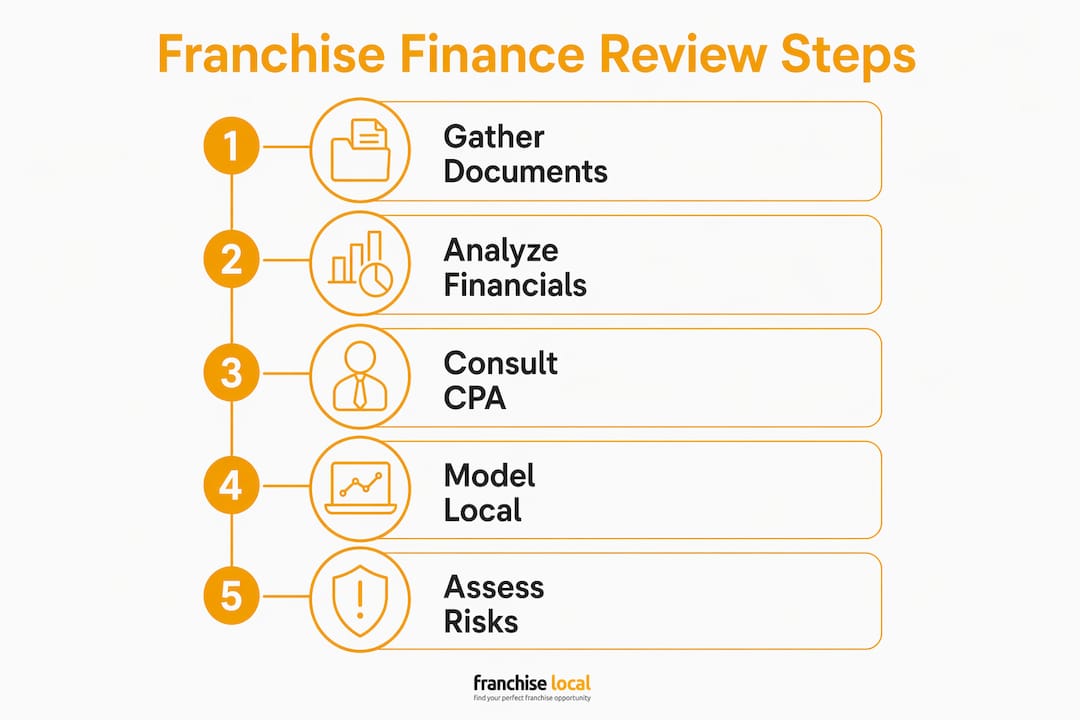
A professional FDD financial review by a qualified CPA costs between £500 and £2,500 depending on depth. A standard Item 21 review sits at the lower end; a full market-adjusted pro forma with entity structuring advice reaches the upper end. That fee is modest relative to a franchise investment that may run into hundreds of thousands of pounds.
Pro Tip: Hire both a franchise CPA and a franchise solicitor before you sign. Franchise attorneys and CPAs provide non-overlapping perspectives: one assesses legal contract risk, the other assesses financial viability. Relying on only one professional leaves critical gaps.

How do lenders evaluate franchise finance applications?
Lenders do not simply fund a well-known brand name. Successful franchise financing depends on brand strength, operator capability, and financial structure working together. A strong brand with weak unit-level financials will still face rejection.
The most common financing tools available to UK and international franchisees include:
- SBA 7(a) loans (relevant for US-based investments): government-backed loans that cover up to 90% of the project cost for qualifying franchise systems.
- Conventional commercial loans: offered by high street banks and specialist lenders, typically requiring stronger personal credit and collateral.
- Equipment finance: used to fund specific assets such as machinery, vehicles, or fit-out, often with the asset itself as security.
- Lines of credit: revolving facilities used to manage working capital during the ramp-up period.
Lenders generally require a down payment of 10% to 30% of the total project cost, sourced from personal savings or pension funds. For a franchise with a total project cost of £300,000, that means you need between £30,000 and £90,000 of your own money in the deal. That equity injection signals commitment and reduces the lender’s exposure.
Beyond the deposit, lenders focus heavily on unit-level performance and well-documented financials rather than national brand recognition alone. They want to see consistent revenue history from existing units, evidence of debt servicing capacity, and your personal credit profile. Location and local market demand also affect both loan approval and the interest rate you receive. A franchise unit in a high-footfall urban location will typically attract better terms than an equivalent unit in a low-demand area.
You can review loans franchise opportunities listed on Franchiselocal to understand the range of financial structures available across different franchise sectors.
Why is modelling local franchise finances so important?
Advertised FDD figures are system averages. They are calculated across every unit in the network, from the top performers in prime locations to the weakest units in saturated markets. Your unit will not be average. Evaluating franchise financials with local variables is the only way to build a credible investment case.
A realistic financial model for your specific location must account for:
- Labour costs: minimum wage rates, local employment competition, and staffing ratios specific to your sector.
- Cost of goods sold (COGS): supplier pricing, delivery costs, and any local sourcing requirements that differ from the national average.
- Rent and rates: commercial property costs vary enormously by region. A unit in central London may carry three times the occupancy cost of an equivalent unit in a northern city.
- Ramp-up period: most franchise units take six to twelve months to reach sustainable trading levels. Your model must include working capital to cover losses during this period.
- Contingency fund: build-out costs routinely exceed estimates. A 20% contingency reserve is standard practice for prudent financial planning.
Effective stress testing means applying a 30% revenue discount, a 180-day ramp period, and a 20% contingency fund to your projections. This approach prevents the overly optimistic assumptions that catch many first-time franchisees off guard. If the business still works under those conditions, you have a genuinely resilient investment case.
Professional franchise CPAs recalibrate franchisor disclosures for local market realities, adjusting revenue assumptions and cost structures to reflect what is plausible in your specific area. The result is a pro forma that a lender can actually rely on, rather than a reprint of the franchisor’s marketing materials.
Pro Tip: Ask the franchisor for a list of franchisees in locations similar to yours by size, demographics, and competition. Contact at least five of them directly and ask for their honest assessment of the ramp-up timeline and actual operating costs. This is the most reliable data you will find.
For a deeper look at building expense models that reflect your local market, the franchise profit model guide on Franchiselocal walks through UK-specific earnings structures in detail.
How does the Item 19 vs. reality gap affect your investment decision?
The gap between what Item 19 shows and what a franchisee actually earns is the single most critical due diligence step in the entire review process. System averages mask substantial unit-level variance, and that variance can mean the difference between a profitable business and a loss-making one.
A concrete example illustrates the risk clearly. A unit generating £2.1 million in annual revenue sounds impressive. After accounting for labour, COGS, rent, royalties, and marketing levies, net income may be only £47,000 to £80,000. That is a net margin of roughly 2% to 4% on a seven-figure revenue figure. Many buyers focus on the top line and miss the bottom line entirely.
The table below shows the most common red flags to watch for when reviewing franchise financial statements.
| Red flag | What it signals |
|---|---|
| Franchisor revenue dominated by franchise fees | Incentive misalignment: growth through new sales, not franchisee success |
| Going concern note in Item 21 | Auditor uncertainty about the franchisor’s ability to continue trading |
| Negative equity on the balance sheet | Franchisor liabilities exceed assets; financial fragility |
| Declining royalty income despite network growth | Existing units underperforming; franchisees may be struggling |
| No Item 19 disclosure | Franchisor unwilling or unable to evidence unit performance |
A franchisor deriving most revenue from franchise fees rather than royalties signals a misaligned incentive structure. Their commercial interest lies in selling new franchises, not in supporting the profitability of existing ones. That distinction matters enormously when you are evaluating long-term support.
“Pre-qualified franchise units that have undergone financial health analysis close faster and at better prices than units without prior due diligence. Identifying and addressing financial issues upfront avoids costly surprises during buyer diligence.”
Always request the historical profit and loss statements for the specific unit you are buying, not just the system-wide averages. Verify royalty payment history to confirm the unit has been trading in good standing with the franchisor. Cross-reference those figures against the Item 19 data to identify any material discrepancies before you proceed.
Before signing any agreement, reviewing the franchise agreement evaluation guide on Franchiselocal gives you a structured framework for assessing both the legal and financial terms together.
Franchiselocal: your starting point for franchise finance research
Franchiselocal is the UK’s leading franchise directory, connecting entrepreneurs with opportunities across every sector and investment level. The platform lists franchises with clear investment figures, helping you shortlist opportunities that match your available capital before you begin the detailed financial review process. Franchiselocal also provides guides covering franchise investment fundamentals and connects you with specialist franchise service providers including financial advisers and CPAs who specialise in franchise due diligence. Whether you are assessing your first opportunity or comparing several, the directory gives you the financial context to ask the right questions from the start.
FAQ
What is a franchise finance review?
A franchise finance review is the process of analysing a franchise opportunity’s financial documents, including the FDD, audited franchisor accounts, and unit-level profit and loss statements, to assess investment viability before committing capital.
Which FDD items are most important for financial due diligence?
Items 5, 6, 7, 19, and 21 are the core financial sections. Item 19 shows unit revenue performance, and Item 21 contains the franchisor’s audited financial statements, making both critical for assessing profitability and franchisor stability.
How much equity do lenders typically require for a franchise loan?
Lenders generally require 10% to 30% of the total project cost as a personal equity injection, sourced from savings or pension funds.
Why do FDD averages not reflect what I will actually earn?
System averages in Item 19 include all units across the network, masking wide performance variance. A unit showing £2.1 million in revenue may produce only £47,000 to £80,000 in net income after all operating costs are deducted.
Do I need both a CPA and a solicitor to review a franchise?
Yes. A franchise CPA assesses financial viability and builds realistic projections, while a franchise solicitor reviews legal contract risk. Each covers ground the other does not, and relying on only one professional leaves critical gaps in your due diligence.