

Yes, AI works for franchise recruitment when it augments human judgement rather than replacing it. Used well, it speeds up qualification and makes scoring more consistent, but it needs a time-boxed pilot, human review checkpoints, and board-level governance before it touches candidate decisions. Franchiselocal.co.uk sees this shift firsthand across listings, and industry research from AFDR backs the pattern: AI helps most where speed and consistency matter, and least where judgement does.
What AI franchise recruitment actually looks like in practice
AI franchise recruitment covers a specific set of jobs, not a single magic system. Most franchisors are already using some form of it, though usage splits sharply by task. Nearly 90% of franchisors used or planned to use AI for recruitment content generation in 2025, yet only around 28% had gone further and used it to actually contact or qualify leads. That gap tells you where the real opportunity sits.
The core use cases fall into five areas:
- Lead generation and ad optimisation. AI tunes ad creative and targeting in near real time, cutting wasted spend on unqualified clicks.
- Speed to lead. Chatbots and automated calling respond to enquiries within minutes rather than the next business day, when candidate interest is highest.
- Structured qualification and scoring. AI builds consistent dossiers for the New Development Manager (NDM), scoring candidates against financial readiness, location fit, and stated motivation.
- Personalised prospect journeys. Tailored landing pages and follow-up sequences adjust based on what a candidate has already told you.
- Human judgement, unchanged. Culture fit, negotiation, and the final decision to award a territory remain firmly human tasks. No scoring model reads a handshake.
A useful framework treats AI as a stage tool: lead generation, qualification, onboarding support, and operations, with humans owning every stage’s final call. That structure keeps AI doing what it is good at, speed and pattern recognition, while people keep doing what they are good at, reading a person.
Practical use cases and sample workflows
The workflows that actually save time in franchise development tend to follow a handful of patterns. Here is what a working pipeline looks like end to end.
- Ad to lead score to AI pre-interview to NDM dossier. A paid ad captures an enquiry, an AI model scores it against your ideal-candidate profile, a chatbot or voice AI runs a structured pre-interview, and the system compiles a dossier before the NDM ever picks up the phone.
- Multi-unit owner prospecting. Enrichment tools pull public business data to flag existing multi-unit operators who match your growth profile, then trigger contextual outreach referencing their current portfolio, not a generic template.
- Interactive prospect journeys. “Pick your adventure” landing pages let candidates self-select by investment level or lifestyle preference, feeding richer data back into the scoring model than a static enquiry form ever could.
- Human checkpoints. Every workflow needs a pause point, typically after AI scoring and before any candidate is told they’ve progressed or been declined, so a person reviews the reasoning, not just the outcome.
Pro Tip: Build the human checkpoint into your CRM as a mandatory field, not a courtesy step. If the NDM can’t move a candidate forward without ticking “reviewed by,” you’ve made oversight structural rather than optional.
One franchisor’s test recorded a 400% increase in qualified appointments within 30 days on the AI-assisted side compared with a human-only approach, which shows how much of the current gain is sitting in speed and follow-up consistency rather than in decision quality itself.
How to run an AI recruitment pilot, from data audit to scale
Rolling out AI for franchise recruitment works best as a staged process, not a switch you flip. Follow this sequence.
- Define objectives and KPIs first. Decide what “better” means, faster response time, higher appointment-to-signing conversion, or lower cost per qualified lead, before you evaluate a single tool.
- Audit your data. Check what’s actually flowing between your CRM, enquiry forms, and any third-party enrichment services. Messy or duplicated data will poison any model you build on top of it. Reviewing how your lead forms capture data is a sensible starting point.
- Design a time-boxed pilot with a control group. Run the AI-assisted funnel against your existing human-led process in parallel for a fixed period, ideally with matched candidate cohorts so you can measure genuine causal impact rather than seasonal noise.
- Integrate outputs into NDM workflows. Scoring and dossiers only add value if they land inside the tools your development team already uses daily, not in a separate dashboard nobody opens.
- Set review thresholds and escalation paths. Decide in advance which score bands trigger automatic progression, which require human review, and which get declined, then document the logic.
This pilot approach with clear measurement and human oversight is the recommended practice for franchisors adopting AI, and it protects you if a regulator or franchisee later asks how a decision was reached.
Risks, governance and the ADM question in franchising
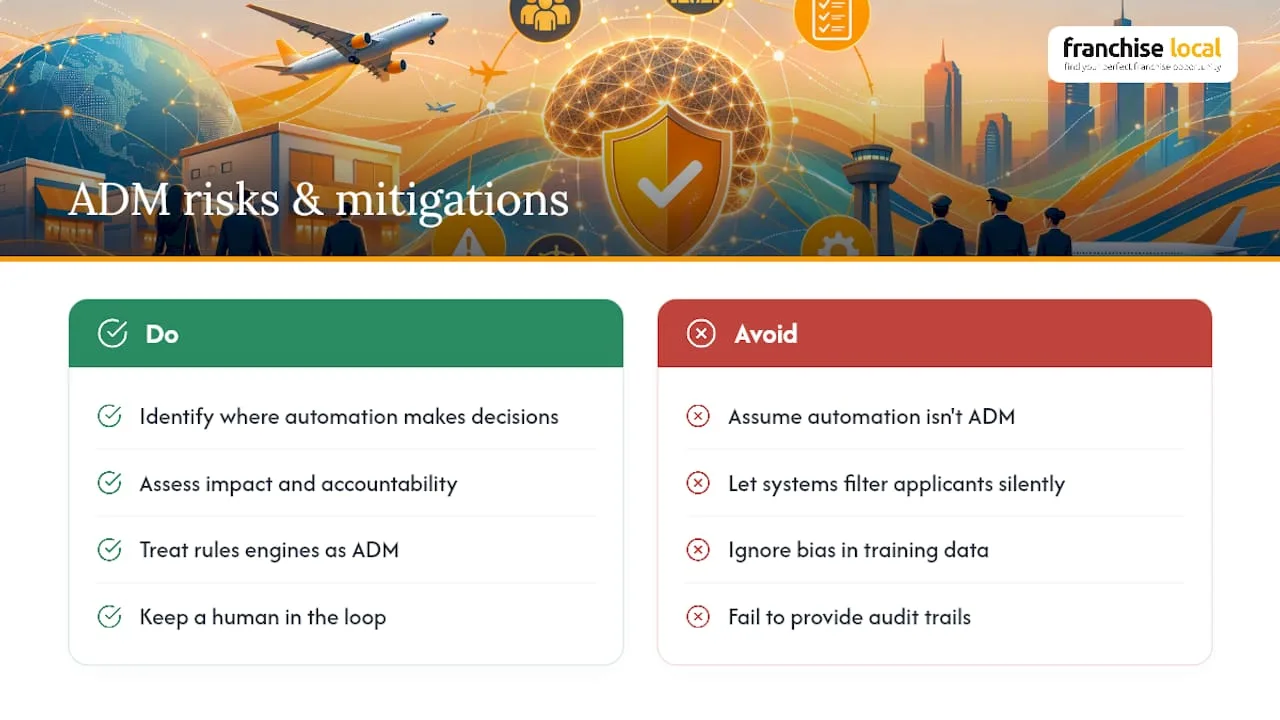
Not every AI application is automated decision-making (ADM), but the moment a system decides who progresses without a human checking that decision, you’ve crossed into ADM territory, and that carries real governance weight.
Automated decision-making in franchising is now a board-level governance issue. Franchisors must identify where automation is already making decisions, not just assisting with them, and assess the impact and accountability that follows.
That framing matters because ADM scrutiny applies even when the automation is a simple rules engine rather than a full machine-learning model. If a rule silently filters out applicants below a certain score, that’s ADM, and it needs the same audit trail as a more sophisticated system.
Bias is the sharpest practical risk. Scoring models trained on past successful franchisees can quietly replicate the demographics of who succeeded before, rather than who could succeed now. Some systems also combine enquiry data with public indicators to deprioritise applicants quietly, which creates real transparency problems for candidates who never learn why they were dropped.
The mitigations are straightforward: keep a human in the loop at every decision point, log every scoring input and output, and insist any vendor can explain, in plain language, why a candidate received a given score.
Measuring success: the KPIs that actually tell you AI is working
Franchisors piloting AI should track a short list of numbers, not a dashboard of vanity metrics.
Speed to lead and qualified appointments per month come first, since faster response almost always lifts conversion. Appointment-to-signing conversion tells you whether speed is translating into actual franchise agreements, not just more meetings. Retention and operational fit at 6 to 12 months is the metric that separates genuinely better screening from a faster path to the wrong candidate. Cost per qualified appointment and hours saved per NDM show whether the pilot pays for itself.
In numbers: Annual franchise development research found 58% of brands said AI streamlined their sales process, and 40% reported improved personalisation in recruitment outreach, roughly matching the reported reduction in onboarding time from 120 days to about 75 days in one pilot.
Structure any pilot with a control group and a matched baseline cohort, otherwise you can’t tell whether gains came from AI or from a stronger sales quarter.
Choosing AI tools without falling for vendor hype
Picking an AI vendor for franchise recruitment software comes down to a handful of practical checks, regardless of brand name or marketing claim.
- CRM integration and secure data handling. If the tool can’t sit inside your existing system without a manual export step, adoption will stall within weeks.
- Transparency of scoring. You must be able to see why a candidate received a given score, and override it, not just accept a black-box number.
- Pilot support and measurement frameworks. A vendor who can’t help you design a control-group test isn’t ready for a franchise sales environment.
- Security and model-update policies. Ask how often the underlying model changes and whether you’ll be told before it does.
- Commercial terms and implementation timeline. Short pilots with clear exit terms beat long contracts with vague onboarding promises.
Pro Tip: Ask any shortlisted vendor to show you a declined-candidate report, not just a success story. If they can’t explain a decline in plain English, they can’t explain a success either.
No-code platforms have made this space more accessible to teams without a data science function; a useful starting point for evaluating options is this overview of no-code AI tools built for non-technical teams.
Training and upskilling your recruitment team
The tool matters less than whether your team knows how to work alongside it. An NDM who doesn’t understand how a scoring model reached its number will either trust it blindly or ignore it entirely, and both are failure modes.
Start with scoring literacy: every team member using AI output should understand, at a basic level, which inputs drive which outcomes. This doesn’t require a data science course, but it does require a documented walkthrough of the model’s logic, ideally delivered by whoever implemented the pilot.
Build in a habit of override review. When an NDM overrides an AI score, log why. Over a few months, that log becomes one of your most valuable documents, revealing where the model’s judgement and human judgement consistently diverge, and which one is usually right.
Rotate responsibility for reviewing declined candidates. If the same person always signs off on AI-driven declines, blind spots compound. Spreading that review across the team keeps everyone calibrated to what “good” and “borderline” actually look like in practice.
Finally, treat vendor training sessions as a floor, not a ceiling. Vendors will teach your team to use the interface. Someone internal still needs to own the question of whether the outputs are actually improving recruitment outcomes, and that’s a governance skill, not a software skill.
What successful AI adoption looks like on the ground
The franchisors seeing real gains from AI recruitment tend to share a pattern: they started small, measured relentlessly, and resisted the urge to automate every stage at once.
Large multi-brand franchisors running side-by-side pilots reported substantial efficiency gains, more qualified appointments and lower ad spend, but many of these systems remain at pilot stage specifically for the contact and qualification steps. That’s a deliberate choice, not a limitation. Franchisors who saw the biggest wins kept AI concentrated where it has the clearest edge: speed of first response and consistency of initial scoring, while leaving the qualifying conversation and territory decision with an experienced NDM.
The common thread across reported successes is restraint. Brands that tried to automate the entire funnel, from first click to signed agreement, ran into the transparency and bias problems covered above far faster than brands that used AI as a triage layer feeding a human-run process. The lesson isn’t that AI underperforms. It’s that the franchisors getting the best return treated the pilot data as a decision tool for where to expand automation next, not as proof that the whole funnel should be handed over.
Where AI still falls short in franchise recruitment
AI franchise recruitment tools are genuinely useful, but they have real limits worth naming plainly.
Scoring models are only as good as the historical data they’re trained on, and franchise recruitment data is often thin. Most brands sign a few dozen to a few hundred new franchisees a year, nowhere near the volume needed to train a robust model without risking overfitting to your last cohort’s quirks.
Candidate opacity is a growing reputational problem, not just a compliance one. Applicants are increasingly aware that they may be judged by an automated profile before a human ever reads their form, and a candidate who feels silently filtered out is unlikely to reapply or recommend your brand to others.
Franchise recruitment also involves judgement calls that resist quantification: whether someone will follow your operating system under pressure, whether they’ll fit the local market’s culture, whether they have the resilience for a slow first year. No scoring model captures this reliably, and pretending otherwise sets up bad hires that look good on paper.
Finally, integration friction is underestimated. Franchise CRMs vary wildly in sophistication across brands, and an AI tool that works beautifully on clean data will underperform badly on the patchy, inconsistent records many franchise systems actually hold.
The AI technology stack franchisors are actually using
The tools doing the work in franchise recruitment fall into a few recognisable categories, rather than one single “AI platform.”
Conversational AI, chatbots and voice bots, handles the instant-response layer: acknowledging an enquiry, asking qualifying questions, and booking a call, all within minutes of a form submission. Predictive scoring engines sit behind the scenes, ranking candidates against your ideal-franchisee profile using inputs like financial readiness signals, stated experience, and engagement patterns across your funnel. Enrichment tools pull in public business and professional data to flag multi-unit operators or industry-relevant experience before an NDM makes first contact.
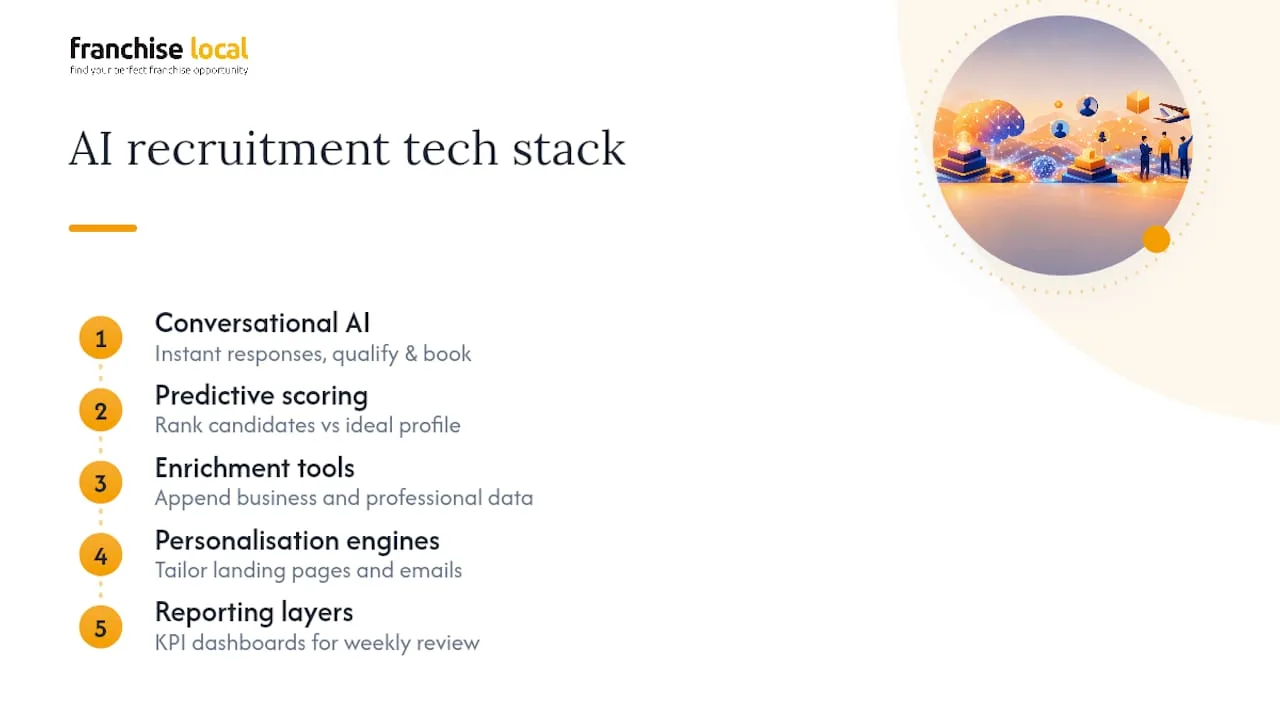
Personalisation engines drive the landing-page and email-sequence layer, adjusting content based on what a candidate has already revealed about their budget or location preference. And reporting layers, often bolted onto existing CRM platforms rather than replacing them, turn all of the above into the KPI dashboards development teams actually check weekly.
None of these categories require a franchisor to build custom machine learning in-house. Most are available as add-ons or integrations to existing recruitment software, which is part of why adoption has spread quickly for content and outreach tasks even while qualification automation lags behind.
Keeping people in charge of the process
The single best practice across every franchisor doing this well is deceptively simple: AI proposes, a person decides.
That principle needs to be built into workflow design, not left as a value statement. Every scoring output should route to a named human before it changes a candidate’s status, whether that’s advancing them to interview or declining them. The system should log that review, including who made the call and roughly why, so the audit trail exists before anyone asks for it.
Set a recurring review cadence, monthly is reasonable for most brands, where someone senior actually looks at a sample of AI-scored candidates against what a human reviewer would have concluded independently. Divergence between the two isn’t a failure. It’s the data that tells you whether the model needs retraining or whether your human reviewers need recalibrating.
Document the override rate. Either extreme is a signal worth investigating, and both are far more useful than a system that never gets questioned at all.
How Franchiselocal complements an AI-driven recruitment funnel
AI can sharpen how you score and respond to leads, but it can’t manufacture demand out of nothing. That’s where a marketplace does the job AI tools can’t: putting your opportunity in front of people actively searching for a franchise to buy, at the exact moment they’re ready to enquire.
Franchiselocal’s search filters by price, industry, and lifestyle preference feed exactly the kind of structured enquiry data your AI scoring model needs to work properly, rather than the vague, unqualified traffic that clogs up a generic ad campaign. Trending opportunity placements and curated listings put your brand alongside genuinely comparable options, which tends to produce candidates who’ve already thought about fit before they ever reach your landing page.
If you’re weighing where AI-enabled follow-up should point first, browse trending franchise opportunities to see how listings across price points and sectors are performing right now, or use the franchise directory search to check how your own opportunity compares to others in your category before your next recruitment push.