

Taking your first steps toward owning a franchise in the United Kingdom can feel like balancing ambition with uncertainty. The reality is, without a detailed approach to due diligence, hidden risks may threaten your investment and business goals. Thorough investigation unlocks clarity about financial stability, contractual obligations, and operational support. This guide uncovers the essential checks, research strategies, and expert insights you need to confidently assess franchise opportunities and make decisions that match your professional aspirations.
What Franchise Due Diligence Involves
Franchise due diligence represents a comprehensive investigative process designed to help prospective franchise owners thoroughly evaluate potential business opportunities before making significant financial commitments. At its core, this systematic approach involves meticulously examining multiple dimensions of a franchise investment to mitigate risks and ensure informed decision-making.
The due diligence process encompasses several critical areas of investigation:
- Financial Performance: Reviewing historical financial statements, revenue records, and profitability metrics
- Legal Compliance: Analysing franchise legal considerations to understand regulatory requirements
- Operational Structure: Examining the franchise’s operational model, support systems, and training programmes
- Market Positioning: Assessing competitive landscape, brand reputation, and growth potential
- Contractual Obligations: Scrutinising franchise agreements and understanding long-term commitments
A robust due diligence framework follows structured principles of proportional risk assessment. This means evaluating potential partnerships or investments through a systematic lens that considers ethical, reputational, financial, legal, and regulatory dimensions. Proper investigation helps entrepreneurs make strategic choices that align with their professional goals and risk tolerance.
The most successful franchise due diligence involves gathering information from multiple sources, including:
- Franchisor-provided documentation
- Existing franchise owner interviews
- Independent financial audits
- Industry market research reports
- Legal expert consultations
By conducting thorough research, potential franchise owners can uncover potential challenges, validate business models, and make more informed investment decisions. Understanding the intricate details of a franchise opportunity requires patience, strategic thinking, and a commitment to comprehensive investigation.
Pro tip: Always request and review the franchise disclosure document (FDD) as your foundational due diligence resource, which provides crucial insights into the franchise’s legal and financial landscape.
Types of Franchise Models in the UK
The United Kingdom offers a diverse landscape of franchise models, each designed to accommodate different business strategies, investment levels, and operational preferences. Franchise model variations provide entrepreneurs with multiple pathways to business ownership, each presenting unique opportunities and challenges.
Key franchise models prevalent in the UK include:
- Product Distribution Franchises: Retailers selling specific branded products with established supply chains
- Business Format Franchises: Most common model where franchisees receive comprehensive operational support, training, and brand guidelines
- Management Franchises: Opportunities for hands-off investors who hire managers to run day-to-day operations
- Master Franchises: Larger territorial franchises allowing sub-franchising and regional development
- Conversion Franchises: Existing independent businesses transitioning into established franchise networks
Each franchise model carries distinct characteristics that impact investment requirements, operational complexity, and potential returns. Business format franchises remain the most prevalent, offering structured support systems and proven operational frameworks that reduce entrepreneurial risk.
Here is a concise comparison of the main franchise models in the UK and their typical investor profiles:
| Franchise Model | Typical Investor Profile | Level of Support | Scalability Potential |
|---|---|---|---|
| Product Distribution | Small retail owners | Moderate | Limited regional |
| Business Format | New entrepreneurs | Comprehensive | High national |
| Management Franchise | Passive investors | Structured | Moderate regional |
| Master Franchise | Experienced business leaders | Advanced | Extensive national |
| Conversion Franchise | Established independents | Transitional | Moderate local |
The selection of an appropriate franchise model depends on several critical factors:
- Personal investment capacity
- Desired level of personal involvement
- Industry sector
- Available support infrastructure
- Long-term business goals
Successful franchise selection requires careful evaluation of these models against individual professional aspirations and market opportunities. Entrepreneurs must thoroughly understand each model’s unique dynamics, potential constraints, and growth potential before making a commitment.
Pro tip: Conduct comprehensive interviews with existing franchise owners across different models to gain nuanced insights into operational realities and potential challenges.
Essential Steps in the Due Diligence Process
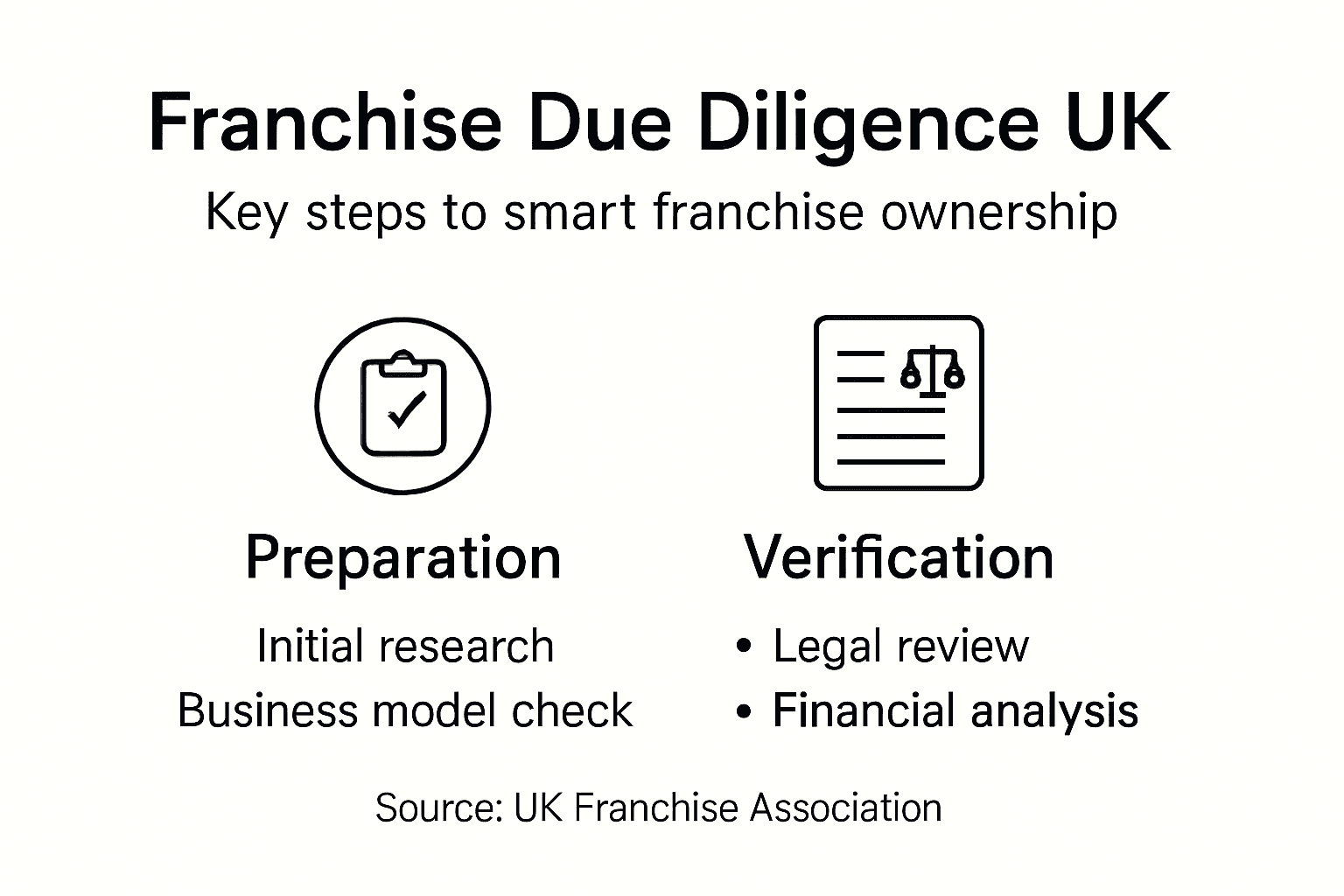
Franchise due diligence represents a strategic investigative process that demands methodical and comprehensive examination. Systematic risk assessment enables potential franchise owners to make informed decisions by uncovering potential challenges and opportunities before significant financial commitments.
The essential steps in franchise due diligence include:
- Initial Research: Gathering fundamental information about the franchise
- Financial Analysis: Examining historical financial performance and projections
- Legal Verification: Reviewing franchise agreements and regulatory compliance
- Operational Assessment: Understanding the franchise’s support systems and training
- Market Evaluation: Investigating competitive landscape and growth potential
A comprehensive due diligence process typically follows a structured approach with specific key actions:
- Request and review the Franchise Disclosure Document (FDD)
- Analyse the franchise’s financial statements
- Interview existing and former franchise owners
- Conduct independent market research
- Perform a detailed competitive analysis
- Verify legal and regulatory compliance
- Assess the franchise’s support and training infrastructure
Each step requires meticulous attention to detail and a critical approach. Franchisees must look beyond surface-level information, seeking to understand the deeper operational dynamics, potential risks, and long-term sustainability of the franchise opportunity.
Effective due diligence is not about finding perfection, but about understanding the complete picture of the franchise opportunity.
Successful franchise due diligence demands patience, thorough investigation, and a willingness to ask challenging questions. Potential franchise owners must be prepared to invest significant time and effort in understanding every aspect of the business before making a final commitment.
Pro tip: Create a comprehensive checklist of investigation points and systematically document your findings to ensure no critical detail is overlooked during the due diligence process.
Legal Rights and Obligations for Franchisees
Franchisees in the United Kingdom operate within a complex legal landscape that defines their rights and responsibilities. Franchise governance framework establishes crucial guidelines that protect both franchisees and franchisors, ensuring a balanced and transparent business relationship.
Key legal rights for franchisees encompass:
- Contractual Protection: Right to receive complete franchise disclosure documentation
- Operational Support: Entitlement to comprehensive training and operational assistance
- Intellectual Property: Permission to use franchisor’s trademarks and business systems
- Performance Transparency: Access to financial and performance-related information
- Termination Safeguards: Protection against arbitrary contract cancellation
Similarly, franchisees must fulfil specific legal obligations that maintain the integrity of the franchise relationship:
- Adhere strictly to franchise operational standards
- Maintain financial reporting and compliance requirements
- Protect franchisor’s intellectual property rights
- Follow designated marketing and branding guidelines
- Participate in required training programmes
The legal framework surrounding franchising in the UK is designed to create a balanced ecosystem where both parties understand their rights and responsibilities. Franchisees must recognise that their obligations extend beyond mere financial contributions, encompassing broader commitments to brand reputation and operational excellence.
Legal compliance is not optional – it’s the foundation of a successful franchise relationship.
Understanding the nuanced legal landscape requires careful examination of franchise agreements, ongoing communication with the franchisor, and a proactive approach to meeting contractual requirements.

Pro tip: Consult an independent franchise legal specialist to thoroughly review your franchise agreement before signing, ensuring you fully comprehend all legal implications.
Common Pitfalls and How to Avoid Them
Franchise investments require strategic navigation to mitigate potential risks and challenges. Risk management strategies are crucial for entrepreneurs seeking sustainable and successful franchise opportunities in the United Kingdom.
Common pitfalls that potential franchisees must be aware of include:
- Financial Miscalculation: Underestimating startup and operational costs
- Inadequate Research: Failing to conduct thorough due diligence
- Unrealistic Expectations: Misunderstanding potential returns and workload
- Poor Communication: Neglecting relationship management with franchisor
- Legal Oversights: Insufficient understanding of contractual obligations
Mitigating these risks requires a proactive and systematic approach:
- Develop a comprehensive business plan
- Conduct extensive market research
- Seek independent financial and legal advice
- Speak with multiple existing franchise owners
- Carefully review all documentation
- Understand your personal capabilities and limitations
- Maintain realistic financial projections
Successful franchise ownership demands more than financial investment. It requires emotional intelligence, adaptability, and a commitment to continuous learning and improvement.
The following table highlights typical errors in franchise due diligence and suggested ways to avoid them:
| Common Pitfall | Business Consequence | Mitigation Strategy |
|---|---|---|
| Financial misjudgement | Insufficient operating capital | Seek independent financial advice |
| Poor communication | Weak franchisor relationships | Schedule regular check-ins |
| Legal oversight | Unexpected liabilities | Review contracts with legal experts |
| Inadequate research | Missed market risks | Use multiple information sources |
| Unrealistic expectations | Early franchise exit | Set practical performance goals |
Not all franchise opportunities are created equal – thorough investigation is your most valuable asset.
Entrepreneurs must remain vigilant, recognising that potential challenges are not roadblocks but opportunities for strategic planning and personal growth.
Pro tip: Create a detailed risk assessment spreadsheet tracking potential challenges, mitigation strategies, and contingency plans before committing to any franchise investment.
Secure Your Franchise Future with Informed Choices
Understanding the importance of thorough franchise due diligence is crucial to avoid costly pitfalls and ensure long-term success. This article highlights challenges such as financial misjudgement, inadequate research and legal oversight that can impact your franchise journey. If you want to grasp key concepts like franchise disclosure documents and operational assessments while exploring suitable business format models, you need reliable tools at your fingertips.
Discover the power of comprehensive search and detailed listings tailored to your investment capacity and lifestyle preferences at FranchiseLocal. Our platform helps you filter franchise opportunities by price, industry and operational style so you can conduct more focused due diligence with confidence. Don’t wait until issues arise – start your strategic evaluation now by visiting FranchiseLocal and take the first step towards making an informed franchise investment today.
Frequently Asked Questions
What does franchise due diligence involve?
Franchise due diligence is a comprehensive investigative process that involves examining various aspects of a franchise opportunity, including financial performance, legal compliance, operational structure, market positioning, and contractual obligations.
Why is conducting due diligence important before investing in a franchise?
Conducting due diligence is crucial as it helps prospective franchise owners mitigate risks, make informed financial commitments, and understand the potential challenges and opportunities associated with the franchise.
What are the essential steps in the franchise due diligence process?
The essential steps include initial research, financial analysis, legal verification, operational assessment, and market evaluation, all aimed at uncovering potential risks and determining the viability of the franchise opportunity.
What common pitfalls should franchisees avoid during due diligence?
Common pitfalls include financial miscalculations, inadequate research, unrealistic expectations about returns, poor communication with the franchisor, and legal oversights. Avoiding these can lead to better-informed decisions and reduce risks associated with franchise investments.