

Securing the right funding is often the biggest hurdle for aspiring franchisees across the United Kingdom. With so many finance options available, from bank loans and government grants to specialist lenders, it is crucial to understand which approach matches your franchise ambitions. Grasping the essentials of franchise funding helps you avoid costly missteps, make informed decisions, and confidently progress toward owning a low to mid-cost franchise business.
Defining Franchise Funding in the UK
Franchise funding in the UK means something quite specific. It’s not simply about borrowing money to open a franchise outlet, though that’s certainly part of it. At its core, franchise funding refers to the financial arrangements and capital strategies used to launch or expand a franchise business within the United Kingdom’s regulatory and economic framework. When you’re looking to invest in a franchise opportunity, you’re essentially securing the funds needed to cover initial setup costs, ongoing operational expenses, and the franchise fee itself. Understanding these dynamics matters because the UK franchise market operates differently depending on whether you’re an individual franchisee, a multi-unit operator, or even an education provider delivering courses through partnership arrangements. The funding landscape varies considerably based on your franchise sector, investment level, and business model.
In practical terms, franchise funding in the UK encompasses several distinct elements. First, there’s the initial franchise fee you pay to the franchisor for the right to operate under their brand and access their support systems. Then comes the capital investment required for setup such as premises, equipment, stock, and technology systems. Beyond these upfront costs, you’ll need working capital to sustain operations until the business reaches profitability. The beauty of the franchise model is that many funding routes exist specifically designed for franchisees. Banks, specialist lenders, and government-backed schemes recognise the lower failure rates associated with established franchise brands compared to independent startups. The food sector alone demonstrates how diverse franchise funding can be, with options ranging from small mobile operations to substantial restaurant investments, each attracting different funding mechanisms and investor appetite.

What makes UK franchise funding distinct from other business financing is the involvement of the franchisor in your success. Unlike a traditional bank loan where the lender simply wants repayment, franchisors have vested interests in your prosperity because their reputation and royalty income depend on your performance. This alignment creates opportunities. Many franchisors offer in-house financing schemes, vendor finance agreements, or partnerships with lenders who understand the franchise model intimately. Equally, government support programmes like the Start Up Loans scheme recognise franchise opportunities as viable investment pathways for aspiring entrepreneurs. Your funding strategy will depend on several factors: the total investment required, your personal savings available, your credit profile, and the specific franchise brand’s requirements and recommendations. Low to mid-cost franchises typically range from £5,000 to £50,000 in total investment, making them accessible to a broader range of prospective business owners compared to high-capital ventures.
Pro tip: Before exploring any funding option, request the franchisor’s Franchise Disclosure Document (FDD) and item 19 financial information, as these reveal how other franchisees have funded their businesses and what realistic costs you should anticipate.
Main Types of Franchise Finance Solutions
When you start looking for funding to launch your franchise, you’ll quickly discover that one approach does not fit all situations. The UK offers several distinct financing pathways, each with different terms, eligibility requirements, and costs. Understanding these options helps you choose what works best for your specific circumstances. The main types include bank loans, specialist franchise finance providers, government-backed schemes, venture capital, and grants. Each operates differently and suits different franchisee profiles. Someone with strong personal collateral might secure a traditional bank loan easily, whilst another franchisee with limited savings could qualify for government support instead. Rather than viewing these as competing options, think of them as tools in your toolkit. Many successful franchisees combine multiple funding sources to reach their target investment amount.
Bank loans remain the most straightforward route for many franchisees. High street banks like Barclays, HSBC, and Lloyds understand the franchise model well enough to offer competitive rates on business loans. The advantage here is simplicity: you borrow a fixed amount, repay it over an agreed period, and the bank charges you interest. However, banks typically require security, a proven track record of managing finances, and a detailed business plan showing how the franchise will generate returns. Specialist franchise finance providers operate differently. These lenders focus exclusively on franchise businesses and often have faster approval processes because they understand franchise dynamics intimately. They may offer higher loan amounts relative to personal equity and sometimes accept franchisees with less established credit histories.
Government-backed schemes and grants deserve serious attention because they can dramatically reduce your personal financial burden. The UK government actively supports franchise development through various programmes. Government grants for small businesses may cover setup costs, training, or expansion activities depending on your location and sector. The Start Up Loans scheme, administered through regional delivery partners, offers loans up to £25,000 at competitive rates for new business owners. Beyond these, grants often combine with other funding. You might secure a government grant covering half your equipment costs, then use a bank loan for remaining capital needs. This stacking approach is entirely legitimate and frequently used. Venture capital and private investment typically suit higher-value franchise opportunities rather than low to mid-cost operations, though some angel investors do back franchisees with compelling business plans.
Pro tip: Compare at least three different funding sources before committing, as interest rates and terms vary significantly, and different lenders specialise in different investment levels.
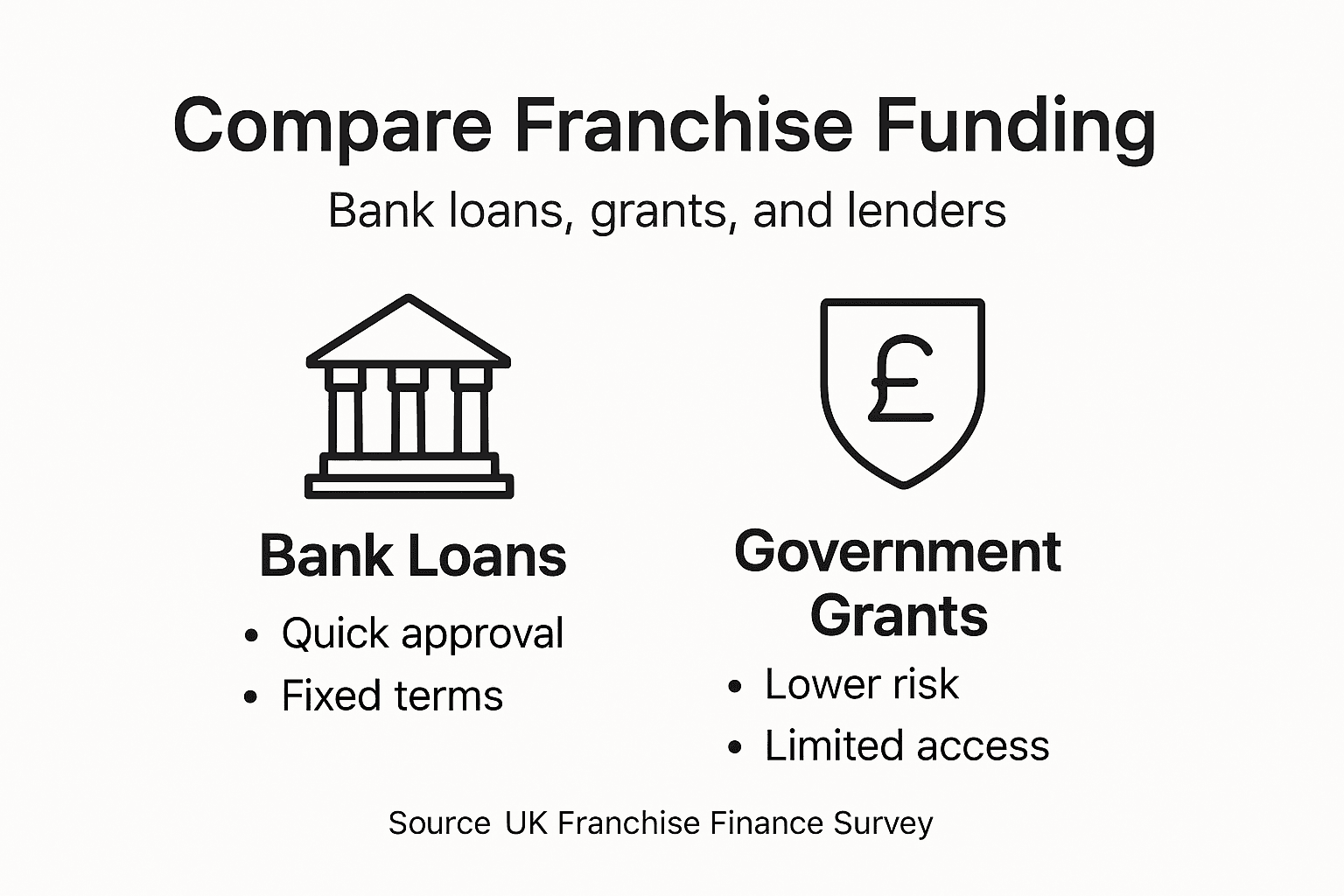
To help clarify your choices, here is a comparison of major franchise finance options in the UK:
| Funding Route | Typical Amounts | Who It Suits | Key Drawbacks |
|---|---|---|---|
| Bank Loan | £5,000 – £50,000 | Those with strong credit & equity | Requires security, rigid terms |
| Specialist Lender | £10,000 – £100,000 | New franchisees, lower savings | Higher interest rates & fees |
| Government Grant | £1,000 – £25,000 | Start-ups, specific sectors | Strict eligibility, not full cost |
| Venture Capital/Private Inv. | £50,000+ | Large or multi-unit projects | Requires robust business case |
| Personal Savings | Varies | All applicants | Limits scale, personal risk |
Eligibility and Application Essentials
Not every franchisee qualifies for every funding option. Lenders and grant providers have specific criteria they use to assess your application, and understanding these upfront saves you time and frustration. Eligibility requirements vary significantly depending on which funding route you pursue. Bank loans typically require you to be at least 18 years old, a UK resident or settled in the UK, and able to demonstrate personal equity investment (usually between 20 and 40 percent of the total project cost). Beyond these basics, lenders scrutinise your credit history, your business experience, and whether you can show a genuine demand for the franchise in your chosen location. Government-backed schemes like the Start Up Loans programme have different eligibility rules. You’ll need to be unemployed, self-employed earning less than £20,000 annually, or employed but wanting to start a business. Some schemes specifically target disadvantaged groups or particular regions, so your postcode and background can affect access. Specialist franchise finance providers often have more flexible eligibility criteria and may work with applicants who wouldn’t qualify for traditional bank lending, but they’ll still require proof that the franchise business can generate sufficient profit to service the loan.
The application process itself demands careful preparation and attention to detail. Start by gathering essential documentation: your personal identification, proof of address, bank statements covering the last three months, tax returns or accounts if you’re already trading, and details of your personal savings available for investment. Preparing a detailed business plan matters enormously because lenders want to see exactly how you’ll use the funds and when the franchise will become profitable. Your business plan should include market research showing customer demand in your area, realistic financial projections for the first three years, details of your management experience, and evidence that you’ve researched the specific franchise thoroughly. The franchisor will support this with their own financial performance data. Some franchisees overlook this step and submit weak applications. Instead, invest time building a compelling narrative that shows you’ve thought through the venture seriously. Most lenders will ask specific questions about why you’ve chosen this particular franchise, what makes you suited to run it, and how you’ll differentiate yourself from competitors.
Compliance and documentation requirements deserve particular attention because they vary by sector and funding source. If you’re launching a regulated franchise (such as financial services or education), you’ll face additional registration requirements beyond securing finance. When completing your application form, be absolutely honest about any previous business failures, personal insolvencies, or county court judgements. Lenders conduct thorough background checks and dishonesty will result in immediate rejection. Submit everything the lender requests, even if it seems excessive. Missing documents delay decisions and sometimes result in rejection. Keep copies of everything you submit, and ask for confirmation that applications have been received. The typical approval timeline ranges from two to eight weeks depending on the lender and complexity of your case.
Pro tip: Get your business plan reviewed by a franchise consultant or accountant before submitting any applications, as professional input often strengthens weak sections and increases approval chances significantly.
Comparing Lenders, Banks, and Grants
Choosing between traditional banks, specialist lenders, and government grants feels overwhelming when you’re staring at multiple options. Each funding route operates on fundamentally different principles, and what works brilliantly for one franchisee might be completely unsuitable for another. Banks offer the most familiar approach. You borrow money, pay interest, and repay over a fixed schedule. This simplicity appeals to many franchisees, especially those with established credit histories and reasonable personal savings. Banks typically lend between 60 and 80 percent of your total project cost, meaning you must find the remaining 20 to 40 percent yourself. Interest rates vary based on your credit score and the loan term, but expect between 3 and 8 percent annually for small business loans. The advantage is speed. Many banks can approve applications within four to six weeks. The disadvantage is risk. You’re personally liable for repayment regardless of whether the franchise succeeds.
Specialist franchise lenders operate differently from high street banks. These companies understand franchise models intimately and often move faster on applications because they don’t need to explain the business model to sceptical credit committees. They may approve higher loan percentages (up to 90 percent of project costs) and sometimes accept applicants with weaker credit profiles. However, specialist lenders charge higher interest rates to compensate for this increased risk, typically between 6 and 12 percent annually. Some also charge arrangement fees ranging from 1 to 3 percent of the loan amount. Before accepting a specialist lender’s offer, calculate your total repayment cost including all fees. Sometimes a slightly higher interest rate from a bank works out cheaper overall. Government grants provide non-repayable funding that fundamentally changes the equation. Rather than borrowing money you must repay with interest, grants give you capital you keep regardless of franchise performance. This sounds ideal, but grants come with strict conditions. They’re typically sector specific (perhaps supporting environmental businesses or rural enterprises), location specific (certain postcodes or regions), or targeted at particular groups (young entrepreneurs, unemployed individuals). Award amounts rarely cover your entire project cost. Most grants cover 20 to 50 percent of eligible expenses. You must still source remaining funding, usually through loans or personal savings.
Making Your Decision
Comparing these options requires looking beyond simple interest rates. Create a financial model for each scenario. Let’s say your franchise requires £30,000 total investment. If you secure a bank loan at 5 percent interest for five years, you’ll pay approximately £6,500 in interest across the loan term. If a specialist lender charges 8 percent plus a 2 percent arrangement fee, your total cost climbs to £13,400. Now imagine securing a £10,000 government grant plus a £20,000 bank loan. You’ve reduced your interest costs dramatically and personal liability. The key insight is that combining funding sources often produces better outcomes than relying on a single route. Many successful franchisees layer their funding: a government grant for equipment, a bank loan for working capital, and their own savings for the franchise fee. This diversification protects you because no single lender controls your entire project.
Timing matters enormously. Banks and specialist lenders can process applications quickly during quieter trading periods, but slow down significantly when loan demand peaks. Government grants often have strict application windows and annual budgets that deplete. If you’re planning to launch your franchise in spring, start funding conversations the previous autumn. Document everything meticulously because all three funding types require extensive paperwork. Banks want proof of creditworthiness. Specialist lenders want franchise validation documentation. Government grants require evidence that you meet their specific criteria. The franchisor plays a crucial supporting role here. Request their Item 19 financial information, which shows how other franchisees funded their launches. This data helps you benchmark realistic funding costs and validates your assumptions to lenders.
Pro tip: Approach three different funding sources simultaneously, not sequentially, so you can compare final offers and timing rather than accepting the first approval that arrives.
Costs, Pitfalls, and Hidden Obligations
Franchise funding looks straightforward when you’re examining interest rates and loan amounts. The reality is messier. Beyond the obvious costs of borrowing money, hidden expenses emerge during your franchise journey that most first-time franchisees don’t anticipate. Understanding these pitfalls before you borrow protects you from unpleasant surprises. Start with the most visible costs. If you take a £25,000 bank loan at 5 percent over five years, you’ll pay approximately £3,250 in interest. But interest is only part of the equation. Some lenders charge arrangement fees (1 to 3 percent upfront), early repayment penalties, and valuation fees if they require property appraisals as security. Specialist franchise lenders might charge broker fees on top of interest. Add these together and your actual cost of borrowing climbs significantly above the advertised interest rate.
Beyond lending costs sit the hidden obligations that catch franchisees off guard. Your franchisor’s contract likely includes mandatory training expenses you must cover personally, often £500 to £3,000 depending on the franchise. You’ll need professional fees for accountants and solicitors to review your franchise agreement before signing (£200 to £800 typically). Insurance costs compound this burden. Most franchisors require you to maintain business liability insurance, often around £300 to £1,000 annually depending on your sector. Some franchises demand additional insurance for customer protection or professional indemnity. These recurring costs drain cash flow during your first year when income is unpredictable. If you borrow money assuming only loan repayments, you’ll face cash shortfalls. Governance and compliance obligations vary by franchise sector, but regulated industries demand extensive documentation and reporting that requires either your time or paid professional support.
Below is a summary of typical hidden costs and obligations franchisees should budget for:
| Expense Type | Description | Estimated Annual Range |
|---|---|---|
| Mandatory Training | Required by franchisor before launch | £500 – £3,000 |
| Professional Fees | Legal/accountant review of contract | £200 – £800 |
| Insurance | Business & liability coverages | £300 – £1,000 |
| Compliance Admin | Sector-specific documentation | £400 – £2,000 |
| Marketing Support | Required franchise-wide campaigns | £700 – £2,500 |
Pitfalls emerge when franchisees underestimate working capital requirements. Your total franchise cost might be £30,000, and you secure funding for exactly that amount. But what happens when your first inventory shipment costs more than expected? Or when a key piece of equipment fails and needs replacing before you’ve generated significant revenue? Or when the franchisor demands payment for marketing support you didn’t budget? Working capital shortfalls force you to take additional borrowing at unfavourable rates or, worse, to miss loan payments because cash hasn’t yet arrived from customer sales. This is the moment many franchisees face serious financial stress. The pitfall deepens if you’ve personally guaranteed the loan. Your personal credit score suffers, and creditors can pursue your personal assets. Some franchisees face county court judgements that damage their creditworthiness for years. Another critical pitfall involves variable costs increasing unexpectedly. Perhaps your franchisor raises royalty rates or management service fees. These changes directly impact profitability and your ability to service debt. When reviewing the franchise agreement, identify which fees are fixed and which are variable. Ask about historical increases and average rate changes.
Red Flags Before You Borrow
Certain warning signs suggest the franchise opportunity isn’t worth the financial risk. Be wary if the franchisor won’t provide audited financial statements showing typical franchisee profitability. Be cautious if they pressure you to borrow aggressively or suggest you should max out personal credit cards. Never accept a franchisor’s recommendation to borrow from a specific lender without shopping independently. Be alert if exit clauses in your franchise agreement are extremely restrictive, meaning you’re locked in regardless of poor performance. Ask current franchisees about their actual costs versus projections. Most will tell you the truth if you ask directly. One franchisee earning poorly might be an anomaly. But if multiple franchisees report spending significantly more than the franchisor projected, that’s a genuine warning signal.
Pro tip: Build a cash buffer equal to at least six months of combined loan repayments plus royalty fees before launching, so temporary revenue dips don’t force you into crisis borrowing at punitive rates.
Unlock Your Franchise Funding Success with Expert Support
Securing the right franchise funding in the UK can feel overwhelming with so many options and hidden costs. This article highlights key challenges such as balancing loan interest, government grants, and personal savings while navigating eligibility criteria and unexpected expenses. If you are ready to explore investment opportunities that align with your financial goals and lifestyle, it is vital to find franchises that match your budget and growth ambitions.
Discover a diverse range of franchise opportunities tailored to different investment levels and sectors at Franchise Local. Use their advanced search filters to compare funding requirements and identify franchises that suit your unique situation. Don’t let uncertainty hold you back. Take control today by visiting Franchise Local’s comprehensive UK directory and start building your funding strategy with confidence. Your ideal franchise investment awaits—make the first step now and explore franchise opportunities designed to fit your needs.
Frequently Asked Questions
What are the main types of franchise funding options available?
Franchise funding options in the UK include bank loans, specialist franchise finance providers, government-backed schemes, venture capital, and grants. Each option has different terms, eligibility requirements, and costs suited to various franchisee profiles.
How does bank financing work for franchising?
Bank financing involves borrowing a fixed amount to cover part of your franchise investment, which you repay over an agreed period with interest. Banks typically require a proven credit history and security, making it more accessible for those with strong financial backgrounds.
What are government-backed schemes and how can they help new franchisees?
Government-backed schemes provide financial support to new business owners, including franchisees. These programmes may offer loans at competitive rates or grants that cover setup costs, helping to reduce the financial burden on entrepreneurs.
What should I include in my business plan when applying for franchise funding?
Your business plan should detail market research, your experience, realistic financial projections for the first three years, and how you’ll use the funds. Additionally, include information about the franchise’s performance to strengthen your application.