

Franchising isn’t the gamble many assume it to be. Franchise profitability stands at 93%, with closure rates below 1% annually, a stark contrast to the 50% failure rate plaguing independent startups. For UK entrepreneurs weighing investment options in 2026, understanding emerging franchise trends isn’t optional. It’s the difference between backing a proven system and navigating uncharted territory alone. This article unpacks the trends, technologies, and economic factors shaping franchise success this year, giving you the insights needed to make informed decisions.
Key Takeaways
| Point | Details |
|---|---|
| Low failure rates | UK franchises consistently outperform startups, with less than 1% failing each year. |
| Technology drives growth | Franchisees embracing new technology gain major competitive advantages in 2026. |
| Resilient sectors | Business, finance, and tech-enabled franchises are among the most recession-resistant. |
| Follow emerging trends | Staying ahead of franchise industry shifts can boost profitability and reduce risk. |
| Use expert resources | Accessing trusted franchise guides and directories helps UK entrepreneurs make better investment decisions. |
Why franchising outperforms traditional startups in 2026
The numbers tell a compelling story. Whilst half of independent businesses fold within their first few years, franchise failure rates remain under 6% over two decades. This performance gap isn’t luck. It’s the result of systemised operations, established brand recognition, and continuous franchisor support that independent ventures simply can’t replicate.
Franchise models eliminate much of the guesswork. You’re buying into tested processes, proven marketing strategies, and supply chains already optimised for efficiency. When challenges arise, you’re not solving problems alone. Franchisors provide training, operational guidance, and collective buying power that reduces costs and increases margins.
Pro Tip: Before committing to any franchise, request detailed financial disclosure documents and speak with at least five current franchisees about their real-world experiences. Their insights will reveal whether the franchisor’s promises match reality.
The table below illustrates how franchises stack up against traditional startups across key performance metrics:
| Metric | UK Franchises (2026) | Independent Startups (2026) |
|---|---|---|
| Five-year survival rate | 94% | 50% |
| Average time to profitability | 12-18 months | 24-36 months |
| Access to established brand | Yes | No |
| Ongoing operational support | Comprehensive | Self-directed |
| Initial risk level | Low to moderate | High |
This performance advantage extends beyond survival rates. Franchises typically reach profitability faster because they skip the brand-building phase that consumes years and capital for startups. You’re leveraging existing customer trust and market positioning from day one.
For deeper analysis of how these models compare, explore our franchise versus startup comparison and review franchise profitability factors that drive these outcomes.
Top franchise industry trends shaping 2026 opportunities
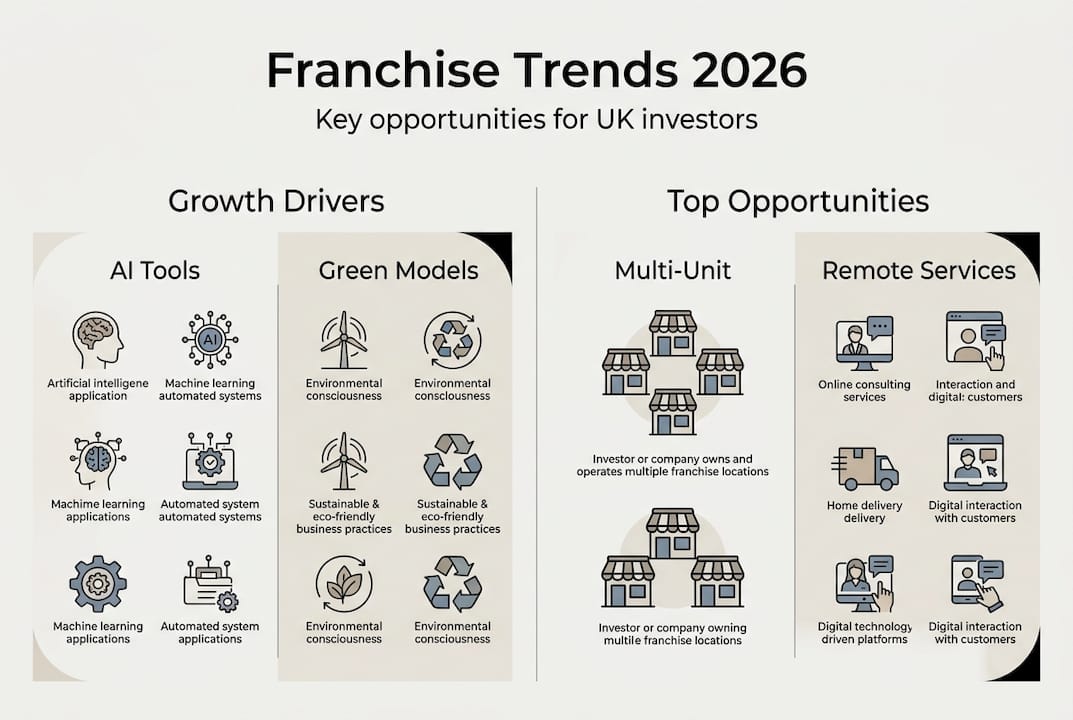
Several powerful trends are reshaping the UK franchise landscape this year, creating fresh opportunities for investors who recognise them early.
Technology integration has moved from optional to essential. Franchises now deploy AI-powered customer service tools, cloud-based inventory management, and automated marketing platforms. These technologies don’t just improve efficiency; they create competitive moats that independent businesses struggle to replicate.
Sustainability-focused franchises are capturing growing consumer demand for environmentally responsible options. Green cleaning services, eco-friendly retail concepts, and sustainable food franchises are experiencing accelerated growth as UK consumers align spending with values.

Flexible operational models have exploded in popularity. Home-based franchises, mobile service units, and hybrid models that combine physical and digital presence offer lower overhead whilst maintaining strong revenue potential. This flexibility appeals to investors seeking work-life balance alongside profitability.
Multi-unit expansion strategies are becoming more accessible. Experienced franchisees are scaling faster by operating multiple locations or territories, leveraging economies of scale and operational expertise gained from their first unit.
Remote and digital-first franchises continue gaining traction. E-commerce support services, digital marketing agencies, and online education franchises require minimal physical infrastructure whilst serving nationwide markets.
These trends aren’t isolated developments. They reflect fundamental shifts in how UK consumers shop, work, and make purchasing decisions. Franchise profitability remains high at 93% precisely because successful franchisors adapt quickly to these changing preferences.
Pro Tip: When evaluating franchise opportunities, prioritise brands demonstrating clear adaptation to at least two of these trends. Franchisors who ignore market shifts risk obsolescence, regardless of past success.
Understanding these trends helps you identify which franchise sectors offer the strongest growth potential. Our guides on franchise marketing strategies and profitability factors for UK franchises provide additional context for evaluating opportunities.
Technology impact: how innovation accelerates franchise growth
Technology has become the primary differentiator between thriving franchises and those merely surviving. The franchises winning in 2026 aren’t just using technology; they’re building entire operational frameworks around it.
Artificial intelligence now handles customer enquiries, appointment scheduling, and personalised marketing at scales impossible for human teams. Cloud-based management systems give franchisees real-time visibility into inventory, sales, and performance metrics across all locations. Contactless payment systems and digital ordering platforms have shifted from pandemic necessities to permanent customer expectations.
The table below outlines key technologies and their impact on franchise operations:
| Technology | Primary Benefit | Impact on Profitability |
|---|---|---|
| AI customer service | 24/7 availability, instant responses | Reduces staffing costs by 30-40% |
| Cloud management platforms | Real-time data access, centralised control | Improves decision speed and accuracy |
| Contactless payments | Faster transactions, reduced friction | Increases transaction volume by 15-25% |
| Automated marketing tools | Personalised campaigns at scale | Boosts customer retention by 20-35% |
| Mobile apps | Enhanced customer engagement | Drives repeat purchases and loyalty |
Technology-enhanced franchises enjoy stronger brand relevance and customer engagement, translating directly to improved financial performance. Customers now expect seamless digital experiences, and franchises delivering them capture disproportionate market share.
Pro Tip: During due diligence, ask franchisors to demonstrate their technology roadmap for the next three years. Brands without clear digital strategies will struggle to compete as consumer expectations continue evolving.
The franchises thriving in 2026 view technology as an investment, not an expense. They understand that upfront costs for robust systems pay dividends through operational efficiency, customer satisfaction, and competitive positioning.
For practical guidance on leveraging these tools, review our resources on franchise management software and franchise marketing strategies.
Economic resilience: franchising in uncertain markets
Economic uncertainty doesn’t affect all business models equally. Franchises demonstrate remarkable resilience during downturns, a characteristic that becomes increasingly valuable as economic conditions fluctuate.
Franchises maintain lower closure rates during downturns compared to independent businesses. This resilience stems from several factors: established brand trust, proven operational systems, and franchisor support that helps navigate challenging periods.
Certain sectors prove particularly recession-resistant:
- Healthcare and wellness franchises serve essential needs that persist regardless of economic conditions
- Financial services franchises actually see increased demand during uncertain times as people seek professional guidance
- Technology-enabled service franchises offer efficiency solutions that businesses need to maintain competitiveness
- Home maintenance and repair franchises benefit from consumers choosing to maintain existing assets rather than purchasing new ones
- Education and training franchises attract individuals seeking skills development during career transitions
These sectors share a common thread: they address fundamental needs rather than discretionary wants. When budgets tighten, consumers cut luxury spending but maintain essential services.
The proven business model underlying successful franchises provides stability that independent ventures cannot match during economic turbulence. Systemised operations, collective brand strength, and franchisor guidance create multiple layers of protection against market volatility.
This resilience doesn’t mean franchises are immune to economic pressures. It means they’re better equipped to weather them. Franchisors with experience navigating previous downturns provide invaluable guidance, helping franchisees adjust operations, manage cash flow, and identify opportunities others miss.
Explore our analysis of recession-proof franchise options and discover why franchises succeed where independent businesses struggle.
Future outlook: what’s next for UK franchising by late 2026?
The franchise landscape will continue evolving throughout 2026, with several developments likely to accelerate in the coming months.
Increasing specialisation will define successful franchises. Rather than broad service offerings, winning brands will focus on specific niches where they can dominate. This specialisation allows deeper expertise, stronger brand positioning, and premium pricing power.
New service sectors will emerge as franchisable concepts. Areas like cybersecurity consulting, remote work support services, and sustainable technology solutions are ripe for franchise development. Historical franchise data suggests recent trends will continue favouring systemised, branded networks.
Franchise models themselves will evolve. Expect more hybrid structures combining traditional franchising with licensing, partnerships, and technology platforms. These flexible arrangements will accommodate diverse investor preferences and market conditions.
For UK investors aiming for long-term franchise success, follow these steps:
- Conduct thorough market research to identify sectors with sustainable demand and limited saturation in your target territory
- Evaluate franchisor stability by reviewing their financial health, franchisee satisfaction rates, and adaptation to market changes
- Assess technology infrastructure to ensure the franchise can compete effectively as digital expectations continue rising
- Calculate realistic financial projections using data from existing franchisees rather than franchisor estimates alone
- Build relationships with current franchisees to gain unfiltered insights into day-to-day operations and franchisor support quality
- Monitor industry developments continuously to identify emerging opportunities and potential threats to your investment
The franchise industry rewards investors who combine careful analysis with decisive action. Opportunities exist across sectors, investment levels, and operational models. Success comes from matching the right franchise to your skills, resources, and market conditions.
Stay informed about emerging opportunities by exploring hot and trending franchises and reviewing franchise profitability insights regularly.
Explore the UK’s leading franchise opportunities
Understanding franchise trends provides the foundation, but finding the right opportunity requires comprehensive resources and expert guidance. Whether you’re exploring your first franchise investment or expanding an existing portfolio, access to detailed listings, comparative data, and industry insights accelerates your decision-making process.
Our platform connects you with hundreds of vetted franchise opportunities across every sector and investment level. From home-based concepts requiring minimal capital to established brands seeking multi-unit operators, you’ll find options matching your specific criteria. Detailed franchise profiles include investment requirements, expected returns, training programmes, and direct contact with franchisors.
Beyond listings, we provide the tools and knowledge needed for thorough due diligence. Our ultimate guide to franchising walks you through every stage of the investment process, whilst sector-specific resources like networking franchises in the UK help you evaluate opportunities within particular industries. Connect with franchise service providers offering legal, financial, and operational support to ensure your investment starts on solid ground.
Frequently asked questions
Why do franchises have a lower failure rate than independent startups?
Franchises use proven business models and ongoing franchisor support, leading to just a 1-6% failure rate versus 50% for startups. This systemised approach eliminates much of the trial and error that sinks independent ventures.
What franchise sectors are best positioned for growth in 2026?
Technology, finance, and business services franchises are projected to perform strongly due to resilient demand and innovation. Healthcare, sustainability-focused concepts, and digital-first models also show exceptional growth potential.
How important is technology adoption for new franchisees?
Technology is critical; adopting modern tools helps franchises stay competitive and efficient in the 2026 market. Franchises without robust digital infrastructure increasingly struggle to meet customer expectations.
Are franchises truly recession-proof investments?
Some franchise models in resilient sectors have far lower closure rates during downturns, offering better security than stand-alone startups. Whilst no investment is completely risk-free, franchises in essential service sectors demonstrate remarkable stability during economic uncertainty.