

Aim to acknowledge every inbound franchise enquiry within 60 seconds using automation, then follow up with a real human within five minutes for high-value leads, or within one hour at the absolute minimum. That single discipline separates franchisors who convert enquiries into signed agreements from those who lose candidates to whoever picked up the phone first.
Here is what your response time targets should look like in practice:
- Ideal: Automated acknowledgement within 60 seconds + human contact within 5 minutes
- Acceptable: Automated acknowledgement within 60 seconds + human contact within 1 hour
- Minimum: Human contact within 24 hours (expect significant conversion loss beyond this point)
- Immediate actions: Deploy SMS + email auto-acknowledgement, set up automatic CRM lead routing, log every first contact attempt with a timestamp
Pro Tip: Set your SLA clock from the moment the enquiry form is submitted, not from when your team notices it in their inbox. Those two timestamps can be hours apart, and that gap is where most conversion is lost.
What does ‘franchise lead response time’ actually measure?
Franchise lead response time, sometimes called speed-to-lead or time-to-first-contact, measures the elapsed time between a prospective franchisee submitting an enquiry and your team making a genuine first outreach attempt. The industry standard term used by sales operations professionals is speed-to-lead, though franchise development teams often use the two phrases interchangeably.
The distinction between an automated acknowledgement and meaningful contact matters enormously here. An auto-reply email saying “thanks, we’ll be in touch” is not a first contact. It is an acknowledgement. Meaningful contact means a personalised call, a personalised SMS, or a tailored email that references the candidate’s specific enquiry details.
What you are measuring across each channel:
- Web form: Time from form submission to first outbound call or personalised email
- Phone call: Time from missed call to callback (if answered, response time is zero)
- SMS enquiry: Time from inbound message to outbound reply
- Live chat: Time from chat initiation to first agent response
- Email enquiry: Time from email receipt to first reply
- Social media DM: Time from message receipt to first reply
Response time expectations vary sharply by channel. A live chat user expects a reply within seconds; an email enquirer may tolerate a few hours. Understanding how franchise lead forms work and how data reaches your team is the first step to closing the gap between submission and contact.
Common tracking pitfalls to avoid:
- Counting automated marketing emails as first contact in your CRM
- Failing to account for time-zone differences when logging timestamps
- Delayed form delivery caused by email filtering or webhook failures
- Measuring from when a rep opens the lead record, not from submission time
| Channel | Measurement start point | Measurement end point |
|---|---|---|
| Web form | Form submission timestamp | First personalised outbound attempt |
| Phone (missed) | Missed call timestamp | Callback attempt logged |
| Live chat | Chat session opened | First agent message sent |
| Email received in inbox | First personalised reply sent | |
| SMS | Inbound SMS received | Outbound personalised SMS sent |
| Social DM | Message received | First reply sent |
Why does response speed change your franchise conversion rate?
Speed is not a courtesy issue. It is a revenue issue. Harvard Business Review’s analysis of online sales leads found that firms contacting prospects within the first hour were nearly seven times more likely to qualify a lead than those waiting even 60 minutes, and that many firms average response times measured in days rather than minutes. The decay in lead engagement is not gradual. It is steep, and it begins within the first few minutes of enquiry submission.
The mechanism is straightforward. When a prospective franchisee submits an enquiry, their intent is at its peak. They have just made a decision to act. Every minute that passes without contact allows doubt, distraction, and competing offers to erode that intent. Research on attention and engagement published in peer-reviewed literature supports this pattern: human responsiveness to inbound prompts decays quickly, and rapid follow-up preserves the original intent that drove the action.
The conversion cliff: A UK white paper from Made Smarter reports a 391% conversion differential between responding within one minute versus waiting 24 hours or more. The same analysis found the UK average response time sits at a generally slow duration far beyond the ideal.
That figure deserves a moment’s attention. The average UK business is responding nearly two days after a prospect raised their hand. In franchising, where candidates are often evaluating three to five brands simultaneously, a 47-hour response means you are almost certainly the last franchisor to make contact.
The ‘first responder’ advantage is well documented. The Made Smarter white paper reports that 78% of customers purchase from the first company to respond to their enquiry. In franchise recruitment, that translates directly to signed franchise agreements.
Generational expectations add further pressure. SOOM’s commentary on Gen Z franchise recruitment highlights that younger candidates expect near-instant acknowledgement and will interpret a slow response as a signal about how the franchisor operates day-to-day. A slow reply does not just lose the immediate enquiry. It communicates something about your brand’s operational standards.
The key conversion thresholds to know:
- Under 5 minutes: Highest qualification and conversion likelihood
- 5–30 minutes: Meaningful contact still possible; conversion drops but remains viable
- 30 minutes–1 hour: Significant drop in engagement; candidate may have moved on
- 1–24 hours: Conversion rate falls sharply; follow-up still worth attempting
- Beyond 24 hours: Leadresponsemanagement classifies this as effectively a missed opportunity in most sales contexts
What are the right UK benchmarks and SLAs by channel?
The UK picture is stark. The Made Smarter white paper places the average UK response time at approximately 47 hours, with only a small fraction of businesses achieving sub-5-minute responses. For franchisors, this creates a genuine competitive advantage: most of your competitors are slow, and speed alone can differentiate your brand.
FranchiseBusinessReview’s analysis reinforces this, noting that rapid response signals professionalism and operational competence to prospective franchisees, and recommends a hybrid model of automation plus fast human follow-up as the practical standard for franchise development teams.
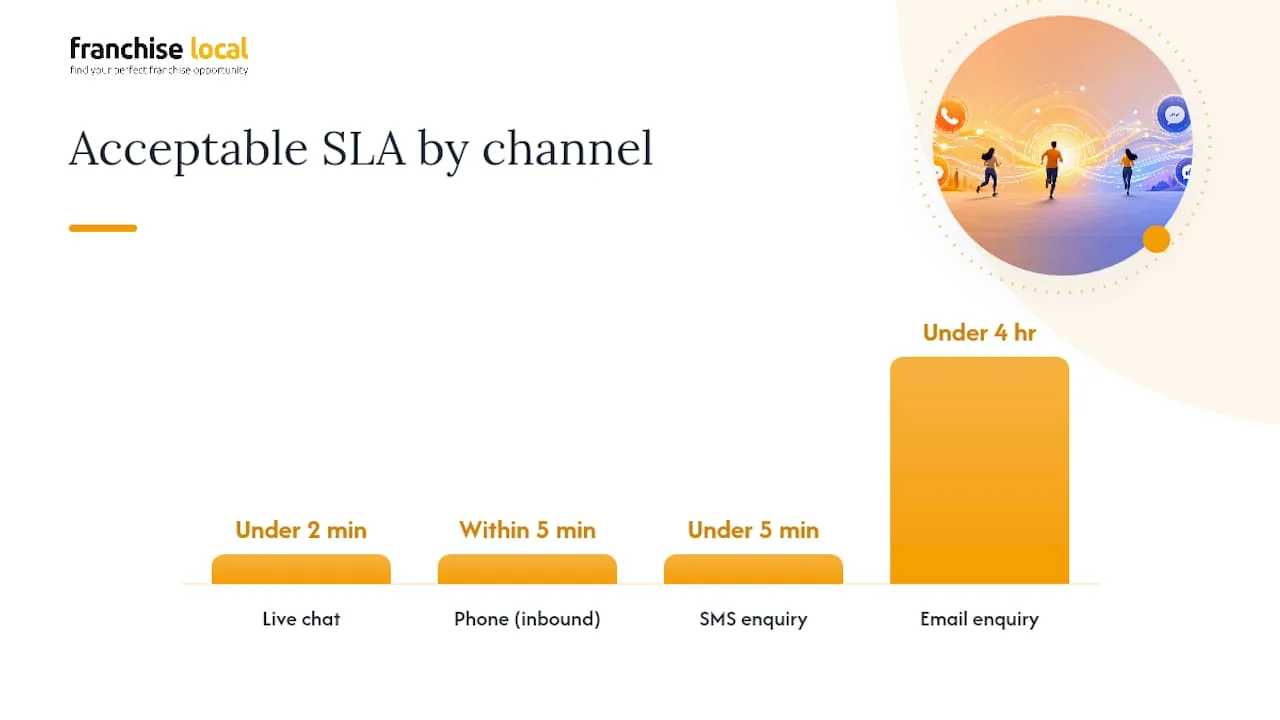
The table below gives recommended SLA targets by channel, grounded in UK benchmarks and franchise-sector norms.
| Channel | Ideal response | Acceptable response | Minimum response | Key tactic |
|---|---|---|---|---|
| Live chat | Under 30 seconds | Under 2 minutes | Under 5 minutes | AI chatbot for out-of-hours; human handoff during business hours |
| Phone (inbound) | Answered live | Callback within 5 minutes | Callback within 1 hour | Missed-call SMS trigger; call routing to on-call rep |
| SMS enquiry | Under 2 minutes | Under 5 minutes | Under 1 hour | Automated reply + personalised follow-up |
| Web form | Under 5 minutes | Under 1 hour | Under 24 hours | Instant auto-acknowledgement + CRM routing |
| Email enquiry | Under 1 hour | Under 4 hours | Under 24 hours | Auto-acknowledgement + template first reply |
| Social media DM | Under 30 minutes | Under 2 hours | Under 24 hours | Monitored inbox; auto-reply with contact details |
Practical SLA language you can adopt:
- “All inbound franchise enquiries receive an automated acknowledgement within 60 seconds and a personalised response from a development consultant within [X] business hours.”
- “High-priority enquiries (investment level above £[X] or multi-unit intent) are escalated to a senior development manager within 5 minutes during business hours.”
Channel-specific tactics worth implementing immediately:
- Always send both SMS and email acknowledgements simultaneously on web form submission; SMS open rates are substantially higher than email
- Route phone enquiries to a shared mobile number monitored by at least two team members
- Set social DM auto-replies that include a direct phone number and a calendar booking link
- For email, configure a dedicated franchise enquiry address separate from your general inbox so filtering rules can trigger instant notifications
How do you measure franchise lead response time accurately?
Measurement is where most franchise development teams fall short. They track volume and conversion but not the time dimension that connects the two. Getting this right requires four core KPIs and a consistent methodology for capturing them.
Core KPIs to track:
- Median time-to-first-response: The midpoint response time across all leads in a period. Use median rather than mean to avoid distortion from outliers (one 72-hour response can skew a mean significantly).
- Percentage contacted within 5 minutes: The share of leads receiving a personalised outreach within the five-minute window. This is your headline performance metric.
- Percentage contacted within 1 hour: A secondary threshold showing your operational floor.
- Percentage contacted within 24 hours: Your minimum coverage rate. Any lead not contacted within 24 hours should trigger an escalation alert.
- Contact attempts per lead: How many outreach attempts are made before a lead is marked as unresponsive. LeadResponseManagement.org’s research recommends multiple attempts across different channels before closing a lead.
- Conversion rate by time bucket: The percentage of leads that progress to a discovery call or application, segmented by how quickly they were first contacted.
How to capture these metrics in your CRM:
Set a custom field for “enquiry submission timestamp” populated automatically from your form or lead source. Set a second field for “first outbound contact timestamp” populated by your rep when they log the first call, SMS, or personalised email. The difference between these two fields is your response time. Never let reps self-report without a logged activity; the CRM activity log timestamp is the authoritative record.
The critical distinction: automated acknowledgement emails must be tagged separately from personalised outreach. If your CRM counts an auto-reply as “first contact,” your metrics will look far better than reality.
Run this report monthly. Within three months, you will have enough data to see the conversion differential between your fastest and slowest response buckets, which is the most persuasive internal case for investing in faster processes.
How should you prioritise and score inbound franchise leads?
Not every enquiry deserves the same urgency. A lead scoring model lets you route the highest-value prospects to your most experienced development consultants within minutes, while lower-priority enquiries enter a structured nurture sequence without consuming senior capacity.
Scoring criteria and suggested weights:
- Investment range declared: Leads indicating investment appetite at or above your target franchise fee score highest. Weight this heavily (30–40% of total score).
- Territory fit: Does the candidate’s location match an available territory? A lead in a saturated territory scores lower regardless of other signals.
- Relevant experience: Prior business ownership, management experience, or sector knowledge increases qualification likelihood.
- Enquiry channel: A phone call or live chat enquiry signals higher immediate intent than a passive web form submission.
- Expressed timeline: “Looking to start within three months” scores higher than “exploring options for next year.”
- Multi-unit intent: Any candidate expressing interest in multiple territories is a high-priority lead by definition.
Routing rules based on score:
- High score (above threshold): Auto-route to senior development consultant with a 5-minute response SLA; trigger simultaneous SMS and phone alert to the assigned rep
- Medium score: Route to development team with a 1-hour SLA; enter into personalised email sequence
- Low score: Enter into automated nurture sequence; human review within 24 hours
Must-route triggers (regardless of overall score):
- Multi-unit or area developer enquiry
- Investment level above £100,000 declared
- Referral from an existing franchisee
- Repeat enquiry from a previously qualified lead
- Enquiry from a candidate who has attended a franchise exhibition or discovery day
For a deeper look at franchise lead qualification frameworks, Franchiselocal’s qualification guide covers scoring models and investment-level segmentation in detail.
A step-by-step response playbook for franchisors
Theory is useful. A working playbook is better. Here is a staged sequence you can implement immediately, with template language for each touchpoint.
Stage 1: Immediate automated acknowledgement (within 60 seconds)
Triggered automatically by your CRM or form tool the moment an enquiry is submitted.
SMS template: “Hi [First Name], thanks for your interest in [Brand] franchising. A member of our team will call you within the hour. In the meantime, here’s a link to our franchise overview: [URL]. Reply STOP to opt out.”
Email subject: “Your [Brand] franchise enquiry — we’ll be in touch shortly”
Stage 2: First human contact (within SLA, ideally within 5 minutes)
The opening call is not a sales pitch. It is a qualification conversation.
Call opener: “Hi [First Name], this is [Name] from [Brand]’s franchise development team. I saw your enquiry come through just now and wanted to reach out personally. Do you have five minutes to talk through what you’re looking for?”
Stage 3: Second attempt (if no answer — within 2 hours of first attempt)
Send a personalised SMS referencing the missed call, and leave a brief voicemail. Do not send a generic follow-up email at this stage; personalised SMS outperforms it.
Stage 4: Third attempt and calendar booking (Day 1, end of business)
Email: Include a direct calendar booking link (Calendly or equivalent) for a 20-minute discovery call. Reference the candidate’s specific enquiry details to show the message is not automated.
Stage 5: Nurture sequence (Days 2–14)
- Day 2: Franchise overview document or video link
- Day 4: Franchisee success story or case study
- Day 7: Invitation to a virtual discovery session or webinar
- Day 14: Final personal outreach from a senior development manager
Recommended cadence summary:
- 0–60 seconds: Automated SMS + email acknowledgement
- 0–5 minutes (high score) or 0–60 minutes (standard): First personalised call
- 2 hours after first attempt: Second call + SMS if no answer
- End of Day 1: Calendar booking email
- Days 2–14: Structured nurture sequence
Pro Tip: Include a direct calendar booking link in every touchpoint from Stage 2 onwards. Candidates who self-schedule a discovery call convert at a significantly higher rate than those who wait for your team to find a mutual slot. Tools like Calendly integrate directly with HubSpot and Salesforce to automate this step.
For practical messaging frameworks, Franchiselocal’s guide on how to attract franchisees in the UK covers conversion-focused recruitment tactics in detail.
Which technology choices actually reduce your response time?
Speed-to-lead is as much an architecture problem as a people problem, according to LeadResponseManagement.org’s research standards. The right technology stack removes the human bottleneck from the acknowledgement and routing steps, leaving your team to focus on the conversations that require genuine expertise.
The core technology categories and what they do:
CRM platforms are the backbone of any response system. HubSpot (UK) and Salesforce (UK) both offer lead routing automation, response time tracking, and SLA alerting out of the box. HubSpot’s free tier is sufficient for smaller franchise development teams; Salesforce scales better for multi-brand or enterprise franchise groups. The key configuration is automatic lead assignment based on scoring rules, not manual inbox monitoring.
Web chat and conversational tools handle the live chat channel. Intercom and Drift both offer AI-assisted chat that can qualify a prospect, answer common questions, and book a discovery call without human involvement. Drift’s conversational marketing approach suits franchise development well because it can route high-intent visitors directly to a calendar booking flow. Zendesk covers the support and ticketing layer, useful when enquiries arrive through multiple channels and need unified tracking.

Telephony and SMS gateways close the phone and text channel. Twilio provides programmable SMS and voice capabilities that integrate with most CRMs, enabling automated SMS acknowledgements triggered by form submissions and missed-call SMS alerts. For UK franchise teams, Twilio’s UK number support and GDPR-compliant messaging infrastructure make it a practical choice.
Integration middleware connects tools that do not natively communicate. Zapier is the most accessible option for franchise teams without dedicated developers: a simple Zap can trigger an SMS via Twilio the moment a HubSpot form is submitted, or alert a Slack channel when a high-score lead arrives. For more complex workflows, a marketing automation checklist covering autoresponders, routing, and calendar booking is a useful reference for small teams building their first automated sequences.
The core trade-offs to understand:
- Speed vs personalisation: Automated responses are fast but generic. The best systems use automation for acknowledgement and routing, then hand off to a human for the first meaningful conversation.
- Cost vs coverage: AI chat tools and SMS gateways add monthly cost but extend your effective response window to 24/7. For franchise brands receiving weekend enquiries, the cost is almost always justified by the conversion uplift.
- AI triage vs human quality: AI-assisted qualification can pre-screen candidates and gather investment-level data before a human makes contact. This saves rep time but risks a cold, transactional first impression if not configured carefully.
Pro Tip: Before deploying AI-assisted responses at scale, run a two-week pilot on a subset of leads and compare qualification rates against your human-only baseline. Configure the AI to hand off to a human the moment a candidate asks a question the bot cannot answer confidently. A poor AI interaction is worse than a slightly slower human one.
For a broader view of how technology supports franchise operations, Franchiselocal’s technology in franchises guide covers the full stack from CRM to field management tools.
What are the most common blockers and how do you fix them fast?
Most franchise development teams are not slow because they lack commitment. They are slow because their systems were not designed with response time in mind. These are the blockers that appear most frequently, and the fixes that work within days rather than months.
Blocker 1: No automated routing
Leads land in a shared inbox and wait for someone to notice them. Fix: configure your CRM to auto-assign leads based on territory or score within seconds of submission. HubSpot and Salesforce both support this natively.
Blocker 2: Weekend coverage gaps
Enquiry volume does not stop on Friday afternoon, but many franchise development teams effectively do. Industry data shows response behaviour worsens significantly at weekends. Fix: establish a weekend on-call rota with a shared mobile number, or deploy an AI chat fallback that captures intent and books Monday morning calls automatically.
Blocker 3: Poor form notifications
Web form submissions trigger an email notification that sits unread. Fix: replace email notifications with SMS alerts to the assigned rep’s mobile. A Zapier integration connecting your form tool to Twilio takes under an hour to configure.
Blocker 4: Single-threaded human dependence
One person handles all enquiries. When they are unavailable, response time collapses. Fix: assign a primary and secondary rep to every lead source, with automatic escalation if the primary does not log a contact attempt within the SLA window.
Blocker 5: Data quality issues
Leads arrive with missing phone numbers, incorrect email addresses, or incomplete territory information, making contact impossible. Fix: add mandatory field validation to your enquiry forms and use a real-time phone number validation tool at the point of submission.
Pro Tip: After implementing any fix, run a before/after comparison using at least 50 leads in each period. Median response time and percentage contacted within one hour are the two metrics that will show improvement fastest. Do not rely on anecdotal rep feedback; the data tells the real story.
UK evidence: what happens when franchisors improve response times?
The UK context is particularly instructive because the baseline is so poor. The Made Smarter white paper documents that UK SMEs face uniquely slow average response performance compared with earlier international benchmarks, which means the upside from improvement is proportionally large.
Headline finding: The Made Smarter analysis reports a 391% conversion differential between responding within one minute and waiting 24 hours or more, with 78% of UK customers purchasing from the first company to respond.
The franchise-specific picture mirrors this. Industry analysis of inbound franchise enquiries found that email averaged roughly 8.8 hours as a first response, while SMS adoption remained low despite substantially higher open rates. Many automated marketing emails were being counted as “responses” in CRM records, which can mask the true gap between submission and genuine first contact.
When franchise brands have implemented integrated automation combining instant acknowledgement, intelligent routing, and calendar booking, the pattern of results is consistent: contact rates rise, discovery call bookings increase, and conversion from enquiry to application improves. SOOM’s practitioner commentary on franchise recruitment cites conversion multipliers from implementing instant qualification and booking flows, and notes that younger candidates in particular treat slow response as a disqualifying signal about the franchisor’s operational culture.
The FranchiseBusinessReview analysis adds the reputational dimension: franchisors who respond quickly are perceived as better-run businesses, which matters to candidates who are evaluating whether they want to stake their own capital on your brand’s operational competence.
What realistic improvement looks like for a UK franchise brand:
| Implementation phase | Typical change | Expected impact |
|---|---|---|
| Automated SMS + email acknowledgement deployed | Response time drops from hours to under 60 seconds for acknowledgement | Candidate drop-off before first contact reduces |
| CRM routing and scoring configured | High-value leads reach senior rep within 5 minutes | Discovery call booking rate increases |
| Weekend on-call rota or AI fallback active | Weekend response gap closes | Weekend enquiry conversion aligns with weekday rates |
| Full cadence and nurture sequence live | Consistent multi-touch follow-up for all leads | Pipeline volume and quality both improve |
A note on applicability: these patterns are drawn from UK SME and franchise-sector data. Results will vary by brand, investment level, and enquiry volume. The conversion differentials are directionally consistent across sources, but your specific uplift depends on your baseline response time and the quality of your follow-up conversations.
Your 30/60/90-day implementation plan and SLA templates
A phased approach lets you capture quick wins immediately while building the infrastructure for sustained improvement. Each phase has clear ownership and a measurable output.
30-day: low-effort wins
- Deploy automated SMS acknowledgement triggered by every web form submission (Zapier + Twilio, or native CRM automation)
- Create and activate email acknowledgement templates for each enquiry channel
- Set up SMS alerts to the development rep’s mobile for every new lead
- Define and document your SLA targets (ideal / acceptable / minimum) per channel
- Establish a baseline: pull median response time and percentage contacted within one hour for the past 90 days
60-day: CRM integration and scoring
- Configure lead scoring rules in HubSpot or Salesforce based on investment level, territory fit, and enquiry channel
- Set up automatic lead routing to assign high-score leads to senior reps within seconds
- Adjust staffing rotas to cover weekend enquiry windows
- Pilot AI chat on your website for out-of-hours enquiries; configure handoff to calendar booking
- Run first before/after comparison on median response time
90-day: full workflow and continuous improvement
- Activate full escalation workflows: if a high-score lead is not contacted within 5 minutes, auto-alert the development manager
- Build a monthly response time dashboard in your CRM or a reporting tool
- Run coaching sessions with development reps using real response time data from the previous month
- Review and refine lead scoring weights based on conversion data
- Implement a lead nurturing sequence for leads that do not convert within the first 14 days
SLA template language (adapt for your brand):
“[Brand] commits to acknowledging all inbound franchise enquiries within 60 seconds via automated SMS and email. A franchise development consultant will make personalised contact within [X] business hours. Enquiries flagged as high priority will receive a call within 5 minutes during business hours (Monday to Friday, 9am–6pm). Weekend enquiries will receive a personalised response by 10am on the next working day.”
Ownership lines for each action:
- Automated acknowledgement setup: Marketing or CRM administrator
- Lead scoring configuration: Head of franchise development + CRM administrator
- Rota adjustments: Head of franchise development
- Dashboard and reporting: CRM administrator or operations lead
- Coaching and review: Head of franchise development
If you are listing franchise opportunities on Franchiselocal and want to make the most of every enquiry that comes through, response time is the single variable most within your control. Every lead that arrives through the Franchiselocal directory represents a candidate who has already decided to explore franchising. Browse the best UK franchise opportunities to see the breadth of options candidates are evaluating, and consider how your response speed positions your brand against every other listing they are reviewing.
Sources
The claims and benchmarks in this article draw on the following primary sources. Each is worth reading in full for the methodology and data behind the headline figures.
- Harvard Business Review — The short life of online sales leads
- Leadresponsemanagement
- The lead response crisis: how poor response times cost UK SMEs billions in lost revenue (Made Smarter white paper)
- SOOM — Gen Z want to buy franchises. Your recruitment process is why they won’t.
- FranchiseBusinessReview — The speed advantage: how rapid lead response drives franchise growth