

A franchise training programme is a structured system that teaches franchisees and their staff how to run a business in line with brand operational and service standards. Every credible franchisor delivers one, but quality varies enormously. Initial training durations range from 3 days for simple mobile services to 12 or more weeks for complex operations. That range reflects the depth of what you need to learn before you open your doors. Measurable performance improvements, covering metrics such as service speed and complaint resolution, should appear within 60–90 days of completing training. Use this franchise training programme guide to know what to expect, what to demand, and how to tell a strong programme from a weak one.

What does a franchise training programme include?
The best programmes cover four distinct disciplines. Franchisees who receive training in only one or two of these areas consistently underperform against those who receive all four.
- Operational training. Daily procedures, product or service delivery, quality control, and health and safety compliance. This is the foundation of every programme and typically occupies the largest share of initial training time.
- Management training. Hiring, scheduling, performance management, and financial literacy. Many franchisors underinvest here, which is a significant gap. Running a team is a different skill from running a till.
- Marketing training. Local marketing tactics, brand standards, customer acquisition, and approved promotional activity. Franchisees who understand local marketing outperform those who rely solely on national campaigns.
- Systems training. Point of sale platforms, inventory management, and reporting tools specific to the franchise. Operational confidence depends on fluency with these systems from week one.
- Certification and ongoing learning. Many franchisors require formal sign-off before a franchisee can trade. Ongoing refresher modules keep standards consistent as the business grows.
- The franchise operations manual. The operations manual is a legally binding document incorporated by reference into the franchise agreement. Any training standard absent from the manual cannot be contractually enforced. Read it before you sign anything.
The manual and the training programme work together. One sets the standard; the other teaches you to meet it. Franchisees who treat the manual as a reference document rather than a living guide tend to drift from brand standards within the first year.
How should you evaluate a franchise training programme before committing?
Evaluating a training programme before you sign is one of the most consequential decisions you will make as a prospective franchisee. Total training hours are a poor proxy for quality. What matters is how those hours are structured.
-
Review Item 11 of the Franchise Disclosure Document (FDD). Item 11 sets out the franchisor’s training obligations in detail. Read the full training agenda, not just the headline hours. A programme listing 200 hours means little if 180 of those hours are classroom lectures.
-
Analyse the ratio of practical to theoretical training. Practical in-field training hours are more predictive of franchisee success than total hours listed in the FDD. Ask specifically what percentage of training takes place on-site in a working location.
-
Calculate the Field Business Consultant to franchisee ratio. The ideal ratio is 1 consultant per 25–30 franchisees. A ratio higher than that signals overloaded consultants who can only offer reactive support. You can calculate this figure directly from the FDD.
-
Speak to existing franchisees. Ask them whether they felt prepared on opening day and how quickly the support team responded when problems arose. Franchisee testimonials are more reliable than any sales presentation.
-
Check the content balance. A programme weighted entirely towards operations and light on management or financial skills will leave you exposed. Ask the franchisor to show you the breakdown of hours by discipline.
-
Assess ongoing training commitments. One-off initial training is not enough. Ask whether refresher training is scheduled, what triggers it, and whether attendance is mandatory or optional.
Pro Tip: Ask the franchisor for the training schedule in writing before your final meeting. Compare it against the FDD Item 11 disclosure. Any gap between the two is a question worth raising directly.
Understanding how training drives results in practice gives you a sharper lens for these conversations. The franchisees who ask the hardest questions during due diligence tend to be the best prepared on launch day.
What best practices make franchise training programmes more effective?
Effective training is not about volume. It is about design. The most effective programmes are built backwards from the outcome, not forwards from a content list.
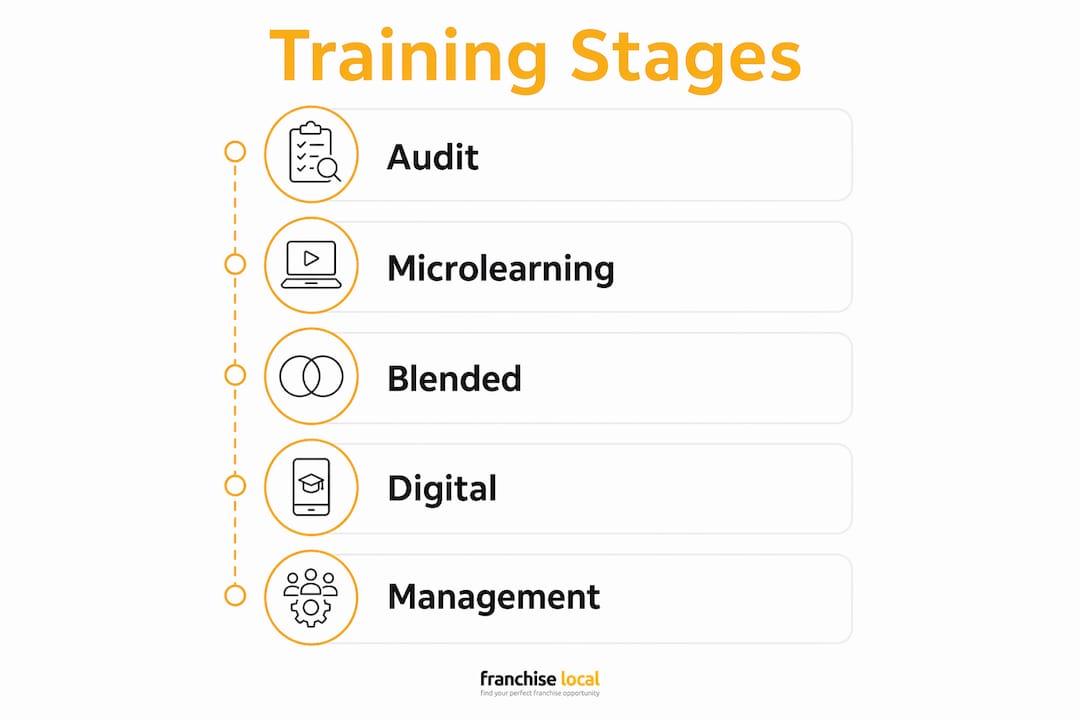
Design from the audit checklist first
The most effective programmes are designed by defining the operational audit checklist first, then building training modules to pass it. This approach ensures every training element connects to a measurable standard. Franchisees trained this way know exactly what success looks like before they open.
Use microlearning for frontline staff
Microlearning modules of 5–15 minutes replace long-form documentation and improve retention among frontline staff. Short, focused modules are easier to complete during shift changes and more likely to be revisited when a specific question arises.
Deliver blended training across three stages
| Training stage | Format | Timing |
|---|---|---|
| Initial headquarters training | Classroom and simulation | Pre-opening |
| On-site practical training | In a live or pilot location | Pre-opening and launch week |
| Ongoing refresher training | Digital modules and field visits | Triggered by audits or performance dips |
Blended delivery works because different skills embed at different speeds. Operational procedures need repetition in a real environment. Financial literacy benefits from structured classroom time. Refresher training should be triggered by specific events, such as a failed audit or a new product launch, rather than by a generic annual calendar.
Use digital checklists as daily training tools
Digital checklists serve two functions simultaneously. They guide staff through correct procedures during the working day and generate audit data that reveals where training has not embedded. Franchisors who use checklist data to update training content close the feedback loop that most programmes leave open.
Pro Tip: When you review a franchisor’s training materials, ask whether their operational checklists are digital and whether the data feeds back into training updates. A franchisor who cannot answer that question clearly has a passive training system, not an active one.
The skills every franchisee needs to succeed go beyond operational knowledge. The best training programmes build management confidence alongside technical competence.
What are the common challenges franchisees face with training programmes?
Training programmes fail for predictable reasons. Knowing them in advance lets you ask better questions and choose a franchisor who has solved them.
-
Low engagement from frontline staff. Training designed for franchisees often does not translate well to part-time or hourly staff. Low participation in ongoing training signals that the content does not address the real challenges staff face on the floor. Ask the franchisor what their staff completion rates look like for ongoing modules.
-
Overemphasis on operations at the expense of management skills. Franchisors are experts in their product or service. They are not always experts in teaching people management or financial planning. Franchisees who lack management training struggle with staff turnover and cost control within the first 18 months.
-
No feedback loop from audits to training. Many franchisors conduct operational audits but do not use the results to update training content. This means the same mistakes recur across the network. Ask whether audit findings are reviewed quarterly and whether they inform training revisions.
-
Unrealistic expectations about the learning curve. Initial training gives you a foundation, not mastery. Franchisees who expect to feel fully confident on opening day are often disappointed. The 60–90 day window for measurable improvement is realistic. Plan for a period of supported operation, not immediate independence.
-
Passive franchisor support after training ends. A Field Business Consultant who manages 40 or 50 franchisees cannot provide proactive support. They can only respond to crises. Knowing the consultant-to-franchisee ratio before you sign tells you whether support will be proactive or reactive.
The solution to most of these challenges is the same: choose a franchisor whose training programme is outcome-oriented, regularly updated, and backed by a support team with the capacity to engage proactively. A well-structured training pathway is one of the clearest signals that a franchisor takes network performance seriously.
Finding franchises with strong training support at Franchiselocal
Franchiselocal lists hundreds of UK franchise opportunities across sectors where structured training is a core part of the offer. Financial business franchises and networking franchises are two categories where franchisors typically invest heavily in franchisee preparation, given the regulatory and relationship demands of those industries. Franchiselocal makes it straightforward to filter by industry, investment level, and location, so you can identify opportunities that match both your budget and your expectations for training quality. If you are at the stage of comparing franchise models, the UK franchise directory is the most practical place to start.
FAQ
What is a franchise training programme?
A franchise training programme is a structured system delivered by a franchisor to teach franchisees and their staff how to operate the business to brand standards. It typically covers operations, management, marketing, and systems.
How long does franchise training last?
Training duration ranges from 3 days for simple mobile service franchises to 12 or more weeks for complex operations. Duration alone does not indicate quality; the ratio of practical to theoretical training is a better measure.
What is FDD Item 11 and why does it matter?
Item 11 of the Franchise Disclosure Document sets out the franchisor’s training obligations in detail. Reviewing it lets you verify whether the training agenda matches what the franchisor has promised verbally.
What is a good Field Business Consultant to franchisee ratio?
The ideal ratio is 1 Field Business Consultant per 25–30 franchisees. Ratios higher than this indicate consultants are overloaded and can only offer reactive rather than proactive support.
How do I know if a franchise training programme is effective?
Look for measurable performance improvements within 60–90 days of training completion, high franchisee participation in ongoing modules, and a franchisor who uses operational audit data to update training content regularly.