

UK franchises report profitability rates of 89 to 93%, compared to a 50% failure rate for independent start-ups within five years. That gap is not luck. It is the direct result of systems, support, and above all, training. Many aspiring franchisees focus their research on brand reputation or territory potential, and they overlook the training infrastructure that actually determines whether the investment pays off. This guide breaks down exactly why franchise training is the backbone of operational success, brand consistency, and long-term investment value in the UK market.
Key Takeaways
| Point | Details |
|---|---|
| Training boosts franchise success | Strong training is a key factor behind the UK franchise sector’s higher profitability and lower failure rates. |
| Quality varies between brands | Prospective franchisees should carefully assess both initial and ongoing training offers before investing. |
| Ongoing learning ensures resilience | Continuous training empowers franchisees to adapt to changes, protect brand consistency, and maximise their investment. |
| Ask the right questions | Direct questions about training scope, content, and results can help you spot the best franchise opportunities. |
Understanding the value of training in franchising
Franchise training is not a welcome bonus or a short induction week. It is the mechanism by which a proven business model is transferred from franchisor to franchisee, reliably and at scale. Without it, you are not buying into a system. You are simply borrowing a brand name.
There are two core types of training in franchising. Initial training covers everything you need to launch: operations, brand standards, software, customer service, and compliance. Ongoing training keeps you sharp after launch, introducing you to new products, updated regulations, and evolving best practices. Both matter equally, and the strongest franchisors treat neither as optional.
Here is what quality franchise training typically covers:
- Operational procedures and quality control
- Financial management and reporting
- Sales, marketing, and customer acquisition
- Staff recruitment, management, and HR compliance
- Health and safety regulations
- Brand standards and customer experience
- Technology and systems used by the network
The types of franchise training available across UK brands vary considerably, which is why understanding what good looks like before you sign anything is critical.
“Training is what separates a scalable franchise from an expensive lesson. It is the conduit through which brand integrity, operational consistency, and investment returns are all delivered.”
The bfa Franchise Survey 2024 confirms that training ensures the consistency vital for brand integrity and investment ROI. In practical terms, this means that every customer interaction, every product delivered, and every staff decision in your outlet reflects directly on the wider network. Training is what keeps that reflection positive.
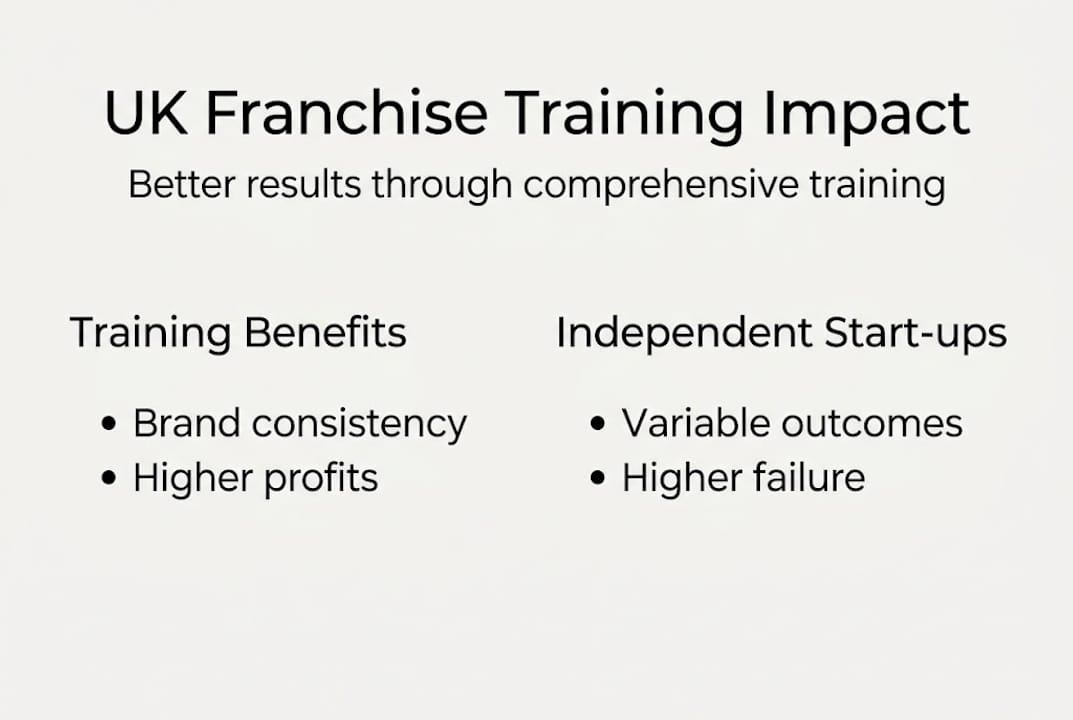
For investors evaluating a franchise, the quality of training on offer is one of the strongest signals of whether the franchisor has genuinely systematised their model, or is simply selling licences.
How training shapes franchisee success and business performance
Data tells a compelling story. UK franchise failure rates sit at just 0.5 to 1% annually, while independent start-ups fail at ten times that rate or more within five years. Training, combined with proven operational models, is a central reason for that resilience.

| Metric | UK franchisees | Independent start-ups |
|---|---|---|
| Profitability rate | 89 to 93% | Varies widely |
| Annual failure rate | 0.5 to 1% | Up to 10% annually |
| 5-year survival rate | Very high | Approximately 50% |
| Access to structured training | Standard | Rare |
These figures make a powerful case. But the numbers only tell part of the story. The real mechanism behind them is that franchisees are not figuring things out alone. They are applying tested methods, supported by structured teaching from day one.
Robust franchise training programmes typically build the following skills:
- Marketing and lead generation tailored to the brand’s target customers
- Financial literacy, including cash flow management and P&L interpretation
- Staff management, covering recruitment, training, and performance appraisals
- Regulatory compliance, including employment law and sector-specific rules
- Customer retention strategies and complaint handling
Understanding why franchises succeed in the UK often comes down to this exact combination of skills delivered through structured programmes. Without them, even a motivated franchisee can find themselves overwhelmed by operational complexity.
The evidence-backed franchise benefits are clear: franchisees with comprehensive training report stronger revenue growth, higher customer satisfaction, and significantly lower stress levels in the critical first year.
Pro Tip: Before committing to any franchise, ask if you can review actual training materials or observe a current training session. Any credible franchisor will welcome this. Hesitation on their part is a red flag worth taking seriously.
What to expect from initial and ongoing franchise training
Knowing that training matters is one thing. Understanding what it actually looks like in practice helps you evaluate offers with far greater precision.
| Training type | Goals | Typical content | Duration |
|---|---|---|---|
| Initial onboarding | Launch readiness | Operations, brand standards, software, compliance | 1 to 4 weeks |
| Ongoing training | Growth and adaptation | Product updates, regulation changes, refresher modules | Quarterly or annual |
After your initial training is complete, a well-structured franchise should take you through a clear progression:
- Certification or assessment to confirm you have met the brand’s operating standards
- Supervised launch where a field support manager assists with your opening period
- Independent operation with access to a support helpline and peer network
- Regular reviews measuring performance against key metrics
- Refresher and upskilling modules as the brand evolves or regulations change
The franchise onboarding guide on Franchise Local walks through what a smooth start genuinely looks like, and it is worth reading before you compare any offers.
Training that stops at launch is a warning sign. The best franchisors build ongoing education into the network because franchise support systems are what keep standards high across tens or hundreds of locations simultaneously. As the evidence shows, training contributes to long-term resilience, not just a strong opening week.
Pro Tip: When comparing franchises, ask specifically what training looks like in year two and year three, not just the initial programme. Brands that invest in long-term upskilling are the ones serious about network-wide success.
Evaluating franchise training offers: Questions every franchisee should ask
A polished brochure and a glossy training schedule are not the same as a genuinely effective training programme. Before you commit your investment, you need to interrogate what is actually on offer.
Here are the essential questions to ask every franchisor:
- What does the initial training programme cover in full, and how long does it last?
- Who delivers the training? Are they experienced practitioners or staff with limited field experience?
- How is ongoing training structured, and how frequently does it occur?
- How do you measure training outcomes? Can I see data on franchisee performance improvements?
- What happens if I struggle after launch? Is there remedial support available?
- Can I speak with existing franchisees about their real experience of training?
- Is training updated regularly to reflect changes in legislation, technology, or market conditions?
Red flags to watch for include vague answers about training frequency, reluctance to share training content before signing, and franchisees who report feeling unsupported after the initial launch period.
The bfa Franchise Survey 2024 highlights that training consistency is vital to protecting brand integrity and delivering the investment returns that make franchising attractive in the first place.
Reviewing franchise training programmes across different sectors reveals a wide range in quality and depth. Similarly, evaluating support systems alongside training will give you a complete picture of how a franchisor backs its network.
The ROI angle here is simple: a franchise that invests heavily in training is protecting its own reputation, which means it is also protecting yours. When you see a franchisor who treats training as a cost to minimise rather than a value to deliver, walk away. Your investment deserves better.
Our perspective: The hidden multiplier behind franchise success
Most guides to franchising spend a great deal of time discussing brand strength, territory rights, and royalty structures. Far fewer talk honestly about what actually saves franchisees from failure: training that is thorough, current, and genuinely supported.
In our view, world-class training is the real predictor of franchise survival, not the brand’s social media following or the gloss of its marketing collateral. We have seen well-known names collapse because their training was superficial and their support non-existent. Conversely, less prominent brands with rigorous programmes produce franchisees who outperform far bigger competitors.
Insufficient training sits behind most franchise struggles. Not market conditions. Not bad luck. Underprepared franchisees operating in a complex environment without adequate guidance.
Here is the practical test: talk to existing franchisees. Not the ones the franchisor directs you to, but ones you find independently. Ask them specifically about their training experience, what was missing, and whether they felt ready. Their honesty will tell you more than any disclosure document.
Understanding why franchises fail almost always leads back to inadequate preparation and insufficient ongoing support. Training is not a feature of a good franchise. It is the foundation.
Next steps: Find the right franchise and training support
If you are ready to invest in a franchise that takes training seriously, the next step is finding opportunities where that commitment is clearly demonstrated. Use the franchising guide on Franchise Local to understand what strong franchise systems look like from the inside. Browse our franchise directory to explore UK opportunities filtered by sector, investment level, and lifestyle fit. You can also connect with franchise service providers who specialise in due diligence, legal advice, and pre-investment assessment. Finding a franchise that genuinely invests in its people is the clearest path to a resilient, profitable business.
Frequently asked questions
Why is training more important in franchising than in independent start-ups?
Training standardises operations across an entire network, protects brand consistency, and gives franchisees a tested system to follow rather than building from scratch. The bfa Franchise Survey 2024 confirms this consistency is fundamental to investment ROI and brand integrity.
What does ongoing franchise training typically involve?
Ongoing training covers operational updates, new product introductions, changes in regulation, and periodic refresher courses. Training contributes to resilience not just at launch but throughout the full life of the franchise.
How can I tell if a franchise invests properly in training?
Look for a structured onboarding programme, regular upskilling sessions, measurable outcomes, and consistently positive feedback from current franchisees when contacted independently.
Does better training really reduce the risk of business failure?
Yes. UK franchise failure rates of 0.5 to 1% annually, compared to around 50% for independent start-ups within five years, demonstrate clearly that robust training and support structures make a substantial difference to long-term survival.