

Franchise market research is the systematic process of gathering and analysing information to assess whether a franchise opportunity is commercially viable before you commit capital. Knowing how to conduct franchise market research correctly separates profitable investments from costly mistakes. UK franchise investment typically falls between £50,000 and £100,000, which means the stakes are too high to rely on a franchisor’s brochure alone. The British Franchise Association sets ethical standards that serve as a baseline benchmark, and franchise disclosure documents provide the raw data you need to make an evidence-based decision.
How to conduct franchise market research: what you need first
Before you analyse a single market trend, you need the right documents in front of you. Franchise research without primary source material is guesswork. The core documents every prospective franchisee must obtain are listed below.
| Document | Purpose in research |
|---|---|
| Franchise Disclosure Document (FDD) | Reveals fees, territory rights, earnings claims, and exit terms |
| Financial projections | Tests whether income forecasts are realistic against market data |
| Companies House filings | Confirms franchisor financial health and trading history |
| Franchise agreement | Defines legal obligations, renewal terms, and restrictions |
The FDD is the most critical document in your research process. Treat it as a diagnostic tool to detect hidden financial and legal risks, not as marketing material. It contains the raw evidence you need to validate every claim a franchisor makes.
Professional advisers are non-negotiable at this stage. A specialist franchise solicitor reviews contractual obligations and flags unfair clauses. An independent accountant stress-tests the financial projections against realistic trading conditions. Both advisers must complete their review at least 14 days before you sign anything or make a non-refundable payment. That window exists to protect you from rushed decisions.
- Obtain the FDD and franchise agreement in full before any meeting with the franchisor
- Confirm the franchisor’s BFA membership status as an initial quality benchmark
- Download Companies House filings independently, not via documents supplied by the franchisor
- Appoint a franchise solicitor and accountant before reviewing any financial figures
Pro Tip: Ask the franchisor for a sample FDD before you pay any discovery fee. A franchisor who refuses to share one early is signalling a lack of transparency.
How do you gather and analyse market data for a franchise sector?
Market data analysis is where franchise research methods move from document review into active intelligence gathering. The goal is to understand whether genuine customer demand exists in your target area, and whether the sector is growing or contracting.

The two primary research methods are quantitative and qualitative. Quantitative methods include surveys, secondary data analysis from industry reports, and demographic studies from sources such as the Office for National Statistics. Qualitative methods include interviews with potential customers, focus groups, and conversations with existing franchisees. Both methods are necessary. Quantitative data tells you the size of the opportunity; qualitative data tells you whether customers will actually choose your franchise over alternatives.
Three metrics define market sizing in any franchise feasibility study:
- Total Addressable Market (TAM): The full revenue opportunity if you captured every possible customer in the sector
- Serviceable Addressable Market (SAM): The portion of TAM you can realistically reach given your territory and model
- Serviceable Obtainable Market (SOM): The share you can capture in the near term based on competition and capacity
Understanding the difference between TAM and SOM prevents the most common research error: confusing a large market with a profitable one. A sector with a £500 million TAM may still deliver a poor SOM if it is saturated with established operators.
Reliable secondary data sources for UK franchise market analysis include IBISWorld industry reports, Mintel sector studies, and trade association publications. For sector-specific demand, local authority planning data and retail footfall statistics provide granular insight that national reports miss.
Pro Tip: Cross-reference any market size figure a franchisor quotes against at least one independent industry report. Franchisors sometimes cite optimistic TAM figures without clarifying the much smaller SOM relevant to a single territory.
How to analyse franchise opportunities through competitive and financial scrutiny
Competitive analysis and financial due diligence are the two disciplines that separate serious franchise investors from those who rely on hope. Both require independent verification, not franchisor-supplied summaries.
Competitive analysis
Start by mapping every direct and indirect competitor operating in your target territory. Visit their premises, review their pricing, and assess their customer reviews on Google and Trustpilot. The goal is to understand whether the franchise model you are evaluating offers a genuine advantage, or whether it is entering a market already well served by established operators.
Ask the franchisor for concrete evidence of recent adaptations made in the past 12–24 months, whether operational, technological, or marketing-related. A franchisor who cannot demonstrate recent evolution is likely operating a static model in a changing market. That is a risk, not a selling point.
Financial scrutiny
Verify the franchisor’s financial health through Companies House records, examining cash flow, revenue consistency, and debt levels across at least three years of filings. A franchisor with declining revenue or growing debt is a warning sign regardless of how strong the brand appears.
Franchise agreements often contain costs that do not appear in headline fee summaries. Look for supplier rebates and mandatory software levies buried in the FDD, as these represent real costs that reduce your net income. A franchise with a 10% royalty and a 3% marketing levy plus a mandatory £200 per month software fee has a very different financial profile from one with a 10% royalty alone.
Financial data in the FDD must be honest, evidenced, and clearly explained, with distinctions made between sample populations and assumptions. If the earnings claims are based on the top 20% of franchisees, they are not representative of what you should expect in year one.
Pro Tip: Ask your accountant to build a worst-case financial model using the bottom quartile of franchisee earnings from the FDD. If that model still covers your costs, the investment has a genuine safety margin.
How do you verify franchise claims and avoid research pitfalls?
Verification is the final and most overlooked stage of franchise market analysis. Franchisors present their best case. Your job is to test it independently.
The most reliable verification method is speaking directly with current and former franchisees. Current franchisees may be cautious about criticising the franchisor, so former franchisees often provide more candid assessments. Ask both groups the same questions: Did actual earnings match projections? Was the support promised actually delivered? Would they invest again?
Anonymous franchisee satisfaction surveys provide the only unfiltered insight into real franchisee experience and business viability. These surveys, conducted independently of the franchisor, reveal patterns that individual conversations may miss. If a franchisor cannot point you to any independent satisfaction data, treat that absence as a red flag.
Common research pitfalls to avoid:
- Accepting earnings projections without asking for the underlying sample size and assumptions
- Reviewing only franchisee contacts supplied by the franchisor, who will naturally provide their most satisfied operators
- Ignoring territory overlap clauses that allow the franchisor to open competing units nearby
- Failing to check whether the franchise agreement terms align with what was promised verbally during the sales process
- Skipping the due diligence process because the brand feels trustworthy
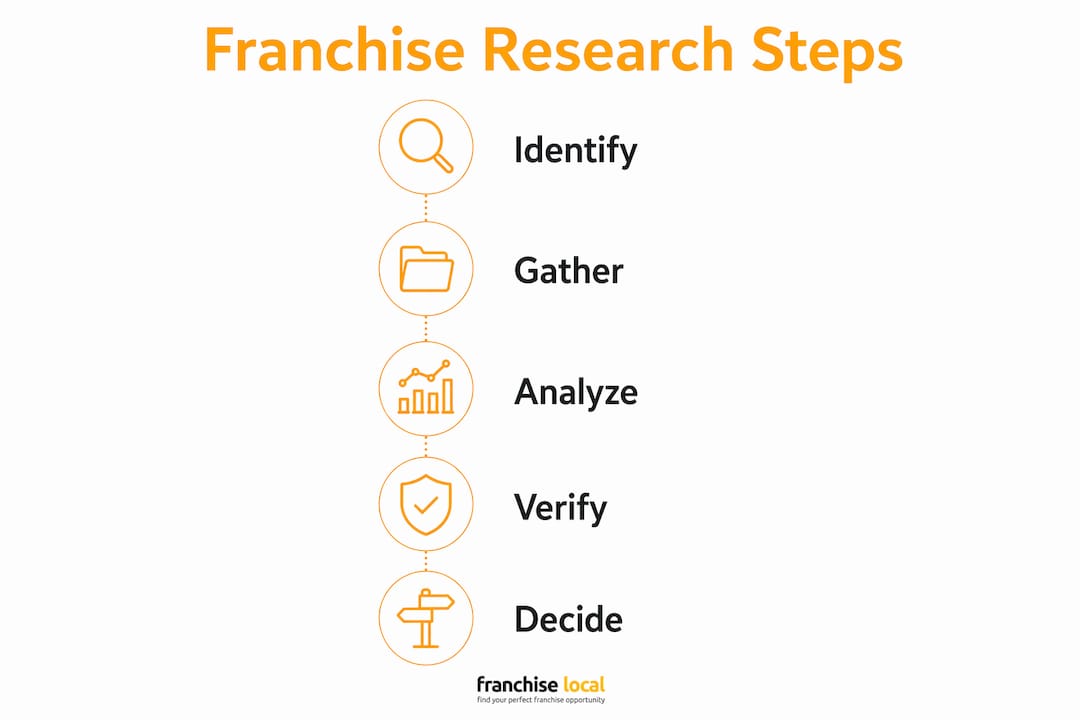
A reliable franchise research workflow follows this sequence:
- Obtain and review all primary documents including the FDD and Companies House filings
- Appoint a franchise solicitor and independent accountant before any financial commitment
- Conduct market sizing using TAM, SAM, and SOM frameworks for your target territory
- Gather competitive intelligence through direct observation and independent data sources
- Interview a minimum of five current franchisees and two former franchisees
- Cross-reference all franchisor earnings claims against independent franchisee accounts
- Allow the full 14-day review window before signing any agreement or making any payment
Pro Tip: Request the full list of current and former franchisees from the franchisor, not a curated shortlist. In the UK, franchisors operating under BFA standards are expected to provide this on request.
Franchiselocal: your starting point for franchise sector research
Once your research framework is in place, you need a reliable source of vetted franchise opportunities to apply it to. Franchiselocal is the UK’s leading franchise directory, listing opportunities across every major sector and investment level. You can filter by budget, industry, location, and lifestyle preference to align your search directly with your market research findings. Whether your analysis points you towards business services franchises or a broader scan of the top UK franchise opportunities, Franchiselocal gives you the breadth to compare options efficiently. Each listing includes investment details and sector context, so you can move from research to shortlisting without switching platforms.
FAQ
What is franchise market research?
Franchise market research is the process of gathering and analysing data to assess whether a franchise opportunity is commercially viable in a specific market. It covers sector demand, competitive conditions, financial projections, and franchisor credibility.
How long does franchise market research take?
A thorough franchise feasibility study typically takes four to eight weeks, allowing time for document review, franchisee interviews, competitive analysis, and professional adviser input. Rushing this process is the leading cause of poor franchise investment decisions.
What documents are needed for franchise due diligence?
The core documents are the Franchise Disclosure Document, the franchise agreement, the franchisor’s Companies House filings, and independently prepared financial projections. A specialist franchise solicitor and accountant must review these before signing.
How do I verify a franchisor’s earnings claims?
Financial data in the FDD must include the sample size and assumptions behind any earnings figures. Cross-reference those figures against accounts from multiple current and former franchisees to test whether they reflect typical rather than exceptional performance.
Why does BFA membership matter in franchise research?
BFA membership indicates the franchisor adheres to the British Franchise Association’s ethical standards, providing a baseline level of confidence in their operating practices and disclosure obligations.