

TL;DR:
- Mobile franchises offer low startup costs and eliminate the need for physical premises.
- Earnings vary but can reach £70k–£1m+ annually with strong territorial exclusivity.
- The model benefits from UK consumer trends favoring on-location services and scalable growth.
Mobile franchise ownership carries a stubborn myth: that running a real business means paying for a shopfront, business rates, and a long commercial lease. The reality is quite different. Startup costs as low as £4k–£30k +VAT put genuine business ownership within reach for thousands of UK investors who previously assumed franchising was only for those with six-figure war chests. This guide walks you through exactly what a mobile franchise model is, how the costs compare, what you can realistically earn, and the practical steps to get started with confidence.
Key Takeaways
| Point | Details |
|---|---|
| Low cost to start | You can enter a UK mobile franchise for as little as £4k–£30k plus VAT, making the model widely accessible. |
| Strong earning potential | Leading UK mobile franchises report annual profits between £70,000 and £325,000 or more for ambitious operators. |
| Flexible and scalable | Mobile franchises suit adaptable working and can scale with demand—just be mindful of logistics and territory strategy. |
| Key risks to manage | Operational risks like fuel costs and vehicle dependence are real but can be reduced with the right support and systems. |
What is a mobile franchise model?
A mobile franchise model means you deliver your product or service directly to customers, wherever they are, rather than waiting for them to visit a fixed location. You are the business. You go to them. This simple shift removes the single biggest cost in traditional retail: the premises.
Think about the range of sectors already thriving on this model across the UK:
- Van-based repair services such as windscreen repair, car bodywork, and mobile mechanics
- Home wellness and beauty including mobile hairdressing, massage therapy, and personal training
- Cleaning and property maintenance covering domestic, commercial, and specialist cleaning
- Technology and IT support delivered directly to homes and small businesses
- Food and beverage via mobile catering units and specialist delivery brands
What makes this model particularly attractive is the freedom it gives you. You work from home when you are not on the road, you set your own schedule, and you keep your overheads remarkably low. Mobile franchises let you operate without retail premises, which slashes both your setup costs and your monthly outgoings significantly. Understanding the franchise model basics is the first step before committing to any specific brand.
The sector is also growing quickly. Post-2025 UK business incentives have favoured mobile operators, particularly those running van-based services, as government policy has shifted away from supporting high-street retail dependency. Consumer habits have reinforced this too: people increasingly expect services to come to them rather than the other way around.
Pro Tip: Use your mobility as a genuine competitive advantage. Rather than covering a broad patch thinly, identify the two or three most affluent or high-density postcodes in your territory and concentrate your early marketing there for faster returns.
Cost comparison: Mobile vs. fixed-location franchises
Now that you know what a mobile franchise is, see how the costs stack up against traditional counterparts. The numbers are striking.
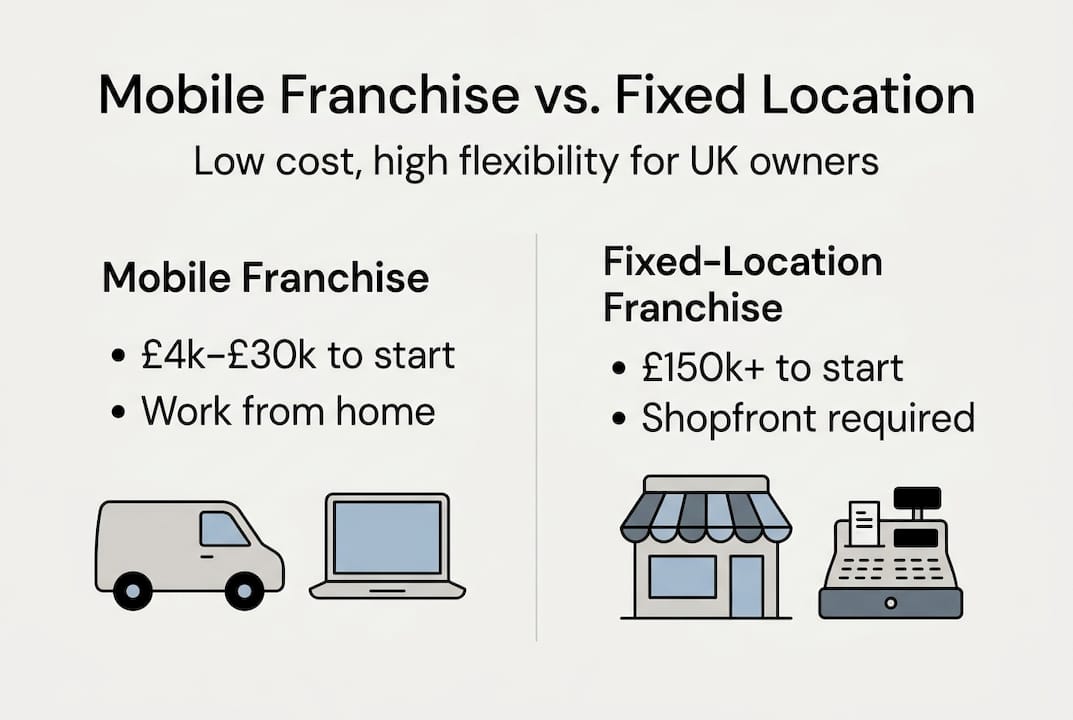
Startup costs for mobile franchises range from £4k–£30k +VAT, compared to £150k–£400k or more for restaurant and other site-based brands. That is not a marginal difference. That is a fundamentally different level of financial risk.
| Cost category | Mobile franchise | Fixed-location franchise |
|---|---|---|
| Initial investment | £4,000–£30,000 +VAT | £150,000–£400,000+ |
| Monthly rent | None | £2,000–£15,000+ |
| Business rates | None | £5,000–£30,000 per year |
| Fit-out costs | None | £20,000–£100,000+ |
| Fuel and vehicle | £3,000–£8,000 per year | Minimal |
| Gross margin potential | 40–70% | 20–50% |
The key advantages for mobile operators include:
- No rent or business rates, freeing up capital for marketing and growth
- Lower staffing requirements in the early stages, since you are the primary operator
- Faster break-even, often within 6–12 months rather than 2–3 years
- Easier scaling, since adding a second van costs far less than opening a second site
The trade-off is real though. Fuel costs, vehicle maintenance, and the logistical demands of travelling between jobs add up. Reviewing the full range of UK franchise types helps you benchmark mobile against other models honestly. For a broader view of what drives service franchise investment in the UK, sector-specific data is invaluable. The UK franchise cost overview from the British Franchise Association confirms that lower capital entry is one of the primary drivers behind mobile franchise growth.
Statistic to note: On average, mobile franchise startup costs are roughly 10 times lower than fixed-location equivalents. That difference in capital exposure changes your risk profile entirely.
Earning potential and empirical UK results
Understanding cost is vital, but real income potential seals the deal for many UK investors. Here is what the numbers actually show.

Mobile franchise earnings vary significantly by brand, territory size, and whether you operate as a single van or grow into a management model. However, the benchmarks from established UK brands are encouraging. Brands like ChipsAway and Revive! report earnings of £70k–£1m+ annually, depending on scale and territory performance.
| Brand type | Model | Typical annual earnings |
|---|---|---|
| Mobile car repair | Single operator | £70,000–£120,000 |
| Mobile cleaning | Owner-managed team | £80,000–£180,000 |
| Mobile tech support | Single van | £60,000–£100,000 |
| Mobile food/catering | Single unit | £50,000–£90,000 |
| Management franchise | Multi-van operator | £150,000–£325,000+ |
A few things drive these figures upward:
- Territory exclusivity means no internal competition from other franchisees in your area
- Repeat customer base builds quickly in service sectors like cleaning and maintenance
- Upselling opportunities are strong when you are face-to-face with customers regularly
- Low fixed costs mean a higher proportion of revenue translates directly into profit
Exploring UK mobile franchise examples gives you a practical sense of what real brands are offering. Browsing top franchise opportunities across sectors helps you compare mobile options against the wider market. Understanding why UK franchises succeed also reveals the structural advantages that make franchising a safer route than going it alone.
Pro Tip: When evaluating a mobile franchise, always ask the franchisor for verified income figures from existing franchisees, not projections. Real operators in comparable territories will give you the most honest picture of what you can achieve.
Pros and cons: Is a mobile franchise model right for you?
You have seen the earning potential. Here are the strengths and weaknesses so you can make a fully informed decision.
The core advantages of mobile models include low capital requirements, genuine flexibility, and the ability to scale rapidly without the burden of property commitments. The disadvantages centre on vehicle dependency, fuel cost exposure, and the management demands that come with growth.
“Mobile franchise models scale faster than almost any other format, but the operators who genuinely thrive are those who treat it as a leadership challenge from day one, not just a driving job.”
Ask yourself these questions before committing:
- Are you comfortable working independently without a fixed base or colleagues nearby?
- Can you manage the physical and logistical demands of travelling daily across a territory?
- Do you have the people skills to build a loyal local customer base quickly?
- Are you prepared to eventually step back from the van and manage a team instead?
- Can you absorb a vehicle breakdown or unexpected fuel cost spike without financial stress?
Key pros at a glance:
- Flexible working hours and location
- Low entry cost and faster break-even
- Scalable from one van to a full management operation
- Strong franchisor support and proven systems
Key cons to weigh up:
- Vehicle and fuel costs are ongoing and unpredictable
- Staff turnover can be higher in mobile roles
- Less centralised control as you grow your team
Comparing a franchise vs startup approach clarifies why the franchise route reduces early-stage risk considerably. The advantages of franchises over independent startups are particularly pronounced in mobile sectors where brand recognition accelerates customer trust.
Steps to succeed with a mobile franchise in the UK
Knowing the pros and cons, you are ready to consider the step-by-step route to securing and growing a mobile franchise.
Exclusive territories and strong franchisor support are the two factors most consistently linked to mobile franchise success. Without them, risks like fuel costs and vehicle breakdowns become much harder to manage profitably.
Here is a clear pathway from interest to launch:
- Research brands thoroughly. Compare at least five mobile franchise brands in your preferred sector. Look at their track record, franchisee reviews, and income disclosures.
- Assess territory availability. Confirm that your preferred postcode area is available and that the territory is large enough to sustain your income targets.
- Speak to existing franchisees. Contact at least three current operators. Ask about their first-year experience, franchisor responsiveness, and realistic earnings.
- Review the franchise agreement carefully. Engage a solicitor with franchise experience before signing anything. Check renewal terms, exit clauses, and territory protections.
- Secure your funding. Many UK banks offer franchise-specific lending. Prepare a business plan using the franchisor’s financial models as a foundation.
- Complete training and launch. Most mobile franchisors provide intensive initial training. Use this period to build your local marketing presence before your first day on the road.
Pro Tip: Prioritise franchises that publish verified UK income figures and offer ongoing field support, not just an initial training week. The quality of post-launch support is often what separates thriving franchisees from struggling ones.
Browsing new franchise opportunities regularly keeps you updated on emerging mobile brands entering the UK market. Searching by industry lets you filter mobile opportunities by sector, making it easier to find a match for your skills and interests.
A fresh perspective: Why mobile franchising is changing the UK game
Here is a view that most franchise guides will not share with you. The shift toward mobile franchise models is not simply a response to high property costs. It reflects something deeper: a fundamental change in how British consumers expect to receive services and how ambitious entrepreneurs want to build businesses.
The pandemic accelerated a trend that was already forming. Customers grew accustomed to services arriving at their door. That expectation has not reversed. If anything, it has hardened into a preference. Mobile franchise operators are not just saving money on rent. They are positioning themselves at the centre of a lasting behavioural shift.
The operators who treat their mobile franchise as purely a cost-saving measure tend to plateau early. Those who treat it as a platform for genuine customer relationships, built through consistent, personal, on-location service, are the ones who scale into management franchises and build real wealth. As management-style mobile franchises scale faster than almost any other format, the ceiling is genuinely high for those who develop their leadership skills alongside their technical ones. Understanding what makes UK franchises succeed confirms that mindset and systems matter as much as the model itself.
Explore top UK mobile franchise opportunities
If the mobile franchise model fits your vision, real options are only a click away. Franchise Local brings together hundreds of verified UK franchise listings, including a wide range of mobile and van-based opportunities across every major sector. Whether you are looking for a low-cost entry point or a management-level investment, the directory filters by budget, location, and lifestyle preference to match you with the right opportunity. Our UK franchising guide walks you through the process from first enquiry to signed agreement. You can also explore networking franchises and connect with franchise service providers who specialise in legal, financial, and operational support for new franchisees.

Frequently asked questions
How much does it really cost to start a mobile franchise in the UK?
Launch costs typically range from £4,000 to £30,000 plus VAT, which is well below what most retail-based franchises require to get off the ground.
What annual income can I expect from a successful UK mobile franchise?
Top operators can earn between £70,000 and well over £300,000 a year before tax, with brands like ChipsAway and Revive! reporting strong benchmarks depending on territory and scale.
Are mobile franchise models risk-free?
No model is risk-free. Mobile franchise risks include vehicle dependency, fuel cost fluctuations, and staff turnover, but strong franchisor support and exclusive territory rights significantly reduce these exposures.
Why are van-based franchises thriving in the UK?
With over 34 million registered vehicles on UK roads, demand for mobile repair, maintenance, and support services remains consistently high and shows no sign of slowing.
Do mobile franchises qualify for post-2025 business tax reliefs in the UK?
Yes. Recent UK budgets have introduced property and business reliefs that particularly benefit mobile operators with low fixed-cost structures, making expansion more financially viable than ever.