

Franchise arbitration is defined as a binding alternative dispute resolution (ADR) method where an impartial arbitrator resolves disputes between franchisors and franchisees outside of court. Unlike mediation, the arbitrator’s decision is final and legally enforceable. The franchise arbitration process explained here covers the full picture: how UK law shapes it, what steps you follow, and how to protect your position at every stage. There is no single Franchise Act in the UK, so franchise agreement clauses govern almost everything. Getting those clauses right before a dispute arises is the single most important thing either party can do.
What are the key steps in the franchise arbitration process?
Arbitration in franchising follows a clear sequence. Knowing each stage removes the uncertainty that makes disputes feel unmanageable.
-
Issue a formal dispute notice. One party serves written notice to the other, identifying the dispute and requesting arbitration. The franchise agreement should specify the exact format and deadline for this notice.
-
Select and appoint the arbitrator. Both parties agree on a neutral arbitrator, often with specialist franchise or commercial expertise. If they cannot agree, an appointing body such as the Chartered Institute of Arbitrators (CIArb) or the London Court of International Arbitration (LCIA) steps in. Arbitral bodies like the LCIA provide procedural rules that govern the entire process.
-
Hold a preliminary meeting. The arbitrator meets both parties to set the timetable, agree on the rules of procedure, and confirm how evidence will be exchanged. This stage prevents procedural arguments later.
-
Exchange evidence and written submissions. Each side submits its case in writing, supported by documents, witness statements, and expert reports where needed. This mirrors court disclosure but is typically faster and less formal.
-
Attend the arbitration hearing. The arbitrator hears oral arguments, questions witnesses, and reviews all submitted evidence. Hearings can be conducted in person or remotely, which reduces cost and travel time.
-
Receive the arbitration award. The arbitrator issues a written, reasoned decision. The award is final and enforceable by courts, meaning the losing party has very limited grounds to appeal.
Timescales vary, but arbitration typically concludes faster than High Court litigation. Costs depend on the arbitrator’s fees, legal representation, and the complexity of the dispute.
Pro Tip: Agree on cost-sharing arrangements and procedural timelines at the preliminary meeting stage. Leaving these open invites delay and inflates fees for both parties.

How does UK law and recent case rulings impact franchise arbitration?
The UK has no dedicated Franchise Act. Franchise agreements are the principal legal document governing every right and obligation between the parties. This makes contract drafting the foundation of any effective dispute resolution strategy.
UK dispute resolution typically follows a tiered structure: direct negotiation first, then formal mediation, then binding arbitration or litigation. Contracts lacking clear exhaustion points for each tier face legal challenges, and courts may refuse to enforce an arbitration clause if earlier steps were skipped without good reason.
The 2025 High Court ruling in Ellis & Ors v John Benson Ltd has shifted the ground considerably. The decision confirmed that implied good faith duties apply in franchise relationships, particularly where the franchisor holds significant control over the franchisee’s operations. This ruling increases scrutiny on aggressive enforcement actions, requiring franchisors to demonstrate that their conduct is proportionate to the breach alleged.
Key legal points every franchise party should understand:
- Arbitration clauses must specify procedural rules, the appointing body, and the seat of arbitration to be enforceable.
- UK courts can compel mediation even when the contract does not explicitly require it.
- Implied good faith duties now influence arbitration arguments, especially in high-control franchise models.
- Poorly drafted escalation clauses may be ruled unenforceable, forcing the dispute into open court.
- The Ellis decision means franchisors must document their reasoning before taking enforcement action.
“Implied duties of good faith now influence arbitration arguments in the UK, especially where franchise relationships exhibit high control and dependency. Franchisors who cannot demonstrate proportionate conduct face a real risk of losing arbitration awards even when the contractual breach is clear.”
Courts are also taking a more active role in compelling parties to mediate before arbitration proceeds. This modern, mediation-friendly approach affects both the timing of arbitration and the enforceability of awards where mediation was bypassed without justification.
What are the benefits and limitations of arbitration in franchising?
Arbitration offers genuine advantages over court litigation for most franchise disputes, but it is not the right tool in every situation.
| Factor | Arbitration | Court litigation | Mediation |
|---|---|---|---|
| Speed | Faster than court | Slowest option | Fastest option |
| Cost | Moderate | Highest | Lowest |
| Confidentiality | Yes, private | Public record | Yes, private |
| Binding outcome | Yes, final award | Yes, judgment | No, voluntary |
| Right of appeal | Very limited | Full appeal rights | Not applicable |
| Relationship preservation | Moderate | Low | High |
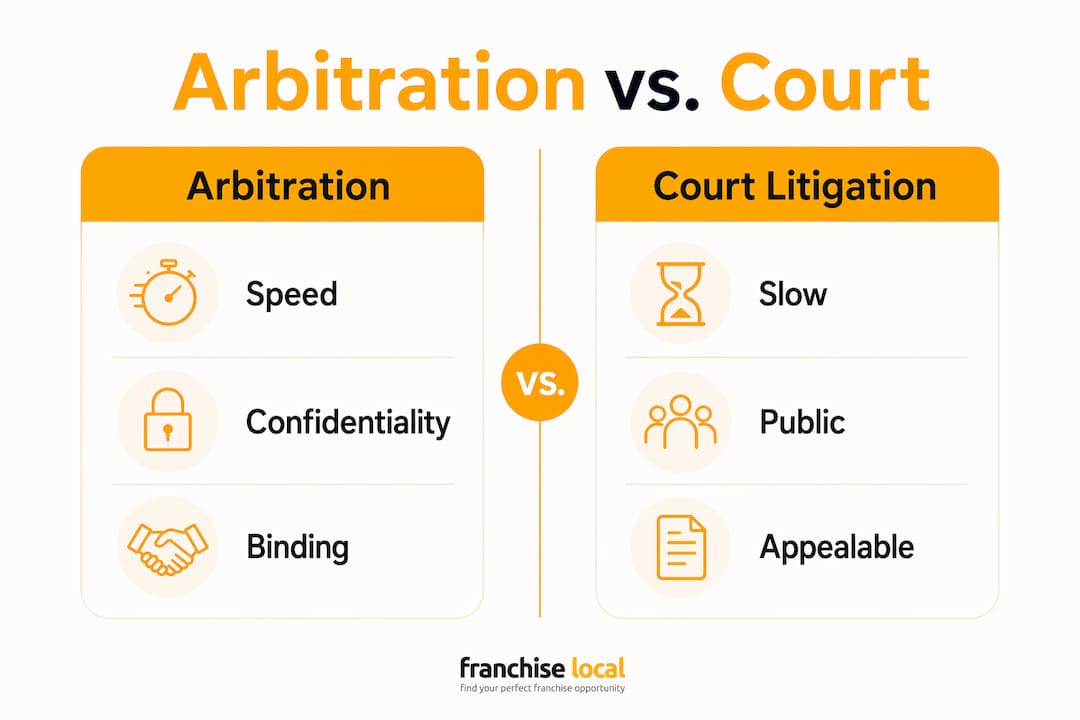
Confidentiality is one of arbitration’s strongest practical benefits. Franchise disputes often involve commercially sensitive information: royalty figures, operational data, and brand reputation. Court proceedings are public. Arbitration keeps those details private, which protects both parties’ commercial interests regardless of the outcome.
The binding and final nature of an arbitration award is both a strength and a limitation. It provides certainty and ends the dispute cleanly. However, the grounds for appealing an award under the Arbitration Act 1996 are narrow. If the arbitrator makes an error of fact, you generally cannot challenge it. This makes arbitrator selection critically important.
UK courts increasingly compel parties to mediate before arbitration proceeds, viewing mediation as a genuine cost-saving step rather than a formality. Treating mediation seriously can resolve disputes at a fraction of the cost and preserve the franchise relationship. Arbitration should be the next step when mediation genuinely fails, not a first resort.
Pro Tip: Use mediation as a real attempt to settle, not a box-ticking exercise. Courts and arbitrators both look unfavourably on parties who treat mediation as a delay tactic.
Arbitration may not suit every dispute. Very low-value claims may not justify arbitrator fees. Disputes requiring urgent injunctive relief, such as stopping a franchisee from trading under the brand immediately, still require court intervention. Knowing when to use which tool is part of effective franchise dispute resolution.
How can franchisors and franchisees protect their interests during arbitration?
Preparation before a dispute arises is far more effective than reacting once one has started. Many franchise disputes arise from inconsistent enforcement and unclear communication rather than deliberate bad intent. Addressing fault lines early prevents costly arbitration or litigation altogether.
Practical steps to protect your position:
- Draft precise arbitration clauses. Your franchise agreement should name the appointing body, specify procedural rules, confirm the seat of arbitration, and set out the arbitrator appointment process. Standard institutional arbitration clauses from bodies like CIArb or LCIA reduce the risk of procedural deadlocks.
- Document everything from day one. Keep records of all communications, compliance checks, and enforcement decisions. Written evidence is the foundation of any arbitration case.
- Understand your franchise agreement fully. The franchise agreement and operations manual define your contractual rights. You cannot argue a breach you cannot locate in writing.
- Select an arbitrator with franchise expertise. A generalist commercial arbitrator may not understand the operational realities of a franchise model. Specialist knowledge leads to better-reasoned awards.
- Act proportionately at all times. Following the Ellis ruling, franchisors must be able to justify every enforcement action. Disproportionate responses weaken your position in arbitration and invite good faith challenges.
- Engage in mediation genuinely. Mediation before arbitration is not just a legal requirement in many agreements. It is a real opportunity to resolve the dispute at lower cost and preserve the commercial relationship.
- Take legal advice early. Consulting a solicitor experienced in franchise legal considerations before serving a dispute notice can prevent procedural errors that undermine your case.
Clear and precise contract drafting is the single most effective way to reduce arbitration-related disputes and costly delays. Parties who invest in well-structured agreements spend less time and money resolving disputes when they arise.
Franchiselocal: resources for franchise parties at every stage
Understanding arbitration is one part of running a franchise well. The broader picture, from selecting the right opportunity to negotiating your agreement, shapes how disputes are prevented in the first place. Franchiselocal provides guides, legal overviews, and franchise agreement resources that help both franchisors and franchisees build stronger foundations before disputes arise. Whether you are reviewing an agreement for the first time or preparing for a formal dispute process, the ultimate guide to franchising covers the legal and commercial essentials you need. Franchiselocal also connects you with specialist franchise service providers who can support you through arbitration and beyond.
FAQ
What is franchise arbitration?
Franchise arbitration is a binding ADR process where an impartial arbitrator resolves disputes between a franchisor and franchisee outside of court. The arbitrator’s decision, called an award, is final and enforceable by courts.
How does franchise arbitration differ from mediation?
Mediation produces a voluntary, non-binding agreement that both parties must accept. Arbitration produces a binding award that the losing party must comply with, regardless of whether they agree with the outcome.
Is arbitration mandatory in UK franchise agreements?
Arbitration is mandatory only if the franchise agreement includes a valid arbitration clause. Without a specific franchise act in the UK, the contract terms govern whether and how arbitration applies.
Can a UK court overturn an arbitration award?
Grounds for appeal are very narrow under the Arbitration Act 1996. Courts can set aside an award for serious procedural irregularity or a point of law, but errors of fact are generally not sufficient grounds for challenge.
How long does franchise arbitration typically take?
Timescales vary by complexity, but arbitration typically concludes faster than High Court litigation. Simple disputes may resolve within a few months; complex multi-party cases can take longer depending on the procedural timetable agreed at the preliminary meeting.