

The UK franchise failure rate sits at roughly 0.5% annually according to industry analysis, with cumulative failure over 20 years staying under 6% based on British Franchise Association survey data. That compares to around half of independent UK start-ups failing within three years. The catch: “failure” in these surveys means commercial closure specifically, not retirement, resale, or a franchisee simply moving on.
Franchise failure rate UK: what the data actually shows
The headline figure prospective franchisees ask for is straightforward, and it’s a good one. The British Franchise Association’s long-term tracking, covering the 20 years leading into 2026, puts cumulative commercial failure at under 6%. Recent surveys report annual commercial-failure rates as very low, generally below 1%.
Elite Franchise Magazine’s analysis of 2024 industry data found the annual commercial-failure rate had actually fallen, from 0.9% in 2018 to around 0.5%. By comparison, independent business survival is much lower, with about half of UK start-ups closing within their first three years; this substantial difference explains why many first-time business owners consider franchising a less risky path into self-employment.
Profitability figures back up the pattern. BFA-linked surveys report that between 89% and 93% of franchise units say they’re profitable in a given year, and confidence in the wider network is high too: 77% of BFA members told the same survey they felt “very” or “fairly” confident in their 2026 business plans.
| Metric | Figure | Source period |
|---|---|---|
| Annual commercial-failure rate | ~0.5% | 2024 |
| Cumulative failure (20 years) | Under 6% | Leading into 2026 |
| Independent start-up failure (3 years) | ~50% | 2024 analysis |
| Units reporting profitability | 89% to 93% | Recent BFA surveys |
| Members confident in 2026 plans | 77% | BFA survey |
Pro Tip: *Ask any franchisor for their own network’s specific closure data, not just the industry-wide BFA figure.
These numbers come with a scope limitation worth flagging early: the UK has no statutory requirement forcing franchisors to publish unit-level failure or profitability data, so BFA surveys rely on member self-reporting rather than an independently audited register.
What counts as a franchise “failure” and what doesn’t?
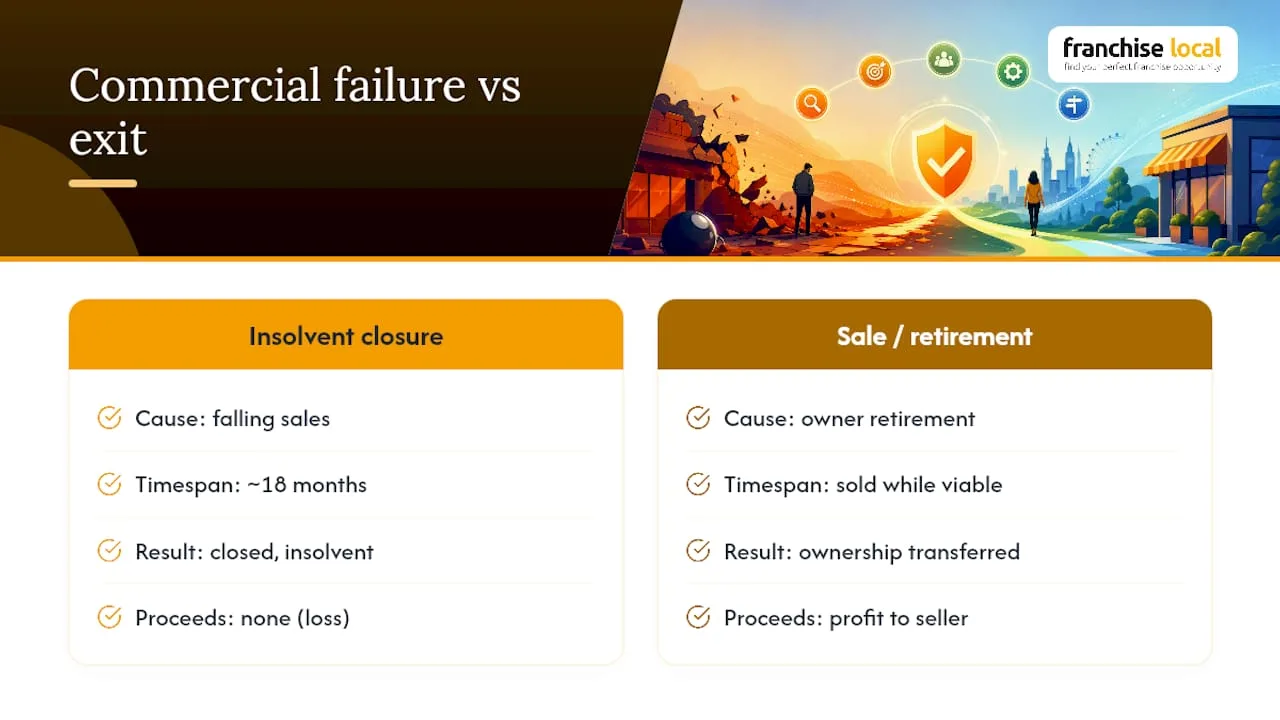
Commercial failure means the business closed because it stopped being financially viable, full stop. It does not cover a franchisee retiring, selling up to bank a profit, stepping away for ill health, or exiting after a dispute with the franchisor. The 2018 BFA NatWest survey breaks closures into exactly these categories, and the split matters more than it first appears.
Picture two franchisees closing their doors in the same month. One is insolvent, unable to cover royalties after eighteen months of falling sales, a genuine commercial failure. The other sold a thriving unit to retire early, banking a healthy return. Both appear as “closures” in a loose count. Only one belongs in a failure statistic, and conflating them is exactly why some independent estimates of franchise risk run higher than the BFA’s own figures.
Why do franchised units tend to survive longer than independents?
Franchising’s lower failure rate isn’t an accident of branding. It comes from structural advantages independent start-ups have to build from scratch, often while trading.
- Tested operating systems. Franchisees inherit processes already refined across dozens or hundreds of units, cutting the trial-and-error phase that sinks many new independents.
- Collective buying power. Franchise networks negotiate supplier and equipment pricing that a lone start-up simply can’t access in its first year.
- Established brand demand. National marketing and recognised branding generate footfall or enquiries faster than a business building awareness from zero.
- Ongoing franchisor support. Regular benchmarking against the network flags underperformance early, before it becomes terminal.
None of this makes failure impossible. A proven model amplifies both strengths and weaknesses: a strong franchise scales well, but a mediocre one just fails more consistently across more locations. Weak territory allocation, an under-resourced franchisor, or fee structures that erode margin can undo every structural advantage on this list. Support systems only work when the franchisor invests properly in delivering them, which is worth checking before signing anything.
Pro Tip: Read how franchise support systems actually work before comparing brands. A directory listing tells you what a franchise sells; support quality tells you whether you’ll still be trading in three years.
What causes franchise failures and what red flags should you check?
Most franchise failures trace back to one of four fault lines, and nearly all of them are visible before you sign.
- Operational weakness. Poor initial training, an oversaturated or badly drawn territory, and fragile supply arrangements that leave franchisees exposed when a supplier changes terms.
- Financial strain. Undercapitalised franchisees, forecasts built on best-case assumptions, and hidden or escalating fees that only surface once the agreement is signed.
- Contractual imbalance. Restrictive transfer clauses, unilateral franchisor powers over pricing or suppliers, and post-termination restraints that make an exit costlier than expected.
- Network-level failure. Franchisors who recruit anyone with the capital rather than assessing fit, and inconsistent enforcement of brand standards across the network.
Watch for these specific signals during a discovery day or in the franchise agreement itself:
- Vague or refused answers when you ask for unit-level P&L data.
- Projections that assume no seasonal dip and zero competitor response.
- Territory boundaries left undefined or “to be agreed later.”
- Transfer and exit clauses buried in dense legal language with no plain-English summary offered.
Legal reviews of UK franchise agreements consistently flag restrictive transfer rules and post-termination restraints as the clauses franchisees most regret not reading closely before signing.
How do you assess franchise failure risk before you buy?
Due diligence in franchising isn’t optional homework, because no regulator is doing it for you. The UK has no statutory franchise regulator, so franchisors aren’t legally required to publish failure rates or profitability data. That responsibility sits entirely with you, the buyer.
- Verify the survey claims. Ask the franchisor directly for their own network’s closure history, not just the industry average.
- Stress-test the numbers. Take the franchisor’s income projections and cut them by 30% to 60% before checking whether the unit still covers royalties, marketing contributions, and loan repayments.
- Read the agreement clause by clause. Pay particular attention to territory protection, renewal terms, and what happens if you need to sell or exit early.
- Talk to current and former franchisees. Ask specifically about time-to-profitability, actual support received, and whether they’d sign again.
- Build a capital buffer. Budget beyond the initial franchise fee for working capital, a realistic runway to profitability, and unexpected costs in year one.
Pro Tip: Franchisee interviews are more reliable than any brochure. Ask former franchisees why they left, not just current ones why they stayed. Structured due diligence that includes both groups catches problems a glossy prospectus never mentions.
Getting the financial modelling right matters as much as the legal review. A detailed guide to assessing franchise financials walks through exactly which figures to request and how to sanity-check them against your own budget, before any money changes hands.
Finding franchises built to last: how Franchiselocal helps
The platform offers filtering features to help shortlist franchise opportunities by price, industry, and location, enabling comparison of options beyond marketing descriptions. The trending franchise opportunities page shows which brands are attracting serious enquiry volume right now, a useful proxy for network health alongside the due diligence steps above.
Once you’ve narrowed a shortlist, the affordability calculator and ROI estimator let you run the same stress-test conservatism this article recommends, checking whether a franchise still covers its costs once you’ve discounted the franchisor’s own projections. If you’re weighing routes into ownership more broadly, teams scaling any small business often lean on broader automation tooling to close the systems gap that franchising otherwise provides out of the box, and funding routes like pre-revenue business loans are worth comparing against franchisor finance packages before you commit capital.
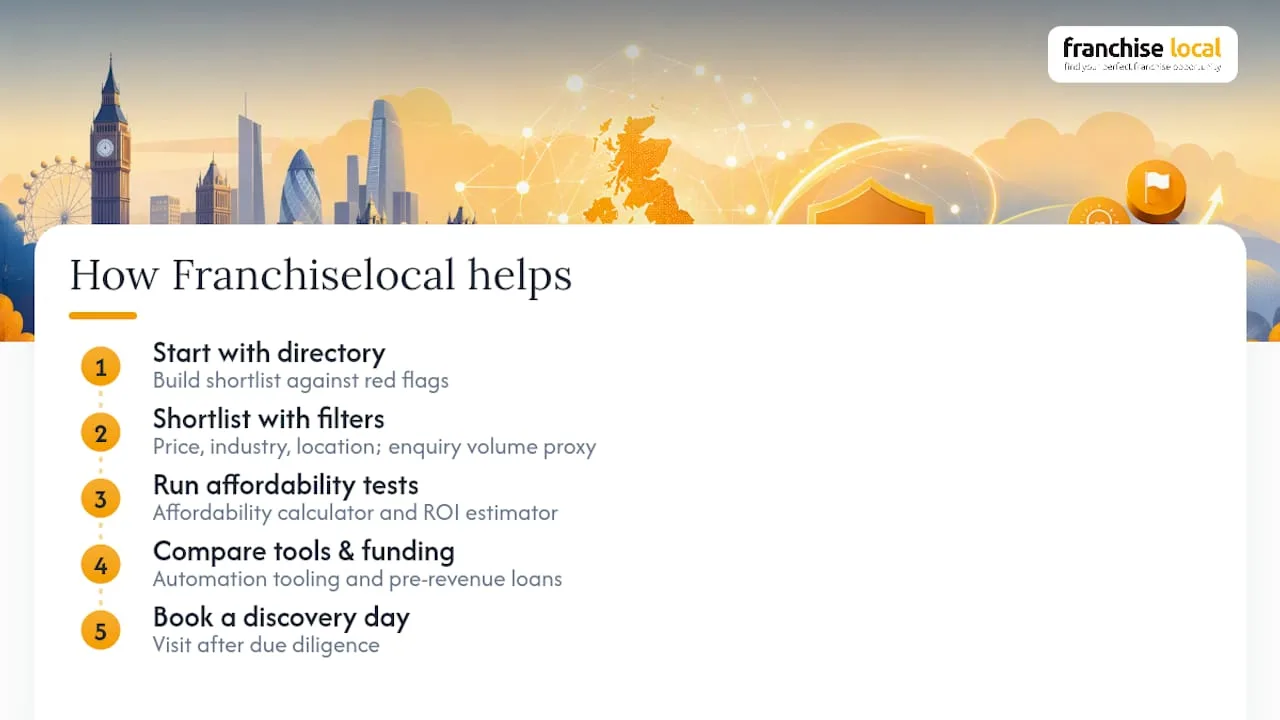
Start with the UK’s franchise directory and build your shortlist against the red flags covered above, before booking a single discovery day.
Sources
- BFA survey shows strong business confidence across franchising heading into 2026
- Franchising facts in 2024: 99.5% of franchises succeed while 50% of start-ups fail – Elite Franchise Magazine
- Disadvantages of buying a franchise in the UK — Sprintlaw UK
FAQ
What is the failure rate of businesses in the UK generally?
Independent start-ups fail at a much higher rate, roughly 50% within their first three years, compared with the sub-1% annual commercial-failure rate reported for franchised units.
What is the most profitable franchise to own in the UK?
Profitability varies enormously by sector, investment level, and territory, so there’s no single answer. Use Franchiselocal’s industry listings to compare investment requirements and typical returns across sectors before shortlisting.
Is a McDonald’s franchise profitable in the UK?
McDonald’s UK franchises can be profitable but require substantial capital investment and strict operational compliance; profitability depends heavily on location and management, and figures aren’t publicly broken out by individual franchisee.
Why do most franchise closures happen for reasons other than failure?
BFA survey categories show many closures stem from retirement, resale, or ill health rather than commercial failure, meaning the true business failure rate is lower than raw closure figures suggest.