

Assessing franchise financials means scrutinising disclosure packs, Companies House filings, fee structures, and financial performance claims to determine whether a franchise investment is viable. This process, known formally as franchise financial due diligence, sits at the heart of every sound investment decision. The British Franchise Association sets clear expectations for what prospective franchisees should examine before committing capital. Get this right, and you reduce risk significantly. Get it wrong, and you may inherit a business model that never delivers the returns you expect.
How to assess franchise financials: the documents you need
The starting point for any franchise financial analysis is gathering the right paperwork. The UK has no statutory Franchise Disclosure Document equivalent to the American model, so disclosure packs are voluntary and vary considerably between franchisors. That variability makes your own diligence more critical, not less.
A thorough disclosure pack should contain:
- Business history: How long the franchisor has operated, how many franchisees are currently active, and the rate of franchisee turnover.
- Fee schedules: All upfront fees, ongoing royalties, marketing levies, and any renewal or audit charges.
- Financial performance data: Revenue figures, profit summaries, and any earnings claims, along with the assumptions and disclaimers behind them.
- Litigation records: Any legal disputes involving the franchisor or its franchisees, past or present.
Financial performance data in disclosure packs must include clear assumptions and disclaimers. The sample size and coverage period behind any earnings figures directly affect how reliable those figures are. A pack quoting average revenues from three franchisees over six months tells you far less than one covering thirty franchisees over three years.
Beyond the disclosure pack, request the franchisor’s filed accounts from Companies House. These are publicly available and give you an independent view of the franchisor’s financial health, separate from any marketing material. You can also read our guide on franchise disclosure documents to understand exactly what to look for in each section.
Pro Tip: Contact at least five to ten existing franchisees directly. Ask them whether the financial projections they received before signing matched their actual trading experience. Their answers will tell you more than any document.
How do you analyse key financial statements in a franchise?
Once you have the documents, the real work begins. Franchise financial analysis requires you to read income statements, balance sheets, and cash flow statements with a critical eye. Each tells a different part of the story.

The income statement shows revenue and profit over a period. Look for consistent revenue growth across multiple years rather than a single strong year. One good year can reflect a market anomaly. Three consecutive years of stable or growing revenue reflects a genuine business model.
The balance sheet reveals what the franchisor owns versus what it owes. Healthy franchisors carry manageable debt relative to their assets. A franchisor with significant liabilities and thin equity is a warning sign, regardless of how attractive the brand appears.
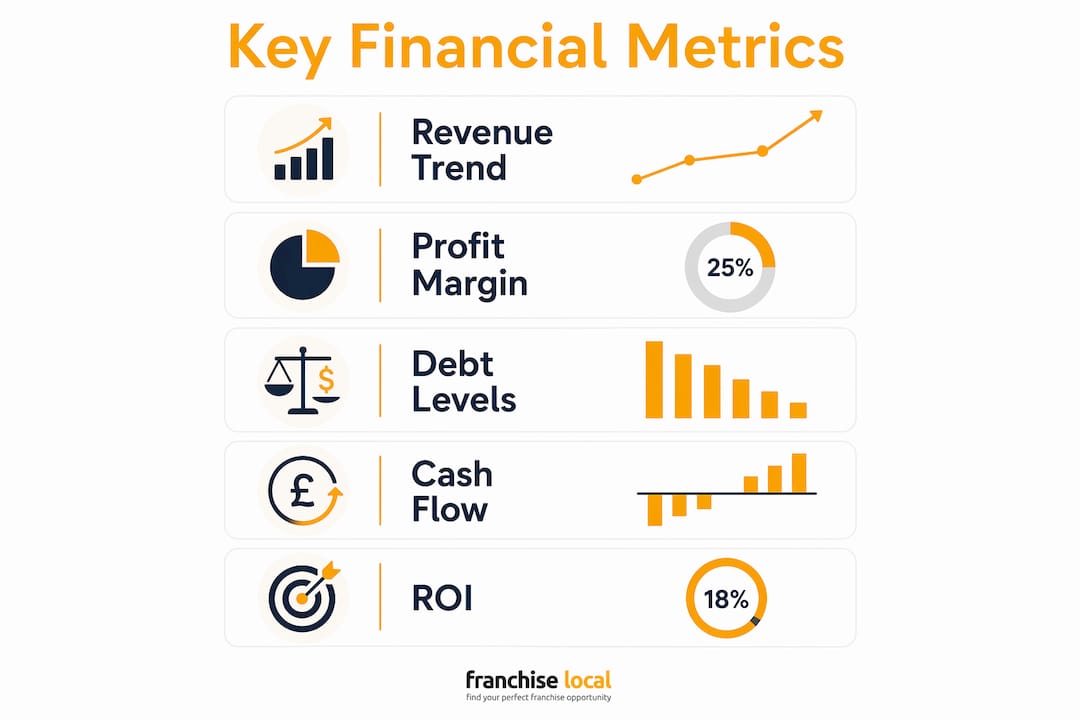
Cash flow is the most telling metric of all. A business can show profit on paper while running out of cash in practice. Reviewing franchisor accounts via Companies House for at least three years lets you check revenue consistency, cash flow stability, and debt levels together. That three-year view is the minimum standard for credible franchise financial assessment.
The table below summarises the key metrics to examine and what each one signals:
| Financial metric | What to look for | Red flag |
|---|---|---|
| Revenue trend | Consistent growth over 3+ years | Single spike year, then flat |
| Gross margin | Stable or improving percentage | Margins shrinking year on year |
| Cash flow from operations | Positive and consistent | Negative or highly variable |
| Debt-to-equity ratio | Low relative to sector norms | Rising debt with flat revenue |
| Royalty-to-revenue ratio | Proportionate to support received | Royalties consuming most of margin |
Return on investment (ROI) is the headline figure most prospective franchisees focus on. Calculate it by dividing your expected annual net profit by your total initial investment. A realistic ROI figure requires realistic cost assumptions, which brings us to the question of projections.
Many franchisors provide forecasted profit and loss statements, but these are not guarantees. A professional accountant can assess whether the assumptions behind a forecast are realistic and identify costs that may have been omitted. Never rely on a franchisor’s projections without independent verification.
Pro Tip: Ask your accountant to build a conservative scenario using the franchisor’s figures, then reduce projected revenues by 20% and increase costs by 15%. If the business still works under those conditions, the model has genuine resilience.
What fees and ongoing costs should you consider?
Understanding franchise costs goes well beyond the initial franchise fee. Franchise fees include upfront payments, royalties, marketing levies, technology fees, renewal fees, and possible audit costs. Each of these affects your monthly cash position and your long-term profitability.
The initial franchise fee buys you the right to operate under the brand and typically covers training and setup support. It is a sunk cost from day one. What matters more for long-term financial health is the structure of ongoing fees.
Royalties are usually calculated as a percentage of gross revenue, not profit. That distinction is critical. If your royalty rate is 10% of gross revenue and your gross margin is 30%, royalties consume one third of your margin before you account for any other costs. Understanding royalties in franchising is one of the most practical steps you can take before signing any agreement.
Beyond royalties, watch for:
- Marketing levies: Contributions to a central marketing fund, often 1%–4% of gross revenue, which you pay regardless of whether you benefit directly from the campaigns.
- Technology and platform fees: Monthly charges for proprietary software, booking systems, or point-of-sale tools mandated by the franchisor.
- Mandatory refurbishments: Many franchise agreements require you to refurbish your premises or update equipment at set intervals, at your own expense.
- Supplier restrictions: Some franchisors require you to purchase stock or materials from approved suppliers at fixed prices, removing your ability to negotiate better deals.
Ongoing costs can include mandatory refurbishments, equipment upgrades, supplier price changes, and technology subscriptions. These add to financial commitments in ways that initial fee schedules rarely make obvious. Read the franchise agreement carefully for clauses that allow the franchisor to change fee structures during the contract term. Clarity on this point protects you from unexpected cost increases mid-contract.
How to evaluate profitability and plan for exit
Evaluating franchise profits is not just about what you earn during the term. It also means understanding what the business is worth when you want to sell, and what it costs to leave if things do not go to plan.
Start with historical cash flow. Adjust the franchisor’s figures to reflect your specific location, staffing costs, and local market conditions. A franchise performing well in a city centre may perform very differently in a market town. Build your own profit and loss model rather than accepting the franchisor’s template as your baseline.
When assessing resale value, follow these steps:
- Review the franchise agreement’s resale terms. Most agreements require the franchisor’s approval for any sale and may include a right of first refusal.
- Assess goodwill and territory exclusivity. Resale value depends on historical cash flow, goodwill, contract stability, and territory exclusivity. A franchise with a protected territory in a high-demand area commands a premium.
- Commission an independent valuation. An independent valuer will assess asset values and cash flow against market multiples, giving you a figure grounded in comparable transactions rather than the franchisor’s optimism.
- Understand exit barriers. Termination fees, de-branding costs, and lease obligations can make exiting a franchise expensive. Know these figures before you sign.
- Factor in competing bids. Market demand at the time of sale significantly influences final price. A franchise in a growing sector will attract more buyers than one in a declining market.
Financial literacy among franchisees leads to better operational decisions and improved profitability. The British Franchise Association recommends that franchisors train franchisees in pricing, margin management, and cash flow understanding. That practical knowledge matters far more than relying on theoretical profit forecasts. You can build this knowledge further by reviewing franchise profitability factors specific to the UK market.
Franchiselocal: your next step in franchise research
Franchiselocal supports prospective franchisees at every stage of their investment research, from initial discovery through to detailed financial evaluation. The platform’s franchising guide covers investment essentials, fee structures, and due diligence frameworks in plain language. If you are ready to compare opportunities with transparent financial details, the franchise directory lets you filter by investment level, industry, and location across the UK. For specialist support, Franchiselocal also connects you with franchise service providers including accountants and legal advisers who understand the specific demands of franchise financial assessment. The right information and the right professionals make a measurable difference to the quality of your investment decision.
FAQ
What documents should I request when assessing a franchise?
Request the franchisor’s disclosure pack, which should cover business history, fees, financial performance data, and litigation records. Also pull the franchisor’s filed accounts from Companies House for at least three years.
Does the UK require franchisors to provide a disclosure document?
The UK has no statutory Franchise Disclosure Document requirement. Disclosure packs are voluntary, so the depth of information provided varies significantly between franchisors.
How do I calculate return on investment for a franchise?
Divide your expected annual net profit by your total initial investment to get your ROI percentage. Always base this calculation on conservative revenue assumptions verified by an independent accountant.
What ongoing fees should I watch for beyond the initial franchise fee?
Watch for royalties, marketing levies, technology fees, mandatory refurbishment costs, and supplier price restrictions. Fee structures can also change during the contract term, so check the agreement carefully.
How is a franchise valued for resale?
Resale value reflects historical cash flow, goodwill, territory exclusivity, contract stability, and market demand at the time of sale. An independent valuation gives you a figure based on comparable transactions rather than the franchisor’s estimates.