

Stepping into franchise ownership is one of the most significant business decisions you will ever make, and the onboarding process is where that decision either pays off or falls apart. Without a clear franchise onboarding guide, many new franchisees feel overwhelmed by the volume of tasks, timelines, and expectations landing all at once. The good news is that onboarding follows a predictable structure, and when you understand each phase before it arrives, you move through it with confidence rather than confusion. This guide walks you through every stage of the process, from signing your agreement to hitting your first performance milestones.
Key Takeaways
| Point | Details |
|---|---|
| Structured onboarding timeline | Following a clear step-by-step onboarding plan builds confidence and ensures smooth franchise launches. |
| Early communication matters | Welcoming franchisees promptly with an onboarding roadmap sets positive expectations from the start. |
| Hands-on training effectiveness | Shadowing and real-time support consolidate learning better than passive materials alone. |
| Avoid rushed changes | New franchisees should maintain steady operations initially to retain staff and customers. |
| Ongoing support essential | Regular check-ins and training updates keep franchises aligned and growing beyond launch. |
Understanding the franchise onboarding process
So what is franchise onboarding, exactly? It is the structured process through which a franchisor prepares a new franchisee to open and operate their business according to brand standards. It covers everything from your first welcome call to the support you receive in those critical first 90 days of trading. It is not simply a training course. It is a full operational handover.
The process matters enormously. A franchisee who enters onboarding without understanding what to expect often misses key deadlines, underestimates preparation time, or clashes with their franchisor over communication gaps. None of that needs to happen.
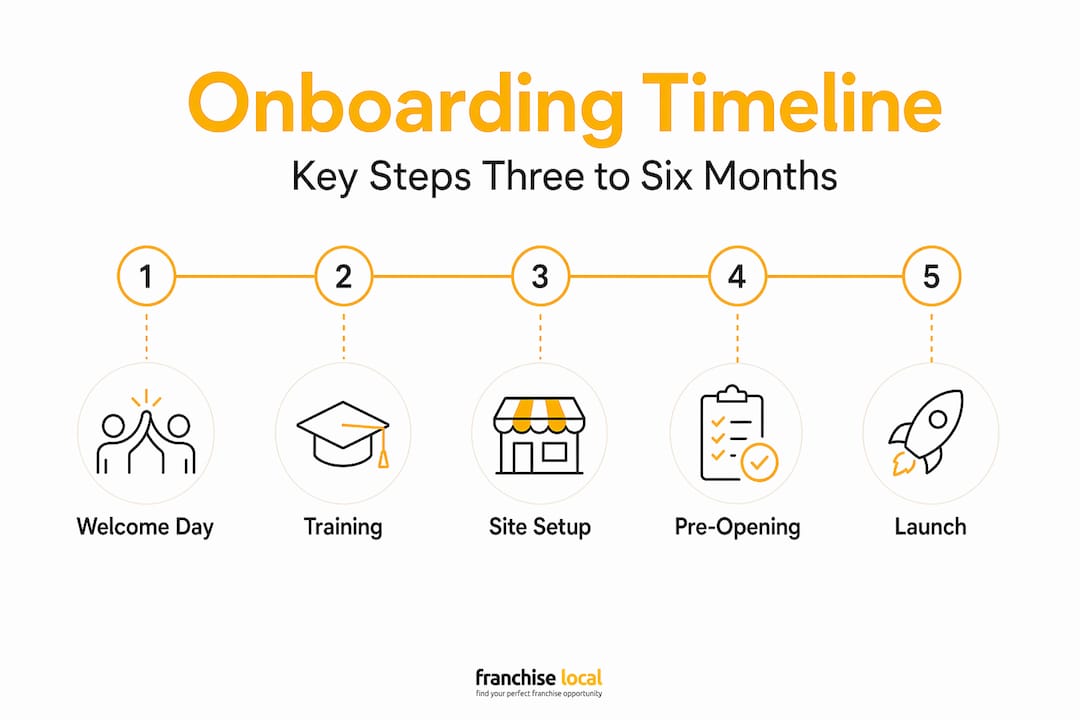
Typical stages of the onboarding process for franchises include:
- Signing the franchise agreement and completing initial documentation
- Welcome communication and onboarding roadmap delivery
- Territory confirmation and site selection
- Premises build-out or refurbishment
- Formal training programme (operations, marketing, systems)
- Staff recruitment and pre-opening preparation
- Grand opening and first 90 days support
Most franchise onboarding programmes take between three and six months, covering training, real estate, and marketing before opening. That timeline might feel long before you start, but it moves quickly once the build-out begins.
What separates a confident franchisee from a stressed one is usually this: onboarding starts immediately after signing, beginning with welcome communication and a clear roadmap. Franchisors who delay that first contact leave new franchisees in an information vacuum, which breeds anxiety and mistakes.
| Onboarding stage | Typical timeframe | Key activity |
|---|---|---|
| Post-signing welcome | Days 1 to 2 | Roadmap delivery, orientation call |
| Documentation and legal | Week 1 to 2 | NDA, proof of funds, territory agreement |
| Training programme | Weeks 2 to 8 | Operations, marketing, systems |
| Site development | Weeks 4 to 14 | Premises setup, fit-out, equipment |
| Staff recruitment | Weeks 8 to 12 | Hiring, onboarding your own team |
| Pre-opening preparation | Weeks 10 to 14 | Local marketing, compliance checks |
| Grand opening | Week 12 to 24 | Launch, franchisor on-site support |
Pro Tip: Ask your franchisor for a written onboarding timeline before you sign. If they cannot produce one, that tells you something important about how organised their support structure is.
For a broader view of how to start onboarding on the right foot, it helps to understand what preparation looks like before the official process begins.
Preparation essentials: what you need before onboarding
To navigate onboarding smoothly, you need the right documents and the right mindset in place before the official process kicks off. Turning up underprepared is one of the most common and avoidable causes of delay.
Key documents to have ready:
- Signed franchise agreement and non-disclosure agreement (NDA)
- Completed franchise application form
- Proof of funds or financing confirmation
- Personal identification and address verification
- Business bank account details (or evidence of account setup)
- Solicitor contact details for agreement review
Proof of funds, NDA, and application form should be submitted early to avoid delays. Many franchisors will not begin site selection or territory mapping until these are confirmed, so a slow start here pushes back your opening date.
Beyond paperwork, your mindset preparation is just as important. You are entering a system that has been built and refined before you arrived. The most successful franchisees approach onboarding as learners, not operators. You will have opinions about how things should be done. Save them for your second year, once you understand why the system works the way it does.
Numbered steps to prepare before onboarding begins:
- Instruct a franchise-specialist solicitor to review your agreement
- Confirm your funding arrangement (personal funds, bank loan, or third-party finance)
- Submit all required documentation to your franchisor
- Attend any pre-onboarding discovery days or introductory calls
- Research your territory thoroughly, including competitor presence and local demographics
- Set up a dedicated business email address and basic accounts structure
- Clear your schedule for the training period — treat it as full-time work
Early welcome communication includes your onboarding roadmap and key development milestones. The moment you receive this, read it in full and flag any timeline conflicts immediately.
| Document | Why it matters | When to submit |
|---|---|---|
| NDA | Protects both parties before disclosure | Before discovery day |
| Franchise agreement | Legally binds the relationship | Pre-onboarding |
| Proof of funds | Confirms financial readiness | Before territory confirmation |
| Application form | Triggers formal onboarding | As early as possible |
Pro Tip: Do not wait for your franchisor to chase you for documents. Proactive franchisees are seen as lower risk from day one, which often translates into better support and faster processing.
Understanding the full UK franchise application process gives you a clearer picture of what comes before onboarding officially begins.
Step-by-step onboarding milestones from agreement to opening
Once prepared, you will move through the onboarding milestones that form the backbone of a successful franchise launch. Each phase builds on the last, and missing steps in sequence creates problems further down the line.
The key onboarding phases in order:
-
Orientation (days 1 to 2 post-signing): Your franchisor should contact you within 48 hours. You receive your roadmap, introductory materials, and book your first orientation call. Onboarding phases begin with orientation within days of signing, moving through training and marketing before culminating in your first 90 days of hands-on experience.
-
Operations training (weeks 2 to 6): This is the formal franchisee training guide phase. You learn the system in depth, covering daily operations, reporting, customer service standards, and quality control. Most UK franchisors deliver this as a combination of classroom-style teaching, online modules, and in-field shadowing.
-
Marketing training (weeks 3 to 7): You learn the brand’s marketing standards, local marketing tools, and how to activate your territory ahead of opening. This covers digital presence, local PR, and any paid advertising the system uses.
-
Site development (weeks 4 to 14): Territory mapping, premises identification, lease negotiation, and fit-out. For service-based franchises, this phase may focus on vehicle branding, equipment procurement, or home office setup instead of physical premises.
-
Staff recruitment (weeks 8 to 12): Many franchisors have a structured recruitment guide to help you hire to brand standard. This phase includes advertising roles, interviewing, and onboarding your own team members.
-
Pre-opening preparation (weeks 10 to 14): Final compliance checks, local marketing activation, and soft-launch preparation. Your franchisor should provide an opening checklist that covers every area.
-
Grand opening and first 90 days: Many franchisors send a field support manager to your opening. The first 90 days include regular check-in calls, performance reviews, and troubleshooting support.
Typical onboarding at structured UK franchises includes enquiry, documentation, meetings, training, premises setup, recruitment, and launch within 12 weeks, though this varies by complexity of the model.
| Phase | Service franchise | Premises-based franchise |
|---|---|---|
| Site development | Vehicle branding, home office | Lease negotiation, full fit-out |
| Training duration | 2 to 4 weeks typically | 4 to 8 weeks typically |
| Pre-opening lead time | 1 to 2 weeks | 4 to 6 weeks |
| Opening day support | Remote or on-call | Franchisor on-site |

Pro Tip: During your operations training, ask to shadow at least two existing franchisees, not just one. Each franchisee runs their day slightly differently, and you will learn far more from observing two operations than from any written franchise training manual.
For a fuller breakdown of the step-by-step franchise setup process, including costs and timelines specific to the UK market, it is worth reviewing additional resources alongside this guide.
Common challenges and mistakes during franchise onboarding
Understanding potential challenges helps you navigate the onboarding process with greater confidence. The franchisees who struggle most during onboarding are rarely those who lacked skills. They are those who were not warned about what was coming.
The most common onboarding challenges:
- Information overload in the first two weeks, leading to passive rather than active learning
- Unclear or shifting timelines from the franchisor, causing planning difficulties
- Delays in premises fitting or equipment delivery that push back the opening date
- Underestimating the time demands of training alongside personal and family commitments
- Poor communication between franchisee and franchisor at critical decision points
- Skipping hands-on shadowing in favour of self-directed reading
“Onboarding is a make-or-break phase requiring clear training, tools and dedicated support to avoid hesitancy.”
That observation from Franchise Business Review is one the industry does not discuss loudly enough. Franchisors who treat onboarding as a box-ticking exercise produce franchisees who open without confidence. That translates directly into poor early performance.
The mistake that catches resale franchisees especially off-guard is the urge to change things immediately. When you take over an existing franchise operation, the temptation to put your stamp on it is real. Resist it. Do not make changes immediately post-transfer. Preserving what works avoids customer and staff turnover in your most vulnerable trading period.
Strategies to avoid common mistakes:
- Request a written milestone schedule from your franchisor on day one
- Schedule weekly check-in calls throughout onboarding, not just monthly reviews
- Block out full days for training and treat them as non-negotiable
- Build a two-week buffer into your premises timeline for unexpected fit-out delays
- Keep a shared document log of all decisions and action points agreed with your franchisor
Pro Tip: If your franchisor does not initiate regular contact during onboarding, you initiate it. Waiting passively for guidance is the single biggest delay multiplier in the onboarding process.
Returning to the fundamentals of smooth franchise onboarding is always worthwhile when challenges arise, particularly around communication gaps.
Measuring onboarding success and preparing for long-term growth
After launching, tracking your onboarding success and embracing ongoing support sustains growth and profitability. The mistake many franchisees make at this stage is assuming that reaching opening day means onboarding is over. It is not. The first year of operation is itself a continuation of the onboarding process.
Numbered steps for measuring onboarding effectiveness:
-
90-day review: Assess trading performance against projections, review operational consistency, and identify any training gaps. Clear milestones at 90 days, 6 months and 1 year with regular check-ins drive performance and confidence in new franchisees.
-
6-month operational audit: Conduct a formal audit with your franchisor’s field support team. This covers compliance with brand standards, customer feedback trends, and financial health indicators.
-
12-month performance review: A full-year review comparing actual versus projected performance. This is the point at which growth plans, territory expansion, or additional investment become realistic conversations.
-
Ongoing training refreshers: Most established franchisors run annual or biannual refresher training. These are not optional extras. They are how you stay current with system updates and maintain your competitive edge.
Signs your onboarding has been effective:
- Revenue is on track or ahead of projections at 90 days
- You are operating confidently within the brand’s standards without needing constant guidance
- Your staff are trained and performing consistently
- Customer feedback is positive and repeat business is building
- You feel clear about your next 12-month targets
Ongoing operational support, mentoring, and regional managers add measurable value to franchises maintaining quality over time. Do not underestimate the benefit of peer networks either. Connecting with other franchisees in your system gives you a sounding board that your franchisor simply cannot replace.
Leveraging the full range of franchise support systems available in the UK market makes a significant difference to long-term performance. The best franchisees are not those who need the least support. They are those who use the most of it.
Rethinking franchise onboarding: expert insights and lessons learned
Here is a perspective that most onboarding guides will not give you: the written materials are the least important part of effective franchise onboarding.
Most franchisors invest heavily in their franchise training manual. Thick binders, detailed operations guides, digital portals filled with video modules. And franchisees dutifully read them, highlight sections, and feel prepared. Then they open their business and realise that reading about how to manage a difficult customer conversation is nothing like having one.
The research backs this up. Hands-on shadowing and real-time Q&A solidify training far better than materials alone. Yet it is the materials that franchisors spend most of their onboarding budget producing and updating. The mismatch is striking.
Immediate welcome communication within 24 to 48 hours sets a tone that many franchisors overlook entirely, despite its outsized impact on franchisee confidence. That first call is not administrative. It is psychological. A franchisee who feels welcomed and guided from hour one approaches their training differently from one who waits three days for their first contact.
Our view, drawn from observing hundreds of UK franchise launches, is this: the franchisees who succeed fastest are those who treat onboarding as a conversation, not a curriculum. They ask more questions than they answer. They push for field visits before their training formally includes them. They seek out the most experienced franchisees in the network and buy them lunch.
The steady-hand principle applies here too. Whether you are launching a new franchise or taking over an existing one, your first instinct to improve and change things is understandable. But your first 90 days are for observing, absorbing, and executing to the system. There will be time for your ideas. The franchisees who try to improve the system before they fully understand it are the ones who create problems for themselves, their customers, and their staff.
Effective franchise onboarding is ultimately about building the right habits before bad ones have a chance to form. That is the real purpose of the process.
Explore top franchise opportunities and resources to kickstart your journey
With a clear understanding of the onboarding process, you are now in a far stronger position to choose the right franchise from the start. FranchiseLocal is the UK’s leading digital directory for prospective franchisees, offering curated listings across every industry, investment level, and location. Whether you are drawn to networking franchise opportunities or exploring the growing loans franchise sector, FranchiseLocal connects you with franchise businesses that match your goals, budget, and lifestyle. Browse listings, compare opportunities, and use the resources available to make an informed decision before you commit to any franchise agreement.
Frequently asked questions
How long does the franchise onboarding process usually take in the UK?
Most franchise onboarding in the UK takes between three and six months, covering training, site development, recruitment and marketing preparation before opening. More straightforward service-based models can move faster, sometimes within 12 weeks.
What are the key steps involved in franchise onboarding?
Key steps include signing the agreement, territory and site selection, formal training, staffing, pre-opening marketing, and grand opening support. Franchise onboarding also includes orientation, hands-on experience, and ongoing performance reviews in the first 90 days.
Why is early communication important in the onboarding process?
Early welcome communication within 24 to 48 hours sets expectations, builds confidence, and helps franchisees understand upcoming milestones and resources. Franchisees who receive prompt, clear communication from day one consistently perform better in their first year.
How can franchisees avoid common onboarding mistakes?
Follow clear written timelines, maintain regular contact with your franchisor, prioritise hands-on training, and avoid rushed changes post-transfer or post-opening to protect customer relationships and staff stability.