

TL;DR:
- Many franchise failures result from poor preparation, undercapitalization, and ignoring proven systems.
- Red flags include vague earnings claims, high fees, limited support, and lack of market validation.
- Success depends on thorough research, right fit, sufficient capital, steady local marketing, and ongoing adaptation.
Franchising is often sold as the safer path to business ownership, and for many people it genuinely is. Yet the reality is more nuanced. Franchisees report high profitability, but not every franchisee succeeds, and the gap between those who thrive and those who struggle often comes down to avoidable mistakes made before the doors even open. If you are seriously considering a franchise investment in the UK, understanding why some fail is just as important as knowing why most succeed. This article breaks down the real reasons behind franchise failures, the warning signs to watch for, and the practical steps you can take to protect your investment.
Key Takeaways
| Point | Details |
|---|---|
| Franchises can still fail | Even with high average profitability, UK franchises face risks if key factors are ignored. |
| Beware common red flags | Vague earnings claims and poor support increase your chance of failure. |
| Thorough research is vital | Analysing both the franchise system and your own fit reduces the risk of a bad investment. |
| Ongoing support matters | Access to training and a strong franchise network greatly boosts your odds of long-term success. |
Understanding franchise failure: myths vs reality
The franchise industry has a reputation for being bulletproof. You buy into a proven system, follow the playbook, and the profits roll in. If only it were that simple. The truth is that while the statistics are encouraging, they can create a false sense of security that leads some investors to skip the hard work of proper preparation.
“The franchise model offers a structured route to business ownership, but structure alone does not guarantee success. Personal fit, local conditions, and financial planning matter just as much as the brand you choose.”
According to industry data, 93% of franchises are profitable, and over two-thirds remain highly profitable for five or more years. Those are genuinely impressive numbers. But they also mean that a meaningful minority do not make it, and understanding why is essential for anyone evaluating an opportunity. You can read more about the evidence-backed franchise benefits to get a balanced picture of what the model offers.
Some of the most damaging myths in UK franchising include:
- Myth: The franchisor guarantees your income. No franchisor can promise you a specific return. Earnings depend heavily on your effort, your local market, and how well you execute the model.
- Myth: If it fails, it is the franchisor’s fault. In many cases, failure traces back to the franchisee’s own decisions, from poor location choices to ignoring operational guidelines.
- Myth: A well-known brand equals automatic customers. Brand recognition helps, but it does not replace local marketing, community engagement, and strong customer service.
- Myth: Franchising requires no business skills. You still need to manage people, finances, and operations. The system supports you; it does not replace your judgement.
Understanding the profitability factors that drive franchise success helps you move past these myths and make genuinely informed decisions.
Top reasons franchises fail in the UK
Even within a high-performing industry, some still fail despite the strong industry averages. The causes are rarely mysterious. They tend to cluster around a handful of recurring problems.

| Cause of failure | How common | Impact level |
|---|---|---|
| Financial undercapitalisation | Very common | High |
| Poor franchisee and brand fit | Common | High |
| Inadequate franchisor support | Moderate | High |
| Weak local market research | Common | Medium |
| Failure to follow the system | Common | High |
| Compliance and regulation gaps | Less common | Very high |
Here are the most significant reasons UK franchises fail, in order of impact:
- Undercapitalisation. Many franchisees underestimate the working capital they need to survive the early months before revenue stabilises. Running out of cash is the single fastest route to closure.
- Market mismatch. A franchise that thrives in Manchester may struggle in a rural market. Local demographics, competition, and spending habits all vary enormously across the UK.
- Poor franchisee selection. Some people buy into a franchise that simply does not suit their skills, personality, or lifestyle. Passion for a product is not the same as aptitude for running the business behind it.
- Inadequate support from the franchisor. Not all franchisors deliver on their promises of training and ongoing guidance. Weak support structures leave franchisees exposed when problems arise.
- Ignoring the proven system. Franchisees who decide they know better and deviate from the established model often undermine the very advantages that made the franchise attractive.
- Compliance failures. UK businesses face specific regulatory requirements around employment law, food safety, data protection, and more. Ignoring these can be catastrophic.
Pro Tip: Before signing anything, compare the franchise versus startup risks carefully. A franchise reduces certain risks but introduces others that are unique to the model. Also review tips for first-time franchisees to avoid the most common early mistakes.
Critical warning signs to spot before investing
Understanding root causes is important, but being able to spot warning signs early is what saves most potential failures. Some red flags are obvious once you know what to look for. Others are subtle enough to slip past even experienced investors.
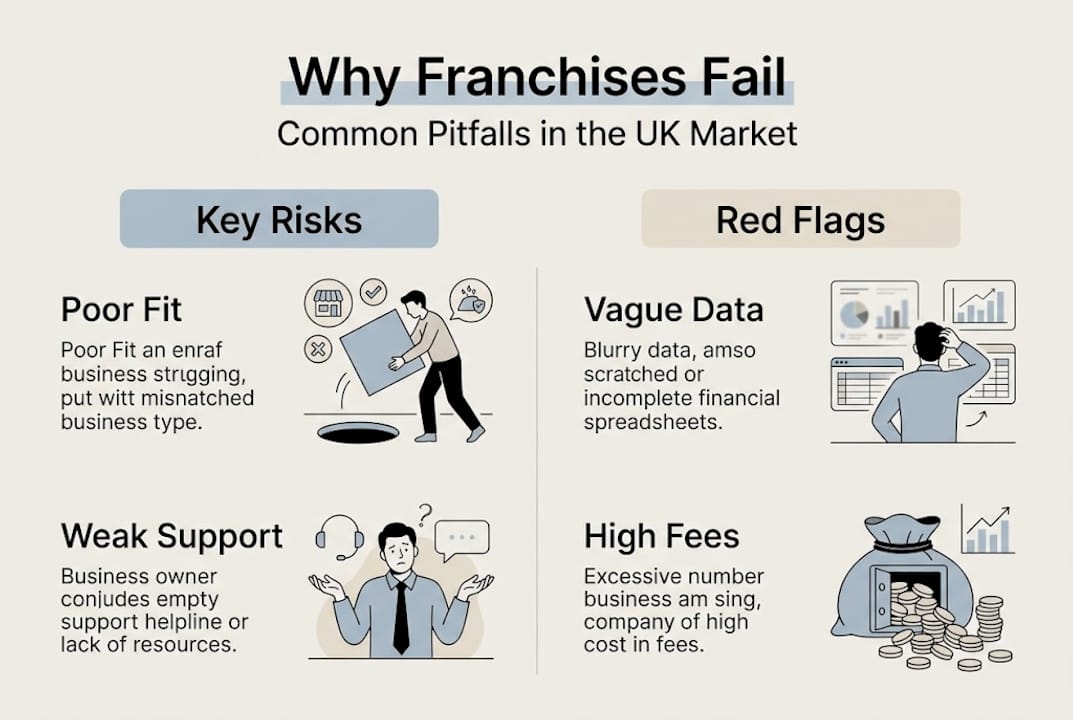
Some units do not reach long-term profitability despite the strong industry trends, and in many cases those failures could have been predicted from the outset.
Here are the key warning signs to watch for:
- Vague or inflated earnings claims. If a franchisor cannot provide clear, verified financial performance data, treat it as a serious red flag. Legitimate franchisors are transparent about what franchisees actually earn.
- High upfront fees with little explanation. Understand exactly what every fee covers. If the franchisor is evasive about fee structures or ongoing royalties, walk away.
- A weak or short track record. A brand that has only been franchising for one or two years has not yet proven its model under varied market conditions.
- Poor or absent training programmes. Ask to see the full training schedule before you commit. Vague promises of “ongoing support” without specifics are not good enough.
- No existing franchisee network to speak to. A healthy franchise system will actively encourage you to contact current franchisees. Resistance to this is a significant warning sign.
- No local market validation. Has the brand actually tested its model in a market similar to yours? Assumptions about transferability across UK regions are often wrong.
A good way to assess franchisor support systems is to ask for a detailed breakdown of what is provided in the first 12 months. Then cross-reference this against the profit model guide to see whether the numbers genuinely add up.
| Green flag | Red flag |
|---|---|
| Verified earnings data provided | Vague income projections |
| Encourages franchisee conversations | Discourages contact with existing franchisees |
| Clear fee structure | Hidden or unexplained charges |
| Established UK track record | Brand new to franchising |
| Structured training programme | Informal or unspecified support |
Pro Tip: Speak to at least three existing franchisees independently, not ones hand-picked by the franchisor. Ask them what they wish they had known before signing, and listen carefully to anything they say about support during difficult periods.
How to set your franchise up for lasting success
Once you can identify risks, the next step is to take practical measures that give your franchise the best possible chance of long-term success. The good news is that consistent practices contribute to over two-thirds of franchises maintaining high profitability for five or more years. Success is repeatable when you approach it methodically.
- Conduct thorough due diligence. Go beyond the brochure. Review the franchise disclosure document, seek independent legal advice, and examine the franchisor’s financial health.
- Choose the right fit, not just the right brand. Align the franchise with your genuine skills, interests, and lifestyle. A well-known brand that does not suit you is still a poor choice.
- Secure adequate working capital. Budget for at least 12 months of operating costs beyond your initial investment. Unexpected expenses are not the exception; they are the rule.
- Commit fully to the training programme. Even if you have relevant experience, the franchisor’s system exists for a reason. Treat training as an investment, not a formality.
- Stay engaged with the franchisee network. Other franchisees are one of your most valuable resources. They have faced the same challenges and can offer practical, tested solutions.
- Measure your performance regularly. Set clear monthly targets and review them honestly. Early identification of underperformance gives you time to course-correct before problems become critical.
- Invest in local marketing consistently. National brand campaigns support you, but local visibility is your responsibility. Regular community engagement and targeted local advertising make a measurable difference.
The profitability factors guide offers detailed insight into what drives long-term returns, and understanding why franchises succeed gives you a practical framework to model your own approach on. Strong franchise advertising strategies are also worth studying early, as local visibility is often underestimated by new franchisees.
Pro Tip: Treat your franchise like the independent business it actually is. The brand gives you a foundation, but your energy, adaptability, and local knowledge are what build on it.
What most franchise advice gets wrong (and what really matters)
Most franchise guidance focuses on statistics and checklists. Both are useful, but they can create a misleading picture. The numbers tell you what is likely on average. They tell you very little about whether you, in your specific market, with your particular skills, will succeed.
The uncomfortable truth is that many UK franchisees invest in a brand they admire rather than a model they are genuinely suited to run. Admiration is not a business strategy. What actually predicts success is a combination of honest self-assessment, deep local market knowledge, and a willingness to keep adapting long after the initial excitement fades.
The franchise industry is also evolving rapidly. Staying across industry trends for 2026 is not optional; it is part of running a competitive franchise. The franchisees who struggle are often those who treat the model as static, assuming that what worked at launch will work indefinitely. Markets shift, consumer habits change, and the franchisees who thrive are those who stay curious and engaged rather than comfortable and complacent.
Explore your franchise opportunities with expert support
Putting these strategies into practice starts with having the right information and the right support around you. At Franchise Local, we have built a platform specifically to help aspiring UK franchisees find opportunities that genuinely match their goals, budget, and lifestyle. Our UK franchising guide walks you through the entire process, from initial research to signing day. If you need professional advice along the way, our directory of franchise service providers connects you with legal, financial, and consultancy experts who specialise in UK franchising. Ready to explore what is available? Browse our full franchise directory and filter by investment level, industry, and location to find the right fit for you.
Frequently asked questions
What is the single biggest reason franchises fail in the UK?
The main reason is poor market fit or failing to adapt the franchise model to local UK conditions. Some profitable franchises still fail when franchisees overlook how much regional differences in demographics and competition can affect performance.
How can I reduce my risk of franchise failure?
Thorough research, choosing the right brand for your skills, securing sufficient working capital, and seeking robust ongoing support all significantly lower your risk. Most franchisees stay profitable when they apply consistent practices and maintain strong relationships with their franchisor.
Are there warning signs I should look out for before investing?
Yes. Vague earnings claims, high upfront fees with little transparency, and weak or unspecified training are major red flags. Due diligence helps avoid hidden risks even in sectors with high overall profitability rates.
Do most UK franchises make money in their first year?
Not always. Many franchises are profitable over the long term, but the first year typically requires significant investment of time and capital before returns stabilise. Over two-thirds of units reach high profitability after five years, which underlines the importance of patience and adequate funding.
Is buying a franchise less risky than starting my own business?
Franchises generally carry lower risk than independent startups, but they are not risk-free. High-rated profitability does not eliminate all risk, and success still depends on thorough due diligence, personal fit, and ongoing adaptation to UK market conditions.