

The franchise validation process is the methodical practice of confirming a franchise opportunity’s viability by speaking directly with current and former franchisees to verify the franchisor’s claims. Known formally as franchisee due diligence, it goes far beyond reading a Franchise Disclosure Document (FDD). The FDD provides legal and financial disclosures, but it cannot tell you whether the corporate support team actually answers the phone, or whether franchisees genuinely hit the projected revenue figures. Validation fills that gap. A thorough due diligence process, including validation, typically takes 60–90 days. The legal 14-day waiting period after receiving the FDD is nowhere near sufficient for proper investigation.
What does the franchise validation process involve, step by step?
The franchise validation process begins with one document: Item 20 of the FDD. Item 20 contains the full contact list of current and former franchisees. This is your primary research resource, and it is legally required to be accurate and complete.

Step 1: Download and organise the Item 20 list
Print or export the list and categorise franchisees by tenure, location, and unit size. This gives you a representative spread rather than a cluster of similar operators. Diversity in your sample produces more reliable findings.
Step 2: Select your sample
Effective validation requires contacting at least 15–20 current franchisees plus 5–10 former franchisees. If the network has fewer than 50 units, aim for 30% coverage. Former franchisees are particularly valuable because they have no ongoing commercial relationship with the franchisor and can speak freely.
Step 3: Prepare a consistent call script
Write 15–20 core questions before you pick up the phone. Consistency matters. If you ask different questions to different franchisees, you cannot compare answers or spot patterns. Your script should cover financial performance, operational costs, corporate support, and overall satisfaction.
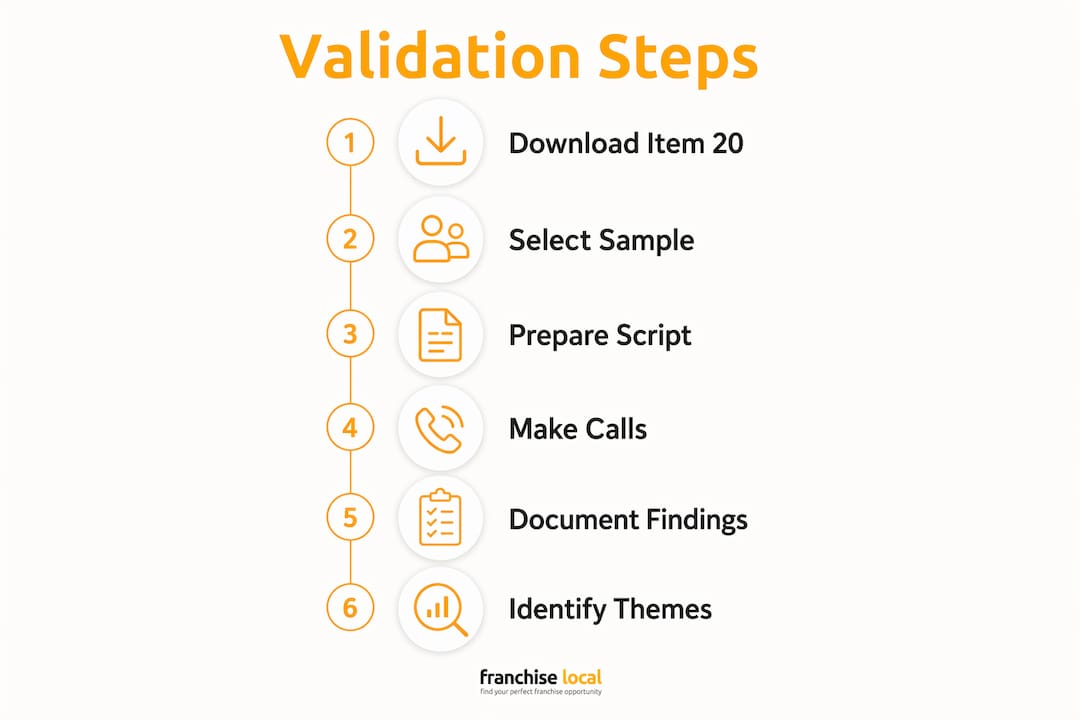
Step 4: Conduct phone calls, not emails
Validation calls should last 15–20 minutes and be conducted by phone. Email strips out tone, hesitation, and the pauses that signal discomfort. A franchisee who answers every written question promptly but stumbles when asked about profitability over the phone is telling you something important.
Step 5: Document and compile findings
After each call, record your notes immediately. Use a spreadsheet to log responses by question, franchisee, and sentiment. After 20 or 30 calls, patterns emerge clearly. Recurring complaints about a specific support function, for example, carry far more weight than a single negative comment.
Step 6: Identify red flags and themes
Look for consistency across franchisees. If multiple operators independently mention unexpected marketing fees, slow IT support, or difficulty reaching break-even, treat those as systemic signals rather than individual grievances.
Pro Tip: Always select franchisees independently from Item 20. Never rely solely on contacts the franchisor suggests. Franchisor-recommended franchisees are often coached, which skews your findings before the first call is made.
Why do validation calls matter more than the FDD?
The FDD is a legal document. It discloses financial performance representations, litigation history, and fee structures. What it cannot disclose is whether the franchisor’s training programme is genuinely useful, whether the supply chain causes daily frustration, or whether the projected earnings are achievable for a first-year operator in a mid-sized UK town.
Validation calls expose real costs, support responsiveness, and profit realities that go beyond FDD disclosures. This is the critical gap between what a franchisor presents in a sales meeting and what franchisees actually experience on the ground.
Consider these common discrepancies that validation calls regularly uncover:
- Hidden operational costs: Franchisees report spending significantly more on local marketing, staffing, and consumables than the FDD’s Item 19 financial performance representation suggests.
- Support quality gaps: The FDD may state that a dedicated support team is available, but franchisees reveal response times of several days or generic advice that does not address their specific market.
- Break-even timelines: Franchisors often present optimistic projections. Franchisees in similar territories frequently report longer break-even periods than the sales materials indicate.
- Franchisee morale: A network where most operators express regret or frustration is a network with structural problems, regardless of how polished the franchisor’s brochure appears.
“Validation is the reality check that reveals the gap between franchisor marketing and the operational franchisee experience.” — Franchise Canada
Current franchisees may still hold back. They have an ongoing relationship with the franchisor and may fear repercussions. This is precisely why former franchisees provide the most candid insights. They have no restrictions and often disclose issues that current operators quietly tolerate.
Investors are also increasingly complementing phone calls with AI-driven sentiment analysis and third-party satisfaction reports for more objective cross-verification. Tools like FranchiseIQ’s AI FDD analysis can flag anomalies in financial disclosures before you even begin your calls.
What questions should you ask during validation calls?
Consistent questioning is the foundation of reliable franchise opportunity analysis. If you ask each franchisee the same core questions, you can compare answers directly and identify patterns that individual responses would obscure.
Here are the key topic areas and example questions to cover:
- Financial performance: “What was your revenue in year one, and how does it compare to the franchisor’s projections?” and “When did you reach break-even?”
- Unexpected costs: “What expenses surprised you that were not clearly outlined before you signed?” and “How accurate were the initial investment estimates?”
- Corporate support: “How responsive is the franchisor’s support team?” and “Has the training programme prepared you adequately for day-to-day operations?”
- Operational challenges: “What is the hardest part of running this franchise?” and “Are there any recurring supply chain or technology issues?”
- Franchisee satisfaction: “Knowing what you know now, would you invest in this franchise again?” and “Would you recommend this opportunity to a close friend or family member?”
- Network health: “How would you describe the relationship between franchisees and the franchisor?” and “Is there an active franchisee association or peer support network?”
Pay close attention to how franchisees answer, not just what they say. Hesitation before answering a question about profitability, or a quick change of subject when corporate support is mentioned, carries as much information as the words themselves. Franchisee unwillingness to return calls or reluctance to speak is a significant red flag indicating potential dissatisfaction or systemic issues across the network.
Pro Tip: After each call, score each franchisee’s overall sentiment on a simple 1–5 scale. When you aggregate scores across 20 or 30 calls, the pattern becomes immediately visible and far easier to present to a solicitor or financial adviser.
You can find complementary franchise research methods that work alongside validation calls to build a fuller picture of any opportunity.
What are the most common pitfalls in franchise validation?
Skipping or rushing franchise validation results in poor profitability outcomes and surprise operational challenges after signing. The mistakes below are the ones that cost prospective franchisees the most.
Calling too few franchisees. Speaking to five or six operators gives you anecdotes, not data. You need a statistically meaningful sample to distinguish individual experience from systemic patterns. Aim for the 15–20 current and 5–10 former franchisee benchmark.
Relying on franchisor-selected references. Franchisees recommended by franchisors are often coached and biased. Selecting a random, independent sample from Item 20 is the only way to get an unbiased assessment. The franchisor will always point you towards their happiest operators.
Ignoring former franchisees. Many prospective buyers focus exclusively on current operators. This is a significant error. Former franchisees, particularly those who exited recently, often reveal the issues that current operators are reluctant to discuss openly.
Failing to document findings. Conducting 20 calls and relying on memory is not due diligence. It is guesswork. Without a structured record, you cannot identify patterns, brief a solicitor accurately, or revisit your findings when negotiating terms.
Substituting email for phone calls. Email responses are curated and edited. Phone calls capture tone, hesitation, and spontaneous comments that written answers never reveal. The 15–20 minute phone call format exists for good reason.
Overlooking non-responses as data. A franchise network where a high proportion of franchisees decline to speak or do not return calls is signalling something. Silence is an answer. Treat low response rates as a warning sign, not an inconvenience.
Pro Tip: Before you begin calling, read the common franchise pitfalls that cause UK franchises to fail. Understanding structural failure points sharpens the questions you ask during validation.
How do you use validation findings to choose the right franchise?
Validation data is only useful if you apply it systematically to your investment decision. Raw notes from 25 phone calls do not make a decision for you. The analysis does.
Start by comparing your validation findings directly against the franchisor’s FDD disclosures and sales materials. Where franchisees consistently report lower revenues than Item 19 projections suggest, adjust your financial model accordingly. Where support responsiveness is praised across the board, that is a genuine operational strength worth weighting positively.
The table below provides a practical framework for translating validation findings into a structured franchise opportunity analysis:
| Validation criterion | Green signal | Amber signal | Red signal |
|---|---|---|---|
| Revenue vs. projections | Franchisees meet or exceed FDD figures | Mixed results across similar territories | Consistent underperformance reported |
| Break-even timeline | Achieved within projected period | Slightly longer than projected | Significantly delayed or not yet reached |
| Corporate support quality | Prompt, specific, and valued | Adequate but inconsistent | Slow, generic, or largely absent |
| Franchisee satisfaction | Would reinvest; recommends to others | Neutral; would not actively discourage | Regrets investment; warns others |
| Hidden costs | Costs align with FDD estimates | Minor unexpected expenses | Significant undisclosed costs reported |
| Network responsiveness | High call-back rate; open dialogue | Moderate response rate | Low response rate; reluctance to speak |
Use this table to score each franchise you are evaluating. A franchise with mostly green signals across all six criteria is worth progressing. One with multiple red signals warrants either a direct conversation with the franchisor to address specific concerns, or a decision to walk away.
Demographic matching also matters when selecting which franchisees to call. Prioritise operators in territories that resemble your target location in terms of population density, income levels, and competition. A franchisee thriving in central London may have a very different experience from one operating in a market town in the East Midlands.
For a broader view of how validation fits into the overall selection process, the franchise comparison process guide offers a useful parallel framework for evaluating multiple opportunities side by side.
My honest view on why most people get validation wrong
I have seen prospective franchisees spend months researching brand reputation, attending discovery days, and poring over financial projections, only to conduct three validation calls in the final week before signing. That is the wrong order of priorities entirely.
Validation is not the final box to tick. It is the filter through which everything else should be assessed. The FDD tells you what the franchisor is legally required to disclose. Validation tells you what they would prefer you did not find out until after you have signed.
The most revealing calls I have encountered are not the ones where franchisees complain loudly. They are the ones where a franchisee pauses for just a moment too long before answering a question about whether they would do it again. That pause is worth more than a dozen polished testimonials on a franchisor’s website.
Technology is genuinely improving this process. AI-driven FDD analysis tools like FranchiseIQ can now flag financial anomalies and inconsistencies in disclosure documents before you begin your calls. That preparation makes your conversations sharper and your questions more targeted. But technology supplements the process. It does not replace the 20-minute phone call with a franchisee who has been running a territory for three years.
My strongest advice is this: allocate the full 60–90 days. Contact franchisees you selected yourself from Item 20. Document every call. And pay as much attention to what people avoid saying as to what they tell you directly.
— Will
Start your franchise search with Franchiselocal
Once you have completed your validation and identified the right opportunity, the next step is finding verified franchises that match your investment profile. Franchiselocal’s UK franchise directory lists opportunities across every sector, investment level, and working style. Whether you are drawn to networking franchises or exploring financial business franchises, the directory gives you a structured starting point for your search. You can filter by budget, location, and lifestyle preference to identify opportunities worth taking through a full validation process. Browse the full franchise directory to begin your search with confidence.
FAQ
What is the franchise validation process?
The franchise validation process is the structured practice of contacting current and former franchisees from a franchisor’s Item 20 list to verify claims made in the FDD and sales materials. It typically involves 15–20 minute phone calls with a representative sample of operators.
How many franchisees should I contact during validation?
Contact at least 15–20 current franchisees and 5–10 former franchisees for a reliable sample. If the network has fewer than 50 units, aim to speak with at least 30% of all franchisees listed in Item 20.
How long does franchise due diligence take?
A thorough franchise due diligence process, including validation, takes 60–90 days. The legal 14-day waiting period after receiving the FDD is a minimum requirement, not a sufficient timeframe for proper investigation.
Why should I contact former franchisees specifically?
Former franchisees have no ongoing commercial relationship with the franchisor, which means they face fewer constraints when speaking candidly. They frequently disclose hidden costs, support failures, and operational issues that current franchisees may withhold.
What is the biggest mistake in franchise validation?
The most costly mistake is rushing or skipping systematic, documented calls. Relying on franchisor-selected references or conducting too few calls produces a biased picture that leads to uninformed investment decisions and unexpected operational challenges after signing.