

Starting your own business in the UK brings a major decision for aspiring entrepreneurs: should you invest in a proven franchise or build an independent venture from scratch? The path you choose affects everything from your daily workload to your long-term profits and exit options. This guide breaks down the core structural and financial differences between franchising and independent ownership, helping you find the route that matches your budget, skills, and growth ambitions.
Core differences between franchise and independent business
Choosing between a franchise and an independent business shapes your entire entrepreneurial journey. The two models operate under fundamentally different structures, with distinct advantages and constraints. Understanding these core differences helps you make a choice aligned with your goals, budget, and risk tolerance.
Support and Systems
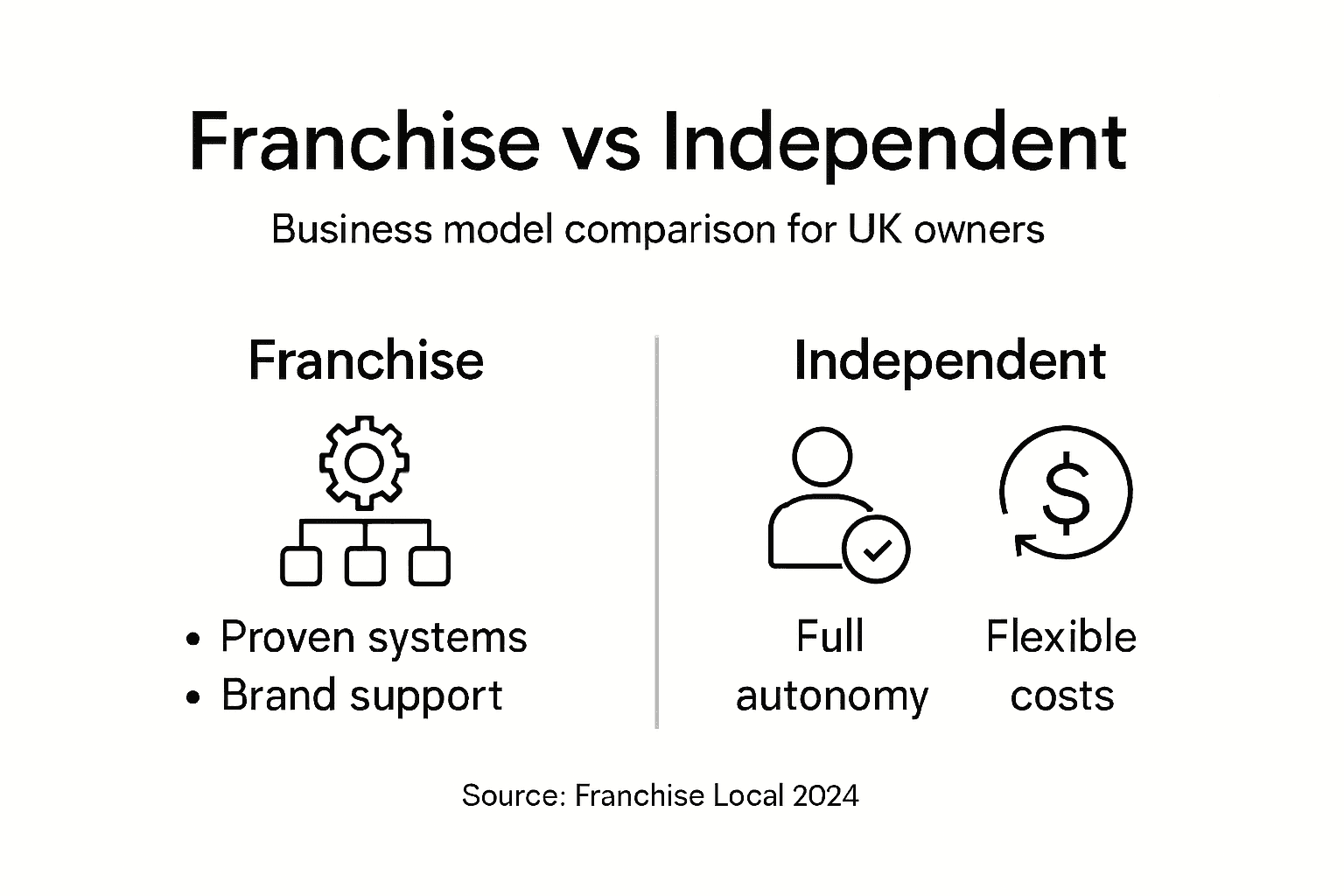
Franchises provide pre-built operational systems and ongoing support from the franchisor. Your business runs on proven processes, training programmes, and brand recognition already established in the market.
Independent businesses require you to build everything from scratch. You create your own systems, brand identity, marketing strategies, and operational procedures.
The support difference is substantial. Franchisees receive initial training, marketing materials, and continuous guidance. Independent operators manage all problem-solving independently, which demands more time and expertise.
Initial Investment and Costs
Franchise costs typically include upfront fees, equipment, stock, and working capital. The franchise model structure means you pay ongoing royalties or service fees to the franchisor, usually a percentage of turnover.
Independent businesses offer greater flexibility on startup spending. You control exactly where money goes and avoid ongoing franchise fees.
However, independent operations often demand higher total costs. Without established supply chains, you negotiate less favourable rates with suppliers. You also invest heavily in building brand recognition from zero.
Brand Recognition and Customer Trust
Franchises leverage an existing brand that customers already know and trust. This accelerates customer acquisition significantly compared to launching an unknown business.
Independent businesses must build brand awareness entirely on their own efforts. Your marketing budget works harder to create initial recognition.
Franchisees gain competitive advantage through brand recognition that would cost independent operators hundreds of thousands to develop.
Operational Freedom and Decision-Making
Franchise agreements dictate many operational decisions. You follow prescribed systems for pricing, product offerings, staff training, and marketing. This standardisation ensures consistency but limits creative control.

Independent owners make all decisions autonomously. You choose your suppliers, pricing strategy, product range, and marketing approach without approval from anyone.
This freedom attracts entrepreneurs who value creative control. However, poor decisions directly impact your business without franchise support safety nets.
Key operational differences:
- Franchises: Standardised systems, brand guidelines, mandatory training, supplier restrictions
- Independent: Complete autonomy, flexible decision-making, no operational constraints, full responsibility for outcomes
- Franchises: Ongoing franchisor support and guidance
- Independent: Self-reliant problem-solving and strategy development
Profitability Timeline
Franchises typically reach profitability faster because proven systems work immediately. Customer acquisition accelerates through brand recognition. Mistakes are fewer because systems reduce trial-and-error.
Independent businesses take longer to become profitable. You invest months building systems, establishing supplier relationships, and developing customer bases.
Many independent operators report profitability within 18-24 months. Franchise owners often achieve it within 12-18 months, depending on the sector.
Resale Value and Exit Options
Franchises have structured resale processes. The franchisor typically approves new owners and maintains valuation standards. This makes selling relatively straightforward.
Independent businesses lack standardised exit pathways. You must find buyers willing to value your unique business on their own terms. Valuations depend entirely on your profitability and customer loyalty.
Here is a summary comparing the main aspects of franchises and independent businesses:
| Aspect | Franchise | Independent Business |
|---|---|---|
| Startup Guidance | Comprehensive training and manuals | Must develop own processes |
| Brand Recognition | Immediate, national or regional reach | Must build from the ground up |
| Operational Control | Franchisor sets most key decisions | Total control, full autonomy |
| Initial Investment | Typically higher, structured fees | Flexible, often lower, variable |
| Ongoing Costs | Royalties and service charges | No royalties, unpredictable costs |
| Support Level | Professional ongoing assistance | Self-reliant or external advisors |
| Exit Process | Franchisor-mediated, streamlined | Negotiated case-by-case |
Pro tip: Compare detailed franchise disclosure documents against your independent business financial projections before deciding—the hidden costs and ongoing obligations in franchises often exceed initial estimates.
Types of franchise models and independent ownership
Franchise models vary significantly in structure and operational scope. Understanding each type helps you identify which aligns with your investment capacity and business vision. Independent ownership structures offer completely different frameworks for control and liability.
Franchise Model Types
Business Format Franchises represent the most common UK model. You receive complete operational systems, brand guidelines, training, and ongoing support from the franchisor. This comprehensive approach suits entrepreneurs seeking proven blueprints.
Product Distribution Franchises focus on selling franchisor products under their brand. You operate as a distributor, managing sales and customer relationships whilst maintaining brand consistency. This model requires less operational complexity than business format franchises.
Management Franchises involve managing franchise locations on behalf of the franchisor. You handle day-to-day operations whilst the franchisor retains significant control over strategic decisions. This suits entrepreneurs wanting operational responsibility without full ownership autonomy.
Multi-Unit Franchises allow you to operate several franchise locations simultaneously. You control multiple outlets within a defined territory, scaling faster than single-unit franchisees but accepting greater complexity.
Area Development or Master Franchises grant rights to develop an entire territory. You recruit sub-franchisees, manage their performance, and collect portions of their royalties. This requires substantial capital and experience but generates significant revenue potential.
Different franchise models suit different entrepreneurs—matching your investment capacity and operational experience to the right model determines long-term success.
Independent Ownership Structures
Independent businesses operate under various legal structures, each with distinct advantages and liabilities.
Sole Traders represent the simplest structure. You own and operate the business alone, keeping all profits but bearing unlimited personal liability for debts. Tax is straightforward—business income counts as personal income.
Partnerships involve two or more owners sharing control, profits, and liabilities. Partners share decision-making responsibility but face joint and several liability. Disagreements between partners require careful management.
Limited Companies separate personal liability from business liability. Your personal assets remain protected if the company faces financial difficulty. However, operating costs and accounting requirements increase significantly.
To help clarify your business model options, see this reference table of franchise and independent ownership structures:
| Legal Structure | Personal Liability | Management Complexity | Best Suited For |
|---|---|---|---|
| Sole Trader | Unlimited, personal | Very simple, single decision-maker | Simple businesses, sole owners |
| Partnership | Joint and several | Moderate, shared responsibility | Family or professional teams |
| Limited Company | Limited (company only) | Complex, involves directors | Larger ventures, growth focus |
| Franchise | Defined by contract | Streamlined, guided by franchisor | New entrepreneurs, proven models |
Key Structural Comparisons
- Sole traders: Complete autonomy, unlimited liability, minimal setup costs, straightforward taxation
- Partnerships: Shared responsibility, joint liability, shared decision-making, flexible profit distribution
- Limited companies: Protected personal assets, separate legal entity, higher compliance burden, more complex tax structure
- Franchises: Restricted autonomy, defined liability within franchise agreement, ongoing royalty obligations, established systems
Choosing Your Structure
Your choice depends on several factors working together. Consider your available capital, risk tolerance, desired control level, and growth aspirations.
Franchises work best if you want proven systems and brand recognition. Independent structures suit entrepreneurs prioritising complete creative control and operational freedom.
Liability considerations matter significantly. Sole traders and partnerships expose personal assets to business risk. Limited companies and franchises (when structured correctly) provide liability protection.
Pro tip: Consult a business accountant before choosing your structure—tax implications, liability exposure, and setup costs differ dramatically across sole traders, partnerships, limited companies, and franchise models.
Legal framework and business obligations in the UK
UK franchise law operates differently from independent business regulation. The legal landscape shapes your obligations, protections, and operational flexibility significantly. Understanding these frameworks prevents costly disputes and ensures compliance.
Franchise Legal Framework
UK franchising is primarily governed by contract law, competition law, and intellectual property law. There is no dedicated franchise-specific statute governing the sector.
Franchise agreements form the foundation of your legal relationship with the franchisor. These contracts outline rights, obligations, fees, support provisions, and operational standards. Franchise agreements define how you operate, what you must pay, and what support you receive.
The British Franchise Association provides a voluntary Code of Ethics setting industry standards. Whilst membership is optional, adherence prevents disputes and demonstrates professional conduct to potential lenders and partners.
Competition law restricts certain franchise practices. You cannot be prevented from selling outside designated territories or restricted from pricing goods independently without franchisor approval, depending on agreement terms.
Independent Business Legal Requirements
Independent businesses operate under general UK business law. Your obligations depend on your chosen structure—sole trader, partnership, or limited company.
Consumer protection laws apply regardless of structure. You must comply with trading standards, provide accurate product information, and honour consumer rights legislation.
Tax obligations vary by structure. Sole traders file self-assessment tax returns. Limited companies file corporation tax returns and maintain statutory accounts.
Employment law applies if you hire staff. You must follow minimum wage requirements, working time regulations, and employment rights regardless of business model.
Key Legal Obligations Comparison
- Franchises: Comply with franchise agreement terms, pay royalties punctually, maintain brand standards, follow operational guidelines, attend mandatory training
- Independent businesses: Follow general business laws, pay relevant taxes, comply with consumer protection regulations, maintain business records, satisfy employment law requirements
- Franchises: Franchisor provides legal framework and support structures
- Independent: You establish and maintain your own compliance systems
The absence of franchise-specific legislation means your franchise agreement becomes your primary legal document—careful review before signing prevents future operational conflicts.
Self-Regulation and Dispute Resolution
The franchise sector relies on self-regulation rather than statutory oversight. The British Franchise Association sets ethical standards, but membership remains voluntary.
Dispute resolution typically occurs through mediation or arbitration clauses in franchise agreements. Independent businesses resolve disputes through standard contract law and commercial courts.
Professional legal advice is essential for both models. Franchisees should have solicitors review agreements before signing. Independent operators need guidance on correct structure selection and ongoing compliance.
Compliance Checklist
- Review franchise agreement clauses thoroughly before commitment
- Understand territorial restrictions and their enforcement mechanisms
- Confirm ongoing fee obligations and payment schedules
- Verify franchisor support commitments match your expectations
- Establish compliance systems for tax, employment, and consumer protection
- Maintain detailed business records for audit purposes
Pro tip: Engage a solicitor specialising in franchise law before signing any agreement—the cost of legal review (typically £500–£2,000) prevents expensive disputes and ensures you understand all financial and operational obligations.
Support, training, and operational systems compared
Support structures differ dramatically between franchises and independent businesses. Franchisees receive systematic guidance and established frameworks. Independent operators build everything themselves. This distinction shapes your daily operations, problem-solving capacity, and growth trajectory significantly.
Franchise Support and Training
Initial training represents a core franchise benefit. You receive comprehensive instruction on operations, product knowledge, customer service, and business management before launch. Most franchisors provide on-site training lasting several weeks.
Ongoing operational support continues throughout your franchise term. Franchise support systems include regular field visits, performance reviews, and access to helplines. Franchisors monitor compliance and provide guidance when issues arise.
Marketing and advertising support accelerates customer acquisition. Franchisors develop national campaigns, provide branded materials, and share proven marketing strategies. You benefit from collective marketing spend negotiated by the franchisor.
Supply chain management is handled centrally. Franchisors negotiate supplier agreements, ensuring consistent quality and competitive pricing across all franchisees. You purchase approved products at franchisor rates.
Technology platforms streamline operations. Most franchisors provide point-of-sale systems, inventory management software, and customer relationship management tools. These systems are pre-configured for your business model.
Independent Business Support Limitations
Independent operators must source all support independently. No franchisor provides training, marketing assistance, or operational guidance.
You hire consultants, attend external training courses, and join industry associations. These cost significantly—business coaches charge £100–£500 hourly, whilst professional courses run £1,000–£5,000.
Supply relationships require individual negotiation. Your smaller order volumes mean less favourable supplier terms compared to franchise networks. Building vendor relationships takes months of relationship-building.
Technology selection falls entirely on you. You research, select, and implement business software independently. Poor technology choices create operational inefficiencies that franchise systems prevent.
Support Comparison Summary
- Franchises: Pre-launch training, ongoing mentoring, regular performance reviews, field support visits, crisis management assistance
- Independent: Self-directed learning, hired consultants, industry conference attendance, peer networking groups
- Franchises: Standardised systems replicated across all units
- Independent: Custom systems built from experience and experimentation
- Franchises: Centralised marketing and supplier negotiations
- Independent: Individual marketing campaigns and supplier relationships
Franchise support removes operational trial-and-error, compressing your learning curve from years to months—independent operators invest significantly to replicate this guidance through external resources.
Quality and Consistency
Franchise systems ensure consistency. Every franchisee follows identical procedures, maintaining brand standards across locations. Quality monitoring prevents poor operators from damaging the brand.
Independent businesses vary wildly in quality and consistency. Your operational standards reflect only your decisions and capabilities. This flexibility attracts creative entrepreneurs but risks inconsistent customer experiences.
Access to Expertise
Franchisees tap into accumulated franchisor knowledge. Franchisors understand market challenges, customer behaviour, and proven solutions. This institutional knowledge accelerates your problem-solving dramatically.
Independent operators rely on personal experience and external expertise. Building comparable knowledge takes years of trial-and-error. Mistakes cost real money before lessons stick.
Operational Systems Comparison
- Franchises: Documented procedures for every operation, staff training materials, quality control checklists, performance metrics, standardised reporting
- Independent: Custom procedures you develop, informal training approach, variable quality control, personalised metrics, flexible reporting
Pro tip: Independent operators seeking franchise-level support should invest immediately in business mentoring and industry associations—£2,000–£5,000 annually in external guidance reduces costly mistakes and accelerates profitability significantly.
Financial implications, risks, and exit strategies
Financial outcomes differ substantially between franchises and independent businesses. Your investment requirements, profit margins, risk exposure, and exit options shape long-term wealth creation. Understanding these factors determines whether each model suits your financial situation.
Franchise Financial Structure
Franchises demand higher upfront investment than many independent businesses. You pay franchise fees (typically £10,000–£50,000), equipment costs, initial stock, and working capital. Total startup costs often exceed £100,000 depending on the sector.
However, franchise financial obligations are predictable and structured. You know upfront fees, recurring royalties (usually 5–10% of turnover), and service charges. This transparency aids financial forecasting.
Return on investment accelerates because established systems work immediately. Most franchisees achieve profitability within 12–18 months. Brand recognition and proven operations compress the ramp-up period significantly.
Ongoing royalty payments reduce net profits. You retain less income compared to independent operators generating equivalent revenue. This structural cost persists throughout your franchise term.
Independent Business Financial Profile
Independent startups typically require lower initial investment. You control spending, purchasing only essentials. Many independent businesses launch for under £50,000.
However, revenue builds slowly. Brand development costs thousands monthly through marketing and advertising. Profitability often takes 18–24 months because customer acquisition moves gradually.
Variable costs fluctuate unpredictably. Without centralised supplier negotiations, your margins depend on negotiation skills and order volumes. This creates cash flow uncertainty during early growth phases.
Profit potential exceeds franchises once established. You retain 100% of revenue after expenses. No royalty payments mean significantly higher net income at comparable turnover levels.
Risk Comparison
Franchises offer lower operational risk but higher financial risk. Your large upfront investment and ongoing fees create substantial financial exposure. Franchisor-imposed changes or market failures affect your entire investment.
Independent businesses present higher operational risk but lower financial commitment. Your smaller initial investment limits downside exposure. However, market failure means you lose everything.
- Franchises: Predictable costs, brand-dependent success, franchisor control risk, royalty obligations, higher capital requirement
- Independent: Variable costs, market-dependent success, complete control, no royalties, lower capital requirement
- Franchises: Established customer base at launch
- Independent: Customer acquisition entirely your responsibility
Higher upfront franchise costs demand significantly faster profitability to justify investment—independent business owners gain financial flexibility through lower startup requirements but accept longer paths to profitability.
Exit Strategies and Valuations
Franchise exits benefit from brand value and standardised operations. Prospective buyers value established customer bases and proven systems. Franchisors typically facilitate resales, ensuring brand continuity.
Valuation methodology is straightforward. Franchises sell based on revenue multiples and profitability metrics. Established brand recognition attracts serious buyers willing to pay premium prices.
Independent business sales face challenges. Custom-built operations lack standardised value metrics. Buyers struggle valuing personal relationships and undocumented systems you’ve created.
Valuation depends entirely on your profitability and growth trajectory. Without brand recognition, buyers pay only for tangible assets and recent profits. Goodwill calculations lack objectivity.
Exit Strategy Summary
- Document all franchise operations meticulously before exit
- Build independent business profitability for 3+ years before seeking sale
- Consider franchisor buyback options as exit strategy
- Identify potential independent business buyers early
- Maintain detailed financial records demonstrating consistent profitability
- Prepare customer lists and supplier contracts as valuation assets
Pro tip: Start exit planning on day one—franchisees should negotiate buyback clauses with franchisors, whilst independent operators must maintain rigorous financial records and customer documentation to maximise resale value when exiting.
Discover the Right Path to UK Business Ownership Today
Deciding between a franchise and an independent business can feel overwhelming with so many factors to consider such as brand recognition, operational control, and financial risks. If you want proven systems and ongoing support to reduce trial and error or prefer full autonomy to craft your own unique venture, understanding these differences is crucial. Don’t let uncertainty delay your entrepreneurial journey because aligning your goals with the correct business model is key to long-term success.
Explore a wide range of franchising opportunities suited to varying budgets and lifestyles at Franchise Local. Whether you seek comprehensive franchise packages or want to compare alternatives, our platform empowers you to filter options by investment type, sector, and operational style. Take control of your future and make an informed decision now by visiting UK Franchise Directory and discovering options that match your ambitions. Start your path to business ownership today with confidence and expert guidance.
Frequently Asked Questions
What are the main differences between a franchise and an independent business?
Franchises operate under a proven business model with established systems and ongoing support from the franchisor, while independent businesses require entrepreneurs to build their own systems and brand identity from scratch.
What are the cost implications of choosing a franchise vs. an independent business?
Franchises often have higher initial investments due to franchise fees and ongoing royalties. In contrast, independent businesses can offer lower startup costs, though they may face higher total costs due to less favourable supplier terms and the need to build brand recognition.
How quickly can I expect to be profitable with a franchise compared to an independent business?
Franchises typically achieve profitability within 12-18 months due to their established systems and brand recognition. Independent businesses usually take longer, often reporting profitability within 18-24 months as they develop their customer base and operational systems.
What level of support can I expect as a franchisee compared to operating independently?
Franchisees receive comprehensive training, ongoing support, and marketing assistance from the franchisor, which helps reduce trial-and-error. Independent operators, however, must seek their own guidance and support, often facing steep learning curves and challenges in establishing systems and processes.