

The trend of UK franchising 2026 tells a more confident story than many entrepreneurs expect. While economic uncertainty has rattled other sectors, the UK franchise market has held firm, backed by strong business fundamentals and growing investor sophistication. If you are considering a franchise investment this year, understanding where the market is heading, which sectors are gaining momentum, and what legal shifts are reshaping operations will give you a real edge. This article cuts through the noise and delivers the data, analysis, and practical guidance you need to make a well-informed decision.
The trend of UK franchising 2026: market size and confidence
Before examining specific opportunities, it helps to understand just how substantial the UK franchise sector has become. The numbers are striking. The UK franchise sector contributes over £19.1 billion annually to the British economy and supports more than 700,000 jobs across the country. That is not a niche corner of commerce. That is a major pillar of small and medium business activity.
What makes this even more significant is the sector’s resilience over time. The franchise failure rate has remained under 6% for more than two decades. Compared to the broadly cited failure rates for independent businesses, this figure is remarkable. It tells investors something critical: a well-chosen franchise, supported by a credible franchisor, carries considerably lower risk than starting from scratch.
Confidence entering 2026 reflects this stability. According to a recent BFA survey, 77% of franchise industry members described themselves as either very or fairly confident about their business plans. Specifically, 28.3% reported being very confident and 49.1% fairly confident. These are not trivial figures. They represent experienced franchise operators who understand economic cycles and still chose to back their own models.

Key market indicators at a glance
| Indicator | Data |
|---|---|
| Annual economic contribution | Over £19.1 billion |
| Jobs supported | 700,000+ |
| Franchise failure rate | Under 6% (sustained 20+ years) |
| Confidence level (2026 outlook) | 77% positive or fairly positive |
| Very confident respondents | 28.3% |
| Fairly confident respondents | 49.1% |
The mood is one of cautious optimism. Macroeconomic pressures including inflation, shifting consumer spending, and labour cost increases are real. But the franchise model’s built-in support systems, established brand recognition, and proven operational frameworks give franchisees a meaningful buffer that independent start-ups simply do not have.
Pro Tip: When assessing franchise confidence data, look beyond headline figures. A sector where 77% of operators feel positive about their plans is one where the infrastructure around franchisees is actively working. That support structure is often the difference between a struggling business and a profitable one.
Emerging franchise sectors worth watching
Not all franchise categories are growing at the same pace. In 2026, certain sectors are pulling ahead, driven by demographic shifts, consumer behaviour changes, and evolving lifestyle priorities. If you are researching UK franchise opportunities 2026, knowing which sectors have real wind in their sails is half the battle.
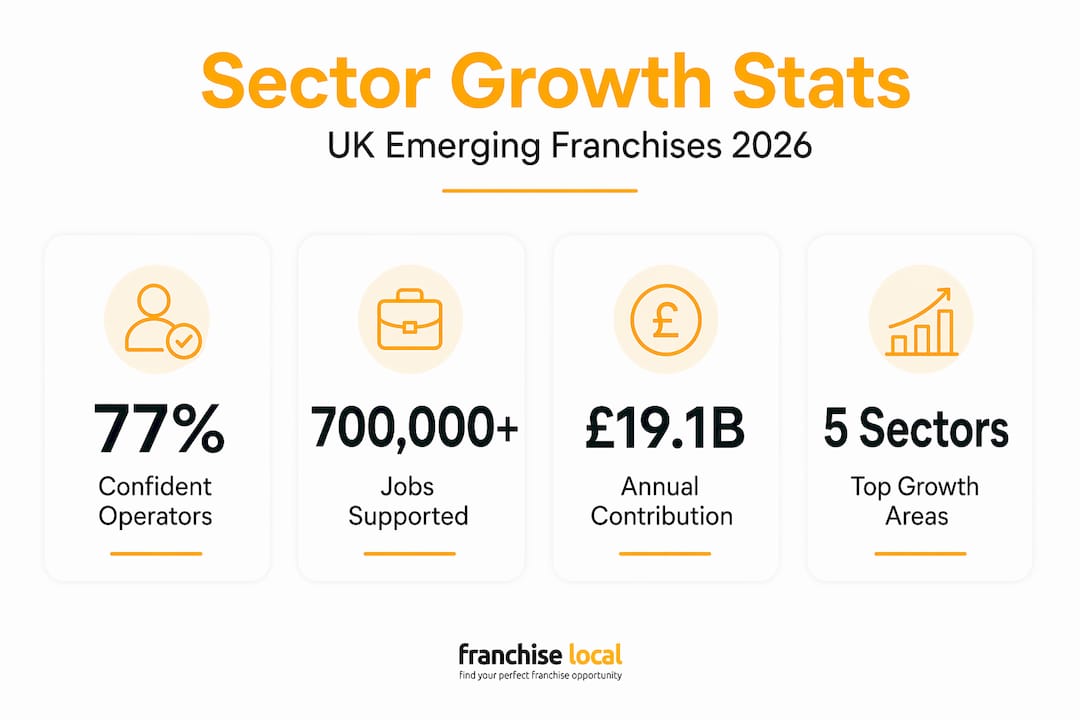
Service-led franchises with recurring revenue and low staffing requirements are consistently outperforming in the current market. Home care, supplemental education, and technology support are the standout categories. These models generate predictable monthly income, often operate with lean teams, and are relatively insulated from foot traffic fluctuations that hit retail and hospitality hard.
Here is a breakdown of the most promising sectors:
-
Home care and domiciliary care. Britain’s ageing population is creating sustained demand that is only increasing. Local home care franchises allow operators to serve a genuine community need while building a stable, contract-based revenue stream. Franchisors in this space often provide robust training and regulatory guidance, which is critical given the Care Quality Commission requirements.
-
Supplemental education. Parents continue to invest in tutoring and enrichment programmes regardless of economic conditions. Franchise models in this space typically require low initial outlay, can be home-based, and often operate in evenings and weekends, making them attractive as either full-time or part-time ventures.
-
Technology support and IT services. Small businesses across the UK are underserved when it comes to affordable tech assistance. Franchises that provide managed IT services, cybersecurity support, or digital marketing are tapping into a market with almost limitless demand and very low physical overhead.
-
Boutique fitness and wellness. Post-pandemic consumer priorities have shifted firmly toward health. Boutique gym concepts, personal training studios, and wellness coaching franchises are expanding rapidly in suburban and regional markets, not just city centres.
-
Environmentally conscious brands. Consumers are increasingly loyal to businesses with clear sustainability credentials. Franchise models built around eco-friendly cleaning, sustainable food sourcing, or green home services are carving out loyal customer bases that competitors struggle to poach.
The common thread across these categories is that they align with top UK franchise growth areas where consumer demand is structural, not cyclical. That distinction matters enormously when you are making a five to ten year investment decision.
Pro Tip: When evaluating any franchise sector, ask whether the demand is driven by a trend or a long-term demographic reality. Home care demand, for example, is tied to population ageing. That is not going away. A boutique fitness fad in a specific postcode, however, may not sustain a ten-year franchise agreement.
The legal and regulatory environment in 2026
The legal context around UK franchising is shifting, and investors who ignore this risk making costly mistakes. The courts and regulators are paying closer attention to franchise agreements, and the direction of travel is clear: fairness and transparency are now expected, not optional.
“English courts are showing increasing intolerance for one-sided franchise contracts. Franchisors who rely on overly rigid or imbalanced agreements to retain control are finding those structures challenged with growing frequency.”
This shift has real implications for both sides of the franchise relationship. For prospective franchisees, it is encouraging. The legal environment is becoming more protective of your rights as a business operator. For franchisors, it is a clear signal: update your agreements, invest in legal review, and prioritise balanced terms if you want to attract quality partners and avoid litigation.
The specific areas of regulatory concern in 2026 include:
-
Employment law reforms. Changes to worker classification rules have created new obligations around how franchisors structure their relationships with franchisee employees. Franchisors who treated franchisee staff as entirely separate from their own operations are discovering that distinction is harder to maintain legally.
-
Brand reputation liability. Regulators and the public increasingly treat franchisor and franchisee as one entity. Managing franchisee standards is critical for brand protection. A franchisee failing a hygiene inspection or receiving poor reviews does not just damage that location. It affects the entire network’s reputation.
-
Agreement transparency. Courts are scrutinising renewal terms, exit clauses, and fee structures. Vague or punitive language around these areas is being challenged. Franchisors who want to recruit strong candidates need agreements that a prospective franchisee’s solicitor will not immediately flag as problematic.
-
Consumer protection alignment. Franchise businesses operating in regulated sectors, including financial services, healthcare, and food, face compounding compliance requirements. Understanding where your franchise sits within this regulatory web is not optional.
The advice here is straightforward: get proper legal counsel before signing any franchise agreement. Read the full document, not just the headline terms. And if a franchisor resists your request for time to have the agreement reviewed, take that reluctance as important information. For a deeper grounding in what to look for, understanding what franchising is in a UK legal context is a sensible starting point.
Operational trends: multi-unit ownership and digital tools
The way experienced investors approach UK franchising is changing significantly. Single-unit ownership, once the default starting point, is giving way to more sophisticated portfolio strategies. Multi-unit and multi-brand ownership is now a dominant strategy among experienced UK franchisees, and this shift is reshaping how franchisors recruit, support, and develop their networks.
Single-unit vs multi-unit franchise ownership
| Aspect | Single-unit ownership | Multi-unit ownership |
|---|---|---|
| Initial investment | Lower | Significantly higher |
| Revenue ceiling | Limited by one territory | Multiple income streams |
| Operational complexity | Manageable for new entrants | Requires experienced management |
| Risk profile | Concentrated in one location | Spread across territories |
| Franchisor support needs | Hands-on guidance | ROI metrics, systems, efficiency tools |
| Growth potential | Moderate | High |
This investor sophistication is forcing franchisors to evolve. The rise of multi-unit franchisees demands operational efficiencies and ROI-focused support structures that differ substantially from traditional single-unit models. Franchisors who continue to offer one-size-fits-all support packages are finding it harder to attract the most capable investors.
Digital transformation is accelerating this shift. Franchises that have invested in strong CRM platforms, data-driven marketing systems, and integrated delivery ecosystems are performing better across every metric. Technology is no longer a nice addition. It is the operational backbone of a competitive franchise network. For context on how franchise marketing strategies are evolving in this environment, the tools available to UK franchisees in 2026 are considerably more powerful than five years ago.
Sustainability is also becoming a genuine differentiator. Franchises with clear environmental commitments, reduced waste policies, and ethical supply chains are winning customers who might otherwise go elsewhere. Equally, they are attracting franchisees who want their business aligned with their personal values.
Rising labour and energy costs remain the most cited operational challenges. Franchisors are responding by improving scheduling software, renegotiating supplier contracts at network level, and investing in energy-efficient equipment standards. Networks that address these pressures collectively give individual franchisees a meaningful cost advantage over independent operators.
Pro Tip: If you are evaluating a multi-unit opportunity, ask the franchisor to show you unit economics across their existing estate, not just for their best performers. A franchise that is profitable at scale in diverse locations is far more reliable evidence than a single flagship unit in a prime postcode.
Evaluating franchise opportunities: practical due diligence
Confidence in the sector is well-founded, but individual franchise decisions still require rigorous assessment. The broad trend of UK franchising in 2026 points upward, but not every franchise on the market deserves your money. Here is how to approach your evaluation systematically.
-
Review the franchise agreement in full with a specialist solicitor. General commercial lawyers often miss franchise-specific clauses around territory protection, renewal rights, and resale restrictions. Find a solicitor who works regularly with franchise agreements.
-
Speak to existing franchisees, both successful ones and those who have exited. Franchisors will naturally point you toward their happiest operators. Your job is to find the full picture. Ask how the franchisor responded when things went wrong, not just when things went well.
-
Understand the full cost structure. Initial franchise fees are just the beginning. Management service fees, marketing levies, software licences, equipment purchases, and territory renewal costs all add up. Model your cash flow for the first two years under pessimistic, realistic, and optimistic revenue assumptions.
-
Match the franchise to your personal circumstances. A hospitality franchise requiring 70-hour weeks is not a better investment than a home-based tutoring franchise just because the brand is more recognisable. Your ability to sustain the model long-term is directly linked to how well it fits your life.
-
Assess the training and ongoing support. A strong induction programme is the baseline. What matters beyond that is whether the franchisor provides continuous training, technology updates, marketing support, and genuine operational guidance when you hit a wall.
-
Check the franchisor’s financial health. Request their most recent accounts. A franchisor in financial difficulty cannot provide the support they promise. Franchisee fees sustain franchisor operations, so understanding their financial position protects your investment.
Matching your research with curated resources makes this process faster. The franchise investment checklist available through Franchiselocal offers a practical framework for working through these considerations before committing.
My take on the 2026 UK franchise market
I have watched entrepreneurs make franchise decisions for long enough to spot the patterns that lead to regret. The biggest one? Prioritising brand excitement over business fundamentals.
The 2026 data on sustainable growth models confirms something I genuinely believe: the investors who do best in franchising are the patient ones. They are not looking for the fastest return. They are building something that works consistently, scales carefully, and remains profitable when conditions get harder.
My honest assessment of the multi-unit trend is that it is encouraging, but it is being misread by some first-time investors. Owning three franchise units is not three times better than owning one unless you have the management capability to run them well. I have seen operators rush into their second and third units before their first was truly stable, and the results are almost always painful. Single-unit mastery before expansion is not a limitation. It is a strategy.
The legal shifts are the development I would watch most closely. The growing intolerance for one-sided agreements is good for franchisees in the long run. But the transition period creates friction. Some franchisors who have relied on punitive contract terms to manage their networks are going to find that those networks start declining as better-informed candidates walk away. The franchisors who embrace transparency now will have a recruiting advantage within two years.
One more thing: do not underestimate the value of the franchise support community. Connecting with other franchise investors through platforms like PeerFounder can surface insights about specific brands and sectors that no brochure or sales call will ever give you.
— Will
Find your next franchise opportunity with Franchiselocal
The 2026 UK franchise market offers real opportunity across a wide range of sectors and investment levels. Whether you are drawn to financial services, telecommunications, networking, or driving instruction, Franchiselocal has curated listings built around the trends shaping this market right now.
Explore networking franchise opportunities for growth-oriented investors, or browse financial business franchises combining strong demand with established operational support. If the technology sector appeals, the telecommunications franchise listings cover some of the UK’s most scalable opportunities. You can also filter across every major franchise industry category to match your budget, lifestyle, and region. Franchiselocal makes it straightforward to move from research to decision with the information you need at every step.
FAQ
What is the UK franchise sector worth in 2026?
The UK franchise sector contributes over £19.1 billion annually to the economy and supports more than 700,000 jobs, making it one of the most significant segments of British small business activity.
Which franchise sectors are growing fastest in the UK?
Home care, supplemental education, technology support, boutique fitness, and eco-conscious service brands are among the fastest-growing sectors, driven by demographic trends and shifting consumer priorities.
How confident are UK franchisees about 2026?
A BFA survey found that 77% of franchise industry members feel positive or fairly positive about their business plans for 2026, with 28.3% describing themselves as very confident.
What should I check before signing a franchise agreement in the UK?
Have a franchise-specialist solicitor review the full agreement, speak to current and former franchisees, understand all fee structures including ongoing levies, and verify the franchisor’s financial health before committing.
Is multi-unit franchise ownership a good strategy in 2026?
Multi-unit ownership offers higher revenue potential and is growing among experienced UK investors, but it requires proven operational capability. Mastering a single unit before expanding is the more reliable path to sustainable returns.