

Starting a business from scratch can feel daunting, especially when funds are tight and risks loom large. Franchising offers a tested, proven business system that lets you step into ownership while minimising uncertainty. Many small and medium-sized enterprises across the United Kingdom thrive as franchises, proving that you do not need huge capital or a well-known brand to succeed. This article clears away franchising myths, explores core concepts, and spotlights affordable options so you can find a pathway to financial independence that fits your ambitions.
Franchising Defined: Core Concepts And Myths
Franchising is a business model where a brand owner (the franchisor) partners with independent business operators (franchisees) under a formal agreement. The franchisor provides a proven system, training, and ongoing support whilst franchisees operate their own businesses using that established model.
At its heart, franchising solves a real problem. You get to own your own business without starting from zero. The model reduces risk because you’re using a tested, proven business system rather than inventing one yourself.
Here’s what actually happens in a franchise relationship:
- Franchisors grant franchisees the right to use their brand, systems, and methods
- Franchisees receive comprehensive training and operational support
- Franchisees pay initial fees and ongoing royalties for this access
- Both parties work under a legally binding franchise agreement
- The franchisor maintains quality standards across all franchised units
Now for the myths. These misunderstandings stop many capable entrepreneurs before they even start.
Myth 1: Franchising Is Only For Big Corporations
This couldn’t be further from the truth. Small and medium-sized enterprises across diverse sectors operate successful franchises. From fitness studios to specialist cleaning services, from recruitment agencies to home-care providers—franchising works at every scale. Your local favourite cafe might be a franchise, and you’d never know.
Myth 2: You Need Massive Capital
Franchise investment varies enormously. Yes, some require six-figure sums. But many profitable opportunities exist for £10,000 to £50,000. Home-based franchises, mobile operations, and service-based models often cost significantly less than high street retail locations.
Myth 3: Franchisees Are Just Following Orders
Franchisees run their own businesses. They make decisions about staffing, customer service, and local marketing. The franchisor sets standards for brand consistency, not every daily detail. It’s collaboration, not control.
Franchising succeeds when both franchisor and franchisee understand their role: the franchisor provides the proven system; the franchisee executes it brilliantly in their market.
Understanding these core concepts protects you from unrealistic expectations. The relationship works best when built on mutual benefit, clear communication, and realistic goals from day one.
Pro tip: Before dismissing franchising as “not for you,” explore the range of different franchise model types available—the variety might surprise you and reveal options that match your capital, lifestyle, and ambitions.
Types Of Franchising Models In The UK
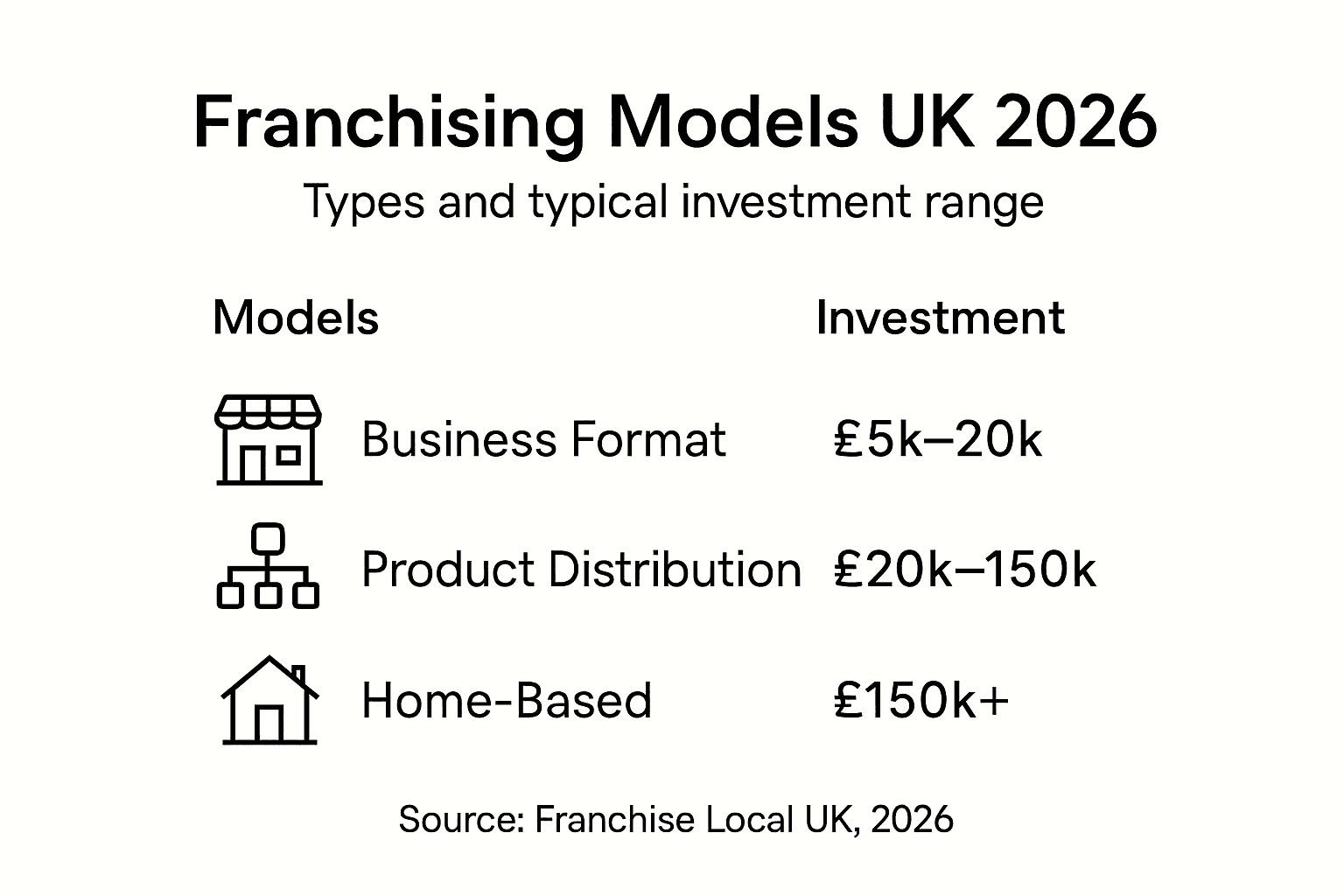
Not all franchises work the same way. The UK franchising landscape includes several distinct models, each with different operational structures, fee arrangements, and growth potential. Understanding these differences helps you identify which fits your circumstances, capital, and ambitions.
Business Format Franchising
This is the classic franchise model you probably picture. The franchisor provides a complete business system—everything from branding and operations manuals to training and ongoing support. You pay an initial fee, then ongoing royalties, typically as a percentage of turnover.
Examples include quick-service restaurants, fitness centres, and cleaning services. This model works well if you want comprehensive support but less independence in decision-making.
Product Distribution Franchising
Distribution franchises focus on selling the franchisor’s products rather than operating a full business system. You become an authorised distributor, selling products under their brand with limited operational control from them.
Think petrol stations or car parts retailers. Your role centres on selling products; the franchisor handles product development and supply.
Job Or Home-Based Franchising
These are small-scale operations, often run from home or a small office. Initial investment is typically £5,000 to £20,000. You provide services directly to customers—cleaning, tutoring, recruiting, or consulting.
This model suits aspiring entrepreneurs with limited capital. You own the business but operate independently with minimal franchisor involvement beyond initial training.
Management Franchising
In management franchising, franchisees manage multiple units or a larger territory. You’re not just running one location; you’re building a mini-network within your area.
This model requires more capital and experience but offers greater earning potential and territory control.
Manufacturing Franchising
Manufacturing franchises grant production rights. You manufacture products using the franchisor’s formula, patents, or processes, then sell them. This model suits established manufacturers seeking expansion.
Master Franchising
Master franchisees acquire rights to develop an entire region or country. They recruit and support sub-franchisees beneath them, acting as a franchisor themselves. This demands substantial capital and business expertise.
Key Model Comparison
Here’s what differs across models:
- Capital required: Job franchises (£5k–£20k) versus master franchising (£100k+)
- Operational control: Tight in business format; loose in distribution
- Support level: Comprehensive for business format; minimal for distribution
- Earnings potential: Lower for job franchises; higher for management or master franchising
- Legal considerations: Each model requires specific territory rights and quality control protections articulated in your franchise agreement
The right franchising model matches your capital, experience, appetite for franchisor involvement, and growth timeline—not which sounds most prestigious.
Pro tip: Compare models side-by-side using your actual capital, desired hours, and income goals—this reveals which models are genuinely viable for you, not which ones sound appealing in theory.
Here’s a comparison of key UK franchise models to help you identify which suits your ambitions:
| Model Type | Typical Investment | Best Suited For | Independence Level |
|---|---|---|---|
| Business Format | £10k–£250k | Structured guidance seekers | Moderate (set systems) |
| Product Distribution | £15k–£70k | Retail-focused entrepreneurs | Higher (product focus) |
| Job/Home-Based | £5k–£20k | Low-capital, flexible businesses | High (solo operations) |
| Management | £40k–£150k | Ambitious, multi-site managers | Moderate to high |
| Manufacturing | £80k–£300k | Existing manufacturers expanding | High (production led) |
| Master | £100k+ | Experienced investors/regional ops | Business builder level |
How The Franchise Relationship Works
Franchising isn’t a simple transaction. It’s an ongoing partnership governed by contract, shaped by mutual responsibilities, and grounded in trust. Understanding how this relationship actually functions helps you anticipate what to expect and identify potential friction points early.

The Core Structure
At its foundation, franchising involves licensing and control. The franchisor owns the brand, systems, and intellectual property. You (the franchisee) pay for the right to use these assets and operate under their system.
You’re not an employee. You’re an independent business owner. But you’re not completely free either—you operate within strict standards set by the franchisor to protect brand consistency.
What You Control (And What You Don’t)
As a franchisee, you retain genuine autonomy in several areas:
- Daily operational decisions (staffing, scheduling, local hiring)
- Local marketing and customer acquisition strategies
- Staff management and training (within brand guidelines)
- Financial management of your unit’s accounts
- Pricing decisions (sometimes within agreed ranges)
What you surrender:
- Brand identity, colours, logos, and visual standards
- Core operational procedures and systems
- Product or service standards and quality benchmarks
- Training methods and customer service protocols
- Territory boundaries (you cannot expand beyond your location)
The Fee Structure
You’ll typically pay two ongoing costs. An initial franchise fee covers training, setup support, and opening expenses. Then ongoing royalties—usually 4% to 12% of turnover—fund continued support, marketing, and system development.
Some franchises charge service fees separately. Others bundle everything. Always clarify exactly what you’re paying for before signing.
Roles And Responsibilities
The franchisor’s role includes providing training, maintaining brand standards, managing intellectual property, offering ongoing support, and sometimes handling national marketing. They set the rules; you follow them.
Your role is executing the system brilliantly. You invest capital, manage staff, handle customers daily, comply with standards, and drive local revenue. Success depends on your effort and local market conditions.
The Legal Foundation
Everything rests on the franchise agreement—a detailed legal document outlining payment schedules, operational standards, territory rights, renewal terms, and termination conditions. This contract protects both parties and clarifies expectations.
Most UK franchise agreements are negotiated upfront. Some elements may be flexible; others are fixed. Never sign without legal review.
Support And Training
Franchisors provide initial training covering operations, systems, customer service, and business management. Many offer ongoing support—regional meetings, refresher training, technology updates, and problem-solving assistance.
The quality of this support varies significantly between franchisors. Strong support accelerates your success; weak support leaves you struggling.
Performance Standards
Franchisors monitor performance through regular reporting, site visits, and mystery customer programmes. They enforce standards because a failing unit damages the entire brand. Poor performers receive warnings; serious breaches lead to termination.
Successful franchise relationships work because both parties understand they succeed together—your profit depends on the system’s integrity, and the franchisor’s reputation depends on your execution.
Pro tip: Before committing, ask the franchisor for contact details of current franchisees. Call them and ask specifically about support quality, response times to problems, and whether the franchisor actually listens to feedback—this reveals the real relationship dynamic.
Legal Framework And Compliance Essentials
The UK has no single franchise law. Instead, franchising operates under a patchwork of general legislation covering contracts, competition, intellectual property, and consumer protection. Understanding this framework protects you from legal pitfalls and ensures you’re dealing with ethical franchisors.
What Governs Franchising In The UK
Franchising relies on contract law as its primary foundation. Your franchise agreement is a legally binding contract that controls everything—fees, territory, operational standards, renewal, and termination. Beyond contracts, franchising is regulated through competition law, intellectual property protections, and consumer legislation.
There’s no dedicated “Franchise Act” like some countries have. This means more flexibility but also more responsibility for you to understand your obligations.
The British Franchise Association Code Of Ethics
Whilst not legally mandatory, the British Franchise Association (BFA) Code of Ethics sets industry standards. Member franchisors commit to transparency, fair dealing, and ethical practices. Membership signals legitimacy, though it’s voluntary.
The Code covers:
- Transparent disclosure of financial information
- Honest representations about earnings potential
- Fair contract terms and dispute resolution
- Reasonable support and training
- Clear territorial rights
- Ethical recruitment practices
Always check if a franchisor is BFA-accredited. It’s not a legal requirement, but it indicates they’ve chosen accountability.
Critical Legal Protections You Need
Your franchise agreement must explicitly address several areas:
- Territory rights: Exactly where you can operate and whether the franchisor can open competing units nearby
- Intellectual property: Your right to use trademarks, patents, and confidential systems
- Fees and payment terms: Initial franchise fees, royalty percentages, marketing levies, and payment schedules
- Term and renewal: How long the agreement lasts, renewal conditions, and notice periods
- Termination clauses: When either party can exit and what happens to your business
- Non-compete restrictions: Whether you can operate similar businesses after the franchise ends
- Data protection: How customer and business data are handled under UK GDPR requirements
Competition Law Compliance
The UK Competition Act 1998 and Chapter II of the Competition Regulation restrict anti-competitive practices. Franchisors cannot impose unreasonable restrictions on your business, and they must comply with these rules.
Watch for red flags:
- Restrictions preventing you from sourcing supplies from competitors
- Prohibitions on selling to specific customer types
- Requirements to charge artificially high prices
- Territorial exclusivity so restrictive it prevents market entry
Trademark And Intellectual Property
Your right to use the franchisor’s brand, logo, and systems must be clearly defined in your agreement. The franchisor retains ownership; you gain a limited licence. Understand exactly what you can and cannot do with the brand.
What You Must Do Before Signing
Critical steps protect your interests:
- Have a solicitor review the agreement (non-negotiable)
- Request disclosure documents showing financial information and franchisee details
- Contact existing franchisees and ask about their experience
- Verify the franchisor’s ownership of intellectual property
- Understand all fees and payment obligations in writing
- Clarify territory boundaries and non-compete restrictions
- Check their compliance with data protection regulations
The franchise agreement is your legal protection. Weak contracts lead to disputes; strong contracts prevent them. Professional legal review costs £500–£1,500 but protects investments worth tens of thousands.
Pro tip: Request the franchisor’s disclosure document at least two weeks before signing—they must provide this. If they resist transparency or rush you, that’s a warning sign that reveals more than any contract clause.
Key Risks, Fees And Common Pitfalls
Franchising isn’t risk-free. Whilst the model reduces some entrepreneurial dangers, it introduces others. Understanding these pitfalls before you invest protects your capital and prevents costly mistakes.
The Financial Reality
Franchise costs extend far beyond the initial fee. You’ll face upfront investment, ongoing royalties, marketing levies, and additional operational expenses. A £25,000 franchise might cost £35,000 total by opening day.
Then royalties arrive every month. A 6% royalty on £100,000 annual turnover means £6,000 going to the franchisor—whether you’re profitable or not. Marketing contributions add another layer of cost.
Common Fee Structures To Watch
Understand exactly what you’re paying:
- Initial franchise fee: £5,000–£50,000+ (sometimes non-refundable)
- Royalty fees: 4–12% of turnover (ongoing, typically monthly)
- Marketing levy: 1–3% of turnover for national campaigns
- Technology fees: £50–£500 monthly for systems and software
- Training fees: Sometimes charged separately beyond the franchise fee
- Renewal fees: Charged when your agreement term expires
Add these up realistically. A franchise costing £20,000 upfront with 8% royalties and 2% marketing on £80,000 annual turnover costs £8,000 per year in ongoing fees. That’s significant.
Compare the typical franchise fee types to clarify ongoing costs:
| Fee Category | Purpose | Typical Range |
|---|---|---|
| Initial Franchise | Access business system & setup | £5,000–£50,000+ |
| Royalty | Ongoing support & brand use | 4–12% of turnover |
| Marketing Levy | National advertising | 1–3% of turnover |
| Technology | IT systems/software upkeep | £50–£500/month |
| Training | Staff/new owner development | £500–£5,000 (if extra) |
Operational Loss Of Control
You own your business but operate within strict boundaries. The franchisor controls:
- Product and service specifications
- Pricing (sometimes within ranges)
- Supplier relationships (often mandatory)
- Marketing messages and campaigns
- Staff uniforms and customer service protocols
- Store layout and branding
This sounds reasonable for consistency. But when franchisor decisions conflict with your local market or profit needs, you’re trapped. Key operational risks include restrictive territorial and supplier agreements that limit your flexibility.
Contract Lock-In
Franchise agreements typically run 5–10 years. Exiting early is expensive. You may owe remaining royalties, face legal challenges, or lose your business overnight if terminated for breach.
Termination clauses often favour franchisors. They can terminate for performance failures, non-compliance, or even minor breaches. You may have limited grounds to exit without penalty.
The Territory Trap
Your territory boundaries matter enormously. A poorly defined territory means:
- The franchisor opens a competing unit near you
- Your earnings disappear overnight
- You’re stuck paying royalties on declining revenue
- No contractual protection existed
Always verify territory definitions in writing. “Greater London” isn’t specific enough. Exact postcodes or clear geographic boundaries protect you.
Brand Reputation Risk
You depend on the franchisor’s brand reputation. If another franchisee performs badly, the brand suffers. Your customers may assume you’re responsible. You lose sales through no fault of your own.
Conversely, if the franchisor’s national marketing disappoints or their product quality declines, your local business suffers regardless of your effort.
Red Flags That Signal Danger
- Pressure to decide quickly
- Vague earnings claims or testimonials
- Reluctance to provide franchisee contact details
- Lack of BFA accreditation without explanation
- Franchisees performing below break-even
- Franchisor financial instability
- Complex, heavily franchisor-favoured contracts
- No clear support structure or training plan
The most expensive franchise isn’t the one with the highest upfront cost—it’s the one where ongoing fees, territorial disputes, or performance failures drain your profit year after year.
Pro tip: Calculate your break-even point before signing: total upfront costs plus two years of royalties and operating expenses divided by estimated monthly profit. If break-even exceeds three years, the financial risk is significant—reconsider or negotiate lower fees.
Find Your Ideal Franchise Opportunity with Confidence
The article “What Is Franchising? UK Insights for 2026” highlights the complexities of franchising in the United Kingdom, including understanding models, navigating legal agreements, and managing ongoing fees. We know that deciding on the right franchise demands clarity on capital requirements, operational control, and Territory rights. These challenges can feel overwhelming when faced alone, especially if you want to avoid costly mistakes or hidden pitfalls.
At Franchise Local, we simplify your search by offering a comprehensive directory tailored specifically to your budget, lifestyle, and business goals. Whether you are exploring business format franchises for structured support or prefer home-based franchise opportunities, our detailed listings and filters help you compare investment levels and operational models easily. Start your entrepreneurial journey with the right knowledge and access to verified franchise brands that match your aspirations.
Take control of your future today. Visit Franchise Local to explore a wide range of UK franchise options and connect directly with franchisors ready to support your success. Don’t wait until uncertainty slows you down — your ideal franchise could be just a few clicks away.
Frequently Asked Questions
What are the main benefits of franchising?
Franchising provides a proven business model, reducing the risks associated with starting a business from scratch. It offers access to established branding, comprehensive training, and ongoing support, allowing franchisees to operate with a higher likelihood of success.
What are the different types of franchising models available?
Franchising models include business format franchising, product distribution franchising, job or home-based franchising, management franchising, manufacturing franchising, and master franchising. Each type has varying levels of support, investment requirements, and operational control.
What ongoing costs should a franchisee expect?
Franchisees typically pay an initial franchise fee, ongoing royalties (usually a percentage of turnover), and possibly marketing and technology fees. It is essential to calculate these costs accurately to understand the total financial commitment before signing an agreement.
How does a franchise agreement affect my business operations?
A franchise agreement outlines the terms of the relationship between the franchisor and franchisee, including operational standards and territorial rights. It defines the level of autonomy a franchisee has, detailing what decisions can be made independently and what must adhere to the franchisor’s system.