

Most UK franchisors charge an initial franchise fee somewhere between £5,000 and £50,000, with the FSB putting the average at roughly £14,000. That licence fee is only the entry ticket, though. Total investment, once you add fit-out, stock, working capital and ongoing royalties of 5–9% of revenue, averages closer to £45,000 and can run well beyond that in retail or multi-unit formats.
What does the initial franchise fee actually cover in the UK?
The initial franchise fee is the one-off licence payment you make to join a franchise network. It buys you the right to trade under the brand, use its systems, and receive the franchisor’s initial training and support. It is not, despite what some listings imply, the full cost of getting your business open.
UK figures vary depending on who you ask, and that spread trips up a lot of first-time buyers. At the lower end, home-based and service franchises often sit at £5,000–£25,000. Mid-market retail and hospitality brands typically charge £10,000–£50,000, a range confirmed by Xero’s UK franchise guide. Larger, more established multi-site brands can charge considerably more before you have spent a penny on premises.
Why the disparity? Three reasons drive most of it:
- Sample mix — an average pulled from hundreds of brands across every sector will always sit lower than a sector-specific average for, say, hospitality.
- What counts as “the fee” — some franchisors bundle initial stock or equipment into the headline figure; others quote the licence fee alone.
- Brand maturity — an established name with a proven format and dense support infrastructure generally commands a higher licence fee than a newer brand still building its playbook.
Statistic to remember: the FSB reports an average initial fee of about £14,000 against an average total investment near £45,000. That gap, roughly three times the licence cost, is the number every prospective franchisee should hold in their head before falling for a low headline fee.
What’s included in the fee, and what’s usually left out?
Ask any franchisor what their fee covers and you’ll usually get a similar answer, but the detail matters enormously when you’re comparing two brands side by side.
Most initial fees include:
- The brand licence and right to trade under the franchisor’s name and systems
- Initial training for you and often your first hires
- The operations manual and access to proprietary processes
- Launch support, which might mean a franchisor representative on-site for your opening days
What’s commonly excluded, and this catches people out more than anything else:
- Premises costs, whether that’s a deposit, rent in advance, or a purchase
- Shopfit and refurbishment
- Equipment, vehicles, and initial stock
- Solicitor and accountant fees
- Local launch marketing beyond whatever the franchisor supplies centrally
Pro Tip: Ask for the fee breakdown in writing before you sign anything, and cross-check it against the franchise disclosure document rather than the sales brochure. Brochures sell the dream; disclosure documents state the obligations.
If a franchisor’s proposal doesn’t spell out inclusions and exclusions clearly, treat that vagueness as your first data point about how transparent they’ll be once you’re locked into the agreement. Franchiselocal’s guide to what a franchise fee covers breaks this down further if you want a sector-by-sector comparison.
How much does total investment really add up to?
The licence fee is the smallest line in most franchise budgets. Everything else, premises, equipment, working capital, is where the real money goes, and it’s where undercapitalised franchisees run into trouble within the first six months.
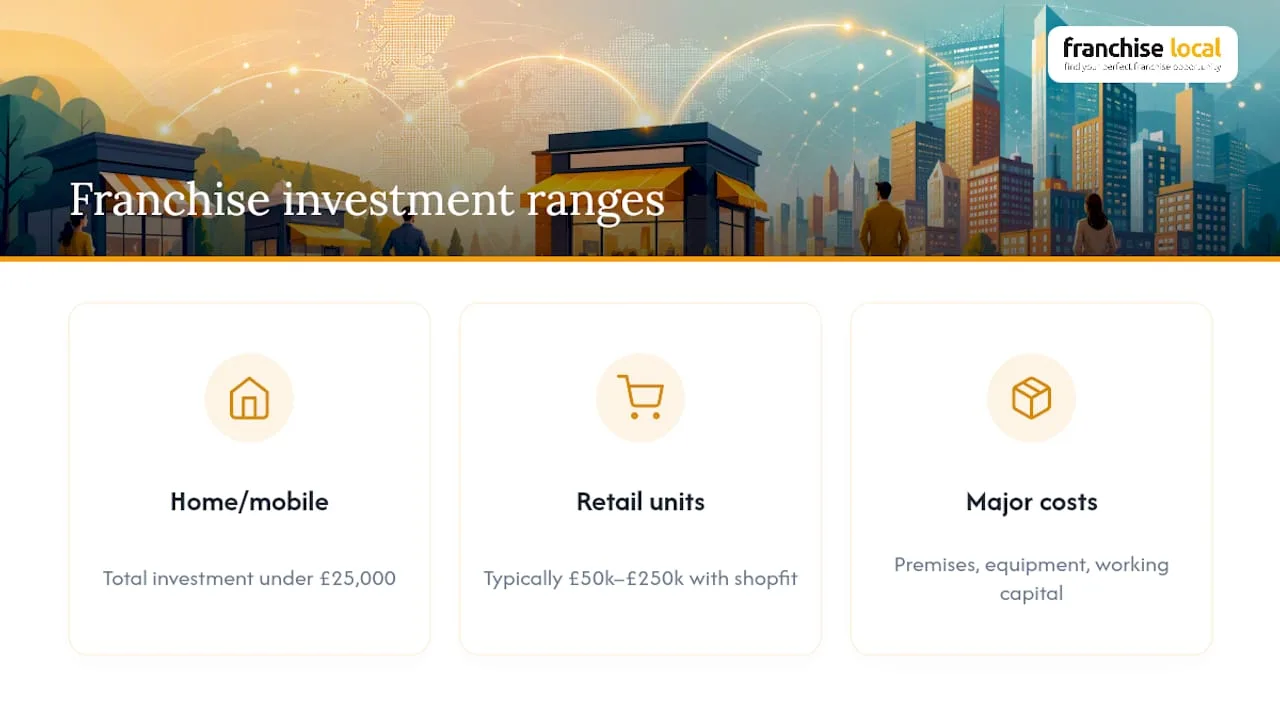
Here’s how the categories typically break down for a UK franchise purchase:
An entry-level, home-based or mobile franchise might keep total investment under £25,000 all in. A retail or hospitality unit with a full shopfit routinely lands between £50,000 and £250,000, a band, which Sprintlaw’s franchise cost guide also confirms for mid-tier operations.
One tax point worth knowing before you budget: Xero notes that HMRC generally treats the initial franchise fee as capital expenditure rather than a deductible revenue cost, while your ongoing royalty payments are usually allowable business expenses. That distinction affects your first-year tax position, so flag it with your accountant early rather than assuming the fee reduces your taxable profit the way a normal running cost would.
How do royalties and marketing levies eat into your margin?
Franchise fee comparison rarely stops at the upfront number. What you pay every month for the life of the agreement matters just as much, and it’s the part many first-time buyers underestimate.
Royalties in the UK typically run at 5–9% of revenue, a range corroborated by both Xero and franchise consultancy data, which pegs the most common band at 7–8%. On top of that, expect a marketing levy of roughly 1–3% of revenue, funding national campaigns and brand assets you couldn’t afford to build alone.
Other recurring costs that rarely make the headline pitch:
- Software or point-of-sale licence fees, often billed separately and scaling with turnover
- Refurbishment reserves, since many agreements require a shop refit every four to five years
- Refresher training charges as systems and product ranges evolve
Worked example: on £20,000 monthly revenue, a 7% royalty removes £1,400 before you’ve paid rent, wages or stock. That’s £1,800 a month, nearly £22,000 a year, leaving your business before it touches overheads. Franchiselocal’s guide to understanding royalties walks through how different royalty structures affect break-even timing.
How much does a franchise cost by sector?
Sector is the single biggest driver of your total investment figure, more than brand reputation or location. Mapping your budget against sector norms early saves you wasting time on opportunities you can’t actually afford.
- Home-based and mobile services (cleaning, tutoring, mobile car care): licence fee typically £5,000–£15,000, total investment often under £25,000.
- Retail and hospitality (cafés, convenience formats, salons): licence fee £10,000–£50,000, total investment commonly £50,000–£250,000 once fit-out and stock are added.
- Care and health services: licence fees vary widely, but regulatory compliance and vehicle costs push total investment into the £30,000–£100,000 band for many operators.
- Automotive and multi-unit high-street formats: total investment can exceed £250,000, and Sprintlaw notes that larger multi-unit opportunities including site acquisition can run past £500,000.
If you’re browsing by budget rather than sector, filtering by price range is often the faster route to a realistic shortlist than starting from a brand name you already recognise.
How do you know if a franchise fee is fair?
A fair fee is one backed by evidence, not just confidence. Franchisors who genuinely believe in their model tend to hand over the paperwork without being asked twice.
Work through these before you commit any money:
- Request a full cost breakdown covering licence fee inclusions and every excluded cost separately.
- Ask for sample profit and loss accounts from existing units, not just projections from head office.
- Speak to at least three current franchisees, ideally without a company representative present.
- Clarify territory rights in writing, including what happens if the franchisor opens a second unit nearby.
- Read the exit and renewal terms before you read anything about the opening timeline.
Red flags worth walking away from: no transparent cost breakdown, no willingness to provide franchisee references, unusually short post-launch support, or pressure to sign quickly. Conversely, audited accounts, an established training curriculum, and franchisees willing to speak candidly are all trust signals worth weighing heavily.
Pro Tip: A low initial fee paired with an unusually high royalty percentage isn’t automatically a bad deal, but it needs modelling over three to five years. As niBusinessInfo explains, a franchisor confident in long-term value sometimes prices the entry fee low deliberately. Just don’t take that confidence on faith; run the numbers yourself.
How should you budget and finance a franchise purchase?
Franchise costs in the UK are rarely a single lump sum from savings. Most buyers combine several funding sources, and lenders expect to see a specific kind of preparation before they’ll talk numbers with you.
Build your budget around these components:
- Contingency of three to six months’ working capital, covering rent, wages and royalties before the business turns a consistent profit
- A realistic cashflow forecast, month by month for the first year, not a single optimistic annual figure
- Personal funds first, since most lenders want to see you’ve invested your own capital before they commit theirs
- Mainstream bank lending, several UK banks run dedicated franchise lending schemes with pre-agreed terms for established brands
- Specialist franchise finance and asset finance, useful for equipment-heavy sectors like catering or automotive
Sprintlaw’s budgeting research is blunt on this point: preparation, not optimism, separates franchisees who succeed from those who don’t. Lenders want contingency planning on paper, not a one-month turnover projection that assumes everything goes right from day one. If you’re sourcing kitchen or catering equipment as part of a food franchise fit-out, understanding equipment financing options before you sign anything gives you a clearer sense of what to negotiate into your working capital.
Franchiselocal’s startup expenses guide sets out a fuller budget template if you want to stress-test your own figures before approaching a lender.
How Franchiselocal helps you compare fees across UK franchises
Comparing headline fees across dozens of brochures gets tedious fast, and the numbers rarely sit on the same basis anyway. Franchiselocal’s directory lets you filter UK franchise opportunities by price band, industry and lifestyle fit, so you’re comparing genuinely similar options rather than apples to oranges.
Beyond the listings themselves, a few resources are worth bookmarking as you narrow your shortlist:
- Curated lists grouping opportunities by investment level, from home-based through to established retail formats
- Guides on royalty structures and what recurring fees actually buy you
- A cash flow visualiser to model your own numbers against a franchisor’s projections
Filtering by budget first, rather than by brand recognition, tends to surface options you’d otherwise scroll past.
Why does independent legal review of your franchise agreement matter?
Franchise agreements are written by the franchisor’s solicitors, for the franchisor’s benefit. That’s not a criticism, it’s simply how contract drafting works, and it’s exactly why you need your own solicitor reading the document before you sign, not after.
Sprintlaw’s guidance on franchise agreement review recommends independent legal review specifically to understand territory rights, exit and termination clauses, and any recurring charges that don’t appear in the headline fee summary. Franchise agreements routinely run to forty or fifty pages, and the clauses that cause the most regret later, non-compete restrictions after exit, renewal fee escalators, mandatory supplier arrangements, are rarely the ones a sales presentation dwells on.
A solicitor experienced in franchise law will typically check:
- Whether the territory grant is exclusive or merely “primary”
- What happens to your investment if the franchisor is sold or the network is restructured
- Notice periods and financial penalties attached to early termination
- Whether supplier arrangements are mandatory and at what mark-up
The Sprintlaw team also flags that many buyer disputes trace back to skipping this step, or leaving it until after a deposit has already changed hands, when leverage to renegotiate has largely disappeared. Franchiselocal’s own piece on why legal advice matters before buying a UK franchise covers the specific clauses to flag with your solicitor, and its checklist of legal considerations is worth taking into that first meeting.
Budget for legal fees as a fixed cost, not an optional extra. A few hundred pounds spent reviewing a contract before signing is trivial against a five or ten-year commitment worth tens of thousands of pounds.
When do you actually pay the franchise fee?
Payment timing varies by franchisor, but most UK agreements follow a recognisable pattern that’s worth understanding before you start negotiating.
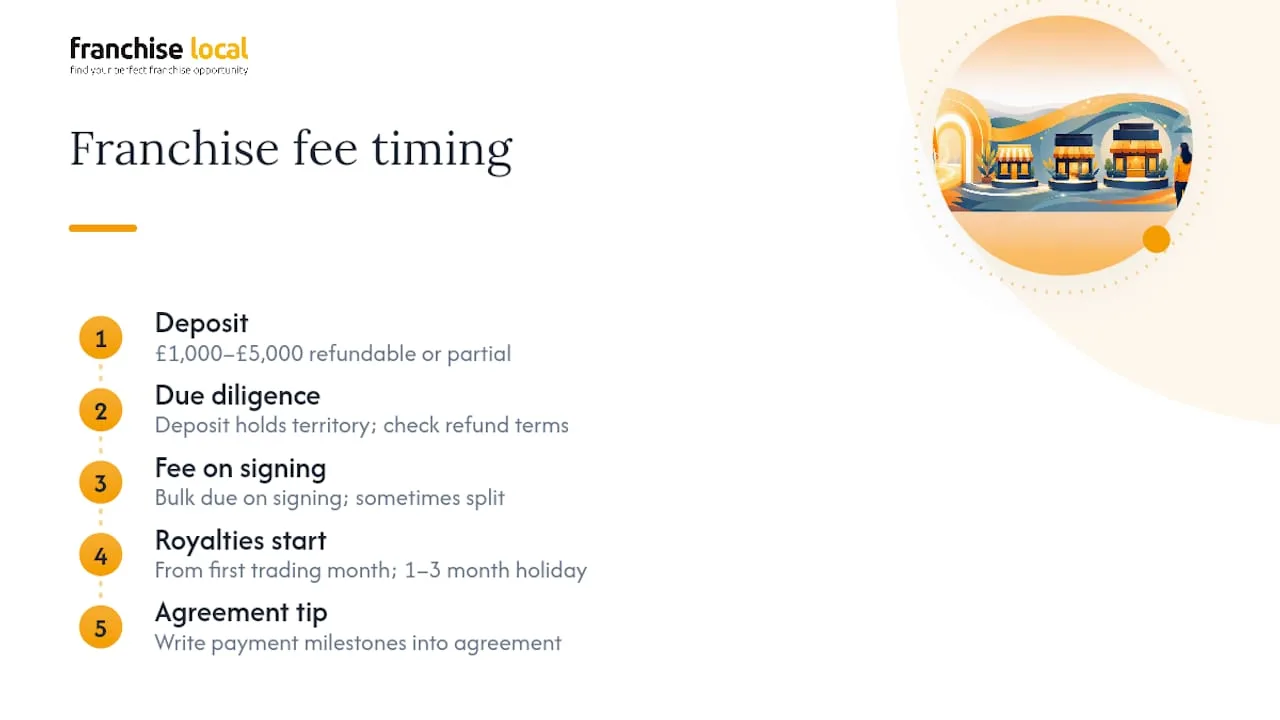
A refundable or partially refundable deposit, typically £1,000–£5,000, usually secures your territory while due diligence and paperwork proceed. This holds your chosen area off the market while you complete checks, but read the refund terms carefully: some deposits become non-refundable once you pass a certain stage, such as attending a discovery day.
The bulk of the initial franchise fee is normally due on signing the franchise agreement, before training begins. Some franchisors split this into two instalments, part on signing and part shortly before or on the opening date, particularly for higher-value packages where cashflow timing benefits both sides. It’s unusual, though not unheard of, for a franchisor to accept the full fee only after opening; most want funds committed before they invest training time and territory allocation in you.
Separately, ongoing royalties and marketing levies typically start from your first month of trading, calculated against actual revenue rather than a fixed projection. Some agreements include a short royalty holiday, perhaps the first one to three months, to ease early cashflow pressure while you build custom.
Always get payment milestones written into the agreement itself, not just discussed verbally during the sales process. If a franchisor asks for the full fee unusually early, before you’ve seen a signed agreement or completed legal review, treat that as a point to push back on rather than accept as standard practice.
How long does it take from application to opening day?
Timelines vary by sector, but most UK franchise purchases run from initial enquiry to opening doors in three to nine months. Home-based and service franchises tend to sit at the faster end, since there’s no premises search or shopfit to coordinate. Retail and hospitality formats routinely take longer simply because finding and fitting out a site adds months on its own.
A typical sequence looks like this: initial enquiry and information pack, followed by a discovery day where you meet the franchisor’s team and, ideally, existing franchisees. Then comes the application and approval stage, usually a few weeks, running in parallel with your own due diligence and legal review. Once you sign the agreement and pay the initial fee, training typically runs from a few days for simple service models to several weeks for technical or regulated sectors.
Premises search and fit-out is usually the longest single phase for retail and hospitality franchises, often taking two to four months depending on lease negotiations and how much construction work the unit needs. Equipment delivery, staff recruitment and pre-opening marketing typically run alongside this rather than after it.
Buyers who rush this timeline, particularly by skipping or shortening legal review to hit an arbitrary opening date, are the ones most likely to discover contract problems after they’ve already committed capital. A realistic nine-month runway from first enquiry to trading gives you room to do due diligence properly without losing momentum.
Find a UK franchise that matches your budget
Working out where you sit on the fee scale, home-based and under £25,000, mid-tier retail at £50,000 to £250,000, or a larger multi-unit commitment, is the first real decision in franchise buying, and it’s one Franchiselocal is built to help with. Rather than working through dozens of individual franchisor websites, you can filter listings directly by price band, industry and lifestyle fit across current trending opportunities, narrowing hundreds of UK franchises down to the handful that actually fit your budget and circumstances.
If you’re still shaping your numbers, run them through the cash flow visualiser before you approach any franchisor, so you’re negotiating from a position of knowing your own figures rather than accepting theirs at face value. For a vetted starting point, browse the best UK franchise opportunities list and shortlist two or three that match both your budget and the sector you actually want to work in.