

Buying a UK franchise means budgeting for several distinct cost buckets: the initial franchise fee, premises fit-out, equipment, opening stock, deposits, licences and permits, professional fees, opening marketing, and working capital. For most buyers, the total investment ranges from under £10,000 for a home-based model to well over £500,000 for a prime-site food or gym franchise. The single most important planning rule, backed by franchise finance advisers at NGI Franchise Funding, is to hold a 3–6 month working-capital buffer on top of every other cost before you open the doors.
Here are the eight core cost buckets to plan for:
- Initial franchise fee — the upfront licence payment to the franchisor
- Premises fit-out — shopfitting, signage, accessibility works and landlord requirements
- Equipment and initial stock — often mandated from approved supplier lists
- Deposits — typically 3–6 months’ rent on a commercial lease
- Professional fees — legal review, accountancy, surveying and lease advice
- Licences, permits and insurance — local authority registrations, public liability, employer’s liability
- Opening marketing — launch campaigns, local advertising and grand-opening costs
- Working capital — cash to cover wages, rent and supplies during the ramp-up period
Pro Tip: Under-capitalisation is the most common reason new franchisees struggle in year one. Build your working-capital buffer before you commit to a site, not after.
What counts as a franchise startup cost?
Franchise costs split into two categories: one-off capital items you pay before or at launch, and recurring charges that affect cashflow every month. Understanding what falls into each bucket prevents nasty surprises when the franchisor’s quoted “total investment” turns out to exclude several significant items.
Initial franchise fee
This is the upfront licence fee that grants you the right to operate under the franchisor’s brand and system. It commonly covers access to the operations manual, initial training, onboarding support and sometimes a territory exclusivity arrangement. Fees range from a few hundred pounds for micro-licences to £50,000 or more for established brands. What the fee does not usually cover is everything else on this list.
Premises fit-out and deposits
If your franchise requires a physical location, fit-out costs can dwarf the initial fee. Landlords typically require a deposit of 3–6 months’ rent, plus you may face planning or building-control fees, accessibility compliance works, and mandatory brand-standard shopfitting specified by the franchisor. Always get independent quotes; franchisor estimates are often based on national averages that do not reflect your specific location.
Equipment and initial stock
Most franchisors mandate equipment from approved supplier lists, which limits your ability to shop around. The same applies to opening stock. These mandated specifications drive cost upward and are worth scrutinising carefully during due diligence.
Professional fees
Budget for:
- A franchise solicitor to review the franchise agreement
- An accountant to review projected unit economics and set up your books
- A surveyor or lease specialist if you are taking on commercial premises
- Any planning consultants required for fit-out approvals
Independent legal review of the franchise agreement is not optional. The agreement defines your territory, renewal rights, exit restrictions and long-term financial obligations. Skipping this step to save a few hundred pounds is one of the costliest mistakes a new franchisee can make.
Opening marketing and staff costs
Many franchisors require a launch marketing spend, sometimes as a separate line item from the ongoing marketing levy. Add staff recruitment, uniforms and pre-opening training wages to this bucket.
Licences, insurance and local authority fees
These are frequently overlooked. Depending on your sector, you may need a premises licence, food hygiene registration, health and safety certification, employer’s liability insurance, public liability cover and business rates registration. Each carries its own fee and timeline.
What are typical startup cost ranges for UK franchises?
Investment levels vary enormously by sector and model. The bands below reflect realistic UK ranges, drawing on Sprintlaw’s UK franchise cost guidance.
Low-cost and home-based franchises (under £20,000 total)
Cleaning, tutoring, mobile beauty, bookkeeping and similar service franchises often start below £10,000 and rarely exceed £20,000. The initial fee is modest, there is no premises fit-out, and equipment costs are limited to a vehicle, tools or a laptop. These models suit buyers with limited capital who want to test franchising before committing to larger investments.

Mid-range retail, hospitality and service franchises (£50,000–£250,000)
This is the most populated band in the UK market. A typical mid-range retail or café franchise might carry an initial fee of £15,000–£30,000, fit-out costs of £40,000–£100,000, equipment of £10,000–£30,000, and working capital of £20,000–£40,000. Professional fees, deposits and opening marketing add a further £10,000–£20,000 on top.
High-investment multi-unit, food or gym franchises (£250,000–£500,000+)
Prime-site food brands, large-format gyms and multi-unit territory acquisitions sit at the top of the range. Site acquisition or long-lease premiums, heavy fit-out requirements and specialist equipment push total investment above £500,000 in many cases.
Key figure: Royalty rates for UK franchises commonly sit between 4% and 12% of sales, with marketing levies typically in the 1%–4% range. These percentages compound over a five-to-ten-year agreement term, so even a 2% difference in royalty rate has a material effect on lifetime returns.
One consistent pattern across all bands: the franchisor’s quoted investment range tends to exclude working capital and professional fees. Always add these before comparing opportunities.
What ongoing costs should you budget for after opening?
Recurring charges begin the moment you trade and continue for the life of the agreement. They affect cashflow directly, so model them carefully before you commit.
Royalties
Royalties are the franchisor’s primary ongoing revenue. Rates typically fall between 4% and 12% of gross or net sales, though some systems charge a flat monthly management fee instead. The payment base matters: royalties on gross sales hit margins harder than royalties on net sales, particularly in high-cost-of-goods businesses.
Marketing fund contributions
Ask for audited accounts of how the fund is spent. Opaque marketing funds are a common source of franchisee dissatisfaction.
Technology and mandatory supplier charges
POS systems, booking platforms, reporting software and approved supplier contracts all carry ongoing costs. These are often non-negotiable and should be itemised in the franchise agreement.
Regular operating costs
- Rent and service charges
- Wages and employer’s National Insurance contributions
- Utilities and broadband
- Business rates
- Public liability and employer’s liability insurance premiums
- Routine maintenance and cleaning
Cyclical renewal costs
Many agreements require a mandatory refurbishment at renewal (typically every 5–10 years), which can run to tens of thousands of pounds. Transfer fees apply if you sell the business. Renewal fees may also be charged. These obligations must be detailed in the franchise agreement — review them carefully before signing.
How do you calculate working capital and set a realistic cash runway?
The practitioner rule is straightforward: aim for a buffer equivalent to 3–6 months of total running costs, held in cash or a committed facility before you open. Running costs should include rent, wages, royalties, marketing levies, utilities, insurance and loan repayments.
A short worked example
Suppose your monthly fixed and semi-fixed costs total £12,000 (rent £3,500, wages £5,000, royalties and levies £1,500, utilities and insurance £1,000, loan repayment £1,000). A three-month buffer requires £36,000; a six-month buffer requires £72,000. Neither figure appears in most franchisors’ headline investment quotes.
Lenders and franchisors expect to see this buffer evidenced in your business plan. Acceptable evidence includes a bank statement showing available funds, a committed overdraft facility or a letter from a lender confirming a working-capital line. Vague references to “savings” without documentation rarely satisfy underwriters.
If the business survives that scenario with your buffer intact, your plan is credible.*
Seasonality matters too. A franchise with a strong December peak and a quiet January needs a larger buffer than one with flat monthly revenue. Model the calendar, not just the annual average.
How can you finance a franchise in the UK?
Several funding routes are available to UK buyers, and most successful applications combine more than one source.
Principal finance options
- Personal savings — the most straightforward contribution; lenders typically expect you to fund 30%–50% of the total investment yourself
- Bank business loans — high-street banks with dedicated franchise lending teams (such as NatWest, HSBC and Lloyds) are familiar with established franchise brands and often offer preferential terms
- Specialist franchise lenders — firms such as NGI Franchise Funding focus exclusively on franchise finance and understand unit economics in a way that generalist lenders may not
- Start Up Loans — a government-backed initiative delivered through the British Business Bank, offering personal loans of up to £25,000 at a fixed interest rate, with free mentoring included; useful for lower-investment franchises or as a top-up alongside other funding
- Asset finance and leasing — equipment, vehicles and fit-out items can often be financed separately, preserving working capital
- Franchisor finance — some franchisors offer deferred payment on the initial fee or contribute to fit-out costs; useful but read the terms carefully, as the franchisor becomes both your licensor and your creditor
- Friends and family — a common early-stage source, but formalise any arrangement in writing to protect the relationship
What lenders look for
A credible application needs:
- A detailed three-year cashflow model with low-revenue stress scenarios
- Evidence of a 3–6 month working-capital buffer
- Management CVs demonstrating relevant experience
- The franchisor’s disclosure document or investment range
- Proof of your own funds (deposit and personal contribution)
- Personal and business credit history
The British Franchising Association (BFA)
The BFA is the UK’s principal franchise industry body. Franchisors who hold BFA membership have agreed to a code of ethical conduct, which provides a degree of assurance during due diligence. Many lenders view BFA membership as a positive signal when assessing franchise applications.
Franchisor finance: pros and cons
Franchisor-backed finance can speed up the process and may carry flexible terms. The risk is that it creates a dependency: if the relationship with the franchisor deteriorates, you have limited leverage when both your licence and your loan sit with the same party. Always take independent advice before accepting franchisor finance.
For a broader view of franchise funding options available to UK buyers, Franchiselocal’s resource section covers the main routes in detail.
Pro Tip: Approach lenders with a franchise that holds BFA membership or has an established track record of successful franchisee exits. Lenders price risk based on the brand’s history, not just your personal creditworthiness.
What documents should you request before signing?
Due diligence on franchise startup expenses is not complete until you have reviewed the right documents and spoken directly to existing franchisees. Franchise fees and obligations must be fully disclosed in the franchise agreement, but the agreement alone rarely tells the full financial story.
Core documents to request
- The franchise agreement (full, not a summary)
- The franchisor’s disclosure document or investment range breakdown
- Projected unit economics, including average and median franchisee revenue
- Supplier lists and any approved-supplier pricing schedules
- Details of mandatory refurbishment cycles and associated cost estimates
- Franchisee performance data for the past 3–5 years, including failure and exit rates
- Audited accounts for the marketing fund
Franchisors should disclose itemised costs and provide a list of current and former franchisees so you can verify figures independently. If a franchisor resists sharing this information, treat it as a significant warning sign.
Questions to ask existing franchisees
- What did your actual opening costs total, compared with the franchisor’s estimate?
- How long did it take to reach breakeven?
- Were there any costs you did not anticipate?
- Are supplier prices competitive, or do you feel locked into expensive contracts?
- How responsive is the franchisor when problems arise?
Why independent legal and accountancy review matters
The franchise agreement defines territory, renewal and exit terms that directly affect your long-term financial exposure. A franchise solicitor will identify clauses that limit your ability to sell, renew or exit without penalty. An accountant will stress-test the unit economics and confirm whether the royalty structure is compatible with a viable margin.
Pro Tip: When interviewing franchisees, ask for specific numbers rather than general impressions. “What did your fit-out actually cost?” yields more useful data than “Was it expensive?” Aim to speak with at least three franchisees at different stages of their tenure.
Which fees are negotiable, and what are the red flags?
Not everything in a franchise offer is fixed. Knowing which items are typically open to discussion gives you a stronger starting position.
Commonly negotiable items
- The initial franchise fee (particularly for a new or expanding brand)
- Territory size or exclusivity boundaries
- Staged payment schedules for the initial fee
- Franchisor contribution to fit-out or opening marketing costs
- Reduced royalty rate during a defined ramp-up period
Red flags to watch for
- Opaque supplier pricing with no independent benchmarking allowed
- Mandatory refurbishment cycles with no cost cap or advance notice period
- Renewal fees that are not fixed or capped in the agreement
- Royalties charged on gross sales in a business with thin margins
- Exit restrictions that prevent you from selling to a buyer of your choice
- Pressure to sign quickly without time for independent legal review
Franchise fees carry long-term legal and financial consequences, and any clause that is unclear or one-sided warrants a direct conversation with the franchisor before you proceed. If the franchisor refuses to clarify or negotiate on a material point, escalate to your franchise solicitor immediately.
A short negotiation checklist:
- Request a written breakdown of every fee before the heads of terms stage
- Ask whether the initial fee has been reduced for any other franchisee in the network
- Confirm in writing any verbal commitments about support, co-funding or fee waivers
- Never rely on a franchisor’s verbal assurance about costs — get it in the agreement
Sample startup budget for a mid-range retail franchise
The figures below represent a realistic mid-range UK retail franchise unit. Replace every line with at least two independent quotes before submitting a finance application.
| Cost item | Sample amount (£) | Notes |
|---|---|---|
| Initial franchise fee | 20,000 | Paid to franchisor at signing |
| Premises fit-out | 40,000–100,000 | Independent quotes required |
| Equipment | 10,000–30,000 | Franchisor approved-supplier list |
| Initial stock | 10,000–30,000 | First order at opening |
| Lease deposit (3 months) | 10,000–30,000 | Based on £3,500/month rent |
| Professional fees (legal + accountancy) | 15,000–30,000 | Franchise solicitor and accountant |
| Opening marketing | 3,500 | Launch campaign and local advertising |
| Licences, permits and insurance | 2,000 | Sector-dependent |
| Miscellaneous and contingency | 3,500 | Typically 5%–10% of subtotal |
| Subtotal (capital outlay) | £50,000–£250,000 | Before working capital |
| Working capital (3 months) | 36,000 | Based on £12,000/month running costs |
| Working capital (6 months) | 72,000 | Recommended lender-ready buffer |
| Total (with 6-month buffer) | £50,000–£250,000 | Full lender-ready figure |
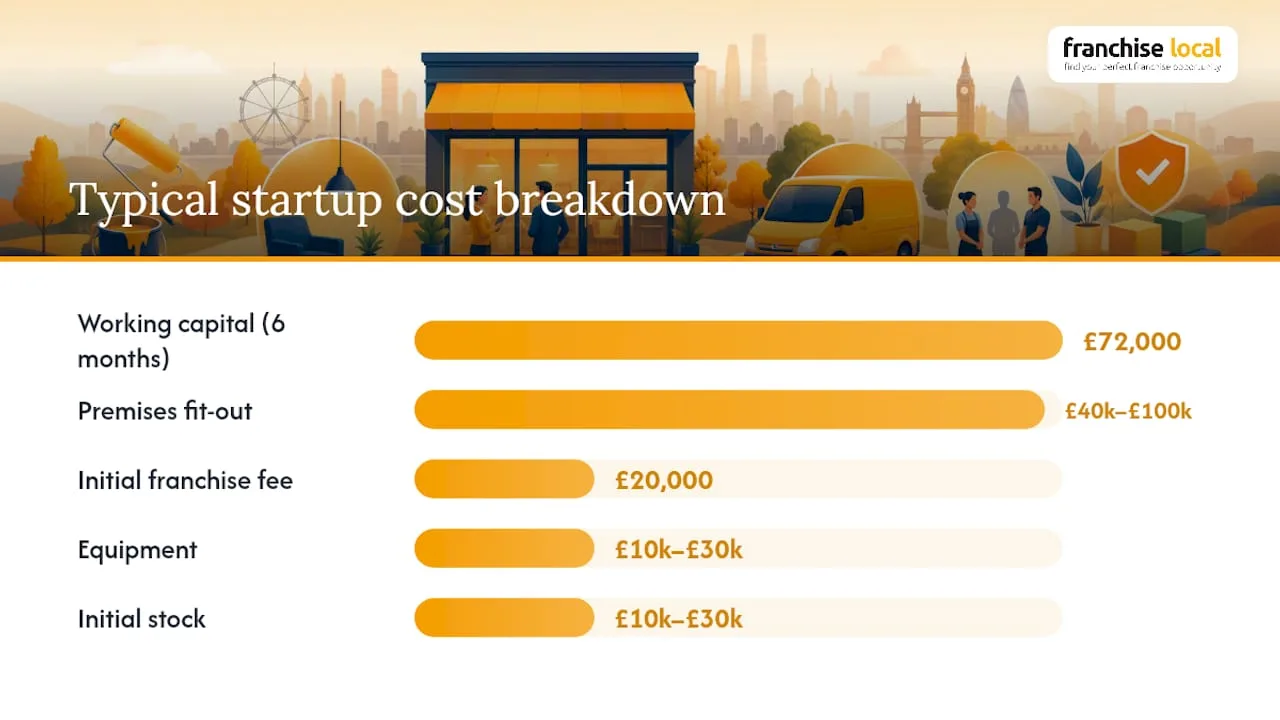
Lenders will expect independent quotes for fit-out and equipment. Professional fees and licences are estimates until you have a specific site and sector confirmed.
For guidance on how to price your franchise and structure your investment, Franchiselocal’s dedicated guide walks through the key variables in detail.
Where can you get help in the UK?
Several authoritative resources and specialist advisers support UK franchise buyers at the budgeting and finance stage.
Industry bodies and official guidance
- British Franchising Association (BFA) — the UK’s leading franchise trade body; its member directory lists franchisors who have agreed to a code of ethical conduct, and its website carries practical guidance for prospective franchisees
- gov.uk — the HMRC Business Income Manual covers the tax treatment of franchise income and expenses; consult a qualified tax adviser for application to your specific case
Specialist funders and finance brokers
- NGI Franchise Funding — a specialist franchise lender with practical guidance on what costs to budget for and what lenders expect to see in a business plan
- Start Up Loans (British Business Bank) — government-backed personal loans of up to £25,000 with free mentoring; a practical option for lower-investment franchises or as a supplementary funding source
Independent legal and accountancy advisers
Seek a solicitor who specialises in franchise agreements, not a general commercial lawyer. Similarly, use an accountant with franchise sector experience — they will recognise royalty structures and marketing levy arrangements that a generalist may miss.
Pro Tip: If you are setting up as a non-UK resident or have overseas income to declare, specialist guidance on setting up a local business as an expat covers the additional documentation and finance considerations you will face.
Franchiselocal
Franchiselocal’s directory at Franchiselocal lets you filter UK franchise opportunities by investment level, industry and lifestyle. The platform’s resource section includes practical guides on funding, business planning and evaluating opportunities — useful reading before you approach a franchisor or lender.
When does each startup expense typically occur?
Understanding the payment timeline helps you plan cashflow and avoid being caught short at a critical stage.
Months 1–2: Discovery and legal review

Professional fees fall here. You will pay a franchise solicitor to review the agreement and an accountant to assess the unit economics. Budget £2,000–£5,000 for this stage. No other major costs should be committed before this review is complete.
Month 2–3: Heads of terms and initial fee
Once you are satisfied with due diligence, you sign the franchise agreement and pay the initial franchise fee. This is typically the largest single payment and is non-refundable in most agreements.
Months 3–5: Site acquisition and fit-out
Lease deposit, fit-out costs and equipment purchases fall in this window. This is the highest-spend phase. Fit-out timelines vary from four weeks for a simple service unit to four months for a full restaurant build-out.
Month 5–6: Pre-opening
Opening stock, licences and permits, utility connections, insurance activation and opening marketing spend all land in the final weeks before trading begins. Staff recruitment and pre-opening training wages also fall here.
Month 6 onwards: Trading and ongoing costs
Royalties and marketing levies begin from the first trading period. Rent, wages and utilities are ongoing from day one. Your working-capital buffer absorbs any shortfall between revenue and costs during the ramp-up period, which typically runs 3–6 months for a well-supported franchise.
For a step-by-step view of how to start a UK franchise from initial research through to opening day, Franchiselocal’s 2026 guide covers the full process.
Hidden and miscellaneous costs that often catch buyers out
The headline investment figure a franchisor quotes rarely captures every cost. A comprehensive total cost projection needs to include the following items, which are frequently absent from initial discussions.
Insurance
Public liability, employer’s liability, product liability (where relevant), business interruption and commercial property insurance are all separate policies. Combined annual premiums for a mid-range retail unit typically run £1,500–£3,500 depending on sector and turnover.
Utility setup and connection fees
New commercial premises often require new utility connections or meter upgrades. Gas, electricity and broadband connection fees can add £500–£2,000 before trading begins, and some landlords pass these costs to the tenant.
Business rates
Business rates apply to most commercial premises in England, Scotland and Wales. The amount depends on the rateable value of your property. Small business rate relief may reduce or eliminate the charge for lower-value premises, but budget for it until you have a confirmed figure from your local authority.
Local authority registrations
Food businesses must register with their local authority at least 28 days before opening. Other sectors may require premises licences, late-night refreshment licences or health and safety notifications. Most registrations are low-cost or free, but the time required to obtain them affects your opening timeline.
Accountancy and bookkeeping software
Ongoing accountancy fees and software subscriptions (Xero, QuickBooks or similar) are recurring costs that rarely appear in a franchisor’s investment summary. Budget £100–£300 per month depending on the complexity of your accounts.
Franchisor technology fees
POS systems, brand apps, loyalty platforms and reporting portals often carry monthly licence fees that are separate from the royalty. Confirm every technology charge in writing before signing.
Contingency
Fit-out overruns, delayed openings and unexpected landlord requirements are common enough that treating contingency as optional is a planning error.
The HMRC Business Income Manual provides supplementary guidance on how franchise-related income and expenses are treated for tax purposes — worth reviewing with your accountant before you finalise your budget.
Franchiselocal’s directory covers opportunities across every investment level, from home-based models under £10,000 to established multi-unit brands. Browse financial business franchises and business services franchises to compare investment ranges across sectors and find an opportunity that fits your budget.
This article provides general information about franchise startup expenses and is not a substitute for professional legal, financial or tax advice. Confirm current costs, rates and regulatory requirements with a qualified adviser before making any investment decision.