

TL;DR:
- Royalties are ongoing fees funding franchise support, marketing, research, and operational resources.
- Most UK franchises have royalty rates between 5% and 12% of gross sales, plus additional fees.
- The value of a franchise depends on support quality and profitability, not just the royalty percentage.
Signing a franchise agreement without fully grasping the royalty structure is one of the most common and costly mistakes aspiring franchisees make. Many people focus heavily on the initial franchise fee, only to discover months later that ongoing royalties quietly erode their margins. Royalties are not simply a tax on your success — they are a fundamental part of how the franchise relationship works, and understanding them properly can be the difference between a thriving business and a frustrating one. This guide breaks down what royalties are, how they are structured, what typical rates look like across the UK, and how to judge whether the fees you are paying genuinely deliver value.
Key Takeaways
| Point | Details |
|---|---|
| Royalties explained | Royalties are ongoing payments for brand support, typically charged as a percentage of sales. |
| Fee structures matter | Understanding all fees is crucial for predicting profitability as a franchisee. |
| Support justifies cost | Healthy royalties often fund essential training, marketing, and long-term franchisor commitment. |
| Ask the right questions | Always check what support and value you receive in return for the royalty fee. |
What are royalties in franchising?
A royalty is an ongoing fee that a franchisee pays to the franchisor, typically on a regular basis throughout the life of the franchise agreement. Unlike the initial franchise fee, which is a one-off payment granting you the right to operate under a brand, royalties are recurring. They continue for as long as you run the franchise, often monthly or quarterly.
The purpose of royalties goes well beyond simply generating income for the franchisor. Royalties fund ongoing support including franchisee training, marketing campaigns, research and development, brand consistency monitoring, and operational guidance. In a well-run franchise system, this means you are not paying a fee into a void — you are investing in infrastructure that helps your business perform better.
Here is what royalties typically cover in a UK franchise:
- Ongoing training programmes and operational updates
- National and regional marketing and advertising campaigns
- Research and development of new products or services
- Brand standards monitoring and compliance support
- Access to proprietary systems, software, and supplier networks
- Head office support staff and field consultants
It is also worth understanding the difference between royalties and the initial franchise fee. The initial fee covers your licence to use the brand and the cost of getting you set up. Royalties, by contrast, are the ongoing cost of staying within the system and continuing to benefit from the franchisor’s resources. You can read more about the franchise fee basics to see how the two interact.
One often overlooked point is that royalties actually incentivise franchisors to keep investing in franchisee success. If the franchisor earns a percentage of your sales, they have a direct financial interest in helping you sell more. This alignment of interests is one of the most compelling arguments for the royalty model.
Pro Tip: Before signing any agreement, ask the franchisor for a breakdown of exactly how royalty income is spent. A transparent franchisor will be able to tell you what percentage goes to support staff, marketing, and development — not just quote you a headline figure.
Types of royalty structures and how they work
Not all royalty models are the same, and the structure you agree to will have a real impact on your cash flow, especially in the early months of trading. Understanding the main models helps you compare opportunities on a like-for-like basis.
Here is a comparison of the most common royalty structures found in UK franchising:
| Structure | How it works | Best for | Watch out for |
|---|---|---|---|
| Percentage of turnover | You pay a set % of gross sales each month | High-volume, consistent revenue businesses | Can feel punishing during slow months |
| Fixed monthly fee | A flat fee regardless of sales performance | Predictable, stable businesses | Expensive if sales are low |
| Hybrid/stepped model | Mix of fixed base fee plus variable % | Businesses with fluctuating revenue | Complexity in forecasting |
| Royalty-free model | No ongoing royalty; higher upfront fee | Franchisees wanting simpler ongoing costs | Less franchisor support incentive |
The percentage of turnover model is by far the most common in the UK, typically sitting between 5% and 12% of gross sales. Total fees average 12% of sales according to BFA/NatWest survey data, which includes royalties alongside other ongoing charges.
Here is how to think about each model practically:
- Percentage of turnover rewards growth on both sides. When you earn more, the franchisor earns more. This creates alignment but also means your fee bill rises as your business scales.
- Fixed monthly fees offer budget certainty. If you are confident in your revenue projections, this can work in your favour — but if sales dip, the fixed cost remains.
- Hybrid models attempt to balance both approaches. You might pay a small fixed base fee plus a lower percentage of sales above a certain threshold.
- Royalty-free franchises are rare and often come with significantly higher upfront investment costs. The absence of royalties does not mean the franchisor earns nothing — they typically make their margin through product supply agreements or other mechanisms.
For deeper context on how pricing affects your investment decision, explore these franchise pricing insights and consider how each model maps to the franchise profitability factors that matter most to your situation.
Typical royalty rates and the full fee picture
Knowing that royalties exist is one thing. Understanding what they actually cost across the full fee profile of a UK franchise is another matter entirely.

Royalty rates in the UK typically range from 5% to 12% of gross sales. However, this figure alone does not tell the full story. Most franchises also charge a separate marketing fund contribution, which commonly sits between 2% and 4% of gross sales. Add in any technology fees, training levies, or operational charges, and your total ongoing fee burden can climb quickly.
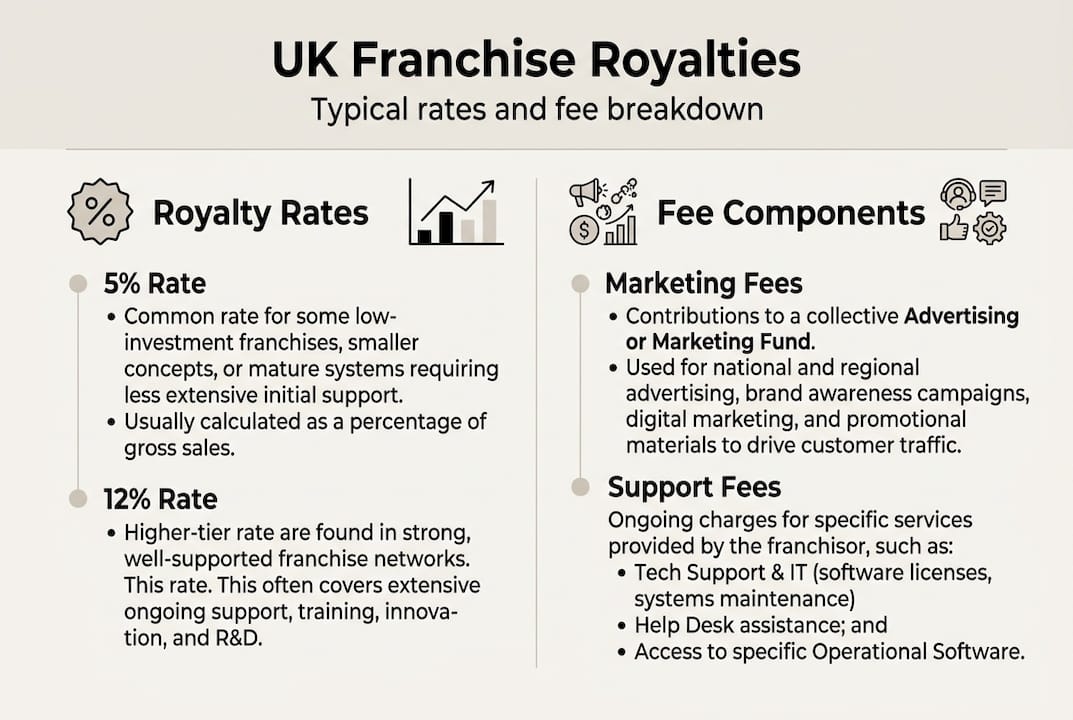
Here is an illustrative breakdown of total ongoing fees for a typical UK franchise:
| Fee type | Typical range |
|—|—|—|
| Royalty fee | 5% to 12% of gross sales |
| Marketing fund contribution | 2% to 4% of gross sales |
| Technology/software fees | £50 to £300 per month |
| Training and compliance levies | Variable, often annual |
| Total ongoing fees | Up to 12%+ of gross sales |
Total fees average 12% of sales across the UK franchise market, meaning that for every £100,000 of turnover, you could be paying £12,000 or more in combined ongoing fees before accounting for your own operating costs.
“A high royalty rate does not automatically mean a worse deal. What matters is the return you receive on that investment in terms of brand strength, support, and systems.”
This is a critical point. A franchise charging 10% royalties with a powerful national brand, a dedicated field support team, and a proven marketing engine may deliver far better returns than one charging 5% with minimal infrastructure. Understanding your UK earnings guide is essential before drawing conclusions from fee percentages alone.
Always ask for a full schedule of fees in writing, including the franchise marketing fund terms. Some franchisors hold marketing funds in separate accounts with full transparency; others are far less clear about how those funds are deployed.
- Request audited accounts for the marketing fund
- Ask how marketing spend is allocated by region
- Clarify whether you have any say in how the fund is used
- Check whether unused marketing funds roll over or are forfeited
How royalties affect profitability and value for franchisees
The real question is not how much you pay in royalties — it is what you get back. A well-structured royalty relationship should make your business more profitable, not less, because the support it funds reduces your risk and accelerates your growth.
High profitability despite fees is a strong indicator that a franchise system is delivering genuine value. When franchisees consistently earn healthy returns after paying all fees, it confirms that the brand, systems, and support are working.
Here is how to assess whether a royalty fee is justified for a specific franchise:
- Talk to existing franchisees. Ask them directly whether the support they receive feels proportionate to what they pay. Their candid feedback is more valuable than any brochure.
- Review the franchise disclosure document carefully. This should outline exactly what the franchisor is obligated to provide in return for royalties.
- Compare like for like. Do not just compare royalty percentages across brands — compare the total support package, brand recognition, and average franchisee earnings.
- Look at franchisee turnover rates. A high rate of franchisees exiting early can signal that the fee structure is not delivering sufficient value.
Pro Tip: Ask the franchisor for the average gross profit margin achieved by franchisees in their network after all fees are paid. A confident, transparent franchisor will share this data willingly.
Red flags to watch for include disproportionate fees with vague support commitments, an inability to clearly explain what royalties fund, and agreements that allow the franchisor to increase royalty rates without franchisee consultation. These are warning signs worth taking seriously before you sign anything.
For a fuller picture of what drives earnings, review the profitability factors that experienced franchisees consider, and browse top UK franchise opportunities to see how different brands structure their fee models.
What most guides miss about franchise royalties
Most articles on franchise royalties fixate on the percentage figure. That is understandable — it is the most visible number. But obsessing over whether you pay 6% or 9% misses the bigger picture entirely.
Healthy royalties are actually a positive signal. They mean the franchisor has genuine skin in the game. When a franchisor earns a percentage of your sales, they are financially motivated to help you grow. A franchisor earning nothing ongoing has far less incentive to invest in your success after the initial fee is banked.
What truly matters is transparency, clearly defined obligations, and access to real, practical support — not just a theoretical list of resources you will never use. We have seen franchisees pay premium royalties and thrive because the system behind those fees was genuinely excellent. We have also seen franchisees attracted by low royalty rates only to find themselves without meaningful support when things got difficult.
The uncomfortable truth is that some of the lowest royalty franchise systems deliver the least value. Before you celebrate a low fee, dig into the profitability insights that reveal what successful franchisees actually prioritise. The fee is just the price of entry — the system behind it is what determines your outcome.
Find your franchise opportunity and get expert fee insight
Understanding royalties is a crucial first step, but choosing the right franchise requires looking at the full picture — fee structures, brand strength, support quality, and market fit. At Franchise Local, we make that process straightforward. Explore our franchising essentials hub to understand the fundamentals before you commit, or work through our full franchising guide for a step-by-step walkthrough of everything from initial research to signing day. With hundreds of vetted UK franchise opportunities listed across every sector and investment level, you can compare fee structures side by side and find the opportunity that genuinely fits your goals.
Frequently asked questions
Do all franchises charge royalties in the UK?
Most UK franchises charge ongoing royalties as the standard franchisor income model, but a small number use alternative structures such as higher upfront fees or product margin arrangements instead.
How much are royalties in franchising typically?
Royalties usually range from 5% to 12% of gross sales, and total fees average 12% of sales when marketing contributions and other ongoing charges are included.
What do royalties pay for in a franchise?
Royalties fund ongoing support from the franchisor, covering training, brand upkeep, national marketing, research and development, and operational guidance throughout your franchise term.
Can negotiating lower royalties hurt the support I receive?
Yes — lower royalties can reduce the franchisor’s capacity to invest in support, so weigh the headline fee against the genuine value and practical help on offer, since high profitability despite fees is the real measure of a strong franchise system.