

Many aspiring franchisees assume that spotting a well-known association logo on a franchisor’s website is enough to confirm a safe investment. It is a comforting thought, but it is not the full picture. Franchise associations play a genuinely important role in shaping the UK market, yet their influence is more nuanced than a simple seal of approval. This guide explains what franchise associations actually do, how they raise standards across the industry, where their power ends, and how you can use membership as one smart layer in a thorough investment decision.
Key Takeaways
| Point | Details |
|---|---|
| Membership signals credibility | Joining a reputed franchise association shows a commitment to standards but is only the start of due diligence. |
| Ethics codes drive best practice | Associations enforce codes that help safeguard both investors and the public. |
| Tiered dispute resolution | Channels include conciliation, mediation (accessible to non-members), and arbitration. |
| Franchisee membership access | Existing franchisor members can extend association benefits to their individual franchisees. |
What are franchise associations and why do they matter?
A franchise association is an independent body that represents the interests of franchisors and franchisees within a given market. In the UK, the most prominent is the British Franchise Association (BFA), which has been setting the tone for ethical franchising since 1977. Other bodies, such as the Approved Franchise Association (AFA), also operate in this space, though the BFA remains the most widely recognised benchmark for quality.
These organisations are not government regulators. They are voluntary membership bodies, which means franchisors choose to join and must meet defined criteria to do so. That voluntary nature is important to understand from the outset. A franchisor outside an association is not automatically disreputable, and a member is not automatically beyond scrutiny.
The UK franchise sector is substantial. The industry contributes £19.1 billion to the UK economy, which illustrates the scale of what these associations help to govern. Staying across industry trends for UK franchising helps you understand how that contribution continues to grow and shift.
So what do franchise associations actually do? Their core roles cover several distinct areas:
- Accreditation: Reviewing franchisors against defined criteria before granting membership status
- Code setting: Developing and maintaining ethical standards that members must follow
- Education: Providing training resources, events, and guidance for both franchisors and franchisees
- Advocacy: Representing the franchise sector in discussions with government and financial institutions
- Dispute Resolution: Providing pathways such as informal conciliation, mediation, and arbitration
As noted in research on UK franchise association standards, associations conduct initial accreditation and cyclical reviews, update codes of ethics, and handle disputes. This ongoing oversight is what separates a genuine association from a badge-only body. Understanding these roles also connects directly to franchise profitability factors, because the operational standards associations enforce often underpin long-term business performance.
How franchise associations enhance credibility and standards
Knowing what associations do is one thing. Understanding how they raise standards in practice is another matter entirely.
While the BFA’s legal committee updates the Code of Ethics, it does not play any part in either re-accreditation or initial accreditation, nor does it handle ongoing reviews. These critical functions are managed by the association’s standards team to ensure members remain compliant as market conditions change. This is not a one-time tick-box exercise. Members face cyclical reviews, meaning a franchisor must demonstrate continued adherence to standards rather than simply passing an entry-level check and coasting indefinitely.
This re-accreditation process is arguably the most valuable function associations perform. It creates ongoing accountability. A franchisor that slips in its ethical or operational conduct risks losing membership, which carries real reputational consequences in a sector where trust is currency.
The table below summarises some of the key benchmarks that association membership typically signals:
| Benchmark | What it means for you |
|---|---|
| Initial accreditation | Franchisor has met defined ethical and operational criteria |
| Cyclical review | Standards are checked regularly by a standards team, not just at entry |
| Code of Ethics compliance | Franchisor operates within agreed ethical guidelines |
| Multi-channel dispute resolution | Access to conciliation (members) and mediation (members and non-members) |
| Franchisee Membership | Membership is available to franchisees of existing franchisor members |
“Associations ensure ongoing compliance and adaptation to market changes, making them a living framework rather than a static certificate.”
This matters enormously for new investors. When you review why UK franchises succeed, the presence of clear operational standards consistently appears as a contributing factor. Associations help establish those standards at a sector level, which in turn supports individual franchise performance. The impact on franchise marketing is also real, as association membership often strengthens consumer trust in a brand.
Pro Tip: When evaluating a franchisor, ask specifically about their re-accreditation history. A brand that has passed multiple cyclical reviews demonstrates sustained commitment to standards, not just an initial willingness to join.
The benefits and limits of association membership
Standards matter, but it is important to grasp both the real benefits and the limitations of relying on association affiliation.
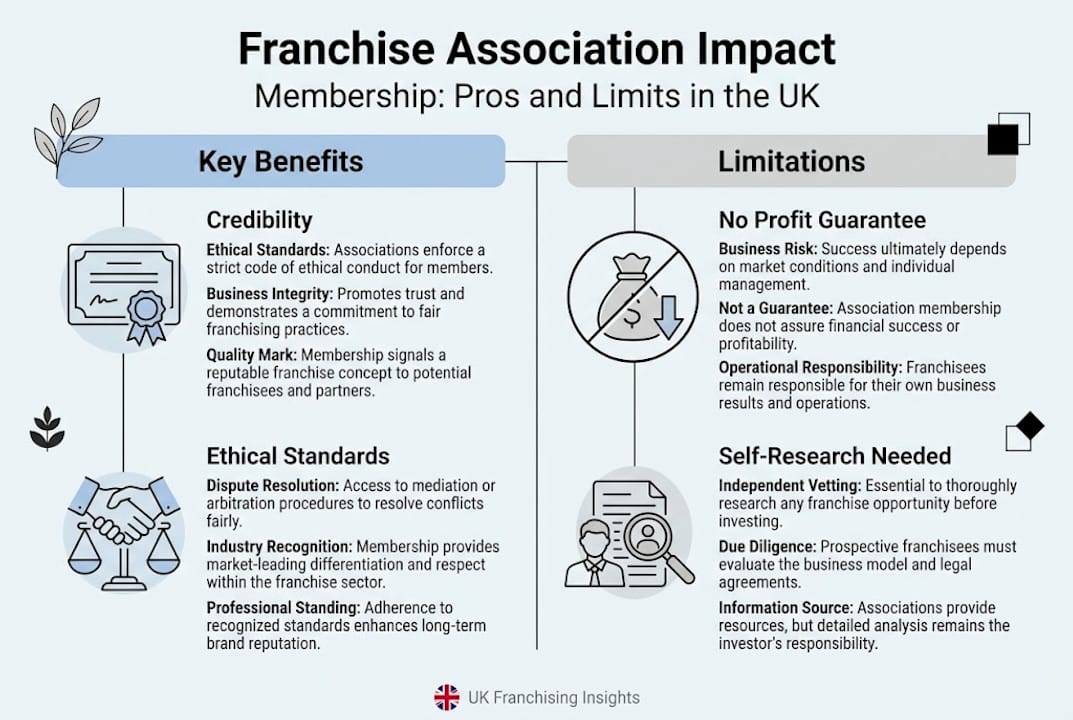
Membership genuinely does provide meaningful advantages. It signals that a franchisor has been scrutinised by an independent body, that they operate under an agreed ethical code, and that franchisees have access to formal dispute resolution if things go wrong. These schemes offer informal conciliation (open to members), mediation (recently opened to non-members), and arbitration. Networking events and educational resources offered through associations can also accelerate your learning curve as a new franchisee, with specific franchisee membership available to those within a member franchisor’s network.

However, membership cannot do everything. It does not guarantee profitability. It does not replace the need for your own careful research. And it certainly does not mean every member franchise is the right fit for your skills, budget, or lifestyle. As empirical benchmarks show, franchising has a strong track record with low failure rates and significant GDP impact, yet success is never assured by association membership alone.
| Factor | Association member | Non-member |
|---|---|---|
| Ethical code compliance | Required | Not verified |
| Mediation access | Available | Available (recent amendment) |
| Re-accreditation oversight | Yes, cyclical | No |
| Franchisee membership available | Yes (for existing members) | No |
| Profitability guarantee | None | None |
The comparison above makes one thing clear: membership provides structure and accountability, but the bottom row is identical for both columns. No association can promise you a return on investment.
Here are the steps you should take even after confirming association membership:
- Request the franchisor’s full disclosure document and review it carefully
- Speak directly with existing franchisees, not just those the franchisor recommends
- Instruct a solicitor with franchise experience to review your agreement
- Examine the brand’s financial performance data independently
- Assess whether the business model suits your personal skills and working style
Reviewing UK franchise success rates and exploring service franchise models can help you build a fuller picture alongside your association checks.
Pro Tip: Use association membership as one layer of evaluation, not the only layer. Think of it as a quality filter that narrows your shortlist, not a substitute for your own rigorous research.
How to assess and use franchise association membership in your investment decision
To put this into action, here is how you can make association membership a meaningful part of your franchise vetting process.
Start by identifying which association the franchisor belongs to and verifying that membership directly with the association itself. Do not rely solely on a logo displayed on the franchisor’s website. Associations maintain public member directories, and a quick check takes only minutes.
Next, look for red flags. Associations with minimal oversight, vague ethics codes, or no clear re-accreditation process offer far less protection than established bodies like the BFA. If an association cannot clearly explain how its standards team reviews members or handles tiered disputes, treat that as a warning sign.
Here are the key checks to carry out when assessing association legitimacy:
- Verify membership directly with the association via their official website or by phone
- Review re-accreditation records to confirm the franchisor has passed multiple review cycles
- Check dispute resolution data to understand how conciliation or mediation processes are handled
- Enquire about franchisee membership to see if you can join as an individual operator
- Seek third-party reviews from franchisee forums, industry publications, and independent advisers
As due diligence research confirms, thorough investigation beyond association membership is essential when choosing a franchise investment. Contacting the association directly to ask about a specific member’s standing is entirely reasonable and often welcomed.
Building a structured franchise selection workflow helps you integrate association checks alongside financial analysis, market research, and personal fit assessments. Pairing this with the right franchise management tools from the outset sets you up to manage your investment effectively once you have committed.
Why association membership is necessary but not sufficient: an investor’s perspective
Having explored the practical steps, here is an honest view you rarely hear when it comes to franchise associations.
We have seen too many investors treat an association logo as the end of their research rather than the beginning. It is an understandable shortcut. Accreditation feels reassuring, and the temptation to stop digging once you see a BFA badge is real. But the most costly franchise mistakes we encounter almost always share one common thread: the investor leaned on the logo and skipped the numbers.
“The real work begins after spotting the logo. Ask tough questions and check the numbers.”
Association membership is a necessary filter in today’s market. It removes the most obviously problematic operators and creates a baseline of accountability. But it is not a substitute for understanding the unit economics of the business, the quality of the support infrastructure, or the realistic earnings potential in your territory. Reviewing profitability factors in detail is where serious investors separate themselves from hopeful ones. Membership narrows the field. Your own rigorous analysis closes the deal safely.
Find vetted franchise opportunities and trusted resources
Ready to put your research into practice? At Franchise Local, you can explore a wide range of UK franchise opportunities, many from brands operating under recognised association standards. Our directory is designed to help you filter by investment level, sector, and operating model so your shortlist reflects your actual goals. You can also connect with specialist franchise service providers covering legal advice, compliance support, and franchise management, giving you the expert backing to move from research to decision with confidence. Start your search today and build your investment case on solid ground.
Frequently asked questions
Do all credible franchises belong to an association?
Not all credible franchises hold association membership, but belonging to a body like the BFA adds transparency, standardisation, and a formal layer of trust. As franchise association research confirms, associations conduct reviews and set standards, though membership is voluntary.
What is the British Franchise Association and what does it do?
The British Franchise Association (BFA) sets ethical standards and accredits franchisors. While the legal committee updates the Code of Ethics, the association’s standards team handles initial accreditation and cyclical reviews.
Can non-members access dispute resolution?
Yes, for mediation. While informal conciliation is restricted to members, recent amendments have made the mediation scheme available to non-members.
Can being in a franchise association guarantee my investment’s success?
Association membership increases credibility and provides structural accountability, but it does not guarantee profits. Success in franchising still depends on thorough due diligence, personal suitability, and sound financial planning beyond any membership badge.