

TL;DR:
- Choosing the right franchise requires honest self-assessment and thorough research over 3 to 12 months.
- Financial planning involves understanding all costs, securing funding, and ensuring ample working capital before investing.
- Due diligence with professional reviews and careful filtering helps prevent costly mismatches and poor-quality offers.
Choosing the wrong franchise can cost you tens of thousands of pounds and several years of your life. That is not an exaggeration. Many aspiring franchisees jump at an opportunity that looks exciting, only to discover months later that it clashes with their lifestyle, drains their savings, or simply does not suit the way they work. A structured selection workflow prevents that outcome. This guide walks you through five essential stages: honest self-assessment, financial planning, researching opportunities, conducting due diligence, and making a confident final decision. Follow each step and you dramatically reduce the risk of a costly mismatch.
Key Takeaways
| Point | Details |
|---|---|
| Self-assessment first | Knowing your finances, interests, and readiness is step one in franchise selection. |
| Budget critically | Accurately capturing all costs and reserves ensures your selection is viable long term. |
| Thorough research | Investigate multiple franchises, using directories, exhibitions, and independent checks. |
| Professional review is essential | Solicitor and accountant checks reduce risks before you make a commitment. |
| Resist rushing | A patient, step-by-step workflow is the best safeguard against costly errors. |
Assess your personal fit and readiness
Before you browse a single franchise listing, you need to understand yourself. This sounds obvious, but it is the step most people skip or rush. Self-assessment is crucial: evaluate your personal finances, skills, interests, time commitment, and risk tolerance to ensure alignment with franchise requirements. A franchise that suits a former retail manager with £80,000 to invest will look nothing like the right choice for a nurse returning to work part-time with £15,000 saved.
Start by asking yourself some direct questions:
- Finances: How much capital can you genuinely invest without putting your family at risk?
- Skills: What professional strengths do you bring? Sales, operations, customer service, technical expertise?
- Interests: Which industries genuinely excite you enough to work in every single day?
- Time: How many hours per week can you commit, and are those hours flexible or fixed?
- Family impact: Does your household support this decision, and have you discussed the pressures involved?
- Risk appetite: Are you comfortable with variable income, or do you need predictable earnings from the start?
Once you have answered those questions honestly, you can begin shortlisting sectors where your strengths meet genuine market demand. For example, if you have a background in facilities management and enjoy working outdoors, a cleaning or property maintenance franchise may align far better than a food retail operation requiring early starts and complex staffing.
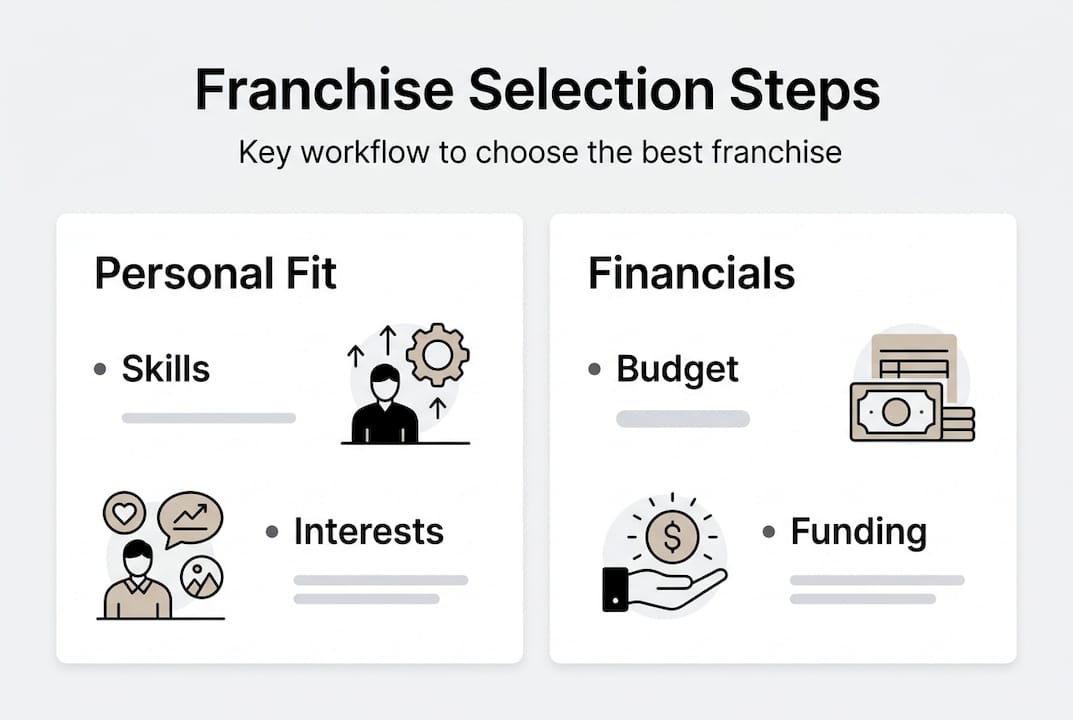
The step-by-step franchise guide at Franchise Local is a useful companion here, helping you structure your thinking before you commit to any direction.
One important reality: the process takes 3 to 12 months from first research to signing. Patience is not optional. Rushing this stage to satisfy excitement almost always leads to regret.
Pro Tip: Create a simple two-column table. On the left, list what you need from a franchise (income level, hours, location, sector). On the right, list what you offer (capital, skills, experience). Use this as a filter every time you evaluate an opportunity.
Calculate your budget and funding options
Once you understand your personal aims, it is vital to be equally clear about the financial realities. Many buyers underestimate the true cost of starting a franchise, and that gap between expectation and reality can be devastating.

Full costs include the initial franchise fee (typically £10,000 to £50,000), legal fees, setup costs, working capital, and ongoing royalties. Each of these deserves careful attention. Royalties, for instance, are often a percentage of turnover rather than profit, which means you pay them even in lean months.
Here is a simplified breakdown of typical costs by franchise type:
| Franchise type | Initial fee (approx.) | Setup costs | Monthly royalty |
|---|---|---|---|
| Home-based (e.g., cleaning, pets) | £5,000 to £15,000 | Low (van, equipment) | 8% to 12% of turnover |
| Mobile service (e.g., repairs, tutoring) | £10,000 to £25,000 | Moderate (vehicle, tools) | 8% to 15% of turnover |
| High street retail | £20,000 to £80,000+ | High (fit-out, stock) | 5% to 10% of turnover |
When calculating your investable capital, do not include money you need for rent, bills, or emergencies. Only count funds you can afford to lock away for the business. From that figure, deduct all expected startup costs. Whatever remains should ideally cover six to twelve months of working capital or living expenses.
For funding, your main options include:
- Personal savings (the most straightforward route)
- High street bank loans (many banks have dedicated franchise lending teams)
- Government-backed Start Up Loans (up to £25,000 at a fixed interest rate)
- Friends or family investment (with formal agreements in place)
- Franchisor financing schemes (some brands offer deferred payment plans)
If your budget is limited, do not be discouraged. There are excellent low-cost franchise options available across the UK, particularly in home-based and mobile sectors. Reviewing the franchise investment steps in detail will help you match your capital to realistic opportunities.
Pro Tip: Aim to keep six to twelve months of living or working capital in reserve before you launch. Trading in the early months is rarely as smooth as forecasts suggest, and that buffer protects you from making panicked decisions.
Research franchises and filter opportunities
With your budget defined, it is time to see what the market has to offer and focus your search. This stage is where many buyers get overwhelmed, because the UK franchise market is genuinely large and varied.
Start with reliable sources: online franchise directories, the British Franchise Association (BFA), and franchise exhibitions such as the British & International Franchise Exhibition. These give you access to hundreds of vetted opportunities in one place.
When filtering, apply these criteria consistently:
- Sector alignment: Does this franchise match your interests and skills from your self-assessment?
- Cost fit: Does the total investment fall comfortably within your budget, including reserves?
- Franchisor support: What training, marketing, and operational support is provided?
- BFA accreditation: Is the franchisor a BFA member? This signals a baseline of ethical standards.
- Brand maturity: How long has the franchise been operating, and how many franchisees are currently trading?
It also helps to understand the different types of opportunity available:
| Opportunity type | Key advantage | Key consideration |
|---|---|---|
| New franchise territory | Full brand support from day one | No local trading history to review |
| Franchise resale | Proven customer base and cash flow | Requires people and culture due diligence |
| Home-based franchise | Low overhead, flexible hours | Limited physical presence and footfall |
Resales offer proven trading history but require careful investigation into why the current franchisee is selling. Read the franchise resale explained guide before pursuing this route.
Avoid franchises that use high-pressure sales tactics, make vague promises about earnings, or cannot provide a list of existing franchisees for you to contact. These are warning signs, not minor concerns. The franchise due diligence guide covers exactly what to watch for during this phase.
Conduct due diligence and final decision checks
Shortlisting is not enough. The final steps are crucial to protect your investment and your peace of mind.
Begin by requesting the franchise disclosure document, the franchisor’s audited accounts, and any earnings or performance forecasts they provide. Read these carefully and cross-reference the figures with what existing franchisees tell you. Speak to at least five current franchisees, not just the ones the franchisor recommends.
Your due diligence checklist should include:
- Legal review of the franchise agreement by a specialist franchise solicitor
- Independent accountant review of the financial projections and fee structures
- Verification of BFA accreditation and any industry-specific licences
- A detailed business plan with sensitivity analysis (what happens if revenue is 20% lower than forecast?)
- Franchise compliance checks to confirm the franchisor meets all relevant legal and regulatory standards
Prioritise BFA-accredited franchisors, get legal and accountant reviews completed, and build a business plan with realistic forecasts before you sign anything. And remember: legal and accountant review is mandatory for any commercial, financial, or legal decision of this scale.
‘Never skip professional review. Mistakes at the contract stage are costly and extraordinarily hard to reverse.’
If the numbers do not stack up, or if the franchisor is reluctant to answer direct questions, walk away. There are hundreds of legitimate opportunities in the UK. Explore the franchise legal considerations checklist and the secure right franchise guide to strengthen your final decision-making.
Pro Tip: Build a simple scoring sheet for each shortlisted franchise. Rate each one on financials, support, sector fit, and legal clarity. The numbers often make the right choice obvious.
Why most new franchisees rush the process — and what works better
Here is something worth saying plainly: the franchisees who end up disappointed almost always share one habit. They let excitement drive the timeline. They find a brand they love, they imagine the lifestyle, and they start compressing every step to get there faster.
The research stage gets shortened. The solicitor review feels like a formality. The conversations with existing franchisees are skipped because the sales team was so reassuring. And then, twelve months into trading, reality arrives.
What separates successful franchisees is not superior knowledge or more capital. It is discipline. They treat every claim in the franchise brochure as something to verify. They talk to franchisees the brand did not suggest. They revisit their original self-assessment criteria when a shiny opportunity tempts them off course.
Slowing down feels counterintuitive when you are motivated. But the selection workflow should always outlast your initial enthusiasm. Give yourself clear deadlines for each stage so you maintain momentum without cutting corners. A structured approach, even when it feels slow, consistently produces better outcomes than speed driven by excitement.
Find your franchise match with expert help
Armed with a clear workflow and a sharper perspective on what separates good decisions from rushed ones, the next step is to put that knowledge into action. The UK franchise directory at Franchise Local brings together hundreds of vetted opportunities filtered by investment level, sector, location, and lifestyle preference, making it far easier to shortlist options that genuinely fit your criteria. Whether you are exploring your first opportunity or comparing several, the ultimate franchising guide provides the depth of information you need to move forward with confidence. Start your search today and let the directory do the heavy lifting.
Frequently asked questions
How long does the franchise selection process usually take?
Most UK buyers take 3 to 12 months to move from first research to signing. Rushing this timeline significantly increases the risk of a poor match.
Should I hire a solicitor and accountant before buying a franchise?
Yes. Professional legal and accountant reviews are essential for understanding contracts, fee structures, and financial projections before you commit.
What is the typical upfront investment for a franchise in the UK?
Initial franchise fees typically range from £10,000 to £50,000, with additional costs for setup, legal fees, and working capital on top of that.
How do I recognise risky or poor-quality franchise offers?
Avoid high-pressure sales, vague earnings claims, and franchisors that are not BFA-accredited. These are consistent indicators of a problematic opportunity.