

A franchise sales funnel turns enquiries into vetted franchisees by combining targeted attraction, strict qualification, and fast, structured follow-up. Treat it as a filter, not a sales pitch: conversion ratios stay in the low single digits across most sectors, so the priority is building qualification stages that surface serious candidates quickly and cutting response time to hours, not days.
What are the stages of a franchise sales funnel?
Every franchise sales funnel moves a stranger through four distinct stages, and each one needs its own measurable goal. Treat them separately or you will pour resources into the wrong problem.
- Awareness: prospects discover your brand through directories, paid search, social ads, or franchise exhibitions. Goal: qualified traffic and enquiry volume from the right channels.
- Consideration: prospects research investment levels, territories, and support packages. Goal: engaged time on your landing pages and requests for information packs.
- Conversion: prospects move through qualification, discovery calls, and discovery days toward a signed franchise agreement. Goal: progression rate between each qualification gate.
- Onboarding: new franchisees complete training and launch. Goal: time to first trading day and early performance against forecast.
Most enquiries enter through franchise portals, your own website, or LinkedIn and Facebook activity. Tracking which channel a lead came from, and how far they progressed, tells you far more about funnel health than raw enquiry counts ever will.
How do you define your ideal franchisee profile?
A clear buyer persona stops you wasting hours on enquiries that were never going to convert. Build it from the franchisees already outperforming your network average, not from a wish list.
- Available capital: minimum liquid funds and total investment capacity, stated honestly rather than optimistically.
- Relevant skills: sales background, people management, or sector experience that maps to what the role actually demands.
- Time commitment: full-time operator versus multi-unit investor with a manager running day-to-day operations.
- Motivation: career change, redundancy, or scaling an existing portfolio, since each type responds to different messaging.
- Location fit: willingness to relocate or operate within an available territory.
Interview your top three performing franchisees and reverse-engineer their profile before writing a single enquiry form question. Sample screening questions worth adding: “What is your available investment capital?” and “Do you intend to operate this business full time?” Both surface disqualifiers early, which LegalVision’s guidance on recruiting franchisees frames correctly: recruitment is a vetting exercise, not a sales pitch, and the sooner unsuitable candidates self-select out, the better it protects your brand.
Which channels and messages attract the right prospects?
Franchise recruitment now favours fewer, better-qualified leads over sheer volume, and the channel mix you choose determines which you get. According to FranchiseInfo’s analysis of current recruitment trends, directories, paid search, LinkedIn, social advertising, and franchise events remain the core channels, and transparency at every touchpoint is what separates the strong performers from those still chasing quantity.
- Directories: strong for candidates already comparing multiple opportunities by price and sector.
- Paid search: effective for capturing intent from people actively searching investment terms.
- LinkedIn: best for career-change professionals with management experience and capital to invest.
- Facebook and social ads: useful for lifestyle-driven, home-based, or lower-investment opportunities.
- Events: valuable for face-to-face rapport building with serious, later-stage prospects.
Your landing page needs three things every time: a stated investment range, a plain description of what the role actually involves day to day, and one clear call to action. Messaging that states the minimum capital required upfront, rather than hiding it behind a form, filters out tyre-kickers before they ever contact you. Our own guide on attracting franchisees in the UK covers channel sequencing in more depth, and Webby’s guide to converting website visitors into leads is worth reading for landing page structure specifically.
Pro Tip: Publish your minimum investment figure on the landing page itself, not just in a downloadable pack. Prospects who can’t meet it will drop off before they ever fill in a form, saving your team hours of unqualified calls.
How do you qualify franchise leads efficiently?
A structured qualification workflow protects your time and your brand. Run every enquiry through the same sequence rather than improvising per lead.
- Acknowledge within 24 hours with a short, personal response, not an automated form confirmation alone.
- Hold a 15 to 20 minute screening call covering capital, motivation, and timeline.
- Send an online questionnaire capturing skills, availability, and territory preference in writing.
- Run a financial check before any deeper commitment of time on either side.
Score each lead against thresholds: minimum liquid capital, credit standing, and stated availability to start within your target window. Anyone falling short on capital or timeline gets a polite decline rather than a slow fade.
Realistic expectations matter here. According to The Franchise Consultant’s UK recruitment data, conversion from initial enquiry to signed agreement typically sits in the low single digits, and in sectors like care the conversion rate can be very low, reflecting the reality that many enquiries are early research and not all candidates are ready or suited. Plan your pipeline volume accordingly, not against wishful assumptions.
Disclosure documents and legal advisor involvement should come once a candidate clears financial screening, never before. Our franchise disclosure guide and lead qualification strategies piece both cover timing and sequencing in detail.
What happens during discovery calls and discovery days?
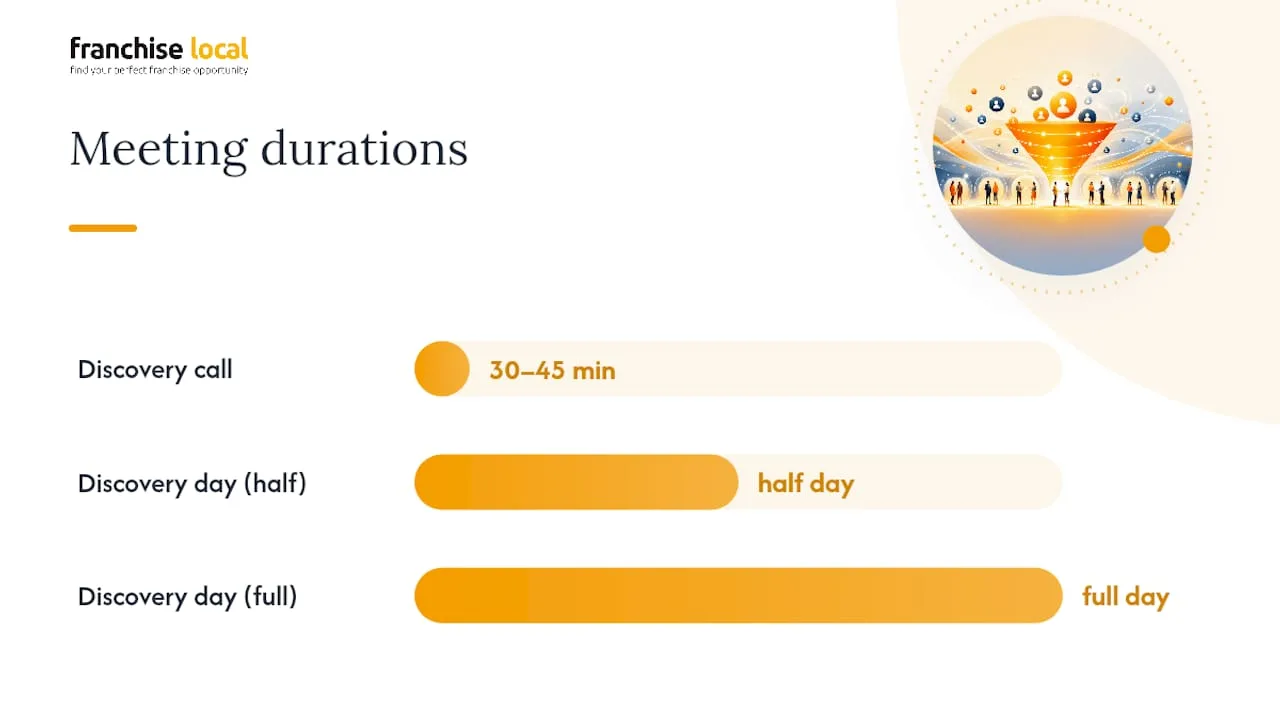
Discovery calls and discovery days serve different purposes, and confusing the two wastes everyone’s time. A discovery call is a 30 to 45 minute conversation establishing fit, answering initial questions, and setting expectations for next steps. A discovery day is a half or full day at head office or an existing unit, involving deeper financial discussion, meeting the operations team, and often a site visit.
HigherVisibility’s franchise sales research points to timely contact and structured nurturing, discovery calls, educational content, and discovery days, as the practices that most reliably lift conversion. Speed of contact alone separates serious candidates from casual browsers.
Build a pre-call pack containing:
- A one-page cheat sheet on your brand history and unit economics.
- Illustrative financials showing typical revenue and cost ranges.
- An FAQ covering territory availability, training length, and ongoing support fees.
Prepare for common objections before they arise: total investment concerns, exclusivity of territory, and questions about your own operational track record. One-to-one discovery days generally allow deeper mutual vetting than group formats, since candidates ask harder questions when they aren’t performing in front of strangers.
Which CRM features and metrics matter most?
Spreadsheets break down once you’re running more than a handful of active leads. A CRM built for franchise recruitment needs pipeline stages that mirror your funnel, source attribution for every enquiry, and automated reminders so no lead goes cold from neglect. The Franchise Consultant’s recruitment guidance is blunt about this: structured pipelines are essential once you’re managing recruitment as an ongoing function rather than a one-off campaign.
Automation earns its keep on acknowledgement emails, screening call booking links, and follow-up sequences for leads that stall mid-funnel. A partner tool like Local Lead Growth’s call tracking service can also show exactly how fast your team responds by channel, which matters given how much conversion hinges on speed.
| Metric | What it tells you |
|---|---|
| Lead source ROI | Cost per qualified lead by channel |
| Lead to discovery rate | Percentage progressing past screening |
| Conversion to agreement | Signed agreements per enquiry |
| Time in pipeline | Average days from enquiry to decision |
How does onboarding protect your funnel’s return?
Onboarding is where a costly funnel either pays off or leaks value through early attrition. The first 90 days should include structured training, an assigned mentor, and a written launch plan with milestones for the first three months of trading.
- Structured training: operational systems, brand standards, and local marketing basics before opening day.
- Assigned mentor: an experienced franchisee or head office contact for the first quarter.
- Written launch plan: clear milestones so both sides can spot problems early, not after they’ve become expensive.
Strong onboarding reduces early attrition, and franchisees who feel supported become your best recruitment asset. Their referrals and testimonials, once you have real ones, are more persuasive than any advert. Our onboarding guide for UK franchisees covers the full 90-day framework, and it’s worth building your own launch checklist directly from it.
How do you test and improve your franchise sales funnel?
Optimisation only works when you test one variable at a time and give it enough volume to mean something. Three experiments consistently move conversion:
- Lead-response speed: cut acknowledgement time from 48 hours to under 4 and measure the change in discovery call bookings.
- Landing page copy: test stating the investment range upfront versus hiding it behind a form submission.
- Qualification form length: compare a 5-field form against a 12-field form for both volume and downstream conversion quality.
Run each test for at least four to six weeks, or until you’ve gathered 50 or more leads per variant, whichever comes first. Smaller samples produce noise, not answers. Babylovegrowth’s guide to lead nurturing is a useful reference for structuring the follow-up sequences you’ll be testing against.
Pro Tip: Don’t test landing page copy and response speed simultaneously. If conversion improves, you won’t know which change actually caused it.
How can Franchise Local support your funnel?
Directories generate meaningful enquiry volume across industries and investment levels, and pairing that traffic with a strong landing page and fast follow-up process is what actually converts browsers into serious candidates.
- Search filters by price, industry, lifestyle, and location, helping the right candidates self-select before they ever enquire.
- Curated listings and trending searches that surface active buyer demand by sector.
- Guidance resources covering franchise evaluation, due diligence, and disclosure to support prospects further down your funnel.
Franchisors listing on the directory should treat it as an awareness and consideration-stage channel, then run their own qualification process from there. Browse trending franchise opportunities to see how listings are currently structured, or explore industry-specific franchise categories to understand how buyers filter by sector.
What legal and compliance issues arise during franchise sales?
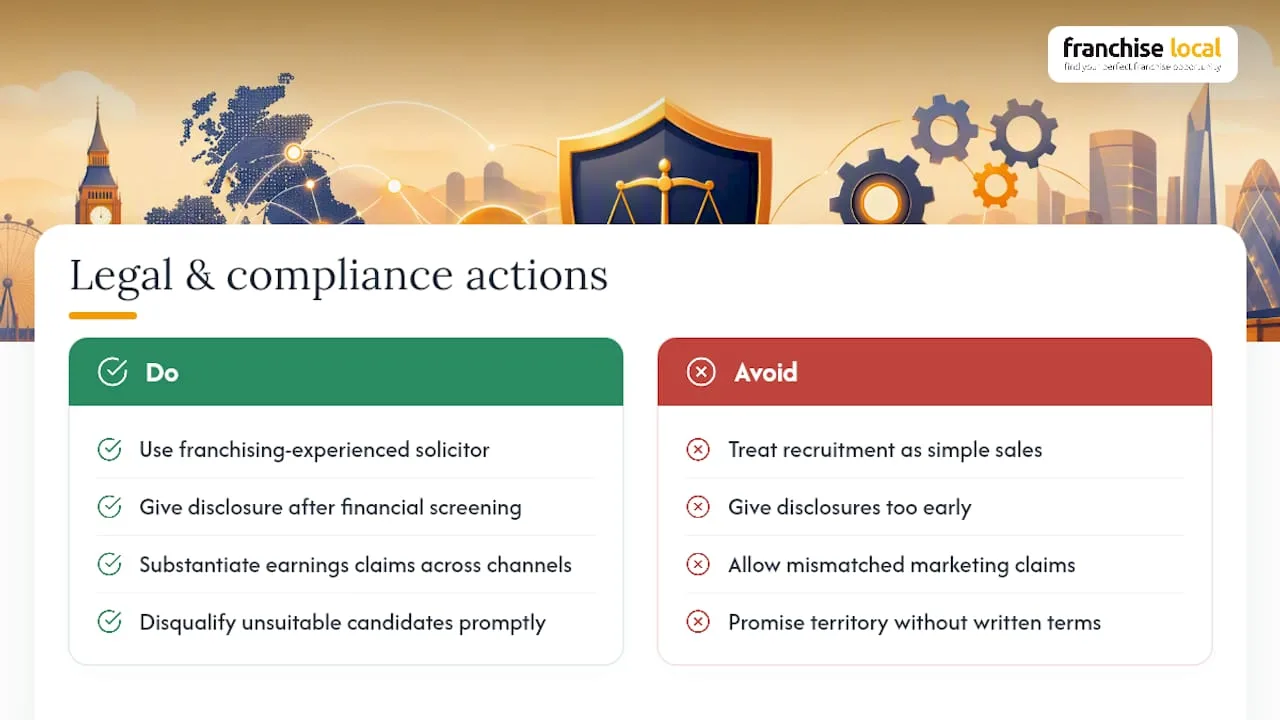
Franchise recruitment carries genuine legal exposure, and treating it as a straightforward sales process rather than a vetting exercise is where franchisors get into trouble. LegalVision’s guidance on UK franchise recruitment is explicit on this point: structured qualification and full disclosure exist to protect the brand, not just to tick a box.
The franchise agreement itself needs to set out territory rights, fees, renewal terms, and termination conditions clearly, ideally reviewed by a solicitor experienced in franchising rather than general commercial law. Disclosure documents, covering financial performance representations, litigation history, and any existing franchisee disputes, should go to candidates only once they’ve cleared financial screening, not before. Handing them out too early wastes legal preparation time on unqualified prospects; handing them out too late risks accusations of misrepresentation if a candidate signs without adequate information.
Advertising claims deserve particular care. Any earnings projections or performance figures you publish must be substantiated and consistent across every channel, since a mismatch between marketing claims and disclosed financials is one of the most common sources of post-sale disputes. Acting quickly to disqualify unsuitable candidates, rather than keeping them warm out of politeness, also reduces future brand risk considerably.
Territory exclusivity terms need to be unambiguous in writing before any deposit changes hands. Our legal considerations checklist for UK franchise buyers and due diligence guide both cover the documentation trail worth keeping for every candidate who progresses past initial screening, qualified or not.
Ready to feed your funnel with better-qualified enquiries? Explore Franchise Local’s directory search to see how franchisors across sectors are structuring their listings, or read the Ultimate Guide to Franchising for a broader view of how recruitment fits within building a successful network.