

Franchise disclosure preparation is the process of assembling a transparent, written pack that gives prospective franchisees all material information about your business before they sign any binding agreement. The UK has no statutory franchise disclosure document (FDD) requirement, but franchisors must still avoid misleading franchisees under the Misrepresentation Act 1967. The British Franchise Association (BFA) Code of Ethics sets the gold standard, requiring full and accurate disclosure of all material information. Knowing how to prepare franchise disclosure correctly protects your brand, reduces legal risk, and builds the franchisee trust that sustains long-term network growth.
How to prepare franchise disclosure: what to include in your UK pack
A well-structured disclosure pack covers every material aspect of your franchise in plain, verifiable language. The goal is to give prospective franchisees enough information to make an informed decision without relying on verbal assurances or guesswork.
Experts recommend that a comprehensive disclosure pack covers the following core elements:
- Business history and franchisor background. Include the company’s founding date, ownership structure, trading history, and any previous insolvencies or litigation. Franchisees need to assess the stability of the business they are joining.
- Financial information. Detail the initial franchise fee, ongoing royalties and fees, marketing contributions, and any other costs the franchisee will bear. Present financial examples that are supportable and clearly labelled as illustrative.
- Territory and exclusivity. Define the geographic area the franchisee will operate in and state clearly whether exclusivity applies. Vague territory descriptions are a frequent source of disputes. Franchiselocal’s guide on franchise territory rights explains how to set these boundaries precisely.
- Operations manual overview. Summarise the scope of the operations manual and the franchisee’s obligations under it. You do not need to reproduce the full manual, but prospects must understand what running the franchise day-to-day involves.
- Support and training. Describe the training programme, ongoing support structure, and any technology or marketing systems provided.
- Legal considerations. Outline the term of the agreement, renewal rights, exit provisions, and dispute resolution mechanisms. Include a clear statement of risks.
Pro Tip: Never include verbal financial projections that are not backed by written documentation. Optimistic verbal assurances that fall outside your written disclosure are a primary trigger for Misrepresentation Act 1967 claims.
The absence of a formal disclosure pack significantly increases your exposure to legal claims. Creating one acts as vital defensive documentation, controlling the information franchisees can rely upon in any future dispute.

How to align your disclosure pack with UK legal and ethical standards
The UK has no franchise-specific legislation mandating a formal FDD. That fact does not reduce your obligations. It increases them, because no statutory template exists to fall back on. You must build a bespoke document that satisfies both common law and ethical standards.
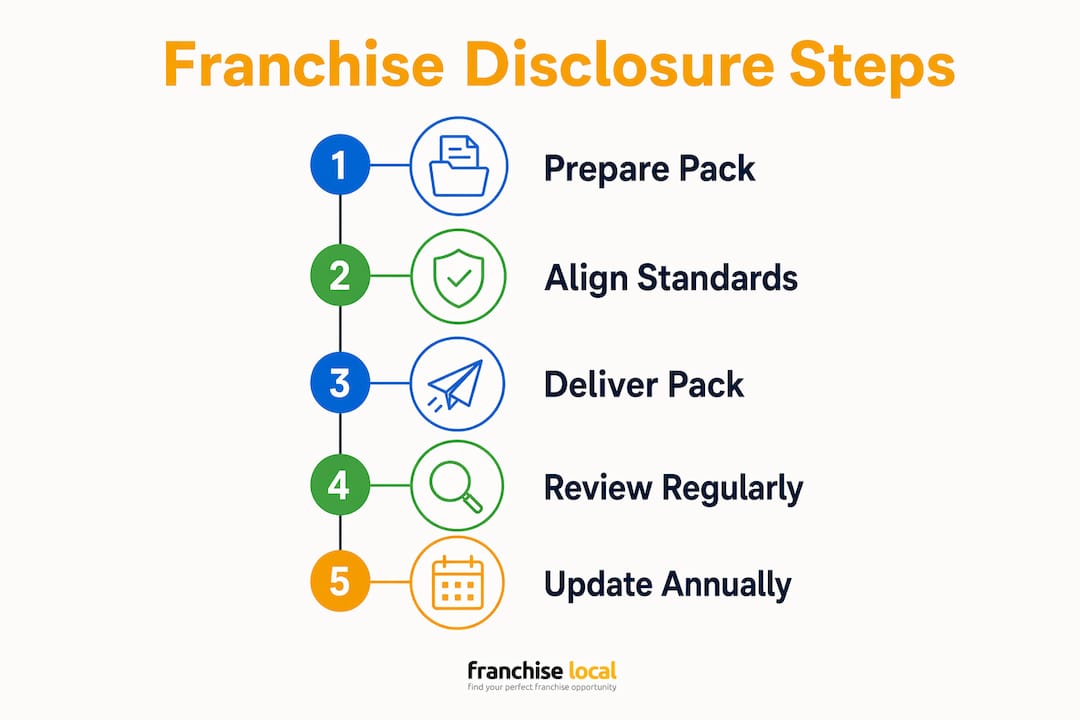
The Misrepresentation Act 1967 is the primary legal risk. Any false or misleading statement made during the pre-sale process, whether written or verbal, can expose you to damages claims. Your disclosure pack must be accurate, consistent, and free of unsupported claims.
The BFA Code of Ethics requires members to provide full and accurate disclosure of all material information before any binding documents are signed. BFA membership signals credibility to prospective franchisees and is widely regarded as the benchmark for ethical franchising in the UK’s £19.1 billion franchising sector. That figure reflects the scale of the industry and the reputational stakes involved in getting disclosure right.
To align your pack with these standards, follow these steps:
- Instruct a franchise solicitor. A specialist solicitor will review your disclosure pack and franchise agreement together to confirm they are consistent. Contradictions between the two documents are a leading cause of costly legal disputes.
- Cross-check every claim. Every statement in the disclosure pack must be verifiable. Remove any claim you cannot support with documented evidence.
- Align the pack with your franchise agreement. The disclosure pack and the franchise agreement must say the same thing. Legal alignment between the two documents avoids contradictions that lead to expensive challenges.
- Implement version control. Date every version of your disclosure pack. When you update the document, retire the old version and record when the new one came into use.
- Schedule annual reviews. Annual or material updates to your disclosure pack are necessary to maintain accuracy. A pack that reflects outdated fees or an old support structure creates misrepresentation risk.
Pro Tip: Treat your disclosure pack and franchise agreement as a matched pair. If you amend one, review the other immediately. Inconsistencies between the two documents are the most avoidable source of franchisee disputes.
What is the recommended process for delivering franchise disclosure?
Delivery is as important as content. A thorough disclosure pack handed over the day before signing provides no real protection for you or the franchisee.
The recommended process follows a clear sequence:
- Provide the pack at least 14 days before signing. Providing the disclosure pack and draft franchise agreement at least 14 days before any binding signature is the recognised best practice. This period gives the prospective franchisee time to read, question, and seek independent advice.
- Document delivery formally. Issue the pack with a dated covering letter or email. Ask the recipient to acknowledge receipt in writing. This record is your evidence that disclosure was made.
- Encourage independent legal and financial advice. Actively recommend that prospects consult a franchise solicitor and an accountant before signing. Encouraging independent advice strengthens franchisee confidence and reduces buyer remorse, which in turn improves network stability.
- Update before each new signing. If your disclosure pack is six months old and fees have changed, update it before issuing it to the next prospect. An outdated pack creates the same misrepresentation risk as no pack at all.
- Train your sales team. Verbal statements made by your sales team during the recruitment process carry legal weight. Train staff to stay within the boundaries of the written disclosure and to avoid making promises the document does not support.
The following practices support consistent delivery across your network:
- Use a standard issue checklist so no document is omitted from the pack.
- Record the date, version number, and recipient name for every pack issued.
- Retain copies of all issued packs for at least the duration of the franchise agreement.
- Brief franchisee recruitment consultants on what they can and cannot say during sales conversations.
The 14-day window, while voluntary, carries strong legal and reputational benefits. It reduces disputes and demonstrates good faith, both of which matter if a disagreement ever reaches a court or arbitration panel.
What common pitfalls should UK franchisors avoid?
Most disclosure failures are avoidable. They stem from shortcuts taken during preparation or delivery, not from deliberate misconduct.
- Using overseas FDD templates without adaptation. UK franchisors should avoid importing US-style FDDs and presenting them as suitable for the UK market. The legal context is different, the terminology is different, and the regulatory references will be wrong. A bespoke UK pack is not optional.
- Making unsubstantiated financial claims. Verbal financial projections that are not backed by documentation are the single most common trigger for Misrepresentation Act 1967 claims. Every figure in your pack must be supportable. Label all financial examples clearly as illustrative and state the assumptions behind them.
- Failing to keep the pack current. A disclosure pack that reflects last year’s fee structure or an outdated support model is misleading, even if the inaccuracy was unintentional. Set a calendar reminder for an annual review and update the pack whenever a material change occurs.
- Giving insufficient time for review. Handing over a disclosure pack at a signing meeting provides no meaningful protection. The 14-day minimum exists precisely to prevent this.
- Omitting disclaimers and assumptions. Financial data must carry clear disclaimers stating that past performance does not guarantee future results and that figures are based on specific assumptions. Omitting these leaves you exposed if a franchisee later claims the numbers misled them.
Pro Tip: Before issuing any disclosure pack, run a simple internal audit. Ask: “Could a franchisee rely on any statement in this document to make a financial decision?” If the answer is yes, verify that the statement is accurate, documented, and consistent with the franchise agreement.
Franchiselocal: your starting point for franchise preparation
Preparing a disclosure pack is one step in a broader process of building a franchise that attracts the right people and operates with integrity. Franchiselocal supports UK entrepreneurs at every stage of that process. The site’s ultimate guide to franchising covers the key documents, legal considerations, and practical steps involved in launching a franchise in the UK. For those who need specialist support, the franchise service providers directory connects franchisors with solicitors, accountants, and consultants experienced in UK franchise law. Whether you are preparing your first disclosure pack or reviewing an existing one, Franchiselocal gives you the resources to move forward with confidence.
FAQ
Is a franchise disclosure document legally required in the UK?
No statutory law requires a formal franchise disclosure document in the UK. However, franchisors must avoid misleading franchisees under the Misrepresentation Act 1967, and the BFA Code of Ethics requires full disclosure of all material information before any binding agreement is signed.
What should a UK franchise disclosure pack include?
A UK disclosure pack should cover business history, financial fees and royalties, territory and exclusivity terms, an operations manual overview, support and training details, and legal considerations including risks and dispute resolution. Every claim must be accurate and verifiable.
How long before signing should a franchisor provide the disclosure pack?
Best practice is to provide the disclosure pack and draft franchise agreement at least 14 days before any binding signature. This gives prospective franchisees adequate time to read the documents and seek independent legal and financial advice.
Can I use a US-style FDD for my UK franchise?
No. US-style FDDs are built around American regulatory requirements that do not apply in the UK. UK franchisors should create bespoke disclosure packs tailored to their specific business and aligned with UK law and the BFA Code of Ethics.
How often should a franchise disclosure pack be updated?
Annual updates are the minimum standard, and the pack must also be updated whenever a material change occurs, such as a fee increase, a change in territory policy, or a new support structure. Version control and dated records are necessary to maintain compliance.