

Pricing a UK franchise correctly can make or break your business before it even opens. Nearly one-third of UK franchise startups fail due to poor pricing strategies, often because franchisees underestimate hidden costs or misjudge ongoing royalties. This guide walks you through a structured, practical approach to pricing your franchise, covering upfront fees, ongoing expenses, market research, and financial modelling so you can make informed decisions and avoid costly mistakes.
Key takeaways
| Point | Details |
|---|---|
| Understand all fees | Upfront fees, royalties, marketing contributions, and hidden costs prevent budget overruns. |
| Research competitors | Market benchmarking ensures your pricing aligns with sector norms and regional expectations. |
| Model financials | Cash flow projections and ROI calculations validate investment viability and payback timelines. |
| Avoid common errors | Ignoring ongoing costs and overestimating revenue are major pitfalls for UK franchisees. |
| Use a structured process | A four-step pricing framework improves accuracy and confidence in setting franchise fees. |
Introduction to franchise pricing in the UK
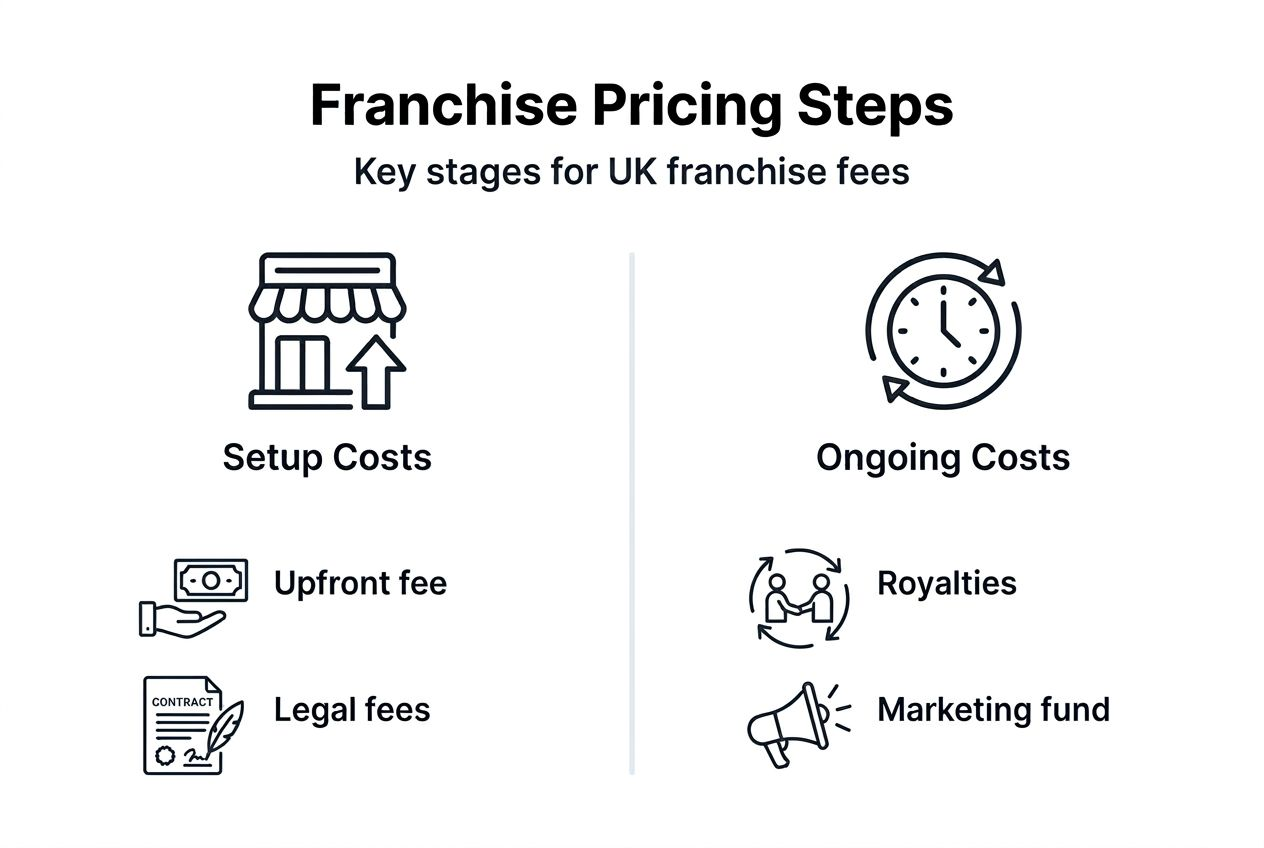
Understanding how franchise pricing works in the UK is essential before you commit capital. Most franchises charge an upfront fee for brand rights and initial support, plus ongoing royalties based on revenue. These fees vary significantly by sector and location. A retail franchise in central London will demand higher upfront costs than a mobile service franchise in rural Scotland.
Precise pricing protects your investment and ensures sustainable profitability. Typical upfront franchise fees in the UK range between £20,000 and £40,000, with royalty fees commonly at 5 to 10 per cent of gross revenue. Ignoring these details leads to cash flow problems and unexpected shortfalls.
Different franchise model types UK operators follow also influence pricing structures. For example, home-based franchises usually have lower upfront fees than high street operations. Service franchises often charge lower royalties than food and beverage concepts. Knowing these norms helps you evaluate whether a franchise opportunity is fairly priced or inflated.
Key pricing components include:
- Upfront franchise fee covering brand rights, training, and initial support
- Ongoing royalty fees, typically a percentage of monthly or annual revenue
- Marketing or advertising fund contributions
- Equipment, inventory, and premises costs
- Working capital for the first months of operation
Grasping the franchise model UK fundamentals ensures you compare opportunities on equal footing. Each sector has its own benchmarks, and understanding these helps you spot red flags early.
Prerequisites: what you need before pricing your franchise
Before you start calculating costs, gather the right tools and knowledge. You need to understand key franchise financial terms to avoid confusion. Upfront fees are one-time payments for joining the franchise network. Royalties are ongoing payments, usually a percentage of revenue. Marketing fees fund national or regional advertising campaigns. Technology fees cover software systems and point-of-sale platforms.
Access to up-to-date UK franchise directories and basic financial modelling skills are critical prerequisites. Use a reputable UK franchise directory to research fee ranges across sectors. This data forms the baseline for your pricing analysis.
You also need basic financial modelling tools. A spreadsheet application with cash flow templates works well. Input projected revenue, subtract all costs, and calculate net profit monthly. This reveals whether the franchise pricing makes economic sense for your circumstances.
Pro Tip: Start building a personal glossary of franchise terms as you research. Jargon like “franchise disclosure document,” “territory rights,” and “renewal fees” will come up repeatedly. Having clear definitions saves time and reduces misunderstandings later.
Essential prerequisites include:
- Clear definitions of upfront fees, royalties, marketing contributions, and other charges
- Access to reliable UK franchise pricing data from directories and industry reports
- Financial modelling software or spreadsheets for projections
- Understanding of your own risk tolerance and available capital
- List of questions to ask franchisors during due diligence
Without these foundations, pricing decisions become guesswork. Investing time upfront to gather data and build models pays dividends throughout your franchise journey.
Understanding upfront franchise fees
Upfront franchise fees are the entry ticket to a franchise network. These fees typically cover brand rights, initial training, site selection support, and launch marketing. The amount varies widely by brand strength and sector. Established brands with strong reputations charge premium fees because they offer immediate market recognition.

UK franchisors typically charge upfront fees between £20,000 and £40,000 depending on brand strength and sector. Food franchises often sit at the higher end due to equipment and premises costs. Service-based franchises, especially mobile or home-based operations, tend toward the lower end.
Brand reputation directly impacts upfront fees. A nationally recognised coffee chain commands higher fees than a regional cleaning service. You are paying for proven systems, customer loyalty, and reduced marketing effort. However, higher fees do not guarantee success. Evaluate whether the brand’s market position justifies the premium.
Statistically, upfront fees form 30 to 40 per cent of total initial franchise investment in the UK. The remainder goes toward equipment, inventory, premises fit-out, working capital, and professional fees. This ratio helps you assess whether a franchisor’s fee structure is reasonable or inflated.
Typical upfront fee components include:
- Brand licensing and territory rights
- Initial training programmes for you and key staff
- Site selection assistance and lease negotiation support
- Launch marketing materials and campaigns
- Operations manuals and proprietary software access
Understanding what the franchise fee explained UK covers helps you negotiate and compare offers. Always request a detailed breakdown in writing. Some franchisors bundle costs that competitors charge separately, making direct comparisons tricky.
Ongoing fees and royalties
Ongoing fees are the lifeblood of the franchisor’s business model. Royalties are usually calculated as a percentage of gross revenue, though some franchises use flat monthly fees. Typical royalty fees in UK franchises range from 5 per cent to 10 per cent of gross revenue. These fees fund ongoing support, system improvements, and national marketing.
Additional ongoing fees often include marketing fund contributions, typically one to three per cent of revenue. Technology fees cover point-of-sale systems, booking platforms, or proprietary software. Some franchises charge annual renewal fees or audit fees. These add-ons can significantly affect net profitability.
Royalty structures vary. Revenue-based royalties mean you pay more as you grow, aligning franchisor and franchisee interests. Flat fees provide cost certainty but can feel burdensome during slow months. Understand which model applies and how it impacts your financial projections.
Pro Tip: Always include ongoing fees in your financial projection models from day one. Many franchisees focus only on upfront costs and get blindsided by monthly royalty payments. Build these into your cash flow forecasts to avoid liquidity crunches.
Common ongoing fees include:
- Royalty payments based on revenue or fixed monthly amounts
- National or regional marketing fund contributions
- Technology platform or software licence fees
- Ongoing training and support charges
- Annual franchise renewal or administration fees
Reviewing the franchise fee details UK thoroughly before signing helps you budget accurately. Ask the franchisor for projected ongoing costs in writing, ideally with examples from existing franchisees.
Accounting for hidden and recurring costs
Hidden costs are the silent killers of franchise profitability. Hidden costs can add 15 to 20 per cent more to the initial investment in UK franchises. These expenses rarely appear in the headline figures but emerge during setup or operation.
Common hidden costs include advanced training modules beyond the initial programme. Equipment repairs or upgrades not covered by the franchisor. Legal fees for reviewing franchise agreements. Insurance premiums higher than anticipated. Local authority licencing fees and permits. Stock or inventory wastage during the learning curve.
Unexpected add-on fees often appear in franchise agreements. Some franchisors charge for mystery shopper audits, compliance inspections, or mandatory participation in new marketing initiatives. Others require franchisees to purchase supplies exclusively from approved suppliers at premium prices.
Strategies to identify hidden costs include requesting a complete cost breakdown from the franchisor. Speaking to existing franchisees about unexpected expenses. Reviewing the franchise agreement with a solicitor experienced in franchise law. Building a contingency buffer of 15 to 20 per cent above stated fees into your budget.
| Cost Category | Typical Range | Frequency |
|---|---|---|
| Advanced training | £1,000 – £3,000 | Annual |
| Equipment upgrades | £2,000 – £5,000 | Every 3-5 years |
| Legal review fees | £1,500 – £3,000 | One-time |
| Insurance premiums | £1,200 – £2,500 | Annual |
| Licencing and permits | £500 – £1,500 | Annual |
Understanding hidden franchise costs UK realities protects your investment. Always assume costs will be higher than advertised and plan accordingly.
Market research for competitive pricing
Market research validates whether a franchise price aligns with sector norms and regional expectations. Using franchise directories and competitor pricing is critical for benchmarking your franchise price effectively. Start by identifying direct competitors operating in your target sector and geography.
A systematic market research framework includes these steps:
- Identify five to ten comparable franchises in your sector and region using a franchise directory UK resource.
- Gather pricing data including upfront fees, royalty percentages, and marketing contributions from franchise disclosure documents or websites.
- Analyse pricing patterns. Calculate average fees, identify outliers, and understand what drives premium or discount pricing.
- Consider regional variations. London-based franchises often charge 20 to 30 per cent more than those in other regions due to higher operating costs.
- Assess sector-specific trends. Food franchises typically have higher upfront fees but lower royalties than service franchises.
- Interview existing franchisees to validate published pricing and uncover hidden costs.
- Document your findings in a comparison spreadsheet to support pricing decisions.
Regional and sector variations significantly impact pricing. A coffee franchise in Edinburgh faces different rent and wage costs than one in Birmingham. Service franchises benefit from lower overhead, allowing more competitive pricing. Retail franchises must account for inventory and premises costs.
Using market pricing data positions your franchise competitively. If competitors charge £25,000 upfront and you encounter a franchise demanding £50,000 with similar support, question the premium. Conversely, unusually low fees may signal weak brand value or inadequate support.
Financial modelling and ROI
Financial modelling transforms pricing data into actionable investment decisions. Key metrics include cash flow, return on investment (ROI), and payback period. Cash flow tracks money in and out monthly. ROI measures profit relative to investment. Payback period indicates how long until you recover initial costs.
Building simple financial models starts with realistic revenue projections. Research average sales figures from existing franchisees in your sector. Apply conservative growth assumptions, especially for the first year. Subtract all costs including upfront fees, ongoing royalties, marketing contributions, rent, wages, inventory, and utilities.
Integrating current UK economic trends into pricing assumptions ensures realism. In 2026, inflation and interest rates affect both costs and consumer spending. Factor in wage increases due to living wage adjustments. Account for potential economic slowdowns that could reduce revenue.
Typical franchise payback periods in the UK range from 24 to 36 months with careful pricing and management. Your model should show positive cash flow within the first year and full investment recovery within three years. If projections show longer payback, reconsider the opportunity or negotiate better terms.
Pro Tip: Test different pricing scenarios to find a robust model. Run best-case, worst-case, and most-likely scenarios. If your investment only works in the best case, the risk is too high. Aim for profitability even in the worst-case scenario.
| Scenario | Year 1 Revenue | Payback Period | ROI (3 Years) |
|---|---|---|---|
| Best case | £250,000 | 18 months | 45% |
| Most likely | £180,000 | 30 months | 28% |
| Worst case | £120,000 | 48 months | 12% |
Your franchise business plan UK should include detailed financial models. Lenders and investors expect to see these projections before committing capital.
Common pricing mistakes to avoid
Franchisees make predictable errors when pricing investments. Ignoring ongoing fees and underestimating working capital are among the most common franchise pricing errors. These mistakes create cash flow crises and force premature closures.
Ignoring ongoing royalty and marketing fees is a frequent error. Franchisees focus on upfront costs and assume revenue will easily cover royalties. In reality, paying 8 per cent royalties plus 2 per cent marketing contributions reduces net profit significantly. Model these costs from day one.
Underestimating working capital and hidden costs leaves you vulnerable. You need funds to cover slow months, unexpected repairs, and seasonal fluctuations. A buffer of three to six months’ operating expenses protects against early struggles.
Overly optimistic revenue forecasts without market validation derail financial plans. New franchisees often project revenue based on the best-performing locations, ignoring their lack of experience and brand establishment. Use conservative figures from average-performing franchisees instead.
“Complete cost accounting is not optional. Every pound you overlook becomes a pound you cannot pay when bills arrive. Franchise pricing demands rigorous, pessimistic financial discipline.”
Tips to avoid common errors include:
- Request complete cost breakdowns in writing from franchisors
- Speak to multiple existing franchisees about actual costs and revenues
- Hire a franchise solicitor and accountant to review agreements and projections
- Build contingency buffers of 15 to 20 per cent above stated costs
- Use conservative revenue estimates based on average, not top, performers
- Test financial models with worst-case scenarios
Avoiding these mistakes requires discipline and scepticism. Question every assumption. Demand evidence for all projections. Better to walk away from an overpriced franchise than to lose your investment.
Step-by-step pricing methodology for the UK market
A structured four-step pricing framework improves accuracy and confidence in setting franchise prices. This methodology integrates data gathering, market validation, financial modelling, and scenario testing into a coherent process.
- Identify all costs, upfront and ongoing. Create a comprehensive checklist covering franchise fees, royalties, marketing contributions, equipment, premises, inventory, working capital, professional fees, insurance, and contingency buffers. Request detailed cost breakdowns from franchisors. Speak to existing franchisees about hidden expenses. Document everything in a spreadsheet.
- Conduct market benchmarking against competitors. Use franchise directories to identify comparable opportunities. Gather pricing data from disclosure documents and franchisor websites. Calculate average fees and identify pricing outliers. Assess regional and sector variations. Understand what drives premium or discount pricing in your market.
- Build detailed financial models including ROI. Input all identified costs and realistic revenue projections. Calculate monthly cash flow, annual profit, payback period, and three-year ROI. Integrate current economic conditions like inflation and wage growth. Ensure models show profitability in conservative scenarios.
- Iterate pricing scenarios for validation. Test best-case, most-likely, and worst-case scenarios. Adjust assumptions based on feedback from franchisees and advisors. Ensure the investment remains viable even in adverse conditions. Refine your models until you achieve confidence in the projections.
Following this methodology when creating franchise business plans ensures thorough analysis. It also demonstrates due diligence to lenders and investors. The process applies whether you are evaluating an existing franchise or learning how to franchise your business UK.
If you plan on listing a franchise UK, understanding franchisee pricing concerns helps you set competitive, attractive fees. Franchisees will conduct similar analyses, so transparent, justified pricing improves recruitment.
Expected results and timelines
Setting realistic expectations about investment recovery and financial performance prevents disappointment. Most UK franchise investments achieve payback within 24 to 36 months with careful pricing and management. However, timelines vary significantly by sector, location, and execution quality.
Typical payback periods depend on multiple factors. High-investment franchises like restaurants or retail stores often take longer to recover costs than low-overhead service franchises. Established brands with strong customer loyalty accelerate payback. Franchisees with prior business experience typically outperform novices.
Financial benchmarks indicating a healthy franchise investment include positive cash flow within 12 months, reaching breakeven by month 18, and full payback within 36 months. Three-year ROI should exceed 25 per cent to justify the risk and effort. Any investment failing these benchmarks warrants serious scrutiny.
Continuous pricing review is essential as market conditions change. Regularly compare your performance against initial projections. Adjust pricing assumptions based on actual results. Monitor competitor pricing and market trends. Be prepared to renegotiate terms with franchisors if conditions deteriorate significantly.
Key ongoing review activities include:
- Quarterly comparison of actual versus projected financial performance
- Annual benchmarking against competitor pricing and market rates
- Regular conversations with fellow franchisees about cost trends
- Updating financial models with current economic data
- Assessing whether ongoing fees still represent fair value
Revisit pricing as your franchise matures. What made sense at launch may need adjustment after three years of operation. Market conditions evolve, consumer preferences shift, and competitive landscapes change. Staying current protects profitability and investment value.
Find your ideal franchise opportunity with FranchiseLocal.co.uk
Now that you understand how to price a franchise accurately, explore the thousands of opportunities available through FranchiseLocal.co.uk. The platform connects you with franchises across every sector and investment level, helping you find opportunities that match your budget and goals.
Access the ultimate guide to franchising for comprehensive resources on starting and growing your franchise business. Browse the UK franchise directory to compare pricing, sectors, and support packages from leading franchisors. Connect with franchise service providers offering legal, financial, and marketing expertise to support your launch.
Pro Tip: Use FranchiseLocal’s directory filters to narrow opportunities by investment level, sector, and location. This saves hours of research and helps you focus on franchises that genuinely fit your criteria and financial capacity.
Frequently asked questions
What is typically included in the upfront franchise fee?
Upfront fees generally cover brand rights, initial training, and setup support. These fees grant you access to the franchise system, operations manuals, and proprietary software. Training usually includes both classroom instruction and on-site coaching. Setup support may cover site selection, lease negotiation, and launch marketing, though scope varies by franchisor.
How do ongoing royalty fees affect franchise profitability?
Royalty fees, usually a percentage of revenue, reduce net profit margins directly. A franchise generating £200,000 annually with an 8 per cent royalty pays £16,000 yearly to the franchisor. Including these fees accurately in pricing models is essential for realistic profit forecasts. Underestimating royalties leads to cash flow shortages and financial stress.
What are some hidden costs in UK franchises to watch for?
Hidden costs may include extra training beyond initial programmes, equipment replacement, marketing levies, and legal fees. Some franchisors charge for mandatory audits, compliance inspections, or participation in new initiatives. Local authority licences, insurance premiums, and inventory wastage also add unexpected expenses. A buffer of 15 to 20 per cent above stated fees helps cover these costs.
How long does it take to recoup a franchise investment in the UK?
Most UK franchises recover initial investment within 24 to 36 months under normal conditions. Timelines vary based on sector, location, brand strength, and operator experience. High-investment franchises like restaurants typically take longer than low-overhead service franchises. Conservative financial modelling and disciplined cost management accelerate payback periods.
What mistakes should I avoid when pricing my franchise?
Avoid ignoring ongoing costs like royalties and marketing contributions in your initial budget. Do not underestimate working capital needs or hidden expenses like equipment upgrades and legal fees. Never overestimate revenue without solid market data and conservative assumptions. Always validate pricing with existing franchisees and independent financial advisors before committing capital.