

Starting a franchise in the UK is one of the most structured routes into business ownership available today. Yet many aspiring entrepreneurs rush into it without understanding what franchising actually demands. Knowing how to start a UK franchise properly means addressing legal obligations, financial planning, operational readiness, and recruitment before you open a single territory. The good news is that franchise businesses report under a 5% failure rate over five years, far outperforming independent start-ups. That statistic reflects the power of a well-built system. This guide gives you that system, step by step.
How to start a UK franchise: assessing your readiness first
Before you recruit a single franchisee or print a single operations manual, you need an honest answer to one question: is your business actually franchisable?
Many businesses that attempt to franchise prematurely fail because their operations are insufficiently systemised and profitable. A great product or a loyal customer base is not enough. To successfully franchise a business in the UK, your model needs to meet three core criteria:
- Profitability. Your business must generate strong, consistent margins. Franchisees will pay you a licence fee and ongoing royalties. If your own margins are tight, theirs will be tighter.
- Replicability. Your business must be deliverable by someone other than you, following a documented process. If your success depends entirely on your personal relationships or specialist skills, it is not yet franchisable.
- Proven demand. There must be demonstrable, repeatable demand for your product or service in multiple locations, not just your home town.
Beyond those three pillars, brand strength matters significantly. A recognisable name, consistent visual identity, and positive reputation give prospective franchisees something worth investing in. If your brand needs work, do that work before you approach the franchise market.
Pro Tip: Run a feasibility study before committing to a franchise model. This should cover market size, competitor analysis, and a realistic projection of franchisee earnings. A credible feasibility study is also the foundation of a solid franchise business plan, which you will need throughout the process.
Goal-setting at this stage is equally important. Are you building a regional network of 10 to 20 franchisees, or a national operation with 100-plus territories? The answer shapes every decision that follows, from fee structures to support infrastructure to the size of your head office team.
Legal framework for starting a franchise in the UK
Getting the legal side right is non-negotiable. The franchise agreement sits at the heart of your entire network, and franchise agreements are legally binding contracts that require specialist legal review before they are signed by anyone.
Here are the key legal steps to work through when starting a franchise in the UK:
- Instruct a specialist franchise solicitor. General commercial lawyers rarely have the franchise-specific knowledge you need. Look for solicitors who are members of the British Franchise Association or who regularly act for both franchisors and franchisees.
- Draft your franchise agreement. This document governs fees, territory boundaries, renewal terms, termination rights, and the obligations of both parties. Every clause carries commercial weight.
- Protect your intellectual property. Register your trademarks with the UK Intellectual Property Office before you franchise. This covers your brand name, logo, and any distinctive product names. Digital assets, including your website domain and social media handles, should also be formally secured.
- Prepare a Franchise Information Memorandum (FIM). This disclosure document gives prospective franchisees a clear, honest picture of your business, its financial performance, and what joining your network involves. It is your legal and ethical obligation to be accurate here.
- Put NDAs in place. Before sharing sensitive business information with any prospective franchisee, require them to sign a non-disclosure agreement. This protects your systems, processes, and financial data during the recruitment process.
- Seek professional accreditation. Accreditation by bodies like the QFA enhances your credibility with investors and signals that your franchise operates to recognised ethical standards. It also gives you access to legal templates and industry guidance.
Pro Tip: Review the franchise legal requirements in detail before instructing your solicitor. Going in with a clear understanding of what you need will save you considerable time and legal fees.
The legal framework also needs to account for good faith obligations. UK franchise law, while not as codified as in some other countries, increasingly expects franchisors to deal honestly and openly with franchisees throughout the relationship. Build that transparency into your documentation and culture from day one.
Financial planning for your UK franchise
Money is where many promising franchise models fall apart. Financial modelling must be rigorously stress-tested before you launch, and setting fees based on real data rather than guesswork is non-negotiable for long-term health.

Understanding the typical cost of franchising in the UK
Here is a practical breakdown of the main cost categories involved in launching a franchise:
| Cost category | Typical range | Notes |
|---|---|---|
| Franchise fee (paid by franchisee) | £5,000 to £50,000+ | Covers licence, training, and initial support |
| Royalty fee | 5% to 15% of turnover | Ongoing, paid monthly or quarterly |
| Marketing fund contribution | 1% to 3% of turnover | Pooled for national or regional campaigns |
| Franchisor set-up costs | £20,000 to £100,000+ | Legal, manuals, pilot, recruitment |
| Franchisee working capital | Variable | Depends on sector and territory size |
To put real figures to this, Molly Maid’s UK franchise requires an entry fee of £23,975 plus £12,000 in first-year marketing capital. That is a mid-range investment for a service franchise, and it gives you a useful benchmark when designing your own fee structure.
Funding options for aspiring franchise owners
Most prospective franchisees in the UK explore several routes to finance their investment:
- Personal savings and equity. The simplest route, and the one that carries least debt. Many banks look favourably on franchisees who commit a meaningful proportion of their own capital.
- High street bank loans. Several major UK banks have dedicated franchise lending teams. They assess the franchise’s track record and the franchisee’s personal finances.
- Franchise finance specialists. Some lenders focus exclusively on franchise funding, offering tailored products for both start-up and resale franchises. You can explore franchise funding options in more detail to match funding to your specific circumstances.
- Grants and government schemes. Schemes such as the Start Up Loans programme can supplement other funding, particularly for franchisees entering new or underserved markets.
Financial realism and detailed projections are the foundation of any successful franchise launch. Your financial model should include a clear break-even point, year-one to year-three revenue projections, and a stress-test scenario that assumes franchisee revenues come in 20% below forecast. If the model still works under those conditions, you have a sound business case. Guidance on pricing your franchise correctly is worth reading before you finalise any numbers.
Operational preparation: systems, training, and support
A franchise without a proper operations manual is not a franchise. It is a loose arrangement that will unravel as soon as your second or third franchisee tries to deliver your service without you standing over their shoulder.
Comprehensive support systems, including training, marketing, and coaching, are what separate successful franchise networks from ones that stagnate. Underestimating these requirements is a leading cause of franchise failures, so build your support infrastructure before you need it, not after you have already sold ten territories.
Here is what your operational preparation should cover:
- Operations manual. Document every process, standard, and procedure in your business. This manual is the legal backbone of your franchise system and the primary training resource for franchisees. It should cover everything from customer service scripts to financial reporting templates.
- Training programme. Design a structured induction covering both the technical skills of the business and the commercial skills franchisees need to run their territory profitably. Classroom training, on-site shadowing, and e-learning all have a role.
- Ongoing support structure. Define how you will support franchisees after launch. This typically includes a field support manager, a regular business review process, a helpdesk function, and access to a national marketing calendar.
- Technology platforms. Invest in systems that allow franchisees to report sales, access marketing materials, and communicate with head office through a single platform. Consistency of data is essential as your network grows.
- Pilot franchise trial. Run a 12-month pilot operation with one or two test franchisees before your full launch. This process identifies gaps in your manual, stress-tests your support model, and gives you real franchisee performance data to show prospective recruits.
The pilot stage is where many smart franchisors discover that their systems are 80% right and 20% incomplete. That 20% matters enormously to the franchisee trying to follow your manual at 8am on a Monday without you available. Find those gaps before you scale.
Recruiting franchisees and launching your network
With your legal framework, financial model, and operational systems in place, you are ready to recruit. This stage deserves as much care as everything that preceded it. Selecting the wrong franchisees damages your brand and wastes resources on both sides of the relationship.
Follow these steps for an effective franchisee recruitment and launch process:
- Define your ideal franchisee profile. Be specific. What commercial experience do you need them to have? What capital should they be able to commit? What personal qualities, work ethic, and local market knowledge make someone a strong fit for your brand?
- Choose your recruitment channels. Franchise exhibition events, online franchise directories, and social media advertising all generate leads. Listing your opportunity on reputable UK franchise portals puts you in front of people actively searching for franchise opportunities in the UK.
- Implement a structured vetting process. Initial enquiry, application form, discovery day, financial verification, franchise agreement review. Every stage filters out candidates who are wrong for your network, protecting your brand at each step.
- Plan your territory launches. Consider population density, competitor presence, and logistics when sequencing which territories open first. A cluster approach, opening several territories in the same region, makes field support more efficient and brand marketing more impactful.
- Monitor and support post-launch. Your most active support period should be the first three to six months of each franchisee’s operation. Set clear KPIs, conduct regular business reviews, and act quickly if performance falls below expectations. Early intervention prevents the kind of long-term underperformance that damages both the franchisee and your network.
Building a quality franchise network is a long game. Five strong, profitable, engaged franchisees are worth far more than twenty mediocre ones. Recruit with that principle in mind.
What I have actually learned about franchising in the UK
I have reviewed and observed enough UK franchise launches to say with confidence: the most common mistake is speed. Founders who have built a genuinely good business often assume that documenting it and selling licences is the straightforward next step. It rarely is.
The businesses that launch prematurely tend to have the same profile. Strong sales, a founder who personally drives most of the value, and a team that has never had to follow a manual because everyone just knows how things work. When a franchisee arrives expecting a system to follow, what they find instead is a collection of unwritten habits. That gap is expensive to close after the fact.
What I have seen work consistently is founders who treat the pilot franchise stage as a genuine test, not a formality. They give their pilot franchisee real independence, observe where the manual fails them, and rewrite whole sections before anyone else joins the network. That discipline is unglamorous but it is where the real work happens.
I would also push back on the industry habit of presenting franchise fees as a secondary consideration. In my experience, franchisors who underprice their fees to attract more recruits end up under-resourced for support, and their networks suffer for it. Pricing your franchise correctly is not just a revenue decision. It is a statement about the quality of what you are offering. Get that number right from the start.
Finally, franchisee selection is where I see the most emotionally driven decisions. It is tempting to approve a candidate who is enthusiastic and has the funds in place. Enthusiasm fades. What lasts is commercial capability, resilience, and genuine alignment with your brand values. Hold out for that combination, even if it means a slower start.
— Will
Find your next franchise opportunity with Franchiselocal
If you are ready to move from planning to action, Franchiselocal is the place to start your search. Whether you are looking to buy into an established brand or explore emerging sectors, the platform connects you with top UK franchise opportunities across every investment level and industry.
You can filter by budget, location, and lifestyle preference to find opportunities that genuinely fit your goals, rather than spending hours sifting through listings that are not relevant to your situation. For those exploring specific sectors, browsing franchise opportunities by industry gives you a clear view of what is available and what realistic investment looks like across different markets.
Franchiselocal also provides supporting resources on legal requirements, funding routes, and step-by-step guidance, everything a prospective franchise owner in the UK needs to make a properly informed decision. Start with a how to choose a franchise guide to sharpen your thinking before you approach any opportunity directly.
FAQ
What are the main steps to start a UK franchise?
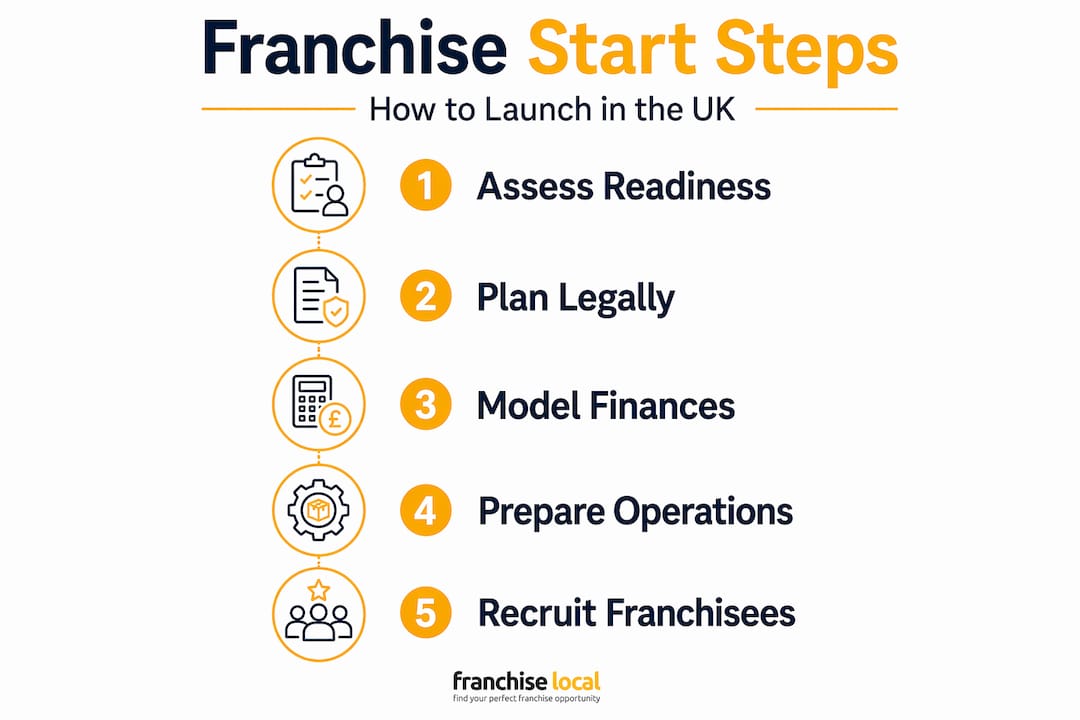
The core steps are: assess your business readiness, build your legal framework including a franchise agreement and FIM, complete financial modelling, develop your operations manual and training programme, run a pilot, then recruit franchisees. Each step builds on the last, so sequencing matters.
How much does it cost to franchise a business in the UK?
Franchisor set-up costs typically range from £20,000 to £100,000 or more, covering legal fees, manual development, pilot operations, and initial recruitment marketing. The exact figure depends on the complexity of your business and the scale you are targeting.
Do I need legal accreditation to start a franchise in the UK?
Accreditation is not a legal requirement, but QFA or BFA accreditation significantly improves your credibility with prospective franchisees and investors, and gives you access to recognised legal templates and industry standards.
How long does it take to launch a UK franchise?
Most well-prepared franchise launches take 12 to 18 months from the decision to franchise to the recruitment of the first franchisee. This accounts for legal documentation, pilot operations, and the time needed to refine your systems before scaling.
What makes a business franchisable in the UK?
A franchisable business needs consistent profitability, a clearly replicable operating model, proven demand across multiple locations, and a brand that prospective franchisees consider worth investing in. Without all four elements, the risk of premature launch is high.