

Many people preparing to invest in a UK franchise assume that, much like buying a regulated financial product, they will receive a legally standardised disclosure document before signing anything. That assumption is wrong, and it carries real financial risk. Unlike the United States, where federal law mandates a formal Franchise Disclosure Document, the UK operates on a voluntary system. Prospective franchisees who understand this distinction, and know what good disclosure looks like, are far better placed to protect their investment and make confident decisions.
Key Takeaways
| Point | Details |
|---|---|
| No statutory UK disclosure | UK franchise disclosure is voluntary, not legally required, unlike the US. |
| Disclosure aids due diligence | A robust disclosure pack helps you assess risks, fees, and legal terms before investing. |
| Verify financial claims | Always ask for written evidence and consult advisers to avoid relying solely on franchisor statements. |
| BFA code is best practice | BFA franchisors follow ethical disclosure guidelines, but buyers must still evaluate disclosures critically. |
| US FDD offers structure | US FDDs are highly structured and mandated, providing lessons UK buyers can use to assess voluntary packs. |
What is a franchise disclosure document?
A franchise disclosure document, commonly called an FDD, is a formal written pack of information provided by a franchisor to a prospective franchisee before any agreement is signed or fees are paid. Its fundamental purpose is straightforward: informed decision-making requires that buyers receive material information about the franchisor, the franchise opportunity, and all key risks and obligations before committing.
In the US, this document is a legal requirement. In the UK, the situation is entirely different. There is no statutory FDD template in the UK; instead, disclosure is usually provided voluntarily as a disclosure pack or information memorandum before a buyer signs or pays any fees. This is a crucial distinction. It means the quality, depth, and reliability of what you receive can vary enormously from one franchisor to the next.
“The purpose of an FDD is to help prospective franchisees make an informed decision by providing material information about the franchisor, the franchise opportunity, and key risks and obligations.” — International Franchise Association
The closest thing the UK has to a regulatory standard is the British Franchise Association (BFA) Code of Ethics. BFA members commit to providing honest, complete, and accurate information to prospective franchisees, making BFA membership a useful signal when you are evaluating a brand. However, it is a self-regulatory standard rather than a legal requirement.
Key reasons a proper disclosure pack matters to UK buyers include:
- It allows you to assess the franchisor’s track record and financial health before committing capital
- It helps you understand your territory rights, obligations, and restrictions clearly
- It sets out ongoing fees, royalties, and marketing levies so there are no financial surprises
- It provides a factual basis for verifying verbal claims made during sales conversations
- It forms the foundation for UK franchise due diligence, working alongside professional legal and financial review
Understanding UK franchise legal rules is equally important when you are trying to place disclosure documents in their proper regulatory context. A broader UK franchise law overview confirms that contract law, rather than specific franchise legislation, is what governs most franchise relationships in England and Wales.
Key components found in UK franchise disclosure packs
Once you know that UK disclosure is voluntary, your next priority is understanding what a thorough pack should contain. The best disclosure packs follow a consistent structure that covers all the areas you need to assess before investing.
Key components that a prospective UK franchisee should expect to see include franchisor background and experience, business model and territory, fees and ongoing costs, training and support systems, intellectual property, marketing and brand standards, financial information and earnings claims with appropriate assumptions and disclaimers, key legal terms, risk factors and warnings, and supporting documents.
Here is a breakdown of each major section and what you should look for:
| Section | What it should cover | Red flags to watch for |
|---|---|---|
| Franchisor background | Company history, directors, litigation history | Undisclosed legal disputes or recent director changes |
| Business model and territory | How the model works, territory boundaries | Vague territory definitions or no exclusivity |
| Fees and costs | Franchise fee, royalties, marketing levy | Hidden ongoing costs or unclear fee triggers |
| Training and support | Initial training, ongoing support, technology | Vague promises with no written commitments |
| IP and branding | Trademark ownership, usage rights | Unregistered trademarks or unclear licence terms |
| Financial information | Earnings projections, assumptions, disclaimers | Projections with no supporting data or caveats |
| Legal terms summary | Key obligations, renewal, exit rights | Punitive exit clauses or excessive restrictions |
| Risk factors | Known risks, market challenges, competition | No risk section at all, or risks downplayed |
| Supporting documents | Sample franchise agreement, audited accounts | Unaudited accounts, missing key documents |
Understanding franchise fees and costs in detail is essential before you evaluate the financials section of any pack. Similarly, if you want to understand what operational standards you will be held to, reviewing a UK franchise operations manual provides the framework within which the business will function day to day.

Pro Tip: When reviewing financial projections or earnings claims in a disclosure pack, always ask the franchisor for the specific assumptions behind the figures. A reputable franchisor will provide written documentation, actual franchisee performance data, and clear disclaimers explaining that results may vary. If they only offer verbal assurances or refuse to share the underlying assumptions, treat this as a significant warning sign.
The checklist approach is valuable here. Work through each section systematically and note any areas where information is missing, incomplete, or contradicted by what you have been told verbally during the sales process. A well-prepared disclosure pack is thorough, consistent, and self-evidently honest.
Comparing disclosure regimes: UK vs US franchise documents
To fully appreciate what you are dealing with as a UK buyer, it is worth understanding what a legally mandated system looks like. In the United States, the Federal Trade Commission requires franchisors to provide a formal FDD to prospective buyers at least 14 days before any agreement is signed or money changes hands.
A US FDD is structured into 23 disclosure items and associated exhibits that summarise key terms of the franchise agreement and background risks. These 23 items cover everything from the franchisor’s litigation history and bankruptcy disclosures to a complete list of current and former franchisees, financial performance representations, and full financial statements.
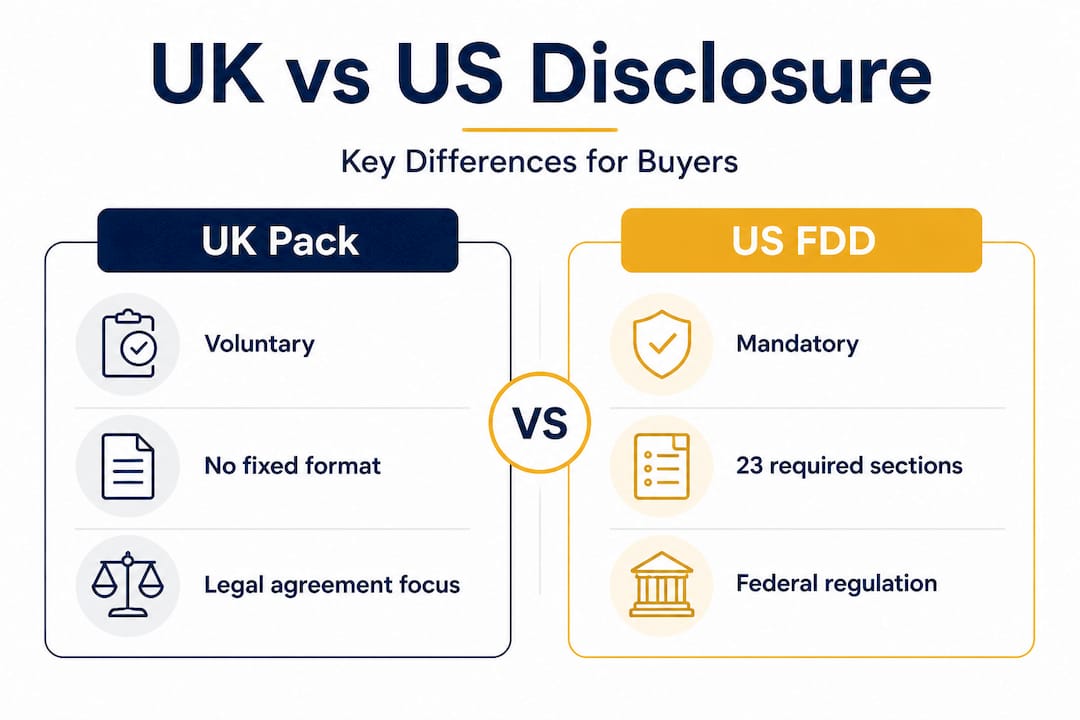
The contrast with the UK is stark. As established when comparing franchise disclosures across jurisdictions, an FDD is not UK-mandated; the US requires a full FDD-like disclosure regime, while the UK relies on contractual disclosures and self-regulation through ethics codes.
| Feature | UK system | US system |
|---|---|---|
| Legal requirement | No statutory requirement | Federally mandated FDD |
| Standard format | No set template | 23-item standardised structure |
| Regulatory body | BFA (voluntary membership) | Federal Trade Commission |
| Review period | No mandatory waiting period | Minimum 14-day review period |
| Enforcement | Contract law and civil litigation | FTC enforcement and state law |
| Earnings representations | No specific rules | Must be included if made, with full disclosure |
“When comparing franchise disclosures across jurisdictions, ‘FDD’ is not necessarily UK-mandated; US requires an FDD-like disclosure regime, while the UK commonly relies on contractual disclosures plus self-regulation and ethics codes.” — Apex Counsel
What can UK buyers learn from the US approach? Quite a lot, in practice. The 23-item structure offers a useful mental checklist even if you are reviewing a voluntary UK pack. If a UK disclosure pack is missing areas that a US FDD would cover as standard, such as litigation history, a complete list of current franchisees, or audited financial statements, you should ask why.
The UK franchise agreement itself carries more weight in the UK than in many other systems, simply because it is often the primary legal document governing the relationship. Understanding UK legal franchise tips before you negotiate or sign is therefore essential.
How UK buyers should use disclosure packs for due diligence
Receiving a disclosure pack is the beginning of your due diligence process, not the end of it. The quality and completeness of voluntary disclosure packs in the UK can vary significantly. Because disclosure is not standardised by statute, quality and completeness vary by franchisor, and prospective franchisees should treat the disclosure pack as due-diligence material and verify key claims, especially around performance and earnings, rather than relying on verbal assurances.
Follow this step-by-step process to use a disclosure pack effectively:
-
Read the entire pack before any further meetings. Do not allow the franchisor’s sales team to walk you through it selectively. Read everything yourself first and mark any sections that are missing, unclear, or contradicted by what you have been told.
-
Map the pack against the franchise agreement. Every key claim in the disclosure pack should be supported by a corresponding term in the draft franchise agreement. If the pack promises dedicated territory and the agreement contains no such protection, the verbal and written promises are worthless.
-
Verify financial claims independently. Ask for supporting data behind any earnings projections. Request the contact details of existing franchisees, as any reputable franchisor will provide these, and speak to them directly about their actual experience.
-
Check the franchisor’s corporate and financial standing. Request audited accounts and verify the company’s registration details at Companies House. A franchisor with unclear financials or a short trading history carries a different risk profile than one with a decade of audited accounts.
-
Engage a specialist franchise solicitor. The UK franchise agreement essentials are complex legal territory. A solicitor who specialises in franchising will identify clauses that restrict your exit options, impose unfair obligations, or leave key matters undefined.
-
Cross-reference with the IFA buying guidance. Even though this guidance is primarily US-focused, its emphasis on reviewing the entire disclosure document and using advisers to interpret risks and answer questions applies equally to UK buyers.
Pro Tip: Never rely on a single conversation with an existing franchisee who has been recommended by the franchisor. Always ask for the full list of franchisees operating within the network and choose your own contacts to call. Franchisors naturally direct you towards their happiest operators. Hearing from a broader cross-section gives you a more realistic picture of life within the network.
Why relying solely on disclosure packs can be risky in the UK
Here is something that does not get said enough in UK franchising circles: a disclosure pack is only as good as the franchisor who wrote it. There is no external body checking that the information is complete, current, or accurate before it lands in your inbox.
This is not a criticism of franchising as a business model. It is simply an honest acknowledgement of the voluntary system’s limitations. BFA membership is a positive indicator, and the BFA does carry out checks on member firms, but membership signals a commitment to process quality rather than providing a guarantee of content reliability in every disclosure document issued.
The danger for buyers is what you might call the credibility trap: receiving a professionally formatted, well-designed disclosure pack and assuming that its presentation reflects its accuracy. Glossy documents and confident projections can obscure gaps in substance. We have seen prospective franchisees make significant investment decisions based on earnings claims that had no meaningful evidential basis, simply because they were set out clearly on a branded page.
Franchise due diligence advice consistently points to the same conclusion: treat every written document as a starting point for questions, not a final answer. Ask for written clarification on any verbal promises. Request evidence for every financial claim. Insist on professional legal and financial review before you commit to any investment.
The prospective franchisees who fare best are not those who receive the most detailed disclosure packs. They are the ones who treat those packs as opening positions in an investigation, and who keep digging until they have genuine confidence in what they are buying.
Find expert guidance and franchise opportunities in the UK
Having understood how disclosure packs fit into the wider landscape of UK franchising, the natural next step is to continue your research with the right resources. Explore our UK franchising guide for a broad overview of how the sector works and what to expect as a first-time buyer. For a deeper look at every stage of the process, the ultimate UK franchise guide covers everything from evaluating opportunities to negotiating agreements. When you are ready to start comparing specific franchise brands that match your budget, location, and lifestyle, our UK franchise directory brings together hundreds of verified opportunities across every sector, so you can search and shortlist with confidence.
Frequently asked questions
Do UK franchisors have to follow a specific disclosure document format?
No, UK franchisors typically provide voluntary disclosure packs rather than a statutory template, following BFA best practice but not a legal requirement. This means the format, depth, and accuracy of what you receive will vary considerably between franchisors.
What information should I verify in a franchise disclosure pack?
Verify all financial claims, especially projected earnings, and ask for written evidence supporting every figure. You should also check legal terms and financial claims including territory rights, training commitments, and ongoing support details against the actual franchise agreement.
How does a UK disclosure pack differ from a US Franchise Disclosure Document?
The UK provides voluntary disclosure packs with no statutory requirements, while the US requires a legal FDD with 23 mandatory sections and a compulsory 14-day review period before any agreement can be signed.
Is written disclosure enough for due diligence?
Written disclosure is a starting point, not a conclusion. Even where a full FDD regime exists, professional guidance stresses using advisers and asking detailed questions to interpret risks and verify answers fully before committing.