

Choosing the right franchise can transform your career, but the research process often feels overwhelming. With thousands of UK franchise opportunities spanning diverse industries and investment levels, prospective franchisees face the challenge of filtering options, verifying claims, and making decisions that could shape their financial future. This guide provides a structured, step-by-step approach to researching franchise opportunities effectively, helping you avoid costly mistakes and identify investments aligned with your goals, budget, and lifestyle.
Key takeaways
| Point | Details |
|---|---|
| Market scale | The UK franchise sector contributes over £17 billion annually and offers diverse opportunities across industries. |
| Structured approach | Effective research combines due diligence, financial evaluation, legal review, and direct franchisee contact. |
| Preparation matters | Organising documents, setting budgets, and understanding requirements streamlines the research process. |
| Avoid pitfalls | Rushing decisions, ignoring red flags, and skipping independent advice lead to poor franchise choices. |
| Expert resources | Leveraging franchise directories and professional advisors increases confidence and investment success. |
Understanding the UK franchise landscape and its importance
The UK franchising sector represents a substantial and growing segment of the economy. The sector contributes over £17 billion annually and has doubled in size since 1996, demonstrating resilience and consistent expansion. This growth reflects franchising’s appeal as a proven business model that combines entrepreneurial independence with established brand support.

Understanding the market’s scale helps you appreciate the breadth of opportunities available. Franchises span numerous franchise industries, from food and beverage to healthcare, education, and professional services. Each sector offers distinct operational models, investment requirements, and growth trajectories. Some franchises operate from home, whilst others require high street premises or mobile setups.
UK franchising remains in good health and continues to expand and mature, creating favourable conditions for new franchisees. However, this positive outlook doesn’t eliminate risk. Market health simply means opportunities exist, but individual franchise performance varies dramatically based on brand strength, location, management, and market fit.
Researching the landscape thoroughly provides essential context for evaluating specific opportunities. You’ll recognise industry trends, identify emerging sectors, and understand competitive dynamics. This foundational knowledge transforms you from a passive buyer into an informed investor capable of asking critical questions and spotting genuine value.
Key considerations when assessing the franchise landscape:
- Industry growth rates and saturation levels in your target region
- Franchise model variations including territory exclusivity and support structures
- Economic factors influencing consumer demand in specific sectors
- Regulatory changes affecting franchise operations and compliance requirements
“Understanding the broader franchise market helps prospective franchisees contextualise individual opportunities and make comparisons based on realistic benchmarks rather than franchisor promises alone.”
Preparing to research: essential requirements and tools
Before diving into franchise listings, organise the resources and information you’ll need for effective evaluation. Careful preparation including understanding legal considerations and financial requirements creates a solid foundation for your research journey. This preparation phase saves time and ensures you can respond quickly when promising opportunities emerge.
Start by establishing your investment budget clearly. Calculate not just the initial franchise fee but also working capital requirements, equipment costs, property deposits, and personal living expenses during the launch phase. Most franchisees underestimate total capital needs, creating financial stress that undermines business success.
Gather essential documents and create a research framework. You’ll need personal financial statements, credit reports, proof of funds, and professional references. Many franchisors request these during initial discussions, so having them ready demonstrates seriousness and accelerates the evaluation process.
Essential research tools and resources:
- Spreadsheet templates for comparing franchise costs, fees, and projections
- Checklist of questions for franchisors covering support, training, and territory rights
- Contact list of professional advisors including franchise solicitors and accountants
- Notebook or digital system for recording franchisee interviews and observations
Create a comparison table to track key metrics across franchise options:
| Requirement | Purpose | Source |
|---|---|---|
| Financial statements | Prove investment capacity | Personal records, accountant |
| Legal documentation | Review franchise agreement terms | Franchise solicitor |
| Market research | Assess local demand and competition | Industry reports, field visits |
| Franchisee contacts | Verify support and performance claims | Franchisor disclosure, independent search |
| Professional advice | Validate financial projections | Accountant, business advisor |
Understanding franchise legal considerations early prevents surprises later. Franchise agreements contain complex terms governing territory rights, renewal conditions, exit clauses, and ongoing obligations. Familiarising yourself with standard legal structures helps you identify unusual or unfavourable terms during negotiations.
Pro tip: Create a dedicated folder system, either physical or digital, with sections for each franchise you research seriously. Include all correspondence, financial documents, agreement drafts, and notes from conversations. This organisation proves invaluable when comparing multiple opportunities or revisiting options months later.
Step-by-step guide to researching and evaluating franchise opportunities
A systematic approach to franchise research reduces overwhelm and ensures thorough evaluation. Successful franchise investments depend on structured steps including due diligence, financial analysis, and speaking with existing franchisees. Following this process methodically increases your chances of selecting a franchise that matches your capabilities and goals.
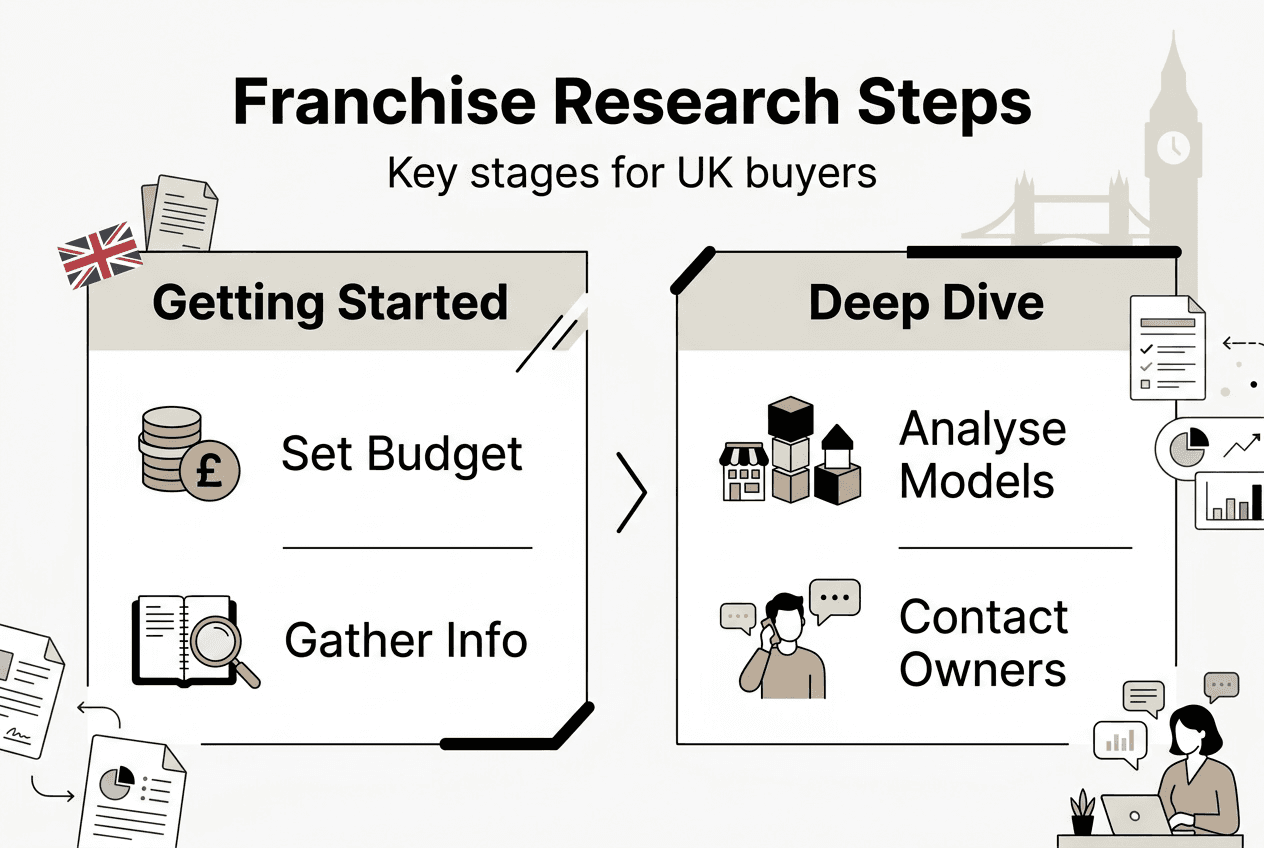
Step 1: Identify franchises matching your criteria. Define your priorities clearly before browsing listings. Consider investment budget, industry preference, lifestyle requirements, and skill alignment. Filter opportunities based on these parameters to create a shortlist of realistic candidates. Don’t waste time researching franchises outside your financial reach or interest areas.
Step 2: Analyse franchise models, support structures, and costs. Request disclosure documents and franchise prospectuses from shortlisted brands. Examine the business model carefully, understanding revenue streams, customer acquisition methods, and operational requirements. Evaluate training programmes, ongoing support, marketing assistance, and technology platforms provided by the franchisor.
Step 3: Review legal agreements and financial projections. Engage a franchise solicitor to examine the franchise agreement thoroughly. Simultaneously, work with an accountant to validate financial projections and assess realistic earning potential. Understanding how to create a franchise business plan helps you develop independent financial models rather than relying solely on franchisor estimates.
Step 4: Conduct due diligence including franchisee contact. This critical step involves speaking directly with current and former franchisees. Ask about actual earnings, support quality, challenges faced, and whether they’d make the same investment again. Visit operating locations to observe customer flow, staff interactions, and operational efficiency firsthand.
Step 5: Compare options using structured analysis. Create a detailed comparison framework:
| Franchise A | Franchise B | Franchise C |
|---|---|---|
| Initial investment: £45,000 | Initial investment: £65,000 | Initial investment: £38,000 |
| Ongoing royalty: 6% | Ongoing royalty: 8% | Ongoing royalty: 5% |
| Training: 2 weeks | Training: 4 weeks | Training: 10 days |
| Territory: Exclusive postcode | Territory: Shared region | Territory: Exclusive 5-mile radius |
| Support: Monthly calls | Support: Quarterly visits | Support: Weekly check-ins |
This visual comparison reveals trade-offs between investment levels, support intensity, and operational freedom. No single franchise will excel in every category, so prioritise factors most important to your success.
“The most successful franchisees invest significant time validating franchisor claims through independent research and direct franchisee contact before committing capital.”
Pro tip: Consult the franchise investment guide for additional evaluation frameworks and financial planning tools. Consider hiring a franchise consultant for complex decisions or if you’re new to business ownership. Their experience identifying red flags and negotiating terms often justifies the advisory fee through better deal structures or avoided mistakes.
Common research pitfalls and how to avoid them
Even diligent prospective franchisees make preventable mistakes during research. Understanding common pitfalls helps you maintain objectivity and thoroughness throughout the evaluation process. Avoiding common pitfalls such as rushing decisions or neglecting legal review protects your investment and increases success probability.
Rushing the decision represents the most frequent and costly error. Franchisors sometimes create artificial urgency, claiming limited territories or special pricing deadlines. Whilst genuine scarcity exists occasionally, pressure tactics often signal weak opportunities. Quality franchises with strong track records rarely need aggressive sales methods because their results speak clearly.
Neglecting to verify franchisor claims through independent sources leaves you vulnerable to exaggerated promises. Some franchisors present best-case scenarios as typical outcomes or cherry-pick successful franchisees for testimonials whilst hiding struggling locations. Always request complete franchisee lists and contact multiple operators randomly rather than only those suggested by the franchisor.
Common research mistakes to avoid:
- Accepting financial projections without independent validation or sensitivity analysis
- Overlooking ongoing fees including marketing contributions, technology charges, and renewal costs
- Failing to assess local market conditions and competitive intensity in your target territory
- Ignoring exit strategy and resale restrictions outlined in franchise agreements
- Skipping professional legal and financial advice to save advisory fees
- Relying exclusively on franchisor-provided information without third-party verification
Overlooking the importance of cultural fit creates long-term frustration. A franchise might offer excellent financial returns but require working styles or values misaligned with your preferences. If you value autonomy, a franchise with rigid operational protocols will feel restrictive. If you need structure, a hands-off franchisor won’t provide adequate guidance.
“The best franchise opportunities balance realistic financial potential with operational models and support structures matching the franchisee’s skills, preferences, and lifestyle goals.”
Failing to understand the franchise negotiation process limits your ability to secure favourable terms. Whilst franchise agreements are typically standardised, some elements remain negotiable, particularly for experienced businesspeople or in less competitive territories. Don’t assume every term is fixed without exploring modification possibilities.
Pro tip: Maintain detailed notes throughout your research, recording dates, conversations, and impressions for each franchise. This documentation helps you spot inconsistencies between initial promises and later revelations. Set a realistic timeline allowing adequate research depth, typically three to six months for thorough evaluation depending on franchise complexity and your business experience.
Explore franchise opportunities and expert resources at FranchiseLocal.co.uk
Navigating the UK franchise market becomes significantly easier with comprehensive resources and expert guidance. FranchiseLocal.co.uk offers an extensive franchise directory featuring thousands of opportunities across diverse industries and investment levels, helping you discover options matching your specific criteria efficiently.
The platform’s ultimate guide to franchising provides in-depth educational content covering every aspect of franchise ownership, from initial research through launch and growth. These expert guides complement your independent research, offering frameworks and insights that deepen your understanding and confidence.
Beyond franchise listings, FranchiseLocal.co.uk connects you with trusted franchise service providers including solicitors, accountants, and business advisors specialising in franchising. Accessing qualified professionals familiar with franchise-specific legal and financial considerations ensures you receive relevant, actionable advice throughout your investment journey.
FAQ
How long does it usually take to research a franchise opportunity?
Typical franchise research spans three to six months for thorough evaluation, though timelines vary based on complexity and your business experience. Simple, low-cost franchises with straightforward models may require less time, whilst complex, high-investment opportunities demand extended due diligence. Rushing this process to meet artificial deadlines often leads to poor decisions and buyer’s remorse.
What are the key documents to review during franchise research?
You must examine the franchise agreement, financial disclosure documents, operations manual excerpts, and territory maps carefully. Request itemised cost breakdowns covering initial fees, equipment, inventory, and working capital requirements. Review training schedules, support commitments, and performance data from existing franchisees. Understanding franchise legal considerations ensures you identify critical terms affecting your rights and obligations.
How can I verify the franchisor’s claims and support quality?
Speak directly with current franchisees, selecting contacts randomly from the complete franchisee list rather than only franchisor referrals. Ask specific questions about actual earnings, support responsiveness, training adequacy, and challenges faced. Request documented performance data and compare it against franchisor projections. Conducting proper franchise due diligence includes visiting multiple operating locations and observing business operations firsthand during peak and slow periods.
What budget range should I consider when exploring franchise opportunities in the UK?
Franchise investment costs vary dramatically, with options available from under £5,000 to over £500,000 depending on industry, scale, and operational requirements. Entry-level franchises under 40k often involve home-based or mobile operations with lower overheads. Mid-range franchises under 100k typically include retail or service businesses requiring premises and equipment. Always budget for working capital beyond the initial franchise fee, typically six to twelve months of operating expenses and personal living costs.