

Nearly nine out of ten UK franchise units turn a profit, and the sector contributes over £19 billion to the British economy each year. That is not an accident. Behind those numbers sits a sophisticated model called master franchising, one that lets ambitious investors operate like a regional brand owner rather than a single outlet operator. If you are serious about scaling a business under a proven brand, understanding master franchising is not optional. This article walks you through exactly what it is, how it works on British soil, who it suits, and what the risks really look like before you commit.
Key Takeaways
| Point | Details |
|---|---|
| Master model defined | Master franchising lets you build a regional network by growing a brand via sub-franchisees in a set area. |
| High profit potential | UK master franchises enjoy impressive profitability and lower failure rates than independent businesses. |
| Key responsibilities | Master franchisees recruit, support, and monitor sub-franchisees while ensuring brand compliance. |
| Risks require planning | Success depends on robust contracts, careful oversight, and substantial investment in people and systems. |
What is master franchising?
Master franchising is a layered business arrangement built on three distinct parties: the master franchisor, the master franchisee, and the sub-franchisee. At its simplest, the master franchisor is the brand owner. The master franchisee buys the rights to operate and expand that brand across a specific territory. The sub-franchisee then purchases individual franchise units from the master franchisee rather than from the brand owner directly.
According to the standard definition, master franchising grants the master franchisee the exclusive right to recruit, train, and manage sub-franchisees within a defined geographic territory, which could be a region, a collection of counties, or an entire country. That exclusivity is the core of the deal’s value.
This is fundamentally different from single-unit franchising, where an investor buys the right to run one outlet. A master franchisee is not operating a shop. They are building a network of operators beneath them, collecting fees, and ensuring brand standards are upheld across every unit they oversee.
| Party | Primary role | Revenue source |
|---|---|---|
| Master franchisor | Licences territory rights, sets brand standards | Initial master fee, share of royalties |
| Master franchisee | Recruits, trains, and supports sub-franchisees | Sub-franchise fees, royalty share |
| Sub-franchisee | Operates individual units | Unit-level trading revenue |
Key terms every aspiring master franchisee must understand:
- Territory: The defined geographic area within which you hold exclusive rights
- Exclusivity: Your protection against the franchisor selling competing rights in your area
- Fee structure: The upfront master licence fee, plus ongoing royalty splits between you and the franchisor
- Training obligations: What you are contractually required to deliver to each sub-franchisee
- Sub-franchise agreement: The separate contract your sub-franchisees sign with you
Pro Tip: Before signing anything, get specialist franchise legal advice on the territory definition. Vague boundaries are one of the most common sources of dispute in master franchise arrangements. The franchise negotiation process demands precision at this stage.
How master franchising works in the UK
In the UK, a master franchise agreement typically grants rights over an entire region or, in some cases, the whole of Britain. The master franchisee takes on a role that mirrors a franchisor in almost every practical sense. They recruit sub-franchisees, run training programmes, monitor brand compliance, and grow the network.
The master franchisee acts as a regional franchisor, handling sub-franchisee recruitment, training, support, brand compliance, and network growth, while sharing franchise fees and royalties with the master franchisor, often on a 50/50 basis. That split means your income scales directly with how well your network performs.

Here is how master franchising compares to single-unit franchising:
| Feature | Single-unit franchise | Master franchise |
|---|---|---|
| Role | Operator | Regional franchisor |
| Revenue | Unit trading profit | Fees and royalty share from network |
| Territory | Single location | Region or country |
| Capital required | Lower | Significantly higher |
| Management focus | Day-to-day operations | Network oversight and growth |
A UK master franchisee is typically responsible for:
- Recruiting and vetting sub-franchisees within their territory
- Delivering initial training and ongoing support
- Ensuring brand and regulatory compliance across all units
- Reporting network performance to the master franchisor
- Managing franchise vehicle operation costs and logistics where relevant
The scale of the UK franchise sector makes this model genuinely attractive. UK franchise benchmarks show roughly 50,000 units operating nationally, an annual commercial failure rate of under 1%, and 89% of units reporting profitability. Average turnover per unit sits around £400,000, which helps you model what royalty income from a network of, say, ten or twenty units could look like.
For a deeper look at where the sector is heading, the UK franchising market trends for 2026 offer useful context. If you are already thinking about what financial projections look like, reviewing franchise business planning guidance is a sensible next step.
Pros and cons of master franchising
The model has real strengths, but it also carries risks that are frequently underplayed in promotional literature. Here is an honest breakdown for both sides of the arrangement.
Top three advantages for the master franchisor:
- Rapid geographic expansion without the capital cost of company-owned units
- Local market expertise from the master franchisee, who understands the regional audience
- Reduced operational burden, since the master franchisee manages day-to-day network issues
Top three advantages for the master franchisee:
- You earn income from an entire network, not just one outlet
- You benefit from an established brand with proven systems behind you
- You build a sizeable, sellable asset over time rather than a single-unit business
Top three disadvantages for the master franchisor:
- Reduced direct control over how individual sub-franchisees behave
- Brand reputation depends on someone else’s management quality
- Contractual complexity and legal exposure increase significantly
Top three disadvantages for the master franchisee:
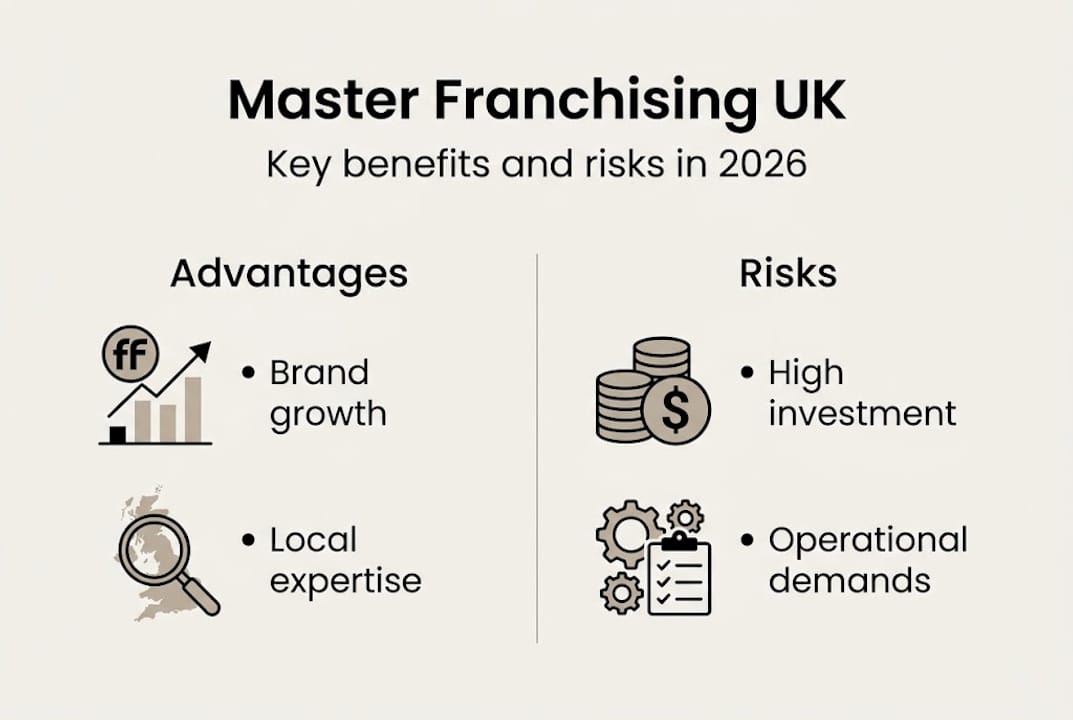
- High initial investment, often running into six figures before a single sub-franchisee is recruited
- Long-term commitment with clauses that can make exiting costly
- Agency risks, meaning sub-franchisees may not perform to the standards you need
“The most significant legal risks in master franchising stem from inadequate contracts. Without robust sub-franchisee performance targets, liability allocation clauses, and monitoring mechanisms, the master franchisee carries exposure they may not fully anticipate.”
The disadvantages are well documented: high initial investment, long-term commitment, demanding operational leadership, agency costs, monitoring challenges, legal complexity, and reduced franchisor control over sub-franchisee conduct.
Pro Tip: The biggest pitfall for UK master franchisees is assuming that a strong brand does the heavy lifting. It does not. Your sub-franchisees need active management, regular reviews, and clear contractual consequences for underperformance. Build those systems before you recruit your first sub-franchisee. Understanding reasons UK franchises succeed shows that support structures matter more than brand recognition alone.
Who should consider master franchising?
Master franchising is not a beginner’s investment. It suits a specific type of operator, and being honest with yourself about whether you fit that profile will save you significant time and money.
The ideal master franchisee candidate typically has:
- Proven business management experience, ideally with responsibility for teams or multiple sites
- Substantial capital reserves, since initial master franchise fees plus working capital often exceed £150,000
- A leadership mindset, focused on building systems and people rather than doing everything personally
- Strong local or regional market knowledge within the target territory
- Patience for long timelines, since building a profitable sub-franchisee network takes years, not months
- Risk tolerance, balanced with commercial caution and legal awareness
Here is a figure worth holding onto. UK franchise units fail at a rate of under 1% annually, compared to roughly 50% of independent businesses within five years. That resilience is partly because franchising comes with built-in structure. But it only holds if you run the model properly.
Master franchising accelerates brand expansion through local expertise but introduces layered agency risks. Success depends on robust contracts covering sub-franchisee oversight, performance targets, and liability allocation. That is not a footnote. That is the central challenge.
If you are drawn to this model because you want to build something significant rather than simply run a single outlet, master franchising is a logical path. But it rewards operators who think like business builders, not those who want a hands-off income stream. If you are exploring whether to take the leap, reviewing guidance on franchising your business in the UK can help you benchmark where you stand.
Why most overlook the crucial risks of master franchising
The typical write-up on master franchising makes the model sound straightforwardly attractive. Earn from a network. Benefit from a brand. Scale without the grind of running a single unit. The framing is almost always optimistic.
What experienced investors know is different. The hardest part of master franchising is not finding sub-franchisees. It is keeping them performing, compliant, and motivated over years. You are, in effect, a people management operation dressed up in a franchise structure.
Most master franchise failures we see are not caused by weak brands. They come from poor monitoring systems, vague contracts, and a master franchisee who underestimated how much time active network management actually requires. A brand cannot rescue you from a sub-franchisee who cuts corners or a territory that was defined too loosely.
Our view is that investors should spend as much time stress-testing the contract and support systems as they do evaluating the brand’s headline turnover figures. The headline numbers are genuinely impressive in UK franchising. But the work that protects those numbers lives in the detail. Getting the negotiating UK master franchise deals stage right is where returns are won or lost.
Find your master franchising opportunity
If master franchising feels like the right fit for your ambitions, the next step is finding the right opportunity and understanding the market you are entering. Our UK franchising guide covers the full landscape, from investment levels to sector comparisons, giving you the knowledge base to make confident decisions. When you are ready to browse active listings, the franchise opportunities directory lets you filter by investment size, industry, and operational model so you can identify prospects that genuinely match your profile. Whether you are still researching or ready to move forward, we are here to help you navigate the process.
Frequently asked questions
What is the main advantage of master franchising for UK investors?
It allows you to operate as a regional mini-franchisor, building a sub-franchisee network under a proven brand and earning fees and royalties from every unit in your territory. The master franchisee role covers recruitment, training, support, and brand compliance.
How risky is master franchising compared to running an independent business?
Considerably less risky on paper. UK franchise units have an annual failure rate of under 1%, compared to roughly 50% of independent businesses failing within five years.
What kind of support does a master franchisee provide to sub-franchisees?
You recruit, train, and support sub-franchisees, ensuring they meet brand standards and comply with local regulations. This is an ongoing operational responsibility, not a one-off handover.
Is master franchising suitable for first-time investors?
Generally not. It suits experienced business operators with strong leadership capabilities and significant available capital. First-time investors often underestimate the agency risks involved and the operational demands of managing a sub-franchisee network.