

Most people who consider franchising picture owning a single outlet. One location, one team, one set of accounts. But what is multi-unit franchising, and why are so many serious investors choosing it over the single-unit route? The reality is that multi-unit franchising represents a fundamentally different model of business ownership. It demands more capital, more management skill, and a sharper mindset. In return, it offers something a single unit rarely can: the ability to scale income, build real asset value, and work on your business rather than in it. This guide covers everything you need to know before committing.
Multi-unit franchising explained
At its core, multi-unit franchising means owning and operating more than one franchise outlet under the same brand, or sometimes across different brands. You are not simply doing the same thing twice. You are building a portfolio of businesses that share systems, branding, and support from a single franchisor.

If you are new to the concept of franchising itself, it helps to understand the basics of franchising before going further. Multi-unit ownership is one of the most ambitious paths available within that model.
There are two main structures to understand.
Sequential ownership is where a franchisee opens one unit, proves their competence, and then applies for a second location. The franchisor grants each unit individually. Growth is slower but carries less upfront financial risk.
Area Development Agreements (ADAs) are a different commitment entirely. An ADA grants territorial rights bound by strict, non-negotiable opening schedules. You agree in advance to open a set number of units within a defined territory over a set period, typically with milestones every 12 to 24 months. Miss a milestone and you risk losing your exclusivity or the agreement entirely.
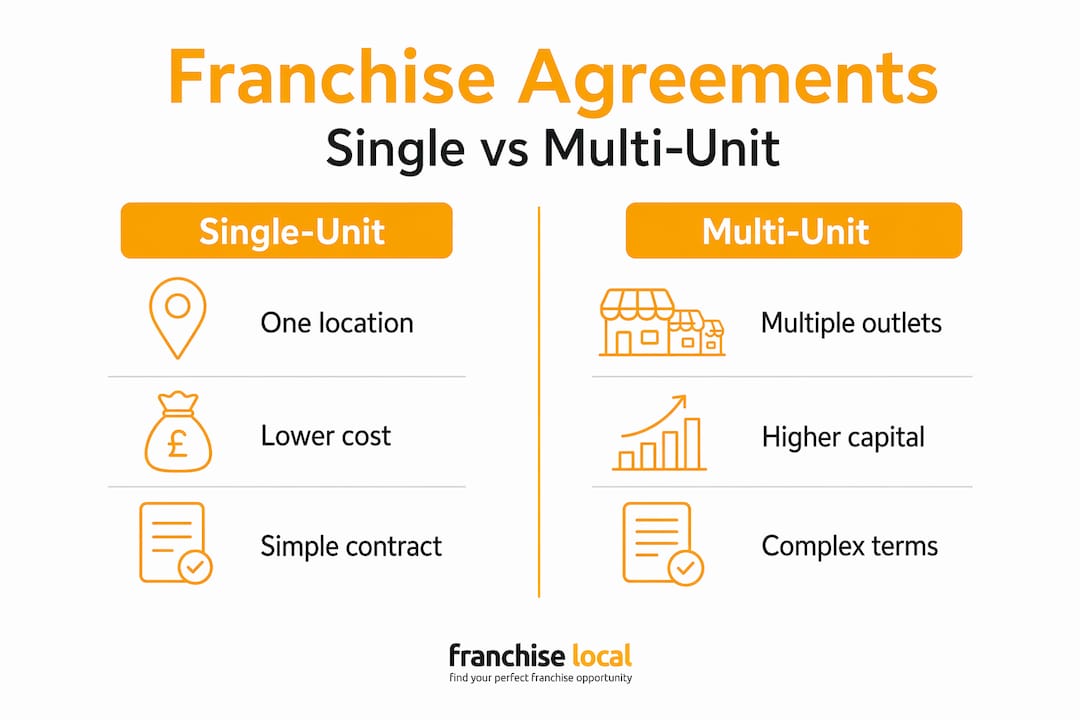
Single-unit vs multi-unit: key differences
| Factor | Single-unit franchise | Multi-unit franchise |
|---|---|---|
| Capital required | Lower initial investment | Higher upfront commitment |
| Operational role | Hands-on daily management | Oversight and systems management |
| Income potential | Limited to one outlet | Scales with each additional unit |
| Risk profile | Contained to one location | Cross-default clauses link all units |
| Franchisor relationship | Standard franchisee | Preferred partner status |
Area Development Agreements typically require upfront fees ranging from £12,000 to £60,000 (equivalent to roughly $15,000 to $75,000), with financial qualification for a three-unit commitment often demanding £400,000 or more in net worth and at least £160,000 in liquid capital.
Understanding the types of franchise agreements available is critical before you sign anything at this level.
The mindset shift required
Here is where most aspiring multi-unit franchisees stumble. They assume owning three locations means doing three times the daily work. That assumption is what gets them into trouble.
Successful multi-unit operators shift from being hands-on managers to architects of systems and culture. You are no longer the person who opens up on Monday morning. You are the person who ensures the right people, processes, and performance metrics are in place so that Monday morning runs without you.
This shift is not natural for everyone. Many first-time multi-unit owners try to stay close to each location, believing their personal oversight guarantees quality. What actually happens is that they spread their attention too thin and every outlet suffers.
Here is the sequence that separates successful multi-unit owners from those who burn out:
- Systemise before you scale. Document every operational process at your first unit until it can run without your daily input. If your first outlet depends on you personally, opening a second will create chaos, not income.
- Hire managers who own the outcome. You need unit managers who treat each location like their own business. Pay them accordingly. Cutting costs on management talent is the most expensive mistake in multi-unit franchising.
- Create a performance dashboard. Before you open your second unit, you need to be tracking weekly revenue, labour costs, customer satisfaction scores, and net profit per outlet. What you cannot see, you cannot manage.
- Build a support structure. As your portfolio grows, you will need a district or area manager overseeing multiple units on your behalf. Building these systems early is the difference between controlled growth and crisis management.
- Invest in your own development. Join franchise owner networks, attend industry events, and work with a mentor who has already scaled multiple units. The knowledge gap between one unit and four units is significant.
Pro Tip: Before approaching a franchisor about multi-unit rights, spend at least 12 months mastering your first unit’s operations and documenting every process in writing. A franchisor awarding ADAs wants evidence of operational excellence, not just enthusiasm.
Legal and contractual considerations
Multi-unit franchise agreements are not scaled-up versions of a single-unit contract. They carry specific clauses that can put your entire portfolio at risk if you do not understand them before signing.
The most important clause to scrutinise is the cross-default clause. Cross-default provisions mean that a serious breach at one location can be treated as a breach across all of your units. A health and safety violation at outlet two could, under certain agreements, trigger termination proceedings across your entire portfolio. That is not a hypothetical risk. It is a contractual reality that many franchisees discover far too late.
Other critical legal areas include:
- Territory exclusivity. Not all territorial protections are equal. Understand precisely what your exclusive zone covers, how the boundaries are defined, and what the franchisor can do if you fail to hit development milestones.
- Non-competition covenants. If you own franchises from different brands, non-competition clauses in each agreement may restrict your ability to operate competing businesses. Franchise agreements across units within the same brand often differ in subtle but significant ways and must each be reviewed in full.
- Transfer and exit rights. Selling a multi-unit portfolio is more complex than selling a single outlet. Check whether the franchisor must approve any sale, what transfer fees apply, and whether your ADA rights can be passed on to a buyer.
- Development milestones and penalties. Missing an agreed opening date under an ADA does not simply delay your timeline. It can trigger financial penalties and, in serious cases, forfeiture of territorial exclusivity.
“When acquiring multiple existing franchises, due diligence must include verifying franchisee standing, territorial rights, and transfer permissions before any acquisition proceeds.” — franchise due diligence guidance
You need a solicitor who specialises in franchise law. Not a general commercial lawyer, and certainly not the franchisor’s legal team. Your adviser needs to be entirely independent, with a track record of representing franchisees in multi-unit transactions specifically.
Financial benefits and realistic risks
The financial case for multi-unit franchising is compelling, but it only works if the numbers are structured correctly from the start.
Consider a straightforward example. Six franchise outlets each generating £30,000 in annual profit equals £180,000 gross profit. Hire a district manager at £70,000 per year to oversee day-to-day operations, and you net £110,000 while working at an executive level rather than a shop-floor level. A single unit generating £30,000 would require the same hours and effort for a fraction of the return.
| Scenario | Annual gross profit | District manager cost | Net profit |
|---|---|---|---|
| 1 unit | £30,000 | £0 | £30,000 |
| 3 units | £90,000 | £0 | £90,000 |
| 6 units | £180,000 | £70,000 | £110,000 |
Beyond income, multi-unit ownership strengthens borrowing potential because multiple profitable units increase your collateral value and demonstrate consistent cash flow to lenders. This makes further expansion easier to finance.
The risks are real though. Increased borrowing means increased liability. If two or three units underperform simultaneously, the financial pressure compounds quickly. Cross-default clauses (discussed in the previous section) amplify this exposure at the contractual level too.
Pro Tip: Model your cash flow conservatively. Assume each new unit takes 18 months to break even rather than 12, and factor in the cost of a manager from day one. Franchisees who budget optimistically are the ones who run into trouble when reality arrives.
How to get started as a multi-unit franchisee
Readiness for multi-unit franchising is not just about having the capital. It is about having the operational proof that you can manage what you already own.
Assessing your readiness
Before approaching any franchisor about multi-unit rights, ask yourself: can your existing unit operate profitably without your daily presence for two weeks? If the answer is no, you are not ready to scale. The discipline and systems required for successful scaling must be in place at unit one before unit two is even a conversation.
Consider these steps when preparing to move forward:
- Audit your current unit. Review every operational metric: profit margins, staff retention, customer satisfaction, and compliance with the franchisor’s brand standards. Address weaknesses before adding complexity.
- Select the right brand for multi-unit growth. Not all franchise brands are designed for multi-unit expansion. Look for franchisors who actively support portfolio growth, have existing multi-unit owners in their network, and provide dedicated field support for franchisees managing more than one location.
- Build your management team early. Recruit your first senior manager before you need them. Train them at your existing unit so they are ready to lead a new location from its first week.
- Engage a franchise consultant or broker. Franchisors increasingly prefer awarding multi-unit territories to proven operators. A consultant who knows which brands are actively seeking multi-unit franchisees in your area gives you a significant advantage.
- Prepare your finances. Multi-unit commitments require strong personal financial statements. Work with an accountant experienced in franchise financing to structure your investment correctly from the outset.
When it comes to selecting sectors suited to multi-unit growth, franchise scaling strategies in the UK show that service-based and B2B franchises are particularly well suited to portfolio expansion because their operational models rely on trained staff rather than expensive physical assets.
- Research the franchisor’s existing multi-unit operators and speak to them directly.
- Review the Franchise Disclosure Document carefully for any financial performance data on multi-unit vs single-unit owners.
- Attend franchise exhibitions and networking events to identify brands actively expanding through multi-unit agreements.
- Explore UK franchise investment opportunities to understand which sectors offer the strongest returns for multi-unit models.
My perspective on multi-unit franchising
I have seen a consistent pattern in the people who ask questions about multi-unit franchising. They focus intensely on the financial projections and the territory maps, and they spend comparatively little time thinking about the management infrastructure that makes those projections real.
In my experience, the biggest reason multi-unit franchise attempts fail is not poor brand selection or bad territory. It is a refusal to let go. The franchisee who built their first unit through personal effort finds it deeply uncomfortable to hand control to a manager they hired six months ago. So they stay involved. They override decisions. Their managers lose confidence and leave. And then the franchisee is running two units instead of one, but with twice the pressure and none of the leverage that multi-unit ownership is supposed to create.
What I have learned is that the mental transition from owner-operator to business owner is harder than any financial hurdle. The numbers can be modelled and funded. The mindset has to be deliberately built.
I also think people underestimate how much multi-unit operators are valued by franchisors. Experienced multi-unit operators control over half of all franchise units in many major systems. Franchisors know that these operators deliver predictable growth and operational consistency. That gives you real leverage when negotiating territory, fees, and support packages.
My honest advice: do not attempt multi-unit franchising until your first unit genuinely does not need you. That is not a limitation. It is the qualification. Once you reach that point, the path forward becomes much clearer, and the financial freedom that multi-unit franchising can genuinely deliver starts to feel attainable rather than aspirational.
— Will
Find your next franchise opportunity
If multi-unit franchising is on your radar, finding the right brand is where everything starts. Franchiselocal makes that search straightforward. Whether you are interested in financial business franchises with strong multi-unit track records, business services opportunities suited to portfolio growth, or B2B franchises with established multi-unit models, the directory covers the full range of UK opportunities. Use Franchiselocal’s UK franchise directory to filter by investment level, sector, and location, and identify the brands actively seeking ambitious multi-unit partners in your area.
FAQ
What is multi-unit franchising in simple terms?
Multi-unit franchising means owning and operating more than one franchise outlet, either through sequential single-unit agreements or via an Area Development Agreement that commits you to opening multiple units within a defined territory and timeline.
How much capital do you need for multi-unit franchising?
Financial requirements vary by brand, but a three-unit Area Development Agreement typically requires £400,000 or more in net worth and at least £160,000 in liquid capital, in addition to the upfront ADA fee.
What is a cross-default clause in a multi-unit franchise agreement?
A cross-default clause means a serious breach at one of your franchise units can be treated as a breach across all units in your portfolio, potentially triggering termination of the entire agreement. Independent legal advice is critical before signing.
What are the main advantages of multi-unit franchises?
The key advantages include scalable profit beyond what a single unit can generate, stronger borrowing power due to multiple revenue streams, preferred status with franchisors, and the ability to build genuine asset value through a portfolio of businesses.
How do differences in franchising models affect multi-unit ownership?
Single-unit agreements give you control over one location with limited territorial protection, while Area Development Agreements grant exclusive territorial rights in exchange for meeting strict opening milestones. Multi-unit ownership under an ADA carries higher rewards and significantly higher contractual obligations than sequential single-unit ownership.