

Franchising is often dismissed as something only wealthy investors or ex-corporate executives pursue. That assumption is flat-out wrong. Franchise failure rates sit at less than 1 to 6% annually, compared to roughly 50% for independent start-ups over five years. That gap is remarkable. This guide breaks down exactly why UK franchises represent one of the most accessible, lower-risk routes into business ownership, covering everything from financial returns and funding to due diligence and long-term growth potential.
Key Takeaways
| Point | Details |
|---|---|
| Low risk investment | UK franchises fail significantly less often than independent start-ups. |
| Strong earning potential | A majority of UK franchises generate more than £250,000 turnover each year. |
| Easier access to funding | Banks and lenders are more likely to fund franchise investments due to reduced risk. |
| Built-in support | Franchisees benefit from established systems, training, and a support network. |
| Practical steps | Research, due diligence, and choosing the right sector are essential for success. |
What makes franchising in the UK appealing?
At its core, franchising means you licence the right to operate under an established brand using a proven system. You are not inventing a product, building a customer base from zero, or guessing at what works. The franchisor has already done that groundwork. Your job is to execute a tested model in your territory.

Understanding the franchise model benefits helps clarify why so many first-time investors are drawn to this route rather than traditional start-ups. The UK franchise sector is mature and well-regulated, which creates a more stable environment compared to many other countries. The British Franchise Association sets standards that many reputable franchisors follow, giving investors an additional layer of confidence.
The survival statistics tell a striking story:
Franchise failure rates are very low at less than 1 to 6% annually, or around 10% over five years, compared to 50% for independent start-ups over the same period.
That is not a marginal difference. It is the kind of gap that should make any aspiring business owner sit up and reconsider their assumptions about risk. So what drives these numbers? It comes down to the structure of what the franchise model is and how it removes so many of the variables that sink independent ventures.
Here are the core benefits franchising offers:
- Proven brand recognition that attracts customers from day one, rather than spending years building awareness from scratch
- Structured training programmes covering every aspect of the operation, so you do not need prior industry experience
- Ongoing operational support from the franchisor, including marketing, supply chain, and business development guidance
- Established supplier relationships that give you access to better pricing than a sole trader could negotiate independently
- A community of fellow franchisees who share experience, insights, and solutions to common challenges
- Scalable growth potential, with many franchisees eventually owning multiple territories once the first is running profitably
UK market conditions add to this appeal. Consumer confidence in recognisable brands remains strong, and the relative stability of the UK retail, food service, cleaning, care, and education sectors means there are franchise opportunities in virtually every part of the economy.
How do UK franchise investments compare to starting from scratch?
Now that you know the advantages of the franchise model, let’s see how these benefits stack up against launching a business on your own.
Exploring franchise versus start-up advantages reveals some fairly stark contrasts across every major business metric. The comparison below illustrates this clearly.
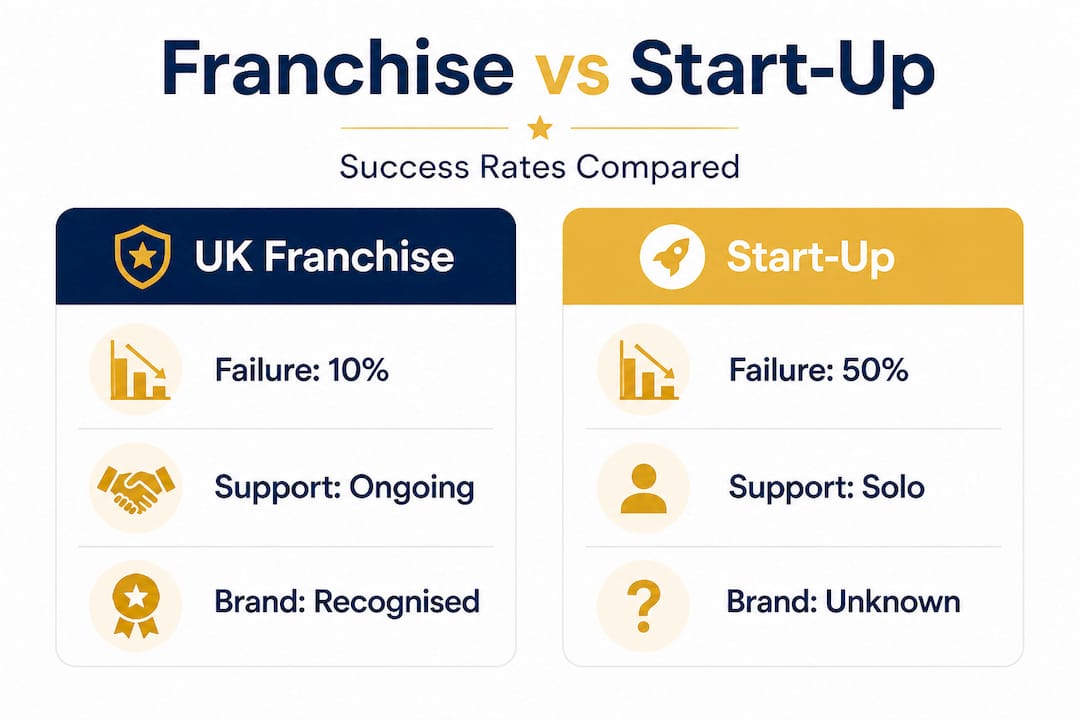
| Factor | UK franchise | Independent start-up |
|---|---|---|
| Failure rate (5 years) | Around 10% | Around 50% |
| Brand recognition | Immediate | Must be built over time |
| Training and support | Provided by franchisor | Self-directed |
| Bank funding access | Easier, specialist products available | More difficult, higher perceived risk |
| Time to profitability | Faster, proven model | Variable, often longer |
| Marketing support | Central campaigns provided | Entirely self-funded |
| Operational systems | Pre-built and tested | Must be created from scratch |
The table above makes the core argument visually. Every row represents a real business challenge, and in almost every case, the franchise route offers a structural advantage.
To assess whether franchising or starting independently suits you better, work through these steps:
- Assess your skills and experience honestly. If you have deep sector knowledge and strong entrepreneurial instinct, an independent venture may suit you. If you value structure and support, franchising is likely a better fit.
- Calculate your available capital and compare it against both routes. Franchise fees vary widely but often come with clearer cost projections than a blank-sheet start-up.
- Research the sector you are considering to understand how established brands are performing versus newer entrants.
- Speak to existing franchisees in your shortlisted networks to understand the reality of day-to-day operations and profitability timelines.
- Review Franchise vs start-up suitability through specialist resources before making any commitment.
Pro Tip: Most aspiring investors focus heavily on the initial franchise fee and overlook the long-term support structure. That ongoing support, including regular check-ins, refresher training, and marketing assistance, is arguably the single biggest risk reducer in the entire franchise model. Do not undervalue it.
The financial appeal: profit, funding and growth
Having compared franchising and starting independently, it’s time to look into the financial upsides and funding avenues unique to UK franchises.
The financial case for franchising is compelling. Consider this: 60% of franchised units turn over more than £250,000 annually, with banks offering specialist credit lines specifically for established franchise networks. That is a meaningful benchmark. It signals that franchising is not a marginal business activity but a substantial contributor to the UK economy.
Here is a snapshot of key financial indicators across the UK franchise sector:
| Metric | Typical range or figure |
|---|---|
| Entry-level franchise investment | £5,000 to £25,000 |
| Mid-range franchise investment | £25,000 to £150,000 |
| Premium franchise investment | £150,000 and above |
| Annual turnover (60% of franchised units) | Over £250,000 |
| Bank loan coverage (franchise-specific) | Up to 70% of total investment |
| Average time to break even | 12 to 36 months (model-dependent) |
These figures show that franchising accommodates a wide spectrum of investors, from those starting with modest budgets to those capable of larger commitments. The funding options for franchisees available in the UK are also considerably more varied than many people realise.
Key funding routes for UK franchise investors include:
- High street bank loans with franchise-specific products from lenders such as HSBC, Natwest, and Lloyds, who have dedicated franchise teams
- Franchisor financing schemes, where the brand itself offers deferred fee arrangements or introductory loan support for approved candidates
- Government-backed start-up loans, which can be applied to qualifying franchise models, particularly for lower-investment opportunities
- Personal savings and equity release, which many franchisees combine with bank lending to reduce borrowing costs
- Investor partnerships, where two individuals co-invest in a franchise territory, splitting the financial commitment and operational load
Understanding which profitable UK franchises align with your budget and goals is a critical first step before approaching any lender.
Pro Tip: Many high street banks have specialist franchise lending teams that assess applications differently from standard business loans. They give significant weight to the franchisor’s track record and network performance data. This means your personal business credit history matters less than it would for a start-up loan, making franchise funding accessible to a broader range of investors.
The growth trajectory in franchising is also worth noting. Many successful franchisees begin with a single territory, build it to profitability within two to three years, and then acquire additional territories. This scalable model means your initial investment can serve as a platform for genuinely significant long-term income rather than simply replacing a salary.
Key factors for successful UK franchise investment
Once you understand the financial landscape, you need a clear plan for evaluating which franchise fits your ambitions and resources.
Not every franchise opportunity is created equal. The brand name matters, but it is far from the only factor. Investors who approach choosing the right franchise systematically consistently outperform those who make decisions based on enthusiasm alone.
Here are the essential factors to evaluate before committing to any franchise:
-
Brand reputation and market positioning. Research how the brand is perceived by consumers in your target territory. A well-established name in one region may have limited awareness elsewhere. Check reviews, news coverage, and social media sentiment.
-
Territory availability and potential. The best franchise model in the wrong territory is still a difficult investment. Assess local population density, competitor presence, and income demographics before agreeing on a territory boundary.
-
Training and support quality. Ask for a detailed breakdown of the initial training programme and what ongoing support looks like after launch. Weak support structures are a red flag regardless of how attractive the brand appears.
-
Funding preparedness. Before approaching a franchisor formally, have a clear picture of your available capital, borrowing capacity, and living costs for at least twelve months. Under-capitalised franchisees are more likely to struggle during the early trading period.
-
Exit options and resale value. Consider the long game. Established franchises in active networks can often be resold to new investors, providing a meaningful exit. Understand the franchisor’s position on resales and what the process entails.
The franchise failure rate data confirms that well-chosen franchises perform significantly better than independent ventures, but that advantage depends on careful selection. Rushing the process or skipping due diligence undermines the very advantages that make franchising appealing.
Evaluating top franchise models across service sectors is a practical place to start if you are unsure which industry suits your background and goals.
Pro Tip: Before signing anything, speak directly with at least three to five current franchisees in the network you are considering. Ask them honestly about the support they receive, whether trading met their expectations, and what they wish they had known before joining. This step alone has saved countless investors from costly mistakes.
The overlooked reason more investors are choosing UK franchises
Numbers tell part of the story. But they do not tell the whole one.
When we look at insider franchise success insights, one pattern consistently emerges that the data alone cannot capture. First-time investors who succeed in franchising rarely point to the failure rate statistics as their main motivation. They point to something more personal: the confidence that comes from having a roadmap and people who have walked the path before them.
An independent start-up is largely a solitary endeavour. You make decisions in isolation, absorb the failures personally, and have limited access to peers who truly understand your specific challenges. Franchising is structurally different. You are joining a network. That network includes the franchisor’s support team, fellow franchisees across the country, and often a formal mentorship structure for new investors.
This human element is decisive in ways that spreadsheets cannot quantify. A franchisee who hits a difficult patch at month nine does not face it alone. They can call on their field support manager, consult a peer franchisee who navigated the same challenge, and draw on a playbook the network has refined over years. That support changes how investors respond to adversity, and it directly influences long-term outcomes.
The conventional wisdom around business investment tends to celebrate the solo founder narrative. Build something from nothing. Disrupt an industry. The reality is that most people entering business ownership are not looking to disrupt anything. They want a reliable income, independence, and a business they can be proud of. Franchising, done well, delivers exactly that. The investors who recognise this early give themselves a significant advantage over those chasing a more romantic but statistically riskier path.
Find the right UK franchise for you
If this article has shifted your thinking about franchise investment, your next step is straightforward: explore real opportunities and match them to your goals, budget, and lifestyle.
FranchiseLocal makes that process practical and well-structured. Our comprehensive franchising guide walks you through the essentials of how franchising works, what to expect as a new investor, and how to approach due diligence with confidence. When you are ready to explore live opportunities, the industries directory gives you an organised view of franchise sectors across the UK, from home care and food service to education, fitness, and professional services. Whether your budget is modest or substantial, there are options worth exploring. Start browsing today and take the first concrete step towards franchise ownership.
Frequently asked questions
Do banks in the UK support franchise investment?
Yes, many UK banks offer credit lines specifically for established franchises due to their lower risk profile, with dedicated franchise lending available from major high street lenders including Natwest, HSBC, and Lloyds.
What are the failure rates for UK franchises versus start-ups?
Franchise failure rates sit at less than 1 to 6% annually, which contrasts sharply with the roughly 50% failure rate for independent start-ups over five years.
Is it possible to invest in a franchise with a modest budget?
Yes, entry-level franchise opportunities in the UK begin from as little as £5,000, including home-based and mobile models that require minimal overheads and no commercial premises.
What ongoing support do UK franchisors typically provide?
Franchisors generally provide initial training, central marketing campaigns, field support visits, and access to peer networks so that franchisees have practical guidance throughout the life of their business.
How can I research the best franchise for me?
Begin by assessing your skills, available capital, and preferred working style, then speak directly to franchisees already operating in networks you are considering before making any financial commitment.