

Many aspiring UK entrepreneurs believe franchising either eliminates all business risks or imposes too many restrictions to be worthwhile. Neither assumption reflects reality. The franchise model offers distinct advantages that significantly improve success rates whilst providing operational frameworks and support systems independent businesses lack. Understanding these benefits helps you evaluate whether franchising aligns with your entrepreneurial goals, investment capacity, and desired level of autonomy. This guide clarifies the real advantages of franchising, from proven business systems to legal protections, enabling informed decisions about your business future.
Key takeaways
| Point | Details |
|---|---|
| Proven systems reduce risk | Franchising provides tested business models with established operational procedures that lower failure rates compared to independent startups |
| Brand recognition accelerates growth | Franchisees benefit from immediate customer trust and awareness built by the franchisor’s marketing efforts |
| Comprehensive support structures | Ongoing training, marketing assistance, and operational guidance help franchisees navigate challenges and scale faster |
| Legal clarity protects interests | Formal franchise agreements define rights, responsibilities, and territorial boundaries, reducing conflicts and uncertainty |
| Diverse investment options exist | UK franchise opportunities span multiple price points and industries, accommodating various budgets and skill sets |
Understanding the franchise model and how it reduces risk
The franchise model operates through a licensing arrangement where a franchisor grants you, the franchisee, the right to operate a business using their established brand, systems, and ongoing support. You pay initial fees and ongoing royalties in exchange for access to a proven business blueprint that would otherwise take years and substantial capital to develop independently. This structure fundamentally differs from starting an independent business where you must create every process, build brand awareness from scratch, and solve operational challenges without external guidance.
Franchising typically features a proven business model lowering failure rates compared to independents. The franchisor has already refined product offerings, pricing strategies, supplier relationships, and customer service protocols through years of market testing. You inherit these advantages immediately rather than learning through costly trial and error.
Several factors contribute to risk reduction in franchising:
- Established brand recognition attracts customers from day one rather than requiring years of marketing investment
- Negotiated supplier agreements provide better pricing and terms than independent operators typically secure
- Comprehensive training programmes accelerate your learning curve and operational competency
- Proven marketing templates and campaigns eliminate guesswork in customer acquisition
- Operational manuals detail every procedure, reducing mistakes and inconsistencies
- Peer network of fellow franchisees offers practical advice and problem solving support
Pro Tip: Request and thoroughly review the franchise disclosure document before committing. This legal document reveals franchisor financial health, litigation history, franchisee turnover rates, and realistic earnings potential, helping you assess actual risk levels beyond marketing promises.
“Franchise businesses demonstrate significantly higher survival rates in their first five years compared to independent startups, with established systems and brand recognition providing crucial competitive advantages during vulnerable early trading periods.”
The franchise model versus independent business comparison reveals trade-offs between autonomy and support. Whilst franchising limits certain creative freedoms, it substantially reduces the operational and financial risks that cause most independent businesses to fail. You sacrifice some control in exchange for dramatically improved odds of profitability and sustainability.
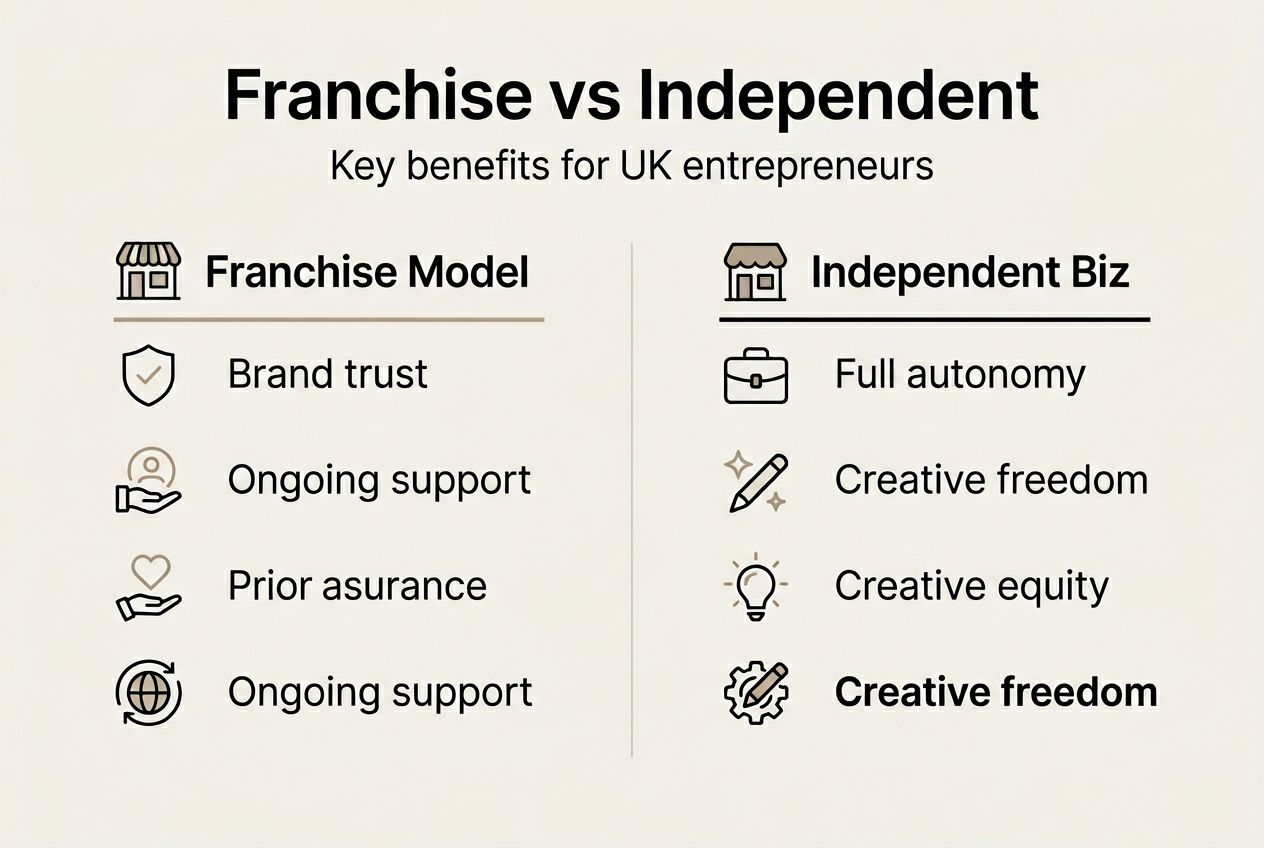
Advantages of brand recognition and ongoing support
Brand recognition represents one of franchising’s most valuable assets. When you open a franchise location, customers already understand what you offer, trust the quality standards, and feel comfortable purchasing without hesitation. Independent businesses spend years and tens of thousands building this same level of market awareness and credibility. A recognisable brand eliminates the costly customer education phase that drains resources from new independent ventures.

Franchisees benefit from ongoing training and marketing support from franchisors, amortising start-up learning curve. This continuous assistance extends far beyond initial training, providing evolving resources as your business matures and market conditions change. Franchisors invest heavily in system improvements, new product development, and marketing innovation that individual operators could never afford independently.
Typical support services franchisors provide include:
- Initial comprehensive training covering operations, customer service, inventory management, and financial administration
- Regular refresher courses introducing new products, services, or operational improvements
- National and regional marketing campaigns driving customer awareness and traffic to your location
- Point of sale materials, digital assets, and promotional templates ready for immediate local deployment
- Technology platforms for inventory tracking, customer relationship management, and financial reporting
- Field support visits from experienced consultants who identify improvement opportunities and troubleshoot challenges
- Annual conferences facilitating knowledge sharing amongst franchisees and introducing strategic initiatives
- Dedicated helplines providing immediate answers to operational questions and technical issues
This infrastructure would cost independent operators hundreds of thousands to replicate, if replication were even possible at smaller scale. Franchisors spread these development costs across their entire network, making sophisticated business tools accessible to individual franchisees at fraction of true cost.
Pro Tip: Actively engage with all franchisor training opportunities, even those covering familiar topics. Franchisors continuously refine best practices based on network-wide data, and attending sessions keeps you current with the most effective operational approaches whilst building relationships with fellow franchisees who become invaluable informal advisors.
The marketing advantage particularly benefits franchisees in competitive markets. Whilst independent businesses struggle to achieve meaningful advertising reach with limited budgets, franchise networks pool marketing contributions to fund television commercials, digital campaigns, sponsorships, and public relations efforts that generate substantial customer awareness. Your local marketing efforts amplify these national campaigns rather than starting from zero visibility.
Ongoing support also adapts to changing market conditions and consumer preferences. When franchisors identify emerging trends or competitive threats, they develop system-wide responses that protect all franchisees simultaneously. Independent operators must recognise these shifts individually and devise solutions without external expertise, often responding too slowly to maintain competitive position. Why invest in franchises becomes clear when you consider this collective intelligence and rapid adaptation capability.
Legal protections and franchise agreements: ensuring clarity and fairness
Franchise agreements establish formal legal frameworks defining the relationship between franchisor and franchisee, creating clarity that informal business relationships lack. These comprehensive contracts specify exactly what each party must deliver, protecting both sides from misunderstandings and disputes. Whilst some entrepreneurs view contracts as restrictive, well-structured agreements actually provide security and operational freedom within defined parameters.
Franchise agreements legally define operational boundaries, fee structures, and support, reducing conflicts. The document functions as your business roadmap, detailing rights you acquire and obligations you accept. Understanding these contractual elements proves essential before investment.
Key contractual elements typically include:
- Territory definition specifying your exclusive or protected geographic area where the franchisor cannot place competing locations
- Initial franchise fee covering training, setup support, and brand licence for a specified term
- Ongoing royalty structure detailing percentage of revenue or fixed payments due to franchisor
- Marketing fund contributions supporting national and regional advertising campaigns
- Training requirements outlining initial and ongoing education you must complete
- Operational standards defining quality specifications, approved suppliers, and service protocols you must maintain
- Term length and renewal conditions explaining franchise duration and requirements for extending the agreement
- Termination clauses describing circumstances under which either party can end the relationship
- Transfer and resale provisions outlining your ability to sell the franchise and franchisor approval requirements
This contractual specificity contrasts sharply with independent business arrangements:
| Aspect | Franchise Agreement | Independent Business |
|---|---|---|
| Territory protection | Defined exclusive or protected area | No protection from competitors |
| Operational guidance | Detailed manuals and standards | Self-developed procedures |
| Brand usage rights | Licensed with quality requirements | Full ownership and control |
| Support obligations | Contractually guaranteed training and assistance | No external support structure |
| Fee structure | Transparent royalties and contributions | No ongoing fees but no shared resources |
| Dispute resolution | Defined processes and mediation paths | Informal or costly litigation |
Franchise agreements secure your ability to operate under an established brand whilst ensuring the franchisor maintains system-wide quality standards that protect brand value. This mutual interest alignment benefits both parties. Your success depends on brand strength, and brand strength depends on every franchisee maintaining standards. The contract formalises this interdependence.
Before signing any franchise agreement, engage a solicitor experienced in franchise law to review terms and explain implications. Legal fees represent a small investment compared to the financial commitment and multi-year obligation you’re undertaking. Professional review identifies potentially problematic clauses, ensures you understand restrictions, and sometimes enables negotiation of more favourable terms. Never rely solely on franchisor explanations or assume standard agreements suit your specific circumstances without independent legal assessment.
Choosing a franchise model right for you: factors and practical tips
Selecting the appropriate franchise requires honest assessment of your financial capacity, skills, lifestyle preferences, and business goals. Not all franchises suit all entrepreneurs, and misalignment between your capabilities and franchise requirements often leads to dissatisfaction and underperformance. Careful franchise selection based on personal fit and thorough research is key to success.
Critical evaluation criteria include initial investment requirements spanning franchise fees, equipment, inventory, premises costs, and working capital reserves. Ensure you can comfortably fund the complete startup without depleting emergency reserves or overextending credit. Undercapitalisation causes franchise failures even when the business model itself proves sound. Consider training and support depth, as franchisors vary significantly in assistance quality and accessibility. Some provide extensive ongoing guidance whilst others offer minimal support after initial training.
Brand reputation and market position directly impact your revenue potential. Research customer perception, competitive positioning, and growth trajectory. A struggling brand offers little advantage over independent operation. Assess whether your existing skills and experience align with operational requirements. Some franchises need specific technical expertise or industry knowledge, whilst others suit generalist business operators. Personal interest in the industry matters more than many entrepreneurs initially recognise, as passion sustains motivation through inevitable challenges.
Follow this systematic research process:
- Review multiple franchise opportunities within your investment range to understand options and compare value propositions
- Request and study franchise disclosure documents for serious candidates, analysing financial performance representations and franchisee satisfaction data
- Interview current franchisees about their experiences, asking specifically about challenges, franchisor responsiveness, and whether they would invest again
- Attend franchise discovery days to experience company culture, meet leadership teams, and observe operational demonstrations
- Analyse local market conditions and competition to verify demand exists for the franchise offering in your target territory
- Prepare detailed financial projections including conservative revenue estimates and complete expense accounting to ensure viability
- Engage professional advisors including franchise solicitors and accountants to review agreements and validate financial assumptions
- Visit operating franchise locations unannounced to observe actual customer experience and operational execution
Pro Tip: Attend franchise exhibitions where you can explore dozens of opportunities efficiently, compare offerings directly, and speak with franchisors face-to-face. These events provide concentrated exposure to the franchise landscape and help you identify options matching your criteria that you might not discover through online research alone.
Different franchise model types suit different entrepreneur profiles. Home-based franchises minimise overhead and offer lifestyle flexibility but may limit revenue potential. Retail franchises provide high visibility and customer traffic but require significant premises investment and longer operating hours. Mobile franchises offer territorial flexibility and lower fixed costs but depend heavily on consistent customer generation and efficient routing.
Your decision timeline matters as much as your selection criteria. Resist pressure to commit quickly despite franchisor urgency about territory availability. Thorough due diligence takes several months and rushing increases the likelihood of overlooking critical issues. The franchise investment guide emphasises patience and systematic evaluation over impulsive decisions driven by excitement or fear of missing opportunities.
Explore franchise opportunities and expert resources
Understanding franchise advantages represents just the first step towards successful franchise ownership. Translating knowledge into action requires access to comprehensive opportunity listings, expert guidance, and professional services supporting your franchise journey. FranchiseLocal.co.uk provides the complete resource ecosystem UK entrepreneurs need to identify, evaluate, and launch franchise businesses with confidence.
Our ultimate guide to franchising delivers in-depth education covering every aspect of franchise investment, from initial research through operational launch and growth phases. The extensive franchise directory features hundreds of opportunities across industries and investment levels, enabling efficient comparison and shortlist development. Advanced filtering by budget, industry sector, operational model, and location helps you quickly identify franchises matching your specific criteria.
Beyond opportunity discovery, our platform connects you with specialist service providers including franchise solicitors, accountants, and consultants who understand the unique aspects of franchise businesses. These professionals provide essential expertise during due diligence, contract negotiation, and business setup phases. Whether you’re exploring options or ready to invest, FranchiseLocal.co.uk offers the tools, information, and expert connections supporting informed decisions and successful franchise ownership.
FAQ
What are the main risks of franchising compared to independent businesses?
Franchising reduces many startup risks through proven systems and brand recognition but includes costs like ongoing royalty fees and marketing contributions that independent businesses avoid. You also sacrifice some operational freedom as franchise agreements require adherence to system standards and procedures. However, franchise businesses demonstrate higher survival rates than independents, making the trade-off between autonomy and support worthwhile for many entrepreneurs. The key risk in franchising involves selecting a weak franchisor or mismatched business model rather than the franchise structure itself.
How much initial investment is typically required for a UK franchise?
Franchise costs vary dramatically based on industry, brand strength, and operational model, with total investment ranging from under £10,000 for some home-based franchises to several hundred thousand for established retail or restaurant concepts. Many viable franchise opportunities exist under £40,000, making franchising accessible to entrepreneurs with modest capital. Remember to account for all costs including franchise fees, equipment, inventory, premises, working capital, and professional fees when calculating total investment requirements. Undercapitalisation causes more franchise failures than poor business models, so ensure you can comfortably fund complete startup costs plus several months of operating expenses.
What ongoing support can franchisees expect from franchisors?
Standard ongoing support includes operational training updates, marketing campaign development and materials, technology platform access, field consultant visits, peer networking opportunities, and helpline assistance for daily operational questions. Support quality and depth vary significantly between franchisors, making this a critical evaluation criterion during franchise selection. Quality franchisors provide comprehensive assistance that accelerates growth and helps franchisees navigate challenges, whilst weaker franchisors offer minimal guidance after initial training. Interview current franchisees specifically about support responsiveness and usefulness to verify franchisor claims match reality.
Can I operate multiple franchise locations simultaneously?
Many franchise agreements include provisions for multi-unit development, allowing successful franchisees to open additional locations within defined territories or timeframes. Franchisors often prefer multi-unit operators who demonstrate operational competence and financial stability, sometimes offering reduced franchise fees for subsequent locations. However, you should master single-unit operations and achieve profitability before expanding, as managing multiple locations requires different skills and systems than running one site. Some franchise agreements grant area development rights requiring you to open specified numbers of locations within set timeframes, creating obligations you must fulfil regardless of individual unit performance.
How do I verify a franchise opportunity is legitimate and not a scam?
Legitimate franchises provide comprehensive franchise disclosure documents detailing company history, litigation records, financial performance, franchisee turnover, and complete fee structures. Request and review this document early in your evaluation process. Verify the franchisor is registered with appropriate regulatory bodies and search for legal complaints or regulatory actions. Interview multiple current and former franchisees about their experiences, asking specifically about franchisor honesty and support delivery. Be wary of opportunities promising unrealistic returns, pressuring quick decisions, or lacking transparent financial information. Professional franchise consultants and solicitors can help assess legitimacy if you have concerns about a particular opportunity.