

Around one in three UK franchisees now operates more than one unit, and that figure has been climbing steadily for over a decade. Multi-unit franchising explained simply is this: instead of running one outlet, you own and operate two or more, either within the same brand or across different ones. Many aspiring franchisees assume the single-unit model is the standard path to profitability. The data tells a different story. This guide covers what multi-unit franchising really involves, how it compares to single-unit ownership, why UK investors are accelerating into it, and the practical steps you need to take to do it well.
Key Takeaways
| Point | Details |
|---|---|
| Rapid growth trend | Multi-unit franchise ownership in the UK has rapidly increased and now represents about a third of all franchisees. |
| Higher profit potential | Multi-unit operators tend to report higher profits, making this model attractive but more demanding. |
| Complexity and risk | Operating multiple units increases both opportunity and operational challenges, including financial and management risks. |
| Step-by-step process | Success in multi-unit franchising requires strategic planning, operational systems, and learning from each new unit. |
| Market-wide impact | The move to multi-unit models is transforming the UK franchise landscape, driving innovation and competition. |
What is multi-unit franchising?
Multi-unit franchising means owning and operating more than one franchised outlet, either under the same brand or across several. It is not simply “buying more shops.” It is a fundamentally different business model that demands a different mindset, a different financial structure, and a different set of management skills.
The rise in multi-unit ownership from 25% to 36% of UK franchisees over the survey timeline signals that this is no longer a niche approach. It is increasingly the mainstream route for serious franchisees.
The three main models
Understanding multi-unit franchising starts with knowing the different arrangements available:
- Sequential expansion: You open one unit, prove it works, then negotiate to open further units over time. This is the most common starting point for first-time multi-unit operators.
- Area development agreement (ADA): You sign a contract committing to open a set number of units within a defined territory over an agreed timeline. You pay an upfront fee for the rights to that territory. This is a faster route to scale, but it comes with binding obligations.
- Area representative (AR) model: You act as a sub-franchisor within a territory. You recruit and support other franchisees, earning a share of their fees and royalties. This is less common but offers significant income leverage.
Each model carries its own franchise agreement types, obligations, and risk profiles. Knowing which suits your capital position and management capacity is the first decision to make.
Common misconceptions
Many people assume multi-unit franchising is simply “doing the same thing twice.” It is not. Running two units does not mean twice the workload for the owner. Done correctly, it means building systems and teams that allow you to work on the business rather than in it. The owner who tries to manage every unit personally will burn out quickly. The owner who builds operational structures from day one will scale efficiently.
Another misconception is that you need to be in the same UK franchise sector for all your units. Cross-brand multi-unit ownership is legal and increasingly popular, though it requires more complex management and franchisor approval.
| Arrangement | Upfront commitment | Expansion pace | Control level |
|---|---|---|---|
| Sequential | Low | Gradual | High |
| Area development | High | Fast, contractually fixed | Medium |
| Area representative | Medium | Dependent on recruitment | Lower (delegated) |
Single-unit vs multi-unit: key differences and opportunities
Having established the fundamental definition, let us compare multi-unit franchising with the more familiar single-unit model to reveal the advantages and challenges you should consider.

The single-unit model is where most franchisees begin. You invest in one location, learn the system, and generate income from that outlet. It is manageable, relatively lower risk, and a good way to understand how a franchise brand operates. But its ceiling is fixed. Your income is tied directly to the performance of one location.
Multi-unit ownership changes that equation entirely.
Side-by-side comparison
| Factor | Single-unit | Multi-unit |
|---|---|---|
| Income ceiling | Fixed to one location | Multiplied across units |
| Risk exposure | Concentrated in one site | Spread across locations |
| Management demand | Owner-operated often viable | Requires hired management |
| Negotiation power | Limited | Stronger with franchisor |
| Capital requirement | Lower | Significantly higher |
| Scalability | Minimal | High |
| Profitability potential | Moderate | Higher for multi-unit operators |
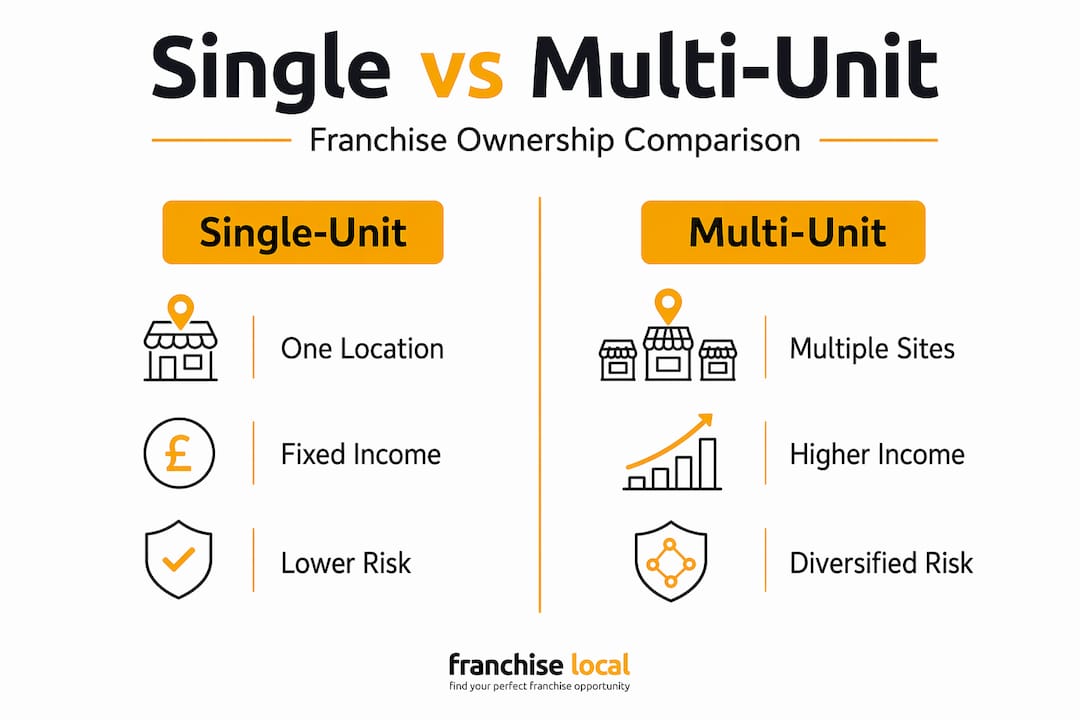
The risk picture is more nuanced than it first appears. Yes, multi-unit ownership requires more capital. But it also diversifies your income. If one unit has a difficult quarter due to local competition or roadworks outside the door, your other units continue generating revenue. Single-unit owners have no such buffer.
Where the real opportunities lie
Multi-unit operators gain negotiating power that single-unit owners simply do not have. When you represent five locations to a franchisor, your voice carries more weight on royalty structures, marketing fund allocations, and territory rights. You become a significant partner rather than a single franchisee in a network.
Supplier relationships also shift. Buying stock, equipment, or services across multiple sites gives you volume leverage that can reduce your per-unit costs meaningfully. That margin improvement flows directly to your bottom line.
You can also build a management layer, a general manager or area manager, whose salary is spread across multiple units rather than sitting entirely on one. This franchise scaling strategy is one of the most effective ways to grow without proportionally increasing your personal workload.
Pro Tip: Before opening your second unit, document every operational process from your first. The systems you build for unit one become the foundation for every unit that follows. Franchisees who skip this step find themselves reinventing the wheel at each new location.
The profitability factors that drive single-unit success, location quality, staff retention, and brand strength, all amplify at scale. Getting them right once and replicating that model is where multi-unit franchising earns its reputation.
Why UK investors are turning to multi-unit franchising
With the differences laid out, it is critical to understand why enthusiasm for multi-unit opportunities is accelerating, especially for those aiming to build wealth and lasting business assets.
The rise from 25% to 36% of UK franchisees operating more than one unit is not a coincidence. It reflects a deliberate shift in how experienced investors view franchise ownership.
“Multi-unit ownership is no longer the exception among UK franchisees. It is rapidly becoming the expectation for those who treat franchising as a long-term wealth-building vehicle rather than a job replacement.”
The key drivers behind the shift
- Income diversification: Multiple revenue streams reduce dependence on any single location or market condition.
- Asset building: Each profitable unit adds tangible business value. When you eventually sell, you are selling a portfolio, not a single outlet, which commands a premium.
- Franchisor support: Many UK franchise brands now actively encourage multi-unit growth, offering reduced fees, preferred territories, or dedicated support for operators who commit to expansion.
- Competitive advantage: In sectors where territories are finite, securing multiple areas early locks out competitors and protects your market position.
- Career progression: For franchisees who want to move from operator to business owner, multi-unit franchising provides a clear path from working in the business to managing a team that runs it.
The UK franchising trends for 2026 point firmly toward continued growth in multi-unit ownership. Brands across food service, personal care, children’s education, and B2B services are all reporting increased interest from existing franchisees looking to expand.
It is worth noting that some data comparisons between single and multi-unit operators are based on smaller sample sizes, so headline figures should be read as directional rather than absolute. That said, the direction is consistent and clear. The franchise industry trends confirm that multi-unit growth is one of the most significant structural shifts in UK franchising right now.
How to succeed in multi-unit franchising: steps and success factors
Knowing the “why” is only half the battle. The next step is learning exactly how to approach and excel in the multi-unit franchising world.
Step-by-step: how to enter and grow
-
Master your first unit before expanding. This sounds obvious, but it is where most failures begin. Your first unit should be consistently profitable and running without your daily presence before you even consider a second. If you cannot step away for two weeks without the unit struggling, you are not ready to expand.
-
Assess your financial position honestly. Multi-unit franchising requires capital not just for the second franchise fee and fit-out, but for working capital across multiple sites. Speak to a franchise-specialist accountant before committing. Understand your debt-to-equity ratio and what lenders will require.
-
Choose brands with multi-unit track records. Not all franchise brands are equipped to support multi-unit operators. Ask the franchisor directly: how many of your current franchisees operate more than one unit? What support do you provide for expansion? What does your area development agreement look like? The answers will tell you a great deal.
-
Build your management team early. The biggest operational mistake multi-unit franchisees make is trying to manage everything personally for too long. Hire a strong unit manager for your first location before you open your second. Train them using the documented systems you built in step one.
-
Use your first unit’s data. Sales patterns, staffing costs, peak hours, supplier performance. All of this data from unit one is your blueprint for unit two. Franchisees who treat each unit as a fresh start waste time and money. Those who replicate proven models with local adjustments scale far more efficiently.
-
Negotiate your expansion terms. Once you have a profitable track record, you have leverage. Approach your franchisor about area development rights, reduced royalty tiers for additional units, or preferred territory access. Many brands will negotiate with proven operators.
-
Review your legal agreements carefully. Each additional unit typically involves a new or amended franchise agreement. Understand your obligations, exit clauses, and territory protections before signing. A franchise-specialist solicitor is not optional at this stage.
The profitability data for multi-unit operators is encouraging, though it is worth remembering that higher reported profitability comes with the caveat that small sample sizes affect some comparisons. The opportunity is real, but so is the complexity.
Common mistakes to avoid
- Expanding too quickly before the first unit is stable.
- Underestimating working capital needs across multiple sites.
- Neglecting staff development in favour of chasing new locations.
- Ignoring territory saturation risks within your chosen brand.
Pro Tip: Treat your second unit launch as a test of your systems, not just your capital. If your processes cannot survive replication, find and fix the gaps before opening unit three. The franchisees who scale to five or more units are almost always the ones who were ruthlessly systematic from unit two onwards.
How multi-unit franchising shapes the UK market
Having walked through the individual and practical aspects, it is vital to zoom out and consider the overall impact these trends are having across the UK franchise market.
Multi-unit franchising is not just changing individual financial outcomes. It is reshaping the competitive landscape, the power dynamics between franchisors and franchisees, and the pace of innovation within franchise networks.
The broader market effects
- Brand concentration: As experienced operators accumulate units, they become dominant players within their brand’s network. This gives them influence over how the brand evolves, from product decisions to marketing strategies.
- Local market dynamics: In towns and cities where one operator controls multiple units of a brand, that franchisee effectively becomes the face of the brand in that region. This can be a significant competitive advantage, but it also creates responsibility.
- Collective negotiation: Multi-unit operators often form informal alliances within franchise networks, coordinating feedback to franchisors on fee structures, support quality, and brand direction. This is a form of franchisee influence that franchise sectors are increasingly having to accommodate.
- Innovation pressure: Experienced multi-unit operators, having seen what works and what does not across several locations, are often the source of operational improvements within franchise systems. Franchisors who listen to these operators benefit from ground-level insight that head office rarely generates on its own.
- Market concentration risks: There is a counterpoint worth acknowledging. When too few operators control too many units within a brand, it can reduce diversity of approach and create dependency risks for the franchisor. A single multi-unit operator exiting a network can have a significant impact.
Multi-unit ownership becoming mainstream is a structural shift, not a passing trend. Understanding why franchises succeed at scale requires recognising that the most successful franchise networks are increasingly built on the backs of experienced multi-unit operators, not first-time single-unit buyers.
Why most guides underestimate the challenges and rewards of multi-unit franchising
Most articles on multi-unit franchising treat it as a linear upgrade from single-unit ownership. Open one, succeed, open another, profit more. The reality is considerably more complicated, and considerably more rewarding for those who understand what they are actually signing up for.
The biggest gap in conventional guidance is the assumption that management skills scale automatically. They do not. Running one unit well is a personal achievement. Running three or five units well is an organisational achievement. The skills required are fundamentally different. A franchisee who is brilliant at customer service, staff motivation, and daily operations at one site will not automatically become a capable multi-site director. That transition requires learning how to hire, how to delegate, how to read financial reports across multiple locations, and how to hold managers accountable without micromanaging them.
The second thing most guides miss is the emotional weight of scale. When one unit has a bad month, it is disappointing. When three units have a bad month simultaneously, perhaps due to a supplier issue or a brand-level PR problem, the financial and psychological pressure is substantial. Multi-unit franchisees need reserves, both financial and personal, that single-unit owners simply do not require.
And yet, the upside is equally underestimated. The franchisees who crack the management challenge and build genuinely replicable systems do not just earn more money. They build businesses that have real sale value, that attract investment interest, and that give them the kind of operational freedom that most small business owners never experience. The ability to take a holiday without the business suffering is not a small thing. It is the difference between owning a business and owning a job.
The franchise scaling success stories you hear about are almost never about franchisees who expanded quickly. They are about franchisees who expanded carefully, built strong teams, and treated each new unit as a chance to improve their system rather than simply add to their income.
Our view: the franchisees who thrive in multi-unit ownership are those who decide, before they open their second unit, that they are building a business to eventually run without them. That decision, made early, changes every subsequent choice they make about hiring, systems, and expansion pace.
Where to find the best UK multi-unit franchise opportunities
If you are ready to explore multi-unit franchising seriously, the right starting point is a clear view of what is available across the UK market. At Franchise Local, you can browse the ultimate UK franchising guide for a full overview of how franchising works, what to expect, and how to evaluate your options. From there, explore UK franchise opportunities by industry to identify the sectors that match your experience, capital, and growth ambitions. Whether you are drawn to food service, personal care, B2B services, or retail, filtering by sector helps you focus your research quickly. For a curated view of the strongest options available right now, the best UK franchise opportunities listings give you a shortlist of proven brands actively seeking franchisees. Multi-unit pathways are increasingly available across all categories, and the sooner you start comparing, the better positioned you will be to secure the territories and agreements that suit your goals.
Frequently asked questions
Is multi-unit franchising more profitable than owning a single franchise unit?
Research suggests multi-unit operators report higher profitability than single-unit owners in the UK, though results vary by brand, sector, and how well the operator manages their expanded portfolio.
What risks should aspiring multi-unit franchisees in the UK be aware of?
Multi-unit franchising brings increased operational complexity, higher capital requirements, and greater management demands, and operational differences between single and multi-unit ownership mean you need strong systems and leadership skills before expanding.
How common is multi-unit ownership among UK franchisees right now?
Around one in three UK franchisees currently operates more than one unit, and the proportion has been rising consistently over the past decade.
What types of franchise brands allow multi-unit ownership in the UK?
A wide range of UK franchise sectors support multi-unit ownership, including food service, retail, personal care, children’s education, and B2B services, so your options are broad regardless of your background.
Can you buy more than one franchise unit right from the start?
Some franchise agreements include area development options that allow you to commit to multiple units from the outset, while others require you to demonstrate success with your first unit before granting expansion rights.